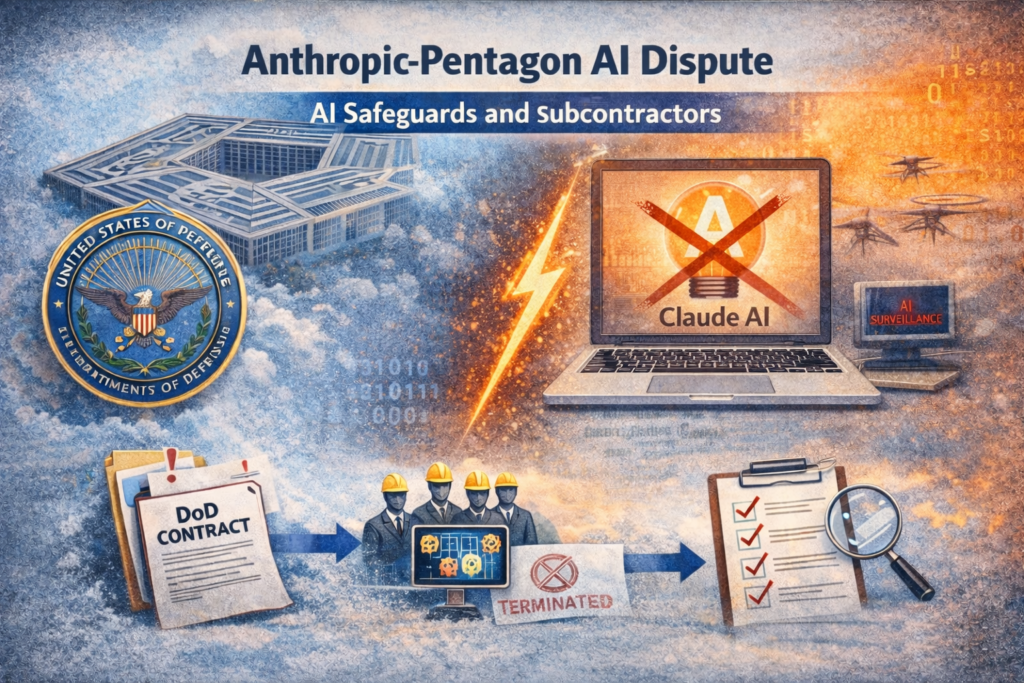
Anthropic-Pentagon AI Dispute
- Situation: The Pentagon gave AI firm Anthropic a Feb. 27, 2026 deadline to remove its safety restrictions (against mass domestic surveillance and fully autonomous weapons) or face contract termination[1][2]. Anthropic declined to accede “in good conscience”[3][4].
- Outcome: On Feb. 27 the administration banned Anthropic’s Claude AI in all federal agencies and Hegseth designated Anthropic a “supply chain risk”[5][6]. OpenAI quickly struck its own DoD deal under less restrictive terms[7].
- Risks for subcontractors: If you use Claude (or planned to) on DoD projects, you may now lose access and must transition. Contracts may include or soon require an “any lawful use” clause, forbidding extra use restrictions[1][8]. Being flagged as a supplier dealing with Anthropic could affect DoD subcontracting[6][9].
- Next steps: Immediately review any DoD contract clauses (especially flow-down terms) concerning AI usage and supply-chain compliance. Remove any reliance on Anthropic tech (swap in authorized models like OpenAI’s) and strengthen your AI governance (cybersecurity and compliance programs) to meet Pentagon rules. Procura can help analyze your contracts, advise on flow-down obligations, and update your AI/cyber policies for these fast-moving changes.
Anthropic-DoD AI Dispute Timeline
- Jul 14, 2025: DoD CDAO awards Anthropic a 2-year prototype Other Transaction Agreement (OTA) with a $200M ceiling to develop “frontier AI” capabilities[10] (similar $200M OTAs went to OpenAI, Google, and Musk’s xAI[11]).
- Feb 22, 2026: Pentagon Secretary Pete Hegseth meets Anthropic CEO Dario Amodei. Hegseth demands that Anthropic allow “all lawful use” of its Claude AI on military networks[12][8]. Amodei refuses, citing two non-negotiable safeguards: no use of Claude for mass domestic surveillance or as fully autonomous weapons without human control[13][14].
- Feb 26, 2026: The Pentagon issues a final “last and final offer” to Anthropic demanding removal of those safeguards by Friday 5:01pm ET[8][15]. On Feb. 26 Anthropic publicly states it “cannot in good conscience accede” to the demand[16][17].
- Feb 27, 2026: Deadline arrives. The administration endorses Hegseth’s stance. President Trump (per administration announcement) orders all agencies to cease using Anthropic products (with a 6-month phase-out)[5][18]. Hegseth formally designates Anthropic a supply chain risk, barring DoD contractors from doing business with it[19][20]. OpenAI announces a new deal to supply its AI (ChatGPT) to the Pentagon under terms that permit the same safeguards Anthropic had insisted on[7][21].
- Mar 2026: Fallout continues. Google and other agencies begin removing Claude from deployments (e.g. GSA yanks Anthropic from its AI roadmap[22]). Industry voices (Google/OpenAI employees, tech analysts) warn that these events create a chilling effect on AI innovation and government collaboration[23][24].
Dispute Details and Safeguards
The crux of the dispute was over usage restrictions built into Anthropic’s Claude AI. Anthropic’s CEO Dario Amodei stressed that Claude is already deployed across classified DoD networks and supports critical missions[25]. However, Amodei has insisted on two “narrow exceptions”: Clauses forbidding any use of Claude for (1) mass domestic surveillance and (2) fully autonomous lethal weapons[13][14]. Amodei argues that current AI models aren’t reliable enough to safely select targets or profile U.S. citizens, and that allowing mass surveillance violates democratic values[13][14].
The Pentagon’s position (reported by senior officials) was that it needed no built-in limitations on Claude’s lawful use. The DoD offered repeatedly to extend Anthropic’s contract but only if Anthropic removed those guardrails[26][27]. Hegseth’s staff even drafted compromise language, but Anthropic says it contained “hitches” that would let the Pentagon ignore the safeguards when convenient[28].
Defense officials (including Pentagon spokesperson Sean Parnell) emphasized that the US military has no interest in illegal surveillance or weapons without human oversight[29][30]. They framed the demand as a simple request to use Claude for “all lawful purposes”[1][30]. But Pentagon leaders also warned that they would invoke extraordinary measures – including invoking the Defense Production Act – if Anthropic refused[31][32]. Hegseth repeatedly made clear that any AI tools “with ideological constraints or limitations” wouldn’t be tolerated[33].
Anthropic publicly countered that it had never tried to block lawful missions, only these two exceptions. In a Feb. 26 statement Amodei noted that both exceptions “have never been included in our contracts”[34] and asked the Pentagon to reconsider preserving them. Anthropic emphasized it would “enable a smooth transition” to another provider if forced out, and remained ready to serve U.S. warfighters under its safety terms[35][36]. But the impasse stood: Anthropic stated flatly, “we cannot in good conscience accede to their request.”[16].
Contracts and Procurement Vehicles
The Anthropic dispute centers on a prototype Other Transaction Authority (OTA) agreement awarded by DoD’s Chief Digital and AI Office (CDAO). In July 2025 DoD signed a two-year OTA with a $200 million ceiling for Anthropic to develop frontier AI capabilities for national security[10]. Similar $200M OTAs were awarded in the same round to OpenAI, Google, and xAI[11]. Under this OTA, Claude was already integrated with partners (like Palantir) into classified DoD networks[37][11].
Procurement-wise, this is a special agreement (not a standard FAR contract), but it flows down clauses like any DoD tech effort. In January 2026, Hegseth directed that future DoD contracts include a standard “any lawful use” provision within 180 days. That means contractors must allow the Pentagon to use provided AI tech for any purpose not explicitly illegal[8][38]. The Pentagon’s stance is that only Congress and law should define lawful use, not vendor policies.
Contractors (and subs) should note: The supply-chain-risk designation uses 10 U.S.C. §3252, which by law only bars Anthropic from DoD contracts. In other words, according to Anthropic, if you’re a DoD contractor, this designation means you can’t use Claude on DoD work – but it doesn’t legally prohibit using Claude in commercial or other non-DoD contexts[9]. In practice, though, any company doing DoD work is likely treating the ban as blanket (FedScoop reports Hegseth ordering “no contractor, supplier or partner” may deal with Anthropic)[39]. Small subcontractors must be very careful: if your prime is a DoD contractor, it probably will forbid any use of Anthropic-based tools.
Implications and Risks for Subcontractors
Legal & Compliance Risks: If your team uses Anthropic’s Claude (via API or integrated products), you face immediate compliance issues. DoD’s move effectively prohibits unapproved usage of Claude on any DoD project. Any subcontract with a DoD prime contractor should be reviewed for flow-down clauses about approved AI vendors. If your contract refers to “AI governance” or “approved tools”, you must align with the new rules. Continuing to use Anthropic tech could violate contract terms or get you flagged as doing business with a designated risk. (Anthropic itself notes the designation cannot legally punish non-DoD uses[9], but many companies will err on the side of exclusion.)
Business Risks: Vendors who counted on Anthropic’s AI may lose out. With a $200M program at stake, Anthropic’s exit opens opportunities for OpenAI’s ChatGPT, Google’s AI, and Musk’s Grok to supply the DoD instead[40][7]. If your tech offerings rely on Claude (for data analysis, coding tools, etc.), you’ll need backup plans. On multi-vendor platforms (like GSA’s AI catalog), Anthropic is being pulled out – e.g. GSA delisted Claude from its USAi.gov sandbox and schedules[22]. Expect government RFPs to favor vendors who agree to Pentagon usage rules.
Policy Risks: This saga suggests the Pentagon is enforcing a hard line that could persist: future AI contracts may explicitly ban usage policies or “tuning” that the military deems ideological[41]. Critics argue this may chill corporate engagement on AI ethics, but under current leadership it’s real. Contractors should monitor developments like new DoD AI guidelines or legislative reactions. (For example, Congress may examine whether labeling a U.S. company a security risk was lawful[42][43].)
Likely Outcomes and Scenarios
- Smooth Transition by Pentagon: With Anthropic out, the DoD will likely certify its other vendors for classified networks. Indeed, Hegseth announced that OpenAI’s model and Musk’s Grok would join secure Pentagon AI networks[44][7]. Small contractors should assume Pentagon-supplied AI needs will shift to those suppliers.
- Legal Challenge: Anthropic says it will legally contest the supply-chain risk designation as “legally unsound”[6][9]. If Anthropic wins (or the policy changes under future administrations), the ban could lift. But don’t count on quick relief – litigation could drag out.
- Congressional/Policy Response: Some lawmakers may intervene. Expert analysts and Democrats (e.g. Sen. Mark Warner) are already raising concerns about political pressure in national security decisions[45]. There may be hearings on balancing AI safety versus military needs. Future procurement law could be clarified – for instance, by codifying or limiting how “supply chain risk” is applied to U.S. tech.
- Industry Backlash: The clash has galvanized tech communities. Many AI developers publicly supported Anthropic’s safety stance[46]. Pressure on other AI firms to negotiate terms (as OpenAI did) could intensify. Small contractors should watch how major firms adjust their strategies (e.g. their insurance and liability language around AI use).
Recommendations for Small Contractors
- Contract Review: Immediately audit any contracts referencing Anthropic or Claude. Check for clauses about “approved AI vendors,” data usage, or supply-chain risk flows. Alert your prime if you rely on Claude; they may need to remove or replace those tasks.
- Flow-Down Obligations: If your customer (prime or agency) is incorporating the supply-chain risk designation, you’ll need similar clauses in your subcontracts. For DoD work, expect to include “all lawful use” and no-constraints language. Procura advises adding explicit flow-down of DoD policy on AI usage and supply chain designations in your subcontracts [9].
- AI/ Cyber Governance: Strengthen your AI governance and cybersecurity posture now. Document how your AI solutions comply with existing laws (Fourth Amendment, FISA, etc.), as even OpenAI’s new DoD agreement hinges on legal compliance frameworks[47]. Ensure any AI training or tools you use meet NIST’s AI Risk Management Framework and agency AI strategies (e.g. NIST and OMB guidelines). Review cyber supply chain controls and CMMC/NIST SP 800-171 compliance too – these incidents show reputational risk can arise from AI policy disputes.
- Alternate AI Tools: Plan to substitute other approved models. OpenAI’s ChatGPT/GPT, Google’s AI, or xAI’s Grok are now favored for DoD use[44][7]. If you sold Claude-based solutions, pivot quickly. Document any cost or schedule impacts from switching.
- Legal Counsel: If you or partners face notices from DoD, get legal advice. As Anthropic notes, the designated supply chain risk technically applies only to DoD work[9]. Affected subcontractors should clarify scopes (“non-DoD uses of Claude remain unaffected” per Anthropic[48]) – though in practice policies may treat it as total ban.
Looking Forward: AI Procurement Landscape
The Anthropic case signals that federal AI procurements will now demand full transparency and use-of-force control. In practice:
– Expect “any lawful use” clauses as standard in DoD AI contracts (and possibly beyond DoD). If you bid on AI-related work, be prepared to relinquish any proprietary constraints on how your AI can be applied.
– Agencies may accelerate development of ethical AI standards (e.g. NIST agentic AI initiatives) and firm up policies on AI certifications. Small contractors should track updates to NIST guidelines and any new Federal Acquisition Regulation (FAR) rules on AI.
– New subcontracting opportunities: With Anthropic sidelined, companies like OpenAI and Google will look for engineering partners. Subcontractors with expertise in ChatGPT integration or secure AI deployment could find openings. But carefully vet any prime’s stance on “woke AI” clauses – if they promise stricter safety than DoD requires, that prime could be at risk of losing the award. – Market caution: The tug-of-war may make some AI startups wary of DoD work. That could slow the field’s growth temporarily. As a small contractor, emphasize flexibility: hedge your AI strategy so you can swap vendors or operate both in commercial and government tracks without regulatory hiccups.
How Procura Can Help
Procura is an AI-powered federal contracting analytics platform built for small subcontractors. It continuously scans SAM.gov and ingests full solicitation documents (including attachments) to surface critical details and compliance requirements. For example, Procura will flag any AI-related clauses or security requirements in an RFP (FedRAMP, CMMC, etc.) early on. In short, Procura automates the “monitoring and reading” of contracts so you never miss important AI policy updates or gating criteria, letting you spend more time on strategy and proposals.
Ready to see Procura in action? Contact us or book a demo today to learn how Procura’s AI-driven analysis can keep your team ahead of AI-related compliance changes. Let Procura be your always-on contract analyst as these AI procurement rules evolve.
Meet with the Procura Team to See How We Can Help

[1] [3] [16] [29] [49] Anthropic cannot accede to Pentagon’s request in AI safeguards dispute, CEO says | Reuters
[2] [4] [13] [14] [25] [34] [35] Statement from Dario Amodei on our discussions with the Department of War \ Anthropic
https://www.anthropic.com/news/statement-department-of-war
[5] [6] [7] [19] [43] [45] Trump orders US agencies to stop using Anthropic technology in clash over AI safety | Federal News Network https://federalnewsnetwork.com/artificial-intelligence/2026/02/anthropic-refuses-to-bend-to-pentagon-on-ai-safeguards-as-dispute-nears-deadline/
[8] [17] [27] [28] [32] Pentagon officials sent Anthropic best and final offer for military use of its AI amid dispute, sources say – CBS News
https://www.cbsnews.com/news/pentagon-anthropic-offer-ai-unrestricted-military-use-sources
[9] [36] [48] [51] Statement on the comments from Secretary of War Pete Hegseth \ Anthropic
https://www.anthropic.com/news/statement-comments-secretary-war
[10] [37] Anthropic awarded $200M DOD agreement for AI capabilities \ Anthropic
[11] [15] [23] Experts raise questions and concerns about Pentagon’s threat to blacklist Anthropic amid AI spat | DefenseScoop https://defensescoop.com/2026/02/27/pentagon-threat-blacklist-anthropic-ai-experts-raise-concerns/
[12] [26] [31] [33] [40] [44] Hegseth warns Anthropic to let the military use the company’s AI tech as it sees fit, AP sources say | Federal News Network https://federalnewsnetwork.com/defense-news/2026/02/hegseth-and-anthropic-ceo-set-to-meet-as-debate-intensifies-over-the-militarys-use-of-ai/
[18] [20] [22] [39] [50] Anthropic faces fallout across federal agencies from DOD clash | FedScoop https://fedscoop.com/anthropic-claude-dod-federal-agency-fallout-trump-hegseth/
[21] [38] [47] How OpenAI caved to the Pentagon on AI surveillance | The Verge
[24] [30] [41] [42] [46] [52] Pentagon Designates Anthropic Supply Chain Risk Over AI Military Dispute
https://thehackernews.com/2026/02/pentagon-designates-anthropic-supply.html