
A new Department of Defense Office of Inspector General (DoD OIG) audit finds DoD did not adequately oversee contractor performance under a major F‑35 air vehicle sustainment contract—an oversight gap that matters because the F‑35 is DoD’s largest acquisition program with an estimated lifetime cost over $2 trillion (buy/operate/sustain). [1]
In Report No. DODIG‑2026‑039 (issued Dec. 19, 2025), the OIG concluded the F‑35 Joint Program Office (JPO) monitored Lockheed Martin’s performance, but did not consistently hold the contractor accountable—largely because key readiness performance requirements weren’t in the contract as enforceable, measurable terms, and because DoD didn’t consistently enforce material inspection and government property reporting requirements. [2]
For small businesses in the F‑35 industrial base (and more broadly across DoD sustainment work), the near-term impact is likely tighter surveillance, more documentation demands, more “prove it” performance reporting, and more scrutiny of government property and supply-chain data. The longer-term impact could be structural: Congress has directed a transfer of sustainment responsibilities away from the JPO to the Services by Oct. 1, 2027, which may change how sustainment requirements are written and how primes flow down oversight and data requirements. [3]
Key facts on the audit
The DoD OIG audit examined DoD’s oversight of Lockheed Martin’s performance on the F‑35 air vehicle sustainment (AVS) contract—specifically the contract vehicle used to sustain the global F‑35 fleet. [4]
The audit’s “Results in Brief” is unusually direct: DoD did not adequately oversee contractor performance on the June 2024 AVS contract. Although the JPO tracked performance, it did not always hold Lockheed accountable for poor sustainment outcomes. [2]
Two numbers illustrate why this report is getting attention: * The DoD OIG reports the average Air Vehicle Availability (AVA) across Military Service F‑35 aircraft in FY 2024 was 50%, meaning aircraft were not available to fly about half the time—17% below the average minimum requirement. [5]
OIG states DoD had paid $1.7B on the June 2024 sustainment contract by July 1, 2025, including $3.89M in incentive fees*, even though readiness outcomes did not meet minimum Service requirements. [6]
Uncertainty to note up front: the audit is focused on DoD oversight of the prime sustainment contract; it does not publish a list of affected subcontractors, nor does it specify which lower-tier contracts will change first (the impacts will often arrive via prime “flow-downs,” new reporting portals, and revised QASPs). [3]
Oversight framework contractors should understand
This audit is fundamentally about how DoD enforces performance in very large, complex, geographically dispersed contracts—the kind of environment where many small firms operate as suppliers, sustainment support providers, software services vendors, or specialty repair shops.
At the enterprise level, the audit notes the Under Secretary of Defense for Acquisition and Sustainment (USD(A&S)) functions as the Defense Acquisition Executive for major programs and is accountable for cost, schedule, and performance reporting. [7] The report also describes how DoD policy offices perform peer reviews for very large awards (e.g., contract peer reviews for awards over $1B). [7]
At the “contract administration” level, the audit anchors oversight in the Federal Acquisition Regulation (FAR) and DFARS ecosystem: * FAR Part 42 governs contract administration and audit services. [8]
CORs and QASPs are core tools for ongoing surveillance; the audit explicitly links its criteria to FAR oversight responsibilities and to using QASPs for service performance monitoring. [9]
DoD guidance emphasizes that for large, geographically dispersed contracts, contracting officers should consider multiple or alternate CORs and tailor surveillance to contract complexity and dollar value. [10]
Government Property accountability is governed by FAR 52.245‑1*, which establishes contractor obligations for stewardship and recordkeeping when government property is furnished or acquired under contract. [11]
In plain English for small businesses: even when DoD’s audit targets a prime, the corrective actions usually translate into more formal surveillance, more deliverable evidence, and more traceability requirements across the supply chain—especially regarding quality acceptance and government property visibility. [6]
What the IG found and how the IG did the audit
Core findings
DoD OIG found a recurring “accountability gap”: requirements that matter most to warfighters—like readiness and availability—were not always embedded as enforceable contract requirements with clear remedies. [2]
The report identifies several drivers:
The contract had a disconnect between Service performance requirements (documented in bilateral arrangements) and the legally enforceable requirements that the contractor could be held to under the AVS contract. [12]
The OIG highlights that incentive structures and performance metrics shifted over time. Critically, for the June 2024 sustainment contract and related modifications, OIG reports that incentives/disincentives tied directly to readiness requirements were not consistently present, and at one point incentive metrics were absent because the parties did not agree on the incentive structure. [13]
The audit also raises operational red flags tied to persistent supply issues and “workarounds.” For example, it documents widespread cannibalization of parts (removing parts from one aircraft to keep others flying), pointing to part shortages and supply chain challenges as operational pressures. [5]
Finally, the audit finds breakdowns in the human and system infrastructure for oversight: * Some CORs lacked access to key systems or repositories needed to perform oversight, limiting their ability to complete surveillance duties and even file required reports. [5]
The JPO did not consistently assign CORs across all bases: 5 of 16 (31%)* F‑35 Military Service bases did not have an assigned COR, and OIG states “there was no COR oversight being performed” at those locations. [5]
Methodology (why the conclusions carry weight)
The OIG structured the audit like a classic “contract oversight” assessment. It selected the most current contract baseline with a performance period beginning around July 2024, reviewed contract requirements and incentive structures across contract actions/modifications, and conducted interviews with users and customers across the Services (e.g., Air Force, Navy, Marine Corps operational units) to identify performance issues experienced in the field. [2]
The audit team also reviewed the “plumbing” documents that contractors often underestimate but that auditors rely on heavily: performance-based arrangements, MoUs, the QASP, the PWS, COR designation letters, and COR monthly reports—then cross-walked those to the applicable FAR/DFARS oversight criteria. [14]
Why this fits a broader pattern (precedent)
This is not a “one-off” oversight problem. GAO and DoD OIG have repeatedly flagged challenges in F‑35 sustainment: rising sustainment costs and lower planned use/availability, heavy reliance on contractors, gaps in technical data, and challenges tracking global spares and losses. [15]
DoD OIG itself has a prior body of F‑35 sustainment oversight work (e.g., reporting on spare parts and incentive fees, and on government-owned property accountability), which the 2025 audit explicitly cites as “prior coverage.” [16]
DoD responses and likely contracting impacts
DoD’s response posture
DoD generally agreed with the audit: six of seven recommendations were considered resolved (agreed to) but “open” pending implementation evidence, while one remained unresolved because DoD did not fully concur. [2]
DoD’s key point of disagreement centered on adding or changing contract incentives/metrics to align more directly with Service readiness requirements—arguing the current metrics were most appropriate and that changing them could require prolonged negotiations and complicate the ongoing shift of sustainment responsibilities. [6]
OIG, however, pushed back that performance requirements were still expected to be present unless formally waived and it emphasized the sustainment contract remains the primary vehicle for delivering performance outcomes during the transition period. [6]
A key administrative detail for forecasting timing: OIG invoked DoD’s recommendation resolution policy and requested additional management comments within 40 days, with a stated comment deadline of Jan. 28, 2026 in the report’s recommendations table. [3]
Likely impacts on programs and contracts
Across the F‑35 sustainment ecosystem, the most probable near-term shifts are:
Contract modifications and option-year tightening. Recommendations focus on embedding more enforceable metrics/remedies and strengthening enforcement of existing requirements (e.g., material inspection/receiving documentation), which often results in revised reporting formats, new surveillance checkpoints, and additional “proof of performance” artifacts. [2]
More aggressive surveillance via CORs/QASPs and data access. OIG explicitly calls for better alignment of COR responsibilities in the QASP and workforce sizing for oversight at bases—this often cascades into more site-level inspections, more corrective action requests, and more formal documentation of systemic issues. [17]
Elevated government property and inventory visibility expectations. OIG faulted weak enforcement of government property reporting requirements; DoD policy already emphasizes structured reporting and oversight for government property in DoD environments. Small firms that touch government property (even indirectly) should anticipate more requests for property records and traceability. [18]
Timeline table: IG audit milestones and expected DoD actions
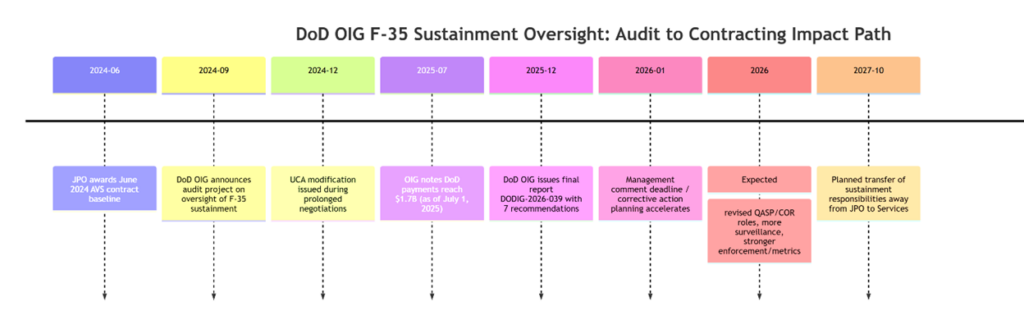
| Milestone | Date (known/estimated) | Primary source | What it signals for contractors |
| DoD OIG initiates audit (project announcement) | Sept. 10, 2024 | DoD OIG project announcement memo | Oversight focus established; expect future data calls and interviews. [19] |
| JPO awards AVS contract N00019‑24‑C‑0039 ($1.6B initial) | June 28, 2024 | DODIG‑2026‑039 | New baseline contract terms; primes may flow down reporting/quality requirements. [7] |
| UCA modification issued due to negotiation impasse | Dec. 2024 | DODIG‑2026‑039 | UCAs can increase documentation and cost/price scrutiny; expect tighter invoice review culture. [20] |
| UCA definitized | Aug. 2025 | DODIG‑2026‑039 | Definitization can trigger scope/metric resets; subs may see revised metrics/acceptance criteria. [7] |
| OIG report issued (DODIG‑2026‑039) | Dec. 19, 2025 | DoD OIG report | Formal recommendations begin; leadership attention increases; performance documentation becomes higher-stakes. [3] |
| DoD management comments requested / follow-up deadline | Jan. 28, 2026 (stated in report) | DODIG‑2026‑039 | Near-term corrective action planning and potential contract/QASP updates accelerate. [3] |
| Corrective actions (workforce study, QASP/COR alignment, enforcement actions) | 2026 (expected) | DODIG‑2026‑039 | Likely increases in surveillance activity and documentation requirements at sites. [6] |
| Structural shift of sustainment responsibilities | By Oct. 1, 2027 | DODIG‑2026‑039 (citing FY2022 NDAA requirement) | Potential new sustainment buying patterns at Air Force/Navy level; teaming opportunities and new “rules of the road.” [3] |
Mermaid timeline chart: audit → response → contracting impacts
Compliance lessons and practical steps for small firms
Even if you are a subcontractor far below the prime, this audit is a reminder: DoD oversight problems often lead to “tightening the screws” contractually—and that tightening lands on suppliers through flow-down clauses, more audits, and stricter acceptance documentation.
Focus on three areas.
Performance evidence and surveillance readiness. The IG report highlights that weak documentation can undermine the government’s ability to leverage performance during negotiations or disputes—expect primes to ask for more substantiation of delivery, quality, and responsiveness. [6] Maintain a clean, time-stamped record of what you delivered, when, and how it met contract requirements (including help-desk “tickets,” turnaround times, repair cycle time, and corrective action closure).
Government property and inventory traceability. Where you handle government property (or government-furnished property), treat FAR 52.245‑1 compliance as a core operational capability, not an afterthought. [21] In DoD environments, also be prepared for system-driven reporting expectations (for example, reporting in designated government modules) and for DCMA property oversight practices. [22]
Cost allowability and invoice defensibility. The broader DoD OIG “lessons learned” work emphasizes risks tied to poor contract files, UCAs, weak QASPs, and invoice review failures—conditions that often trigger tighter invoicing scrutiny and more “show me the backup” requests. [23] If you bill labor or materials, keep your support “audit-ready”: timekeeping records, purchase orders, receiving records, and mapping to CLINs/SLINs.
Checklist table: documents small contractors should gather now
| Document category | What to compile | Why it matters in an IG-driven tightening cycle |
| Contract & mods | Prime contract extract (relevant CLINs), mods, task orders, SOW/PWS, deliverable list | Lets you prove scope and defend performance against moving metrics. [3] |
| QASP/surveillance artifacts | QASP (if provided), surveillance checklists, site visit notes, quality plans | IG reports often trigger QASP updates and more formal surveillance reporting. [24] |
| Acceptance & inspection | DD250/WAWF package (or electronic equivalents), receiving reports, inspection logs, nonconformance reports | Material inspection/receiving discipline is a recurring audit focus. [6] |
| Government property | GFP lists, property records, inventories, loss/damage reports, disposition paperwork | Property accountability gaps are repeatedly flagged across F‑35 oversight history. [25] |
| Supply chain proof | OEM traceability, serial/lot tracking, shipping logs, backorder data, corrective action requests | Supports reliability claims and helps explain delays and shortages. [5] |
| System access evidence | Portal access requests/approvals, repo permissions, tickets for inaccessible systems | The OIG found oversight suffered when personnel lacked access to key systems. [5] |
| Invoicing support | Invoices, labor backups, material invoices, rate support, mapping to CLINs | Expect tighter invoice reviews after oversight findings. [23] |
| Performance metrics | SLA/KPI tracking, response-time reports, cycle times, reliability/availability metrics you control | Helps primes align subcontract performance to revised readiness priorities. [26] |
| Staffing & qualifications | Key personnel resumes, certifications, training records | Supports staffing adequacy and reduces “capacity risk” concerns. [5] |
| Communications record | Formal notices, COR/PM emails, meeting minutes, action item trackers | Protects you in disputes and shows responsiveness/closure discipline. [23] |
Recommended responses for firms that may be “in the blast radius”
If you support the F‑35 sustainment ecosystem (or any major DoD sustainment prime), assume oversight will tighten and take proactive steps:
Engage your prime now. Ask whether the prime anticipates revised surveillance, reporting, or acceptance requirements based on OIG recommendations (especially QASP and property reporting changes). The OIG report specifically emphasizes improving COR alignment and surveillance coverage—subs should be prepared for more structured oversight touchpoints. [17]
Document performance in “negotiation-ready” form. OIG warns that weak performance documentation can reduce DoD leverage in negotiations; primes will want their subcontractor evidence in usable form (dashboards, issue logs, closure data). [6]
Use counsel strategically when contract terms shift. If a contract modification materially changes performance metrics, remedies, or data-rights/data-access requirements, legal review can prevent accidental assumption of unpriced risk—especially in sustainment environments where “readiness” metrics can be difficult to control at a single tier. [12]
Procura helps small federal contractors and subcontractors stay ahead when oversight pressure rises and compliance expectations tighten. Procura’s AI platform continuously scans SAM.gov for relevant opportunities, reads full solicitation packages (including attachments), and surfaces the clauses, deliverables, and compliance requirements that are likely to drive surveillance and documentation demands post-award. By turning dense contracting documents into clear summaries and fit scores, Procura helps small teams focus on the right bids—and build proposals and execution plans that hold up under heightened DoD scrutiny. [27]
Meet with the Procura Team to See How We Can Help

[1] [2] [3] [4] [5] [6] [7] [9] [12] [13] [14] [16] [17] [18] [20] [24] [26] Report No. DODIG-2026-039: Audit of the DoD’s Oversight of Contractor Performance for the F‑35 Joint Strike Fighter Sustainment Contracts
https://media.defense.gov/2025/Dec/23/2003848755/-1/-1/1/DODIG-2026-039_FINAL%20SECURE.PDF
[8] Part 42 – Contract Administration and Audit Services | Acquisition.GOV
https://www.acquisition.gov/far/part-42?utm_source=chatgpt.com
[10] PGI 201.602-2 Responsibilities. | Acquisition.GOV
https://www.acquisition.gov/dfarspgi/pgi-201.602-2-responsibilities.?utm_source=chatgpt.com
[11] [21] [25] 52.245-1 Government Property. | Acquisition.GOV
https://www.acquisition.gov/far/52.245-1?utm_source=chatgpt.com
[15] GAO-24-106703, F-35 Sustainment: Costs Continue to Rise While Planned …
https://www.gao.gov/assets/gao-24-106703.pdf?utm_source=chatgpt.com
[19] Project Announcement: Audit of the DoD’s Oversight of Contractor Performance for the F-35 Joint Strike Fighter Sustainment Contracts (Project No. D2024-D000AT-0173.000) > Department of Defense > Project Announcement Memos
[22] Part 245 – GOVERNMENT PROPERTY | Acquisition.GOV
https://www.acquisition.gov/dfars/part-245-government-property?utm_source=chatgpt.com
[23] Summary Report: Lessons Learned from DoD OIG Reports on Contract Oversight (Report No. DODIG-2025-096)
https://www.oversight.gov/sites/default/files/documents/reports/2025-05/DODIG-2025-096_Final.pdf
[27] Latest Defense News | Federal News Network
https://federalnewsnetwork.com/category/defense-main/?utm_source=chatgpt.com