

How to become a subcontractor on a federal prime contract starts with one number: $900,000. Above that value, a large prime contractor must carry a small business subcontracting plan under FAR 19.702. In government subcontracting, that plan is what turns a polite meeting into a purchase order. Most guides on this subject still print $750,000. However, that figure is out of date, and quoting it to a prime is a fast way to look like you do not read the regulations.
I have sat on both sides of this. I have been the small firm asking a prime for a piece of work. On other contracts I read the solicitation and decided which pieces were worth handing out. The gap between those two views is where most small contractors lose time. So this guide closes it with the actual regulations and the actual reported numbers. It also gives an honest answer about when government subcontracting is the right path.
What is government subcontracting, and who counts as a federal subcontractor?
Government subcontracting is the sale of supplies or services to a company that holds a federal prime contract, rather than to the government itself. FAR 44.101 defines a subcontractor as a supplier, distributor, vendor, or firm. That firm furnishes supplies or services to or for a prime contractor or another subcontractor. That definition is wide on purpose. For example, it catches the firm that paints a barracks under a construction prime and the firm that sells that prime its paint.
A first-tier subcontract is one the prime awards directly, and it is the only tier the public data captures. A second-tier subcontract, awarded by a subcontractor to someone else, is invisible in the federal reporting systems. Your position in that chain decides what the prime owes you and what it must report about you.
The customer also changes. As a prime you answer to a contracting officer, and the Contract Disputes Act and the Prompt Payment Act stand behind you. But as a subcontractor you answer to a commercial company under a commercial agreement, and your remedies come from that agreement. The government is not a party to your subcontract and will not enforce it for you. So that single fact must shape how carefully you read what you sign.
How much work do federal primes actually subcontract?
Federal prime contractors reported 139,200 first-tier subcontracts in fiscal year 2025, worth about $118.1 billion. Prime contract obligations over the same period were $778.5 billion, per USASpending.gov. That works out to roughly 15 cents of reported subcontract value for every prime dollar obligated. That market is real, and it is large enough that ignoring it costs you money.
Where that money sits is the part worth studying. The reported subcontract dollars concentrate in defense manufacturing and technical services, not in the labor verticals many small firms assume are full of pass-through work.
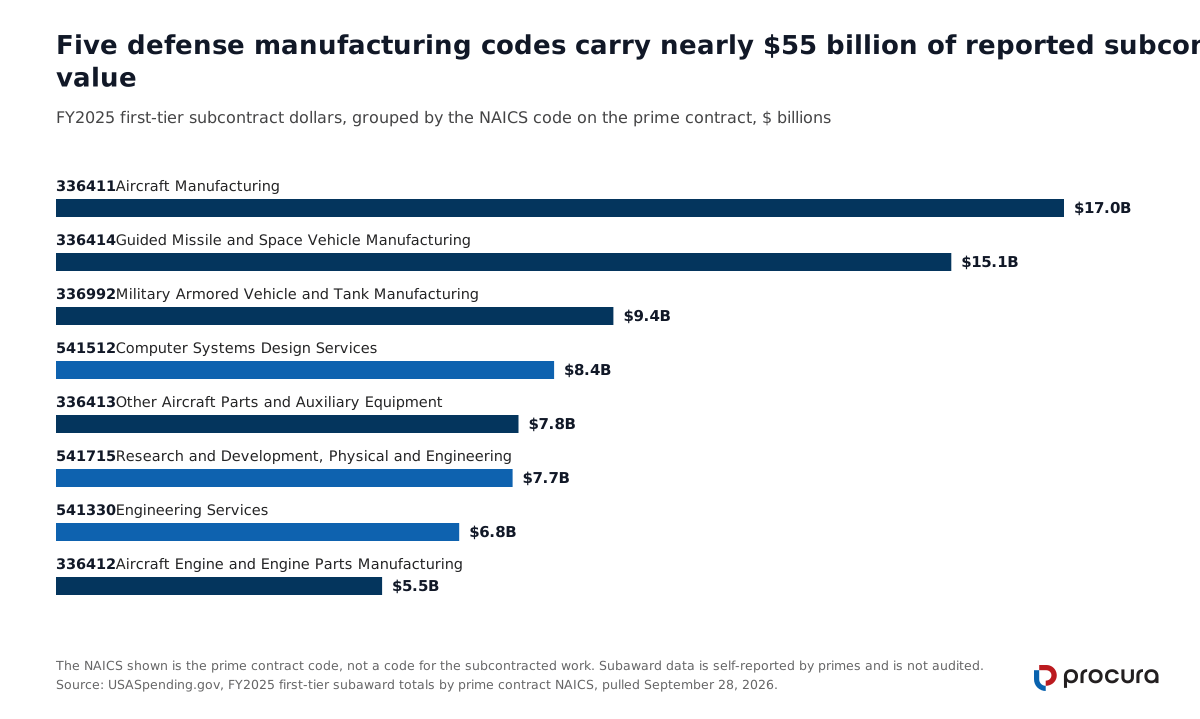
Data table: FY2025 reported subcontract value by prime contract NAICS
| NAICS | Prime contract industry | FY2025 reported subcontract value |
|---|---|---|
| 336411 | Aircraft Manufacturing | $17.0B |
| 336414 | Guided Missile and Space Vehicle Manufacturing | $15.1B |
| 336992 | Military Armored Vehicle and Tank Manufacturing | $9.4B |
| 541512 | Computer Systems Design Services | $8.4B |
| 336413 | Other Aircraft Parts and Auxiliary Equipment | $7.8B |
| 541715 | Research and Development, Physical and Engineering | $7.7B |
| 541330 | Engineering Services | $6.8B |
| 336412 | Aircraft Engine and Engine Parts Manufacturing | $5.5B |
Before you quote government subcontracting data
Two cautions belong with that table, and both are the kind of thing a prime will expect you to know. The NAICS shown is the code on the prime contract, not a code for the subcontracted work. A janitorial subcontract under an aircraft sustainment prime thus lands in the aircraft row. And the whole dataset is self-reported by primes and is not audited.
The scale of that second problem is easy to show. For example, sorting FY2024 subawards by value returns a single record showing a $39.2 trillion subcontract. That is larger than the world economy, and it is plainly a keying error that nobody caught. In short, treat the public subcontract data as a map of where the work clusters, and never as a ledger you can quote to the dollar.
When does a prime have to look for small subcontractors?
A prime that is not a small business must submit a small business subcontracting plan the contracting officer approves. The trigger is a contract expected to exceed $900,000, or $2 million for construction, with subcontracting possibilities. FAR 19.702 sets that rule for negotiated acquisitions, for sealed bidding, and for any modification that pushes a contract past the threshold. An apparently successful offeror that fails to negotiate an approved plan becomes ineligible for award.
The plan is not a gesture. Under FAR 19.704 it must carry separate percentage goals for six categories of subcontractor. Those are small business, veteran-owned, service-disabled veteran-owned, HUBZone, small disadvantaged, and women-owned small business concerns. It must also name the employee who administers it, describe how the goals were built, and describe how the prime will find sources. The prime then reports against those goals twice a year through the Electronic Subcontracting Reporting System.
| Condition | Subcontracting plan required? | Authority |
|---|---|---|
| Contract over $900,000 with subcontracting possibilities | Yes | FAR 19.702(a)(1)(i) |
| Construction contract over $2 million | Yes | FAR 19.702(a)(1)(i) |
| Modification that pushes the value past the threshold | Yes, if the contracting officer finds opportunities exist | FAR 19.702(a)(1)(iii) |
| Prime is a small business concern | No | FAR 19.702(b)(1) |
| Personal services contract | No | FAR 19.702(b)(2) |
| Work performed entirely outside the United States | No | FAR 19.702(b)(3) |
| Subcontract you receive is itself over $900,000 | Yes, you must adopt your own plan | FAR 19.704(a)(9) |
That last row surprises people. The obligation flows downhill. If you win a subcontract worth more than $900,000 and you are not a small business, you must adopt a subcontracting plan of your own. You then hunt for small firms exactly as the prime did.
Why do primes want a small subcontractor specifically?
Goodwill is not the reason, and neither is the scorecard. The reason is FAR 52.219-14, the limitations on subcontracting clause, and it is the single most useful rule a small subcontractor can understand.
On a set-aside contract, the clause caps how much of the government money a prime can pay out to firms that are not similarly situated. A similarly situated entity is a first-tier subcontractor with the same small business program status that qualified the prime for the award. It must also be small under the NAICS code the prime assigned to the subcontract. Work paid to a similarly situated entity does not count against the cap.
| Type of work | Most the prime can pay firms that are not similarly situated | Basis |
|---|---|---|
| Services, except construction | 50 percent | Amount paid by the government |
| Supplies, other than from a nonmanufacturer | 50 percent | Amount paid, excluding cost of materials |
| General construction | 85 percent | Amount paid, excluding cost of materials |
| Construction by special trade contractors | 75 percent | Amount paid, excluding cost of materials |
Read that table from your own side of the desk. A small prime holding a services set-aside can hand 50 percent of the contract to anybody. Better still, it can hand an unlimited amount to a small firm with matching status. So you are not asking that prime for a favor. You are the only kind of subcontractor that does not consume a scarce allowance. Saying so in the first meeting changes the conversation.
The pass-through trap in FAR 52.219-14
One trap sits inside the same clause. Work that a similarly situated entity further subcontracts counts back toward the prime’s cap. As a result, a prime that plans to pass your scope straight through to a large firm gets no relief from the rule. A prime that asks you to do exactly that is asking you to help it fail a compliance test.
Where do you find government subcontracting opportunities?

There is no SAM.gov for subcontracts. No single system carries federal subcontracting opportunities the way SAM.gov carries prime solicitations, and any guide that implies otherwise has not looked recently. Instead, what exists is a short list of thin sources plus direct outreach, and the honest ranking puts direct outreach first.
| Source | What it holds | Realistic value |
|---|---|---|
| SBA SUBNet | Subcontracting notices posted voluntarily by primes | Thin. Ten open notices nationwide on September 28, 2026, mostly water and sewer construction and Job Corps facilities work |
| SBA Directory of Prime Contractors with Subcontracting Plans | Companies that carry a plan, with small business liaison contacts | The best starting list for direct outreach |
| GSA and DOT subcontracting directories | Agency-specific prime contractor lists | Useful if you sell into those agencies |
| Small Business Search at SBA | Your own public profile, which primes search by NAICS and certification | Inbound only, and worth an hour to complete properly |
| APEX Accelerators | Free local counseling and prime introductions | Underused, and free |
| SAM.gov award data and USASpending.gov | Who won the prime work you want a piece of | The real source list, because the winners are the buyers |
Follow the prime awards, not the portals
The last row is the method that actually works. Find the prime contracts in your industry and region, and note who won them. Approach those companies before the follow-on competition starts. A prime that has just won a five-year award and owes the government a subcontracting plan has a problem you can solve. It is looking for you at the same moment you are looking for it. Our guide to finding federal contracts covers the search side of that work in detail.
Timing matters more here than in prime work. The best moment to contact a prime is while it is still writing its proposal. That is when it builds the subcontracting plan and names teammates. The second best moment is the first ninety days after award. After that the team is set and you are waiting for somebody to fail.
What do you need in place before a prime will talk to you?

Most checklists on how to become a subcontractor open with paperwork. This one opens with what a prime actually checks before it answers your email. A subcontractor does not need a SAM.gov registration to sign a subcontract. It needs one anyway, for three practical reasons, and the first two are mechanical.
- A Unique Entity ID. The prime must report every first-tier subcontract of $40,000 or more under FAR 52.204-10, and that report needs your identifier. A firm the prime cannot report is a firm the prime cannot easily buy from.
- A verified size and certification status. Your similarly situated value depends on a status the prime can check rather than take on trust.
- Credibility. A registered firm has already proven it can complete a federal process without help. That is a cheap signal and primes read it.
The $40,000 reporting threshold is itself current, and recently changed. It moved up from $30,000 in an August 2025 rule, so any checklist still quoting the old figure predates the change. Our SAM.gov registration walkthrough covers the identifier and the certifications in order.
What a prime wants to see beyond registration
Beyond registration, a prime wants one page that answers three questions. What do you do, where have you done it, and what makes you countable toward its goals. Put your NAICS codes, certifications, Unique Entity ID, and two specific past performance references on that page. Generic capability language reads as noise to a small business liaison officer reviewing forty of these a month. The structure in our capability statement guide is built for exactly this reader.
One more item separates a serious subcontractor from a hopeful one. Primes on cost-reimbursement, time-and-materials, and labor-hour contracts often need the contracting officer to consent to individual subcontracts under FAR 44.201-1. A prime without an approved purchasing system carries that burden on most meaningful awards. If you can supply clean pricing backup quickly, you remove work from the prime’s desk. That is a durable reason for the prime to keep buying from you.
How do you get paid in government subcontracting?
Payment is where subcontracting disappoints people, so it is worth knowing the two protections that exist and the large gap between them.
FAR 52.232-40 covers a prime that receives an accelerated payment from the government. After a proper invoice, it must pass accelerated payment to its small business subcontractors within 15 days, to the maximum extent practicable. The clause also bars the prime from charging you a fee for that acceleration, and it flows down into every small business subcontract. Note that “to the maximum extent practicable” is doing real work in that sentence, and the clause creates no new rights under the Prompt Payment Act.
A second protection is reputational. FAR 19.701 defines an untimely payment as one more than 90 days past due under the subcontract terms. It covers supplies and services the government has already paid the prime for. A reduced payment is one smaller than the subcontract calls for in the same circumstances. Primes must report these, and a pattern of them is a past performance problem, which is the language a prime understands. Our explainer on how past performance ratings work covers why that pressure is real.
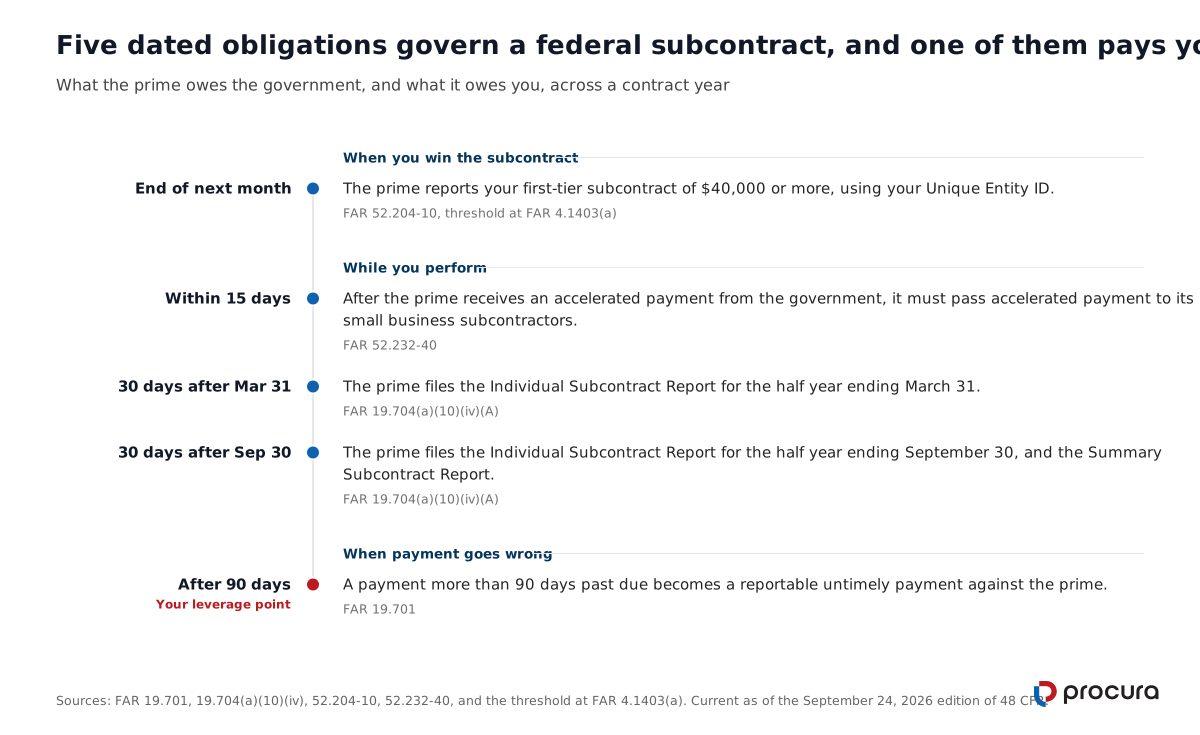
Note what neither protection gives you. There is no federal mechanism that pays you when a prime simply refuses. Therefore, your only real protection is the subcontract you negotiated. Fix payment timing, retainage, and the pay-when-paid language in writing before the work starts.
Is government subcontracting really the easiest way in?
It depends entirely on what you sell. The honest answer on government subcontracting is not the one most articles give.
If you build parts, write software, or provide engineering services, subcontracting is the shortest path in federal contracting. The money proves it. Aircraft manufacturing alone carried $17.0 billion of reported subcontract value in FY2025, and no small firm wins a missile program as a prime. In fact, teaming into that work is the only realistic entry. Our guides to bidding parts through DLA DIBBS and federal construction work both sit inside that world.
If you sell janitorial, landscaping, trucking, or guard services, the picture reverses. Those industries barely register in reported first-tier subcontract data, and the federal government buys them directly through small business set-asides in large volume. Chasing a prime for that work often means accepting a margin haircut for access you did not need. Instead, the honest recommendation is to compete for the prime award, and our ranking of the easiest government contracts to win exists for that reader.
For many firms the best answer to how to become a subcontractor is that government subcontracting is a stage, not a destination. Subcontract first to build the past performance record you do not have yet. Then use that record to bid as a prime within two or three years. Subcontract work still counts as experience, and the step-by-step approach in our guide to winning government contracts assumes exactly that progression.
The hard part is knowing which primes are worth calling
Everything above is knowable. The regulations are public, the directories are free, and the award data is downloadable. But the work that does not scale is the reading. You open a prime’s award, find the statement of work in the attachments, and decide which scope the prime cannot self-perform. You then confirm whether the set-aside status makes your certification worth anything on that contract. That is an hour per opportunity, and there are thousands.
Procura Federal was built to collapse that hour. It opens the attachments on a solicitation and finds the scope and the clause list. It then rates the opportunity against your capability statement and names the compliance duties. You then see which awards carry work in your lane before you write a single introduction email. It costs $399/month, against five-figure annual subscriptions for the legacy platforms built for large primes.
Frequently asked questions about government subcontracting
Do I need to register in SAM.gov to be a federal subcontractor?
No rule forces it. But the reporting your prime owes the government runs on your Unique Entity ID, so registration is worth completing anyway.
Who is considered a federal subcontractor?
Any firm furnishing supplies or services to a prime contractor or to another subcontractor for the performance of a federal contract, per FAR 44.101. Labor and employment obligations can reach further, so check the specific clause before assuming a rule does not apply to you.
Can a large business be a subcontractor on a set-aside contract?
Yes, within the percentage caps in FAR 52.219-14. The cap is what makes a small subcontractor commercially attractive rather than merely welcome.
Does government subcontracting count as past performance?
Yes, and agencies routinely accept it. Also, ask your prime for a reference letter at the time you finish. It must name the contract number, your scope, and the dollar value, because chasing it two years later rarely works.
What is a subcontracting plan, in one sentence?
It is the document in which a large prime commits to percentage goals for buying from small and socioeconomic firms. The prime must then report against it twice a year.
Are wage rules different for subcontractors?
No. Service and construction wage determinations flow down, and a subcontractor carries the same obligation as the prime. Our Service Contract Act guide covers how that works on service awards.
Book a demo
See how Procura rates live federal awards against what your firm actually does. It also shows which primes are worth an introduction email this week.