

CPARS is the government-wide system where a federal agency rates your performance on every contract over $350,000 (FAR 42.1502). An agency rates you at least once a year and again when the work ends. Each rating sits on a five-point scale from Exceptional to Unsatisfactory. Then you get 14 calendar days to answer it, and source selection officials read it for the next three years. Only 243,739 of the 5.8 million federal contract awards with fiscal 2025 activity cleared that dollar line, per USASpending.gov. Yet those awards carried 95 percent of the money.
What is CPARS?
CPARS stands for Contractor Performance Assessment Reporting System. It lives at cpars.gov, a government-run portal, and FAR 42.1501(b) names it the official source for past performance information. A contracting officer who evaluates your proposal must use what CPARS holds on you. So nothing you write in a proposal replaces it.
Moreover, a record covers more than the quality of the work. Specifically, FAR 42.1501(a) lists eight things an agency writes down:
- Conformance to requirements and quality standards
- Cost forecasting and control
- Schedule adherence, including the administrative side of performance
- Cooperative behavior and commitment to customer satisfaction
- Compliance with a small business subcontracting plan
- Reporting into government databases
- Integrity and business ethics
- Concern for the interest of the customer
A late report into SAM.gov is a past performance event under that list, and so is an unpaid subcontractor.
CPARS also carries the FAPIIS module. Under FAR 42.1503(h), a contracting officer has 3 calendar days to post three kinds of event. Specifically, those are a termination for default, a defective pricing determination, and a history of unjustified late payments to small subcontractors. Meanwhile, rating narratives stay inside the government. FAPIIS entries are public, unless a Freedom of Information Act exemption applies.
Which contracts get a CPARS evaluation?
In general, any contract or order that exceeds the simplified acquisition threshold, which is $350,000, gets an evaluation under FAR 42.1502(b). However, construction and architect-engineer work run on their own lines. A construction contract of $900,000 or more gets one under 42.1502(e), and an architect-engineer contract of $45,000 or more gets one under 42.1502(f). In addition, a termination for default earns an evaluation at any dollar value in both trades.
That threshold applies to the total value of the contract, rather than to the money spent in one year. The cpars.gov guidance says an evaluation becomes due once a modification pushes the aggregate value over the line, starting with the next anniversary. An order under a GSA Schedule, a government-wide contract or another agency’s multiple-award vehicle gets its own evaluation when it exceeds the threshold. Finally, agencies do not evaluate AbilityOne awards under FAR subpart 8.7, and they keep classified contracts out of CPARS entirely.
CPARS evaluation thresholds by contract type
| Contract type | Civilian agencies | Department of Defense | Cite |
|---|---|---|---|
| Supplies and services (general) | Over $350,000 | Over $350,000, with internal thresholds of $1,000,000 for services and information technology, $500,000 for ship repair, and $5,000,000 for systems | FAR 42.1502(b), CPARS guidance Table 1 |
| Construction | $900,000 or more | $900,000 or more | FAR 42.1502(e) |
| Architect-engineer services | $45,000 or more | $45,000 or more | FAR 42.1502(f) |
| Any construction or architect-engineer contract terminated for default | Any value | Any value | FAR 42.1502(e), (f) |
| Orders under a Federal Supply Schedule, GWAC or another agency’s multi-agency contract | Over $350,000 per order | Over $350,000 per order | FAR 42.1502(c) |
| Orders under a single-agency IDIQ | Contracting officer’s choice above $350,000 | Contracting officer’s choice above $350,000 | FAR 42.1502(d) |
| AbilityOne (FAR subpart 8.7) and classified contracts | Not evaluated in CPARS | Not evaluated in CPARS | FAR 42.1502(h), 42.1503(f) |
How many contracts cross the $350,000 line?
One dollar line splits the federal market into two very different piles. Overall, of the 5,784,604 contract awards with fiscal 2025 activity, 243,739 carried a total value above $350,000. That is 4 percent of the awards and 95 percent of the $778.5 billion the government obligated. Meanwhile, small businesses held 123,859 of those larger awards, which is 51 percent of everything that generates a CPARS record.
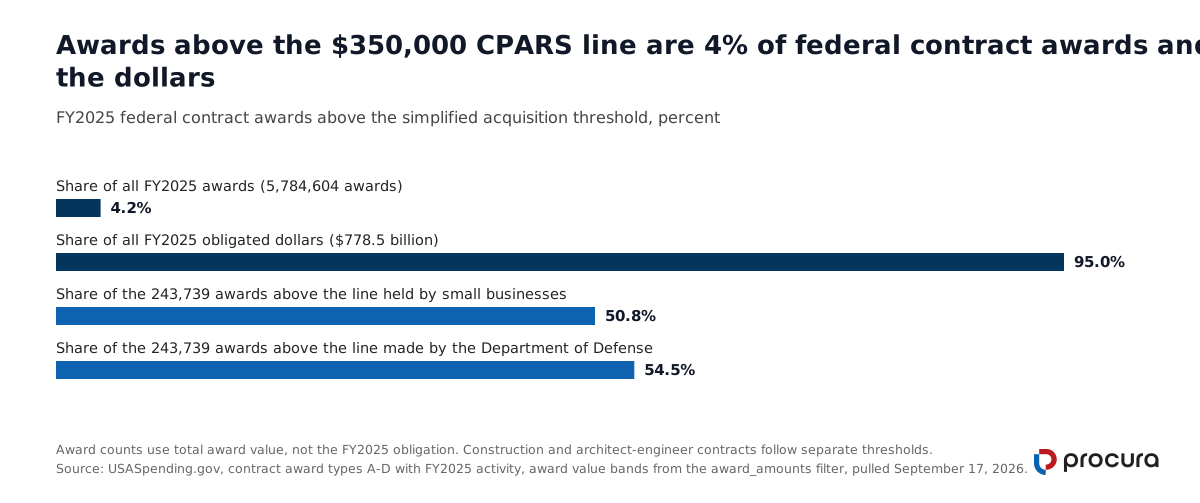
Data table: FY2025 federal contract awards and obligations by CPARS threshold band
| Total award value | Awards with FY2025 activity | Share of awards | FY2025 obligations | Share of dollars | CPARS rule |
|---|---|---|---|---|---|
| $15,000 or less | 4,839,167 | 84% | $5.1B | 1% | No evaluation |
| Over $15,000 through $350,000 | 702,511 | 12% | $34.1B | 4% | No evaluation |
| Over $350,000 through $900,000 | 85,300 | 1.5% | $21.2B | 3% | Evaluation required, except construction |
| Over $900,000 | 158,495 | 2.7% | $718.2B | 92% | Evaluation required in every trade |
| All awards above $350,000 | 243,739 | 4.2% | $739.4B | 95% | 123,859 to small businesses (51%), 132,869 by DoD (55%) |
| All FY2025 awards | 5,784,604 | 100% | $778.5B | 100% | — |
What the CPARS threshold split means for your firm
Read the two numbers together. For example, a firm that lives on purchase orders and micro-purchases can go years without a rating. Many of the easiest federal contracts to win sit in that pile. However, your first award above the line changes that. From then on, every year of work adds a page to a file that follows you into every source selection.
Why so many pages still say $750,000
Search for the CPARS threshold and you find $750,000 for construction, $35,000 for architect-engineer work and $250,000 for everything else. All three were correct once. Then, on October 1, 2025, the general threshold moved to $350,000, the construction line to $900,000 and the architect-engineer line to $45,000. Current text is at FAR 42.1502 on acquisition.gov, with the FAC number and effective date printed at the top of the page. When you put a threshold in writing, cite that page and not a blog post.
How are CPARS ratings scored?
An evaluator rates six factors, and each one gets its own rating and its own narrative. Specifically, FAR 42.1503(b)(2) fixes the list. Those factors are technical quality, cost control, schedule, management or business relations, and small business subcontracting where a plan applies. A sixth factor covers other items such as tax delinquency or a termination. However, cost control drops out on a firm-fixed-price contract. Then each factor gets one of five ratings, and the FAR defines every rating in Table 42-1.

The five CPARS rating definitions
| Rating | What the FAR requires | What the evaluator must show |
|---|---|---|
| Exceptional | Performance meets the requirements and exceeds many of them to the government’s benefit, with few minor problems and highly effective corrections | Multiple significant events with a stated benefit to the government, and no significant weakness |
| Very Good | Performance meets the requirements and exceeds some of them, with some minor problems and effective corrections | One significant event with a stated benefit, and no significant weakness |
| Satisfactory | Performance meets the requirements, with some minor problems and satisfactory corrections | Only minor problems, or major problems the contractor recovered from without impact. A contractor is not rated below Satisfactory for doing only what the contract requires |
| Marginal | Performance does not meet some requirements, with a serious problem and no effective corrective action yet | A significant event in each category and its impact, backed by the deficiency report or letter that told the contractor about it |
| Unsatisfactory | Performance does not meet most requirements, recovery is not likely on time, and corrections were ineffective | Multiple significant events in each category and their impact, backed by the deficiency reports or letters |
Why Satisfactory is not a bad CPARS rating
Row three holds the sentence every contractor must know. FAR Table 42-1 says a contractor will not get a rating lower than Satisfactory solely for not performing beyond the requirements. In short, Satisfactory is the rating for a contract done as written. Therefore, an evaluator who wants to write Marginal must point to a document that told you about the problem at the time. For example, a deficiency report or a cure letter is that document. If no such document exists, the rating has no support under Table 42-1.
In addition, large primes get a seventh test. When a contract carries the subcontracting plan clause at FAR 52.219-9, the evaluator rates the plan under a separate Table 42-2. Three or more unjustified late payments to small business subcontractors in 12 months put that factor at Unsatisfactory and trigger a public FAPIIS entry.
What does a CPARS Very Good rating mean?
In short, Very Good means you met every requirement and exceeded at least one in a way that helped the government. At the same time, only minor problems occurred. However, an evaluator must name the event. A Very Good narrative that names nothing is a Satisfactory rating with a better label, and a reviewer can send it back for that reason.
How does the CPARS process work, and when does the clock start?
The clock starts on the day the Assessing Official signs the evaluation, not the day you read it. Everything before that point is government work, and everything after it runs on fixed calendar days. First, agencies register the contract in the system within 30 days of award. They must then finish the whole evaluation within 120 days after the performance period ends. Notably, that 120 days includes your comment window.
Who signs a CPARS evaluation?
Three people move the record. First, the Assessing Official is the government employee who writes and signs the ratings, often the contracting officer or the program manager. Second, your Contractor Representative is the person your company names to receive and answer the evaluation. Finally, the Reviewing Official sits one level above the Assessing Official and steps in only when you disagree.
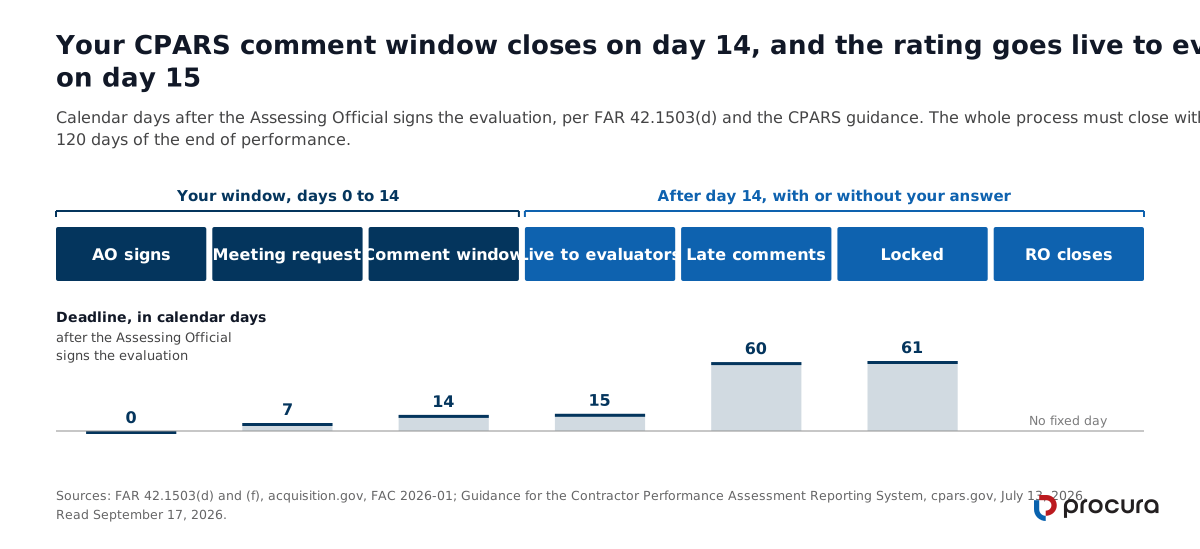
Data table: CPARS evaluation deadlines for the contractor and the agency
| Step | Who | Deadline | Source |
|---|---|---|---|
| Register the contract or order in CPARS | Agency | Within 30 calendar days of award | CPARS guidance 3.5.3, 4.2 |
| Assessing Official signs and sends the evaluation | Agency | Day 0 of the contractor clock | CPARS guidance 4.4 |
| Request a meeting with the Assessing Official, in writing | Contractor | Within 7 calendar days of receipt | CPARS guidance 3.5.5 |
| Submit comments, rebuttal or additional information | Contractor | Up to 14 calendar days from notification | FAR 42.1503(d) |
| Evaluation opens to source selection officials, marked Pending if unanswered | System | Day 15 after the signature | FAR 42.1503(f), CPARS guidance 4.5 |
| Last day to send comments | Contractor | Day 60 after the signature | CPARS guidance 4.5 |
| Contractor locked out, evaluation returned to the Assessing Official | System | Day 61 after the signature | CPARS guidance 4.6 |
| Reviewing Official comments, signs and closes (required on non-concurrence) | Agency | No fixed day | FAR 42.1503(d), CPARS guidance 4.7 |
| Whole evaluation complete | Agency | Within 120 days of the end of the performance period | CPARS guidance 4.8 |
Which CPARS deadlines actually matter?
Two dates on that clock matter more than the rest. First, on day 14 the FAR comment period ends. On day 15 the evaluation opens to source selection officials with or without your comments, marked Pending if you have not answered. The system keeps your comment box open until day 60, and anything you add appears within a day. But a contracting officer on another agency’s source selection can read the rating from day 15 onward. Therefore, answer inside the 14 days.
Besides that, one more deadline hides inside the guidance. If you want a meeting with the Assessing Official to discuss the evaluation, you must request it in writing within 7 calendar days of receipt. That meeting happens inside your comment period, so it is the cheapest way to fix a factual error before it reaches a reviewer.
How do you respond to a bad CPARS rating?
Respond in writing, inside 14 days, with facts and document references, and mark the evaluation as non-concur if the rating is wrong. Notably, non-concurrence forces the Reviewing Official to read the file and sign it. Under FAR 42.1503(d) the agency must provide that review at a level above the contracting officer, and the agency’s conclusion is final. Your comments stay attached to the evaluation for its full life, so every future evaluator reads both sides.

Generally, narratives are where a Marginal rating fails. Specifically, CPARS guidance requires ratings that match the Table 42-1 definitions and narratives supported by objective evidence. Test the evaluation against that standard, one factor at a time:
- The narrative names a specific event, a date and its effect on the government.
- The government holds a deficiency report, cure notice or letter from that date.
- The narrative matches the rating definition instead of putting minor problems under a Marginal label.
- No change order, government delay or stop-work order caused the schedule slip it describes.
- No rating below Satisfactory rests only on work that met the contract without exceeding it.
How to write a CPARS rebuttal
Write the answer the way you would write a claim. For instance, quote the contract, cite the modification number, attach the email that shows the government approved the change. Also, leave out the adjectives and the history of the relationship. If the Assessing Official revises the ratings after your comments, both the original and the revised versions stay in the record. As a result, a reader sees the correction and the reason for it.
When the Reviewing Official signs a rating you still believe is arbitrary, the path continues outside the system. Then a contractor can submit a claim under the Contract Disputes Act. A board of contract appeals or the Court of Federal Claims can then find the evaluation arbitrary and order a new one. That route costs legal fees and months, so it makes sense only for a rating that blocks bids you would otherwise win.
How long does a CPARS rating last?
Three years from the end of performance for most contracts, and six years for construction and architect-engineer work, under FAR 42.1503(g). That rule tells agencies what to use, not what to keep, so an older evaluation still exists in the system. However, a source selection official is directed to the evaluations inside the window, plus whatever FAPIIS holds.
Inside a source selection, the FAR then adds two rules that decide how the record is read. First, under FAR 15.305(a)(2)(iii), an agency weighs relevance and recency. For example, a Very Good rating on a $400,000 janitorial contract says little about a $6 million IT bid. Second, under 15.305(a)(2)(iv), a firm with no relevant record gets neither credit nor penalty. That second rule is the reason a new firm can still win.
What changed in CPARS in 2026?
The ratings, the thresholds and the 14 days did not change in 2026. Its address did. In 2025 the FAR overhaul rewrote Part 42 as model deviation text, and that text moves contractor performance information from subpart 42.15 to subpart 42.11.
Then the Department of Defense adopted the new text by class deviation 2026-O0050 on March 6, 2026, effective March 16. Similarly, Energy and other agencies followed with their own. Meanwhile the codified FAR on acquisition.gov still reads 42.15 under FAC 2026-01, so the two citations are correct for now, depending on the agency.
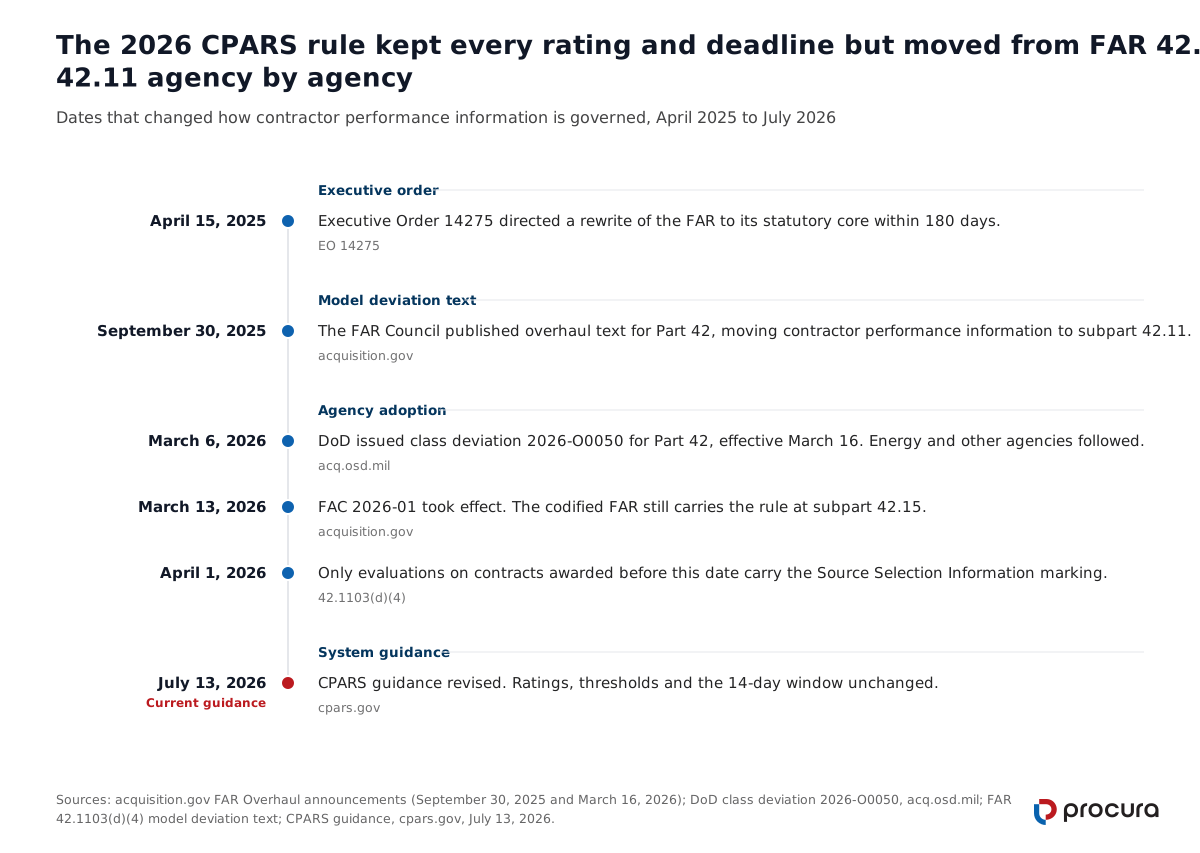
Data table: 2025 to 2026 CPARS rule change dates
| Date | Event | Source |
|---|---|---|
| April 15, 2025 | Executive Order 14275 directed a rewrite of the FAR to its statutory core within 180 days | EO 14275 |
| September 30, 2025 | FAR Council published overhaul model deviation text for Part 42, placing contractor performance information at subpart 42.11 | acquisition.gov |
| March 6, 2026 | DoD class deviation 2026-O0050 for Part 42 issued, effective March 16, 2026 | acq.osd.mil |
| March 13, 2026 | FAC 2026-01 effective. The codified FAR still carries the rule at subpart 42.15 | acquisition.gov |
| April 1, 2026 | Cutoff for the Source Selection Information marking on evaluations, by contract award date | Model text 42.1103(d)(4) |
| July 13, 2026 | CPARS guidance revised. Ratings, thresholds and the 14-day window unchanged | cpars.gov |
What the new FAR 42.11 text changes
Two sentences in the new text matter to a contractor. Previously, old 42.1501 called past performance information relevant for future source selection purposes. By contrast, new 42.1101 drops the words “source selection” and says “for future purposes.” As a result, that wording lets an agency use your record across the whole contract lifecycle. And under the new 42.1103(d)(4), only evaluations on contracts awarded before April 1, 2026 carry the “Source Selection Information” marking. Evaluations on later awards are still restricted to government personnel and the rated contractor, but they lose that label.
Finally, a July 13, 2026 revision of the CPARS guidance removed the Public Key Infrastructure login instructions and changed nothing about the workflow or the thresholds. Every deadline in this guide comes from that edition.
How do you compete without a CPARS record?
Instead, you compete on the neutral rule and on the records of the people you bring. FAR 15.305(a)(2)(iv) bars an agency from rating an offeror with no relevant past performance favorably or unfavorably on that factor. In addition, FAR 15.305(a)(2)(iii) tells the evaluator to consider three other records. In particular, those are predecessor companies, key personnel with relevant experience, and subcontractors that will do major parts of the work. For instance, a new firm whose project manager ran three similar federal jobs has past performance to offer. Read the step-by-step guide to winning government contracts for where that goes in the proposal.

Ninety-six percent of federal awards sit below the $350,000 line, and they are still real work with real references. A contracting officer who bought $200,000 of your services can answer a past performance questionnaire even when no rating exists. Therefore, keep the names, the contract numbers and the dollar values from the first purchase order onward. Likewise, subcontract work counts in the same way. A prime holds the rating, but the prime’s contracting officer representative can still vouch for the part you did.
Construction firms face a different first step, because a job at that size requires performance and payment bonds before it generates a rating. Generally, most first federal construction jobs sit under the two lines. From there the path runs through the federal construction market one bonded job at a time.
A clean record wins only the bids you can find
Every solicitation sets its own test for past performance, and that test hides in the attachments. For example, one asks for three references above $500,000 inside three years. Meanwhile, another accepts commercial work. Finally, a third scores recency and relevance on a matrix that rewards the exact NAICS code. However, none of that appears in the SAM.gov notice. A firm with a strong record still loses bids where its record did not match the instructions.
Procura Federal reads the full solicitation and every attachment. It scores each one against your capability statement and flags the past performance thresholds and other compliance items that decide whether you can bid. It costs $399/month, and our comparison of federal contracting tools shows what the incumbents charge for the same search without the attachment reading.
Frequently asked questions
How do I access CPARS as a contractor?
First, your company names a Contractor Representative. Then the Assessing Official gives that person’s name, title, email and phone to the agency’s Focal Point, who authorizes the account. However, you cannot self-register. If nobody at your firm has an account, ask the contracting officer on your first contract above the threshold to start that step.
How often does a contract get a past performance report?
At least once a year and once more at completion, with interim evaluations allowed under agency procedures. For example, a five-year contract produces at least five ratings.
Is CPARS public?
No. Instead, ratings and narratives go only to government personnel and to the rated contractor. By contrast, FAPIIS entries for terminations, defective pricing and unjustified late payments are public.
Does a subcontractor get a CPARS rating?
No. Instead, agencies rate the prime. A subcontractor’s work still counts in a later source selection under FAR 15.305(a)(2)(iii). Therefore, collect a written reference from the prime at the end of each job.
Can a Satisfactory rating hurt me?
Only against a competitor with Very Good or Exceptional ratings on more relevant work. Satisfactory is the rating for a contract done as written, and the FAR bars anything lower for that.
What is the difference between CPARS and FAPIIS?
Specifically, CPARS holds the ratings on how you did the work. FAPIIS is a module inside that system that holds integrity records such as terminations and defective pricing determinations, and those records are public. Our federal contracting glossary covers the two terms with the rest of the vocabulary.
See which open solicitations your CPARS record can win
Book a demo with your CPARS ratings and one live solicitation in hand. On the call, Procura pulls the past performance instructions out of the attachments and matches them to your record. You learn in twenty minutes whether the bid is worth the week it takes to write.