

The Davis-Bacon Act applies to every federal construction contract in excess of $2,000. In FY2025 that reach covered $51.1 billion in federal construction obligations, per USASpending.gov. One number matters more right now, and it is three. On June 24, 2026, a federal court vacated three provisions of the 2023 Davis-Bacon rule nationwide. Yet the Department of Labor page most contractors read still calls those provisions enjoined.
I read federal construction solicitations every week. Every time, the wage determination is the attachment that decides the margin. A bid schedule is arithmetic, but a wage determination is a rule. It locks your labor cost for the life of the contract. Bid at commercial rates and you lose the difference on every hour worked. This guide covers the rules, the one a court changed this year, and the deadlines that keep a compliant job profitable.
What does the Davis-Bacon Act require?
Coverage starts at 40 U.S.C. 3142(a). It reaches every contract in excess of $2,000 to which the federal government or the District of Columbia is a party. Covered work means construction, alteration, or repair of public buildings and public works, including painting and decorating. Two thousand dollars is not a typo, and the figure has not moved since 1935. Almost every federal construction action clears it.
The five obligations coverage brings
Coverage brings five obligations. Pay each laborer and mechanic the prevailing wage and fringe benefits listed in the wage determination. Rates follow the classification of the work actually done. Pay weekly, and post the wage determination and the WH-1321 poster at the site. Submit certified payrolls weekly. Keep the records for three years after all work on the prime contract is complete.
Two details catch new contractors. First, the obligation attaches to hours worked on the site of the work, not to a job title. One person who frames in the morning and paints in the afternoon earns two classifications in one day. Second, the prevailing wage is a basic hourly rate plus a fringe amount. You can pay the fringe in cash, in bona fide benefits, or in a mix of the two.
| Trigger | What it turns on | Citation |
|---|---|---|
| Contract in excess of $2,000 | Davis-Bacon prevailing wages, fringe benefits, weekly pay, posting, certified payroll | 40 U.S.C. 3142(a) |
| Contract in excess of $100,000 | CWHSSA overtime clauses, as prescribed by regulation | 29 CFR 5.5(b) |
| FAR-covered contract valued over $200,000 | The CWHSSA overtime clause goes in the solicitation and contract | FAR 22.305(a), FAC 2026-01, effective March 13, 2026 |
| Over 40 hours in a workweek | Overtime at 1.5 times the basic rate of pay | 29 CFR 5.5(b)(1) |
| Second construction category over 20% of project cost or over $2.5 million | A second wage determination | DOL Prevailing Wage Resource Book |
| Classification missing from the wage determination | A conformance request to the Wage and Hour Division | 29 CFR 5.5(a)(1)(iii) |
Which parts of the 2023 Davis-Bacon rule are still in force in 2026?
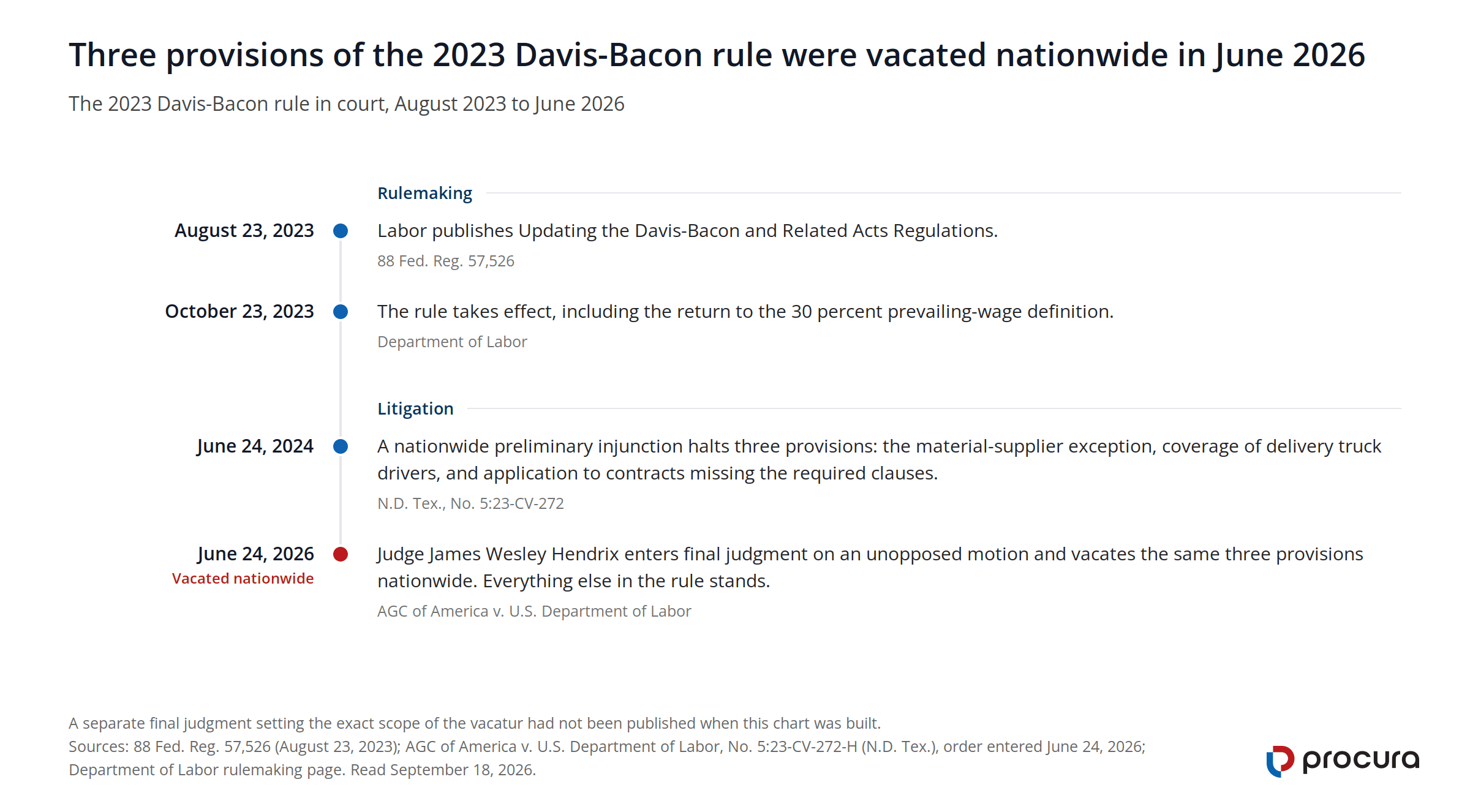
Most of it. The Department of Labor published “Updating the Davis-Bacon and Related Acts Regulations” at 88 Fed. Reg. 57,526 on August 23, 2023. It took effect on October 23, 2023. Three of its provisions are now dead. Everything else stands, including the return to the 30 percent definition that sets how a prevailing wage is calculated.
How the court challenge unfolded
Associated General Contractors of America sued in the Northern District of Texas, and a judge there enjoined three provisions nationwide on June 24, 2024. Exactly two years later, under a different judge, James Wesley Hendrix entered judgment in Associated General Contractors of America v. U.S. Department of Labor, No. 5:23-CV-272-H. That order vacated the same three provisions nationwide, and the Department of Labor did not oppose the motion.
Why the DOL guidance page is still wrong
This matters for a practical reason. On dol.gov, the page that explains the rule still calls these provisions subject to a 2024 preliminary injunction. It does not mention the 2026 judgment. An injunction can lift, but a vacatur removes the rule text. A consultant quoting the injunction language is reading a page three months behind the docket.
| Provision | What the 2023 rule did | Status |
|---|---|---|
| Material suppliers | Narrowed the material-supplier exception so coverage reached suppliers operated by a contractor or subcontractor | Vacated nationwide, June 24, 2026 |
| Delivery truck drivers | Required prevailing wages for drivers whose time on the site of the work was more than de minimis | Vacated nationwide, June 24, 2026 |
| Contracts missing the clauses | Applied Davis-Bacon requirements to contracts from which an agency left the required clauses out | Vacated nationwide, June 24, 2026 |
| The 30 percent prevailing-wage definition | Restored the pre-1983 method for setting the prevailing rate | In force. Challenged separately in the Eastern District of Texas, unresolved |
| Everything else in the 2023 rule | Recordkeeping, anti-retaliation, interest on underpayments, frequently recurring classifications | In force |
One caveat belongs here. The order granting the motion and the judgment vacating the provisions are two separate docket entries, both filed on June 24, 2026. For the exact wording of what came out of the rule, read the judgment itself rather than a news summary.
Who buys Davis-Bacon-covered construction?
Federal agencies obligated $51.1 billion on construction contracts under NAICS sector 23 in FY2025, per USASpending.gov. Small businesses took $21.6 billion of it. A 42 percent small-business share sits far above the government-wide rate. It is the best argument for learning these rules rather than avoiding the work.
Concentration is severe. Defense alone obligated $31.45 billion, or 62 percent of the sector. Build a federal construction practice without selling to a military installation and you ignore nearly two thirds of the market. Our federal construction contracting guide covers the codes and the buyers in more detail.
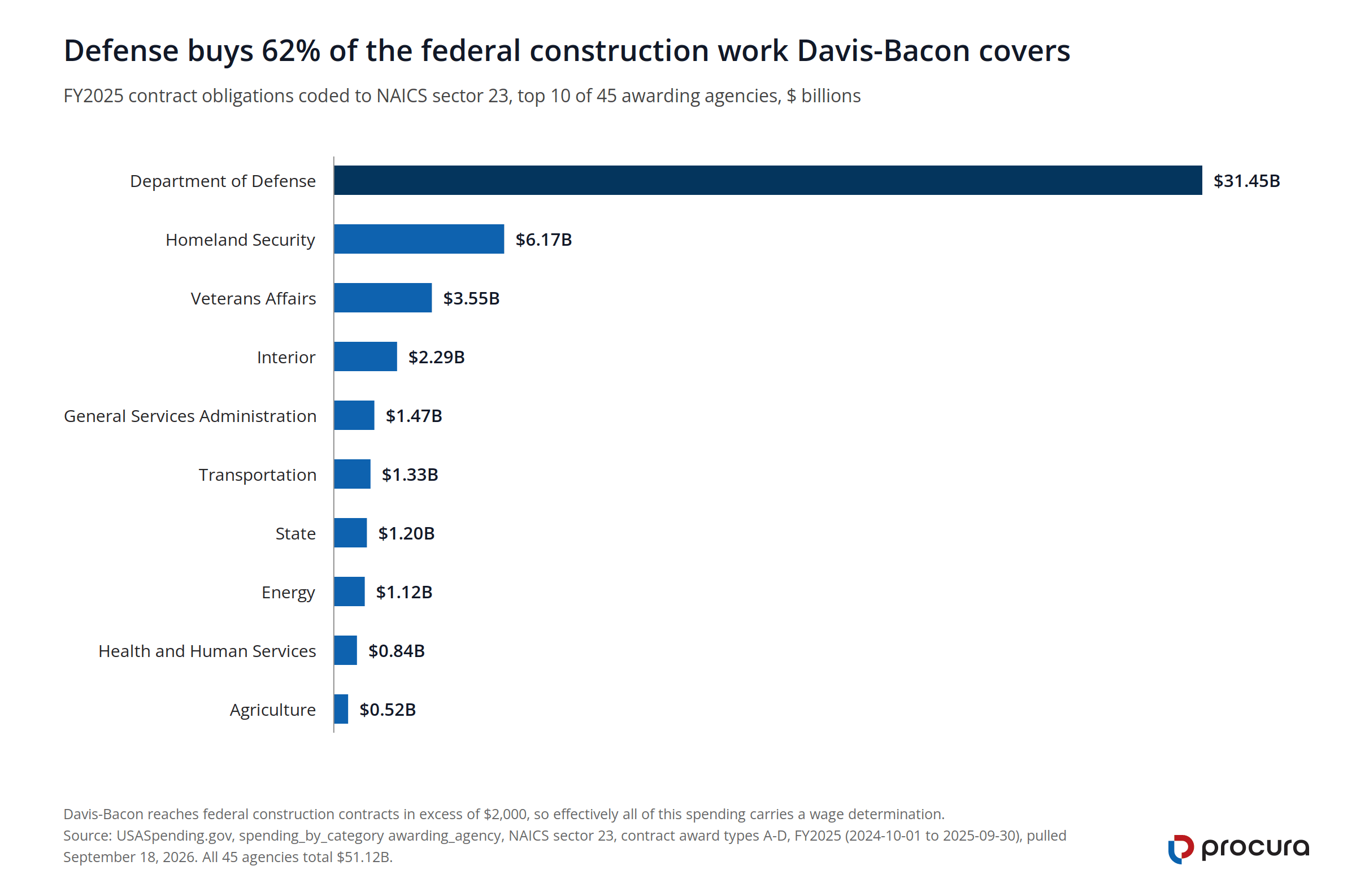
Data table: FY2025 federal construction obligations by awarding agency
| Awarding agency | FY2025 obligations, NAICS sector 23 | Share of the $51.1B total |
|---|---|---|
| Department of Defense | $31.45B | 62% |
| Homeland Security | $6.17B | 12% |
| Veterans Affairs | $3.55B | 7% |
| Interior | $2.29B | 4% |
| General Services Administration | $1.47B | 3% |
| Transportation | $1.33B | 3% |
| State | $1.20B | 2% |
| Energy | $1.12B | 2% |
| Health and Human Services | $0.84B | 2% |
| Agriculture | $0.52B | 1% |
| NASA, Justice and 33 other agencies | $1.19B | 2% |
How do you read a Davis-Bacon wage determination?
General and project wage determinations
A general wage determination covers a county and a construction type, and it does not expire. New annual editions roll over in the first quarter of each year. Rate changes land in weekly modifications, generally on Friday. Since June 14, 2019, SAM.gov is the official source for all Davis-Bacon Act general wage determinations, free of charge.
A project wage determination covers one named project. An agency requests it on Standard Form 308, and it stays effective for 180 days. Miss that window without an award and it is void. Labor calls these rarely issued, so most contractors never see one.

The four construction types
Every wage determination ties to one of four construction types. Picking the wrong one is the fastest way to misprice a job. Building covers sheltered enclosures with walk-in access. Residential covers single-family houses, townhouses, and apartment buildings of no more than four stories. Highway covers roads, streets, runways, and most paving that is not incidental to other work. Heavy is the catch-all. It holds dredging, water and sewer lines, dams, major bridges, flood control, and solar and wind farms.
A project can carry more than one. Work in a second category counts as substantial when it exceeds 20 percent of total project cost or $2.5 million. Substantial work generally gets its own wage determination. Under the two figures, it is incidental. Raise a categorization question with the Wage and Hour Division before bid opening. After the lock-in date, the answer costs money instead of time.
When does a wage determination lock in?
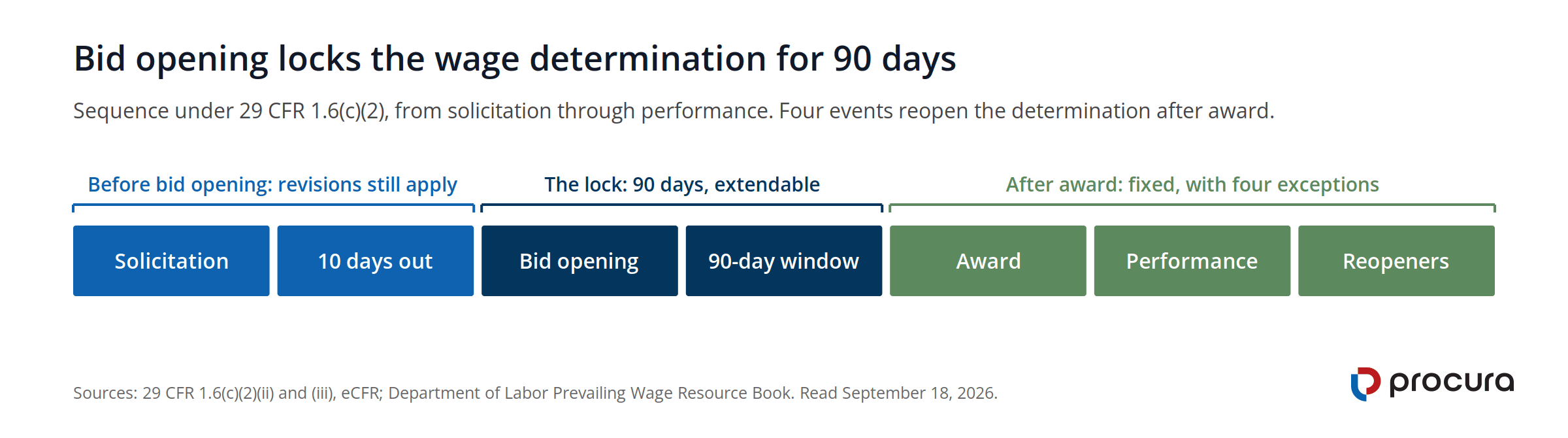
Your solicitation’s wage determination is not always the one that binds you, and the rules differ by procurement method. Under 29 CFR 1.6(c)(2)(ii)(A), a revised wage determination issued at least 10 calendar days before bid opening applies to the solicitation. Issued inside 10 days, it still applies. One exception exists: an agency finding that no reasonable time remains to notify bidders, filed in the contract file.
Then comes the rule that surprises people. Bid opening locks the general wage determination for 90 days. Miss that window without an agency extension, and every modification issued up to award goes into the contract. A slow award can thus raise your labor cost after you priced the job. Ask the contracting officer about the extension rather than waiting to find out.
What changes after award
After award, modifications generally do not apply. Whatever wage determination you carry sets the minimum rates for the term of the contract. Four things reopen it:
- Substantial added work outside the original scope
- An exercised option or an added period of performance
- The annual anniversary update on IDIQ and other long-term contracts
- A corrected wage determination, which applies back to the start of construction
Scope changes and options are the common ones, and both arrive when a contractor is thinking about schedule rather than labor rates.
| Period | What it governs |
|---|---|
| 10 calendar days | Notice buffer before bid opening for a revised wage determination |
| 30 days | Wage and Hour Division decision window on a conformance request, extendable on notice |
| 30 days | Agency deadline to incorporate a corrected wage determination after a Wage and Hour Division request |
| 90 days | Post-bid-opening lock on a general wage determination, extendable by agency request |
| 180 days | Validity of a project wage determination |
| Weekly | Pay frequency and certified payroll submission |
| 3 years | Record retention, running from completion of all work on the prime contract |
What if your classification is not on the wage determination?
You request a conformance, and the contracting officer submits it. Under 29 CFR 5.5(a)(1)(iii), the request must clear three tests. No classification already on the wage determination does the work. Contractors in that area actually use the classification. Finally, the proposed rate, including fringe benefits, bears a reasonable relationship to the other rates on the wage determination.
The Wage and Hour Division Administrator approves, modifies, or disapproves within 30 days of receipt. That officer can instead get notice inside the window that more time is necessary. An approved rate then applies from the first day of work in the classification, not from the date of approval. Price that exposure into the bid.
Two traps are worth naming. Wanting to pay less than a listed rate is not grounds for a conformance. A conformance also cannot split or subdivide a classification the wage determination already lists. Separately, the current text of 29 CFR 5.5 no longer names Standard Form 1444. It routes requests to [email protected] instead. Labor’s conformance guide from September 2021 still describes the form, and agencies use the two side by side. Ask which one yours wants.
What does certified payroll actually require?
A certified payroll is a weekly submission for every week in which covered work happened. Prime contractors answer for every subcontractor’s submissions as well as their own. Form WH-347 is optional. Any format that carries the necessary data is permitted. That is why most payroll software prints its own layout.

Underlying records must carry more than the transmittal does. Each worker needs a name, Social Security number, address, telephone number, and email address on file. They also need the correct classifications of the work actually done. They need hourly rates, including fringe contributions, and daily and weekly hours in total and on each covered contract. Deductions and actual wages paid complete the set. A weekly transmittal is different. Full Social Security numbers, addresses, telephone numbers, and email addresses must not go on it. Use an individually identifying number, such as the last four digits.
Each certified payroll carries a Statement of Compliance, which certifies three things. Records and payroll are correct and complete. Every worker got full weekly wages with no impermissible deduction. Every worker got at least the applicable rates and fringe benefits for the classification actually done. That signature must be handwritten or a legally valid electronic signature. Falsification exposes the signer to prosecution under 18 U.S.C. 1001 and 31 U.S.C. 3729.
Apprentices and the ratio rule
An apprentice earns below the listed rate under either of two conditions. The first is individual registration in a program registered with the Office of Apprenticeship or a recognized state agency. The other route covers a worker certified as eligible but not yet registered, for the first 90 days of probationary employment. Fringe benefits follow the program, and where the program is silent the full listed fringe applies. Your apprentice-to-journeyworker ratio on site must not exceed the ratio the registered program allows. Go over it, and every apprentice above the ratio earns the full classification rate.
One thing changed quietly. Current 29 CFR 5.5 has no trainee provision at all. Its paragraph is titled apprentices and equal employment opportunity, and the separate pre-2023 trainee clause is gone. Guidance that still pairs apprentices and trainees describes an older regulation.
What happens if you get the Davis-Bacon Act wrong?
The agency can withhold accrued payments to cover unpaid wages, and it must withhold on written request from the Department of Labor. Withholding does not stop at the contract where the violation happened. It can take funds from any other federal contract held by the same prime contractor. It can also reach any other federally assisted Davis-Bacon Act contract, no matter which agency awarded it.
Then read 29 CFR 5.5(a)(2)(ii) closely, because it is the sentence that surprises the finance side. The Department of Labor has priority to withheld funds over seven other claimants. Those are performance bond sureties, payment bond sureties, a contracting agency’s reprocurement costs, a bankruptcy trustee, assignees, successors, and Prompt Payment Act claims. Your surety sits behind the Department of Labor. That is worth knowing before you sign an indemnity agreement, and the guide to bid and performance bonds covers what the surety underwrites.

Withholding is not the end of it. A breach can ground contract termination, liability for the government’s excess completion costs, and debarment for three years. Underpayments also carry interest. CWHSSA violations add liquidated damages of $33 for each affected worker. That runs for each calendar day over 40 hours without the overtime pay. Labor adjusts that figure for inflation most years, and made no adjustment for 2026, so $33 still stands. Retaliating against a worker who complains is itself a ground for debarment.
Labor standards disputes bypass the contract’s disputes clause. They run through Department of Labor procedures, to an Administrative Law Judge, then the Administrative Review Board, then the federal courts. That is a different calendar and a different lawyer than a normal claim. A bad outcome also follows you into every past-performance record you carry.
Two related rules that changed recently
Executive Order 14236 revoked Executive Order 14026, the federal contractor minimum wage, on March 14, 2025. Labor no longer enforces it or 29 CFR part 23, and plans to rescind that part. Older compliance checklists still carry it. Delete that line.
The Service Contract Act is the sibling statute, and contractors confuse the two constantly. The Davis-Bacon Act covers construction, alteration, and repair. Its sibling covers service work such as janitorial, grounds maintenance, and security, under separate wage determinations. A base operations contract can carry the two together. Bid federal cleaning work or grounds maintenance, and your wage determination is probably a Service Contract Act one.
Registered, bonded, and compliant. Now find the work.
Everything above is the cost of being allowed to bid. With an active SAM.gov registration and bonding in place, the work becomes a search problem. That is where small firms lose the most hours. Wage determination, construction type, conformance risk, and the second-category question all live in attachments. None of them appears in the solicitation summary. Reading the attachments takes an afternoon per opportunity, and most opportunities are not worth the afternoon.
Procura Federal reads every solicitation and every attachment, scores fit against your capability statement, and flags the compliance requirements buried in the documents. A bid or no-bid call then takes minutes instead of an afternoon. It costs $399/month, against five-figure annual contracts at the legacy market intelligence platforms. Our comparison of federal contracting tools prices them honestly, including where competitors are stronger.
Frequently asked questions
What is the difference between the Davis-Bacon Act and prevailing wage?
Prevailing wage is the concept. The Davis-Bacon Act is the federal statute that imposes it on federal construction. Many states run their own prevailing wage laws on state-funded work, often called little Davis-Bacon acts.
What are the current Davis-Bacon wages?
There is no single rate. Rates run per county, per construction type, and per classification, and you find yours at sam.gov/content/wage-determinations. Whatever number sits in your contract binds you, not the current published one.
What are the most common Davis-Bacon Act violations?
Wage and Hour lists five. Misclassified work. An unpaid fringe amount. A missing weekly certified payroll. Incomplete records for a worker who did two classifications in one day. No apprenticeship registration documents for an apprentice below the listed rate.
Does the Davis-Bacon Act apply to federally funded state and local projects?
Often, through the Related Acts. Many statutes that fund construction with grants, loans, loan guarantees, or insurance carry Davis-Bacon Act labor standards into the assisted work. Three named examples are the Federal-Aid Highway Acts, the Housing and Community Development Act of 1974, and the Federal Water Pollution Control Act.
Do I have to use Form WH-347?
No. Wage and Hour calls the form optional. It takes any format that carries the necessary data with a signed Statement of Compliance.
Bring a wage determination to a demo
Pick a live federal construction solicitation and book a call. We will open its attachments together and pull out the wage determination and the construction type. You will see what Procura flags before you spend an afternoon on a job that was never going to price.