
Government contract factoring costs a small federal contractor the equivalent of roughly 12 to 42 percent a year. FAR 32.501-1 offers a cheaper route. A small business concern can take progress payments at 85 percent of incurred cost. Everyone else gets 80 percent. The government charges no fee and no interest for either.
That route has a gate. In FY2025 only 14.0 percent of federal awards made under a total small business set-aside were big enough to pass it, per USASpending.gov.
Eighty-six percent of those awards came in at or below $350,000. A small business contract price must exceed that figure before a contracting officer can authorize customary progress payments at all. Those 143,986 small awards carry 13.0 percent of the money. The other 23,475 awards carry 87.0 percent.
I run a small veteran-owned engineering firm and I read federal solicitations every week. The financing answer splits cleanly along that line. Firms that sell factoring rarely raise the free option first, because they do not sell it.
What does government contract factoring actually cost?
No government source publishes factoring prices. Every figure in this section is thus a third-party estimate and stays directional.
Across the general market, invoice factoring runs 1 to 5 percent of invoice value per 30 days. Factors advance 80 to 90 percent of the invoice up front. For federal receivables one lending marketplace narrows the discount to 1 to 3 percent, with advances of 85 to 97 percent. The reason given is credit risk. The obligor is the United States Treasury rather than your customer.
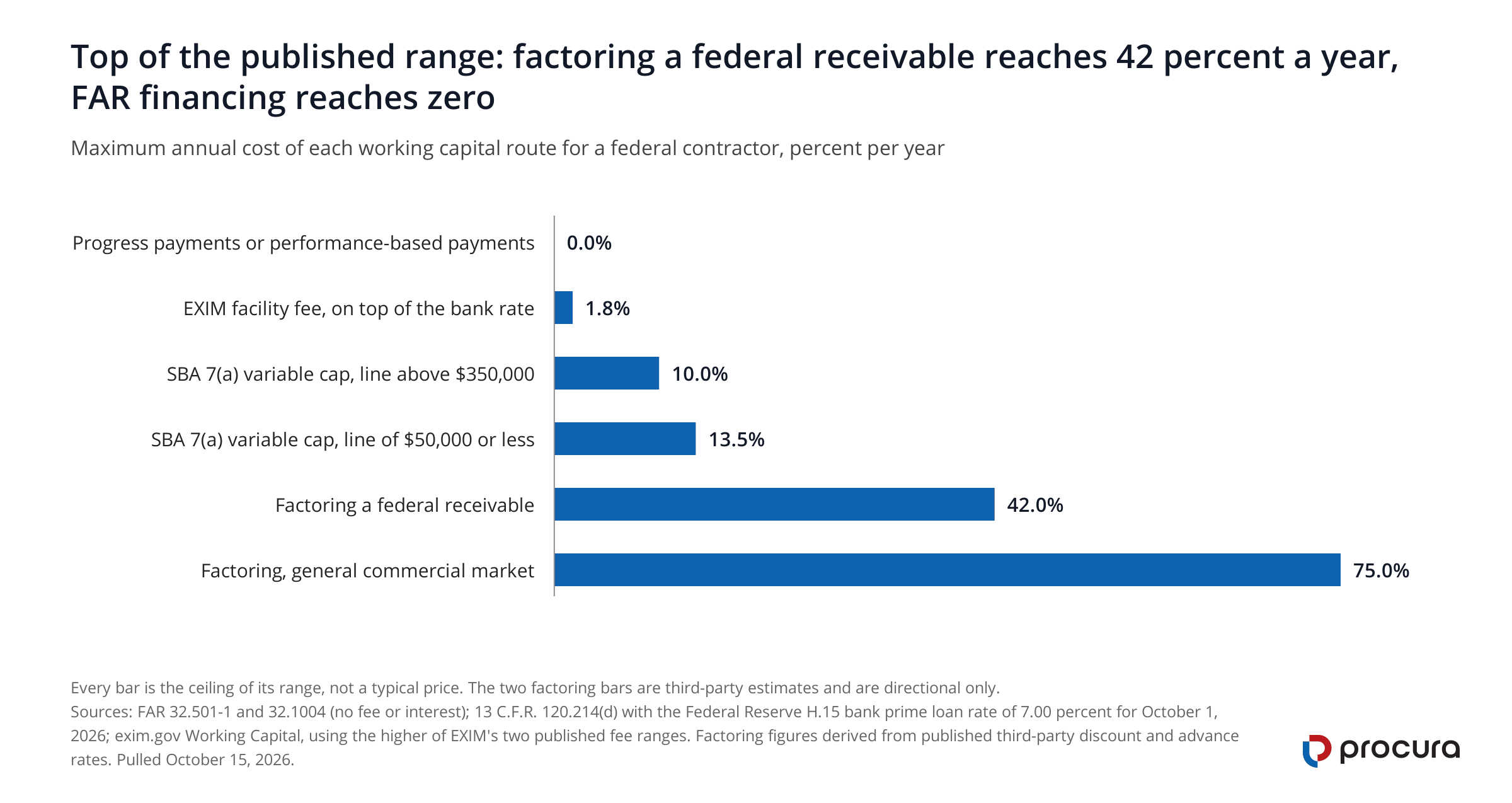
Convert the discount rate to an annual cost and the number changes character. Divide the discount rate by the advance rate, then multiply by 12. A 1 percent discount at a 97 percent advance works out near 12 percent a year. A 3 percent discount at an 85 percent advance works out near 42 percent. The same arithmetic on general-market terms reaches about 75 percent. That calculation is mine, applied to the published third-party ranges above.
Hidden fees in factoring agreements
Those annual figures are still understated, because they count the discount rate alone. Published fee schedules add a long tail of charges:
- Lockbox fees of $50 to $1,000 a month
- Origination charges of zero to 3 percent of the credit line
- Monthly access fees up to $300
- Wire fees of $15 to $30 and ACH fees of $5 to $30 per transaction
- Credit-check fees of $35 to $100 per debtor
- Same-day funding at about 1 percent
- Float of three to five days before a payment is credited, which can push an invoice into a more expensive aging tier.
Two clauses matter more than the rate card. The two of them punish the way federal work actually arrives. A minimum volume commitment sets a floor on invoice dollars you must sell each month. One factoring broker documents a shortfall charge of $160,000 against a client who missed that floor.
An early-termination fee can run 10 percent of the facility. That same broker records one such fee as $100,000 on a $1 million line. Federal award timing is lumpy and outside your control. A floor set against a good quarter thus becomes a penalty in a slow one.
Factoring does buy one thing the government cannot sell you. It works on awards under $350,000, and that is where most federal work lives.
Why will the government finance your contract for free?
Government contract financing exists because the government would rather fund your working capital than lose your bid. FAR Part 32 is where it lives, and FAR 32.106 ranks the options. Private financing without a government guarantee comes first. Customary contract financing comes next, then loan guarantees, then unusual financing, with advance payments last. Four methods sit inside that order, and three of them cost a contractor nothing.
Progress payments based on costs
Progress payments based on costs are the familiar method. FAR 32.501-1 sets the customary rate at 80 percent of total costs of performing the contract. For contracts with small business concerns the rate is 85 percent. The clause is FAR 52.232-16. FAR 32.502-4(b) directs the contracting officer to use it with Alternate I for a small business.
Recovery works through liquidation. FAR 32.503-8 makes the liquidation rate equal to the progress payment rate at the start of a contract. At 85 percent the government recovers 85 cents of every delivery dollar against the outstanding balance.
Performance-based payments and other methods
Performance-based payments are the method the FAR actually prefers. FAR 32.1001(a) calls them the preferred government financing method, when the contracting officer finds them practical and the contractor agrees. They pay on events or measurable results instead of incurred cost. That can remove the accounting-system review which progress payments trigger under FAR 32.503-3. FAR 32.1004(b)(2)(ii) caps them at 90 percent of the contract price. A contract gets progress payments or performance-based payments, never both, per FAR 32.113(d) and (e).
Two other methods are narrower. Commercial product and commercial service financing under FAR 32.202-1 allows commercial advance payments. FAR 32.202-1(b)(6) caps those advances at 15 percent of the contract price before any work starts. FAR 32.202-1(b)(5) also requires adequate security. Read FAR 32.202-4(b)(1) before you pledge the same assets twice. A government lien taken as that security ranks ahead of every other lien. It takes effect immediately on the first payment, without filing or notice.
Advance payments under FAR Subpart 32.4 are the least preferred method of all. An agency authorizes them sparingly, only on written findings, and they normally carry interest. FAR 32.407(d) lets an agency head waive that interest for four classes of contract.
Financing methods compared
| Method | What it pays | Ceiling | Cost to you | Main gate | Citation |
|---|---|---|---|---|---|
| Progress payments based on costs | A percentage of costs incurred, before delivery | 85% of cost for a small business, 80% otherwise | No fee, no interest | Contract price must exceed $350,000 for a small business | FAR 32.501-1, 32.104(d)(3) |
| Performance-based payments | A set amount on each defined event or measured result | 90% of the contract price | No fee, no interest | Fixed-price work, both parties must agree, and the same FAR 32.104(d) price floor applies | FAR 32.1001, 32.1004(b)(2)(ii), 32.104(d) |
| Commercial interim and advance payments | Interim payments, plus cash before performance | Advances capped at 15% of the contract price | No fee, no interest, but adequate security is required | Price must exceed $350,000 and financing must be commercial market practice | FAR 32.202-1(b)(2) and (b)(6), 32.202-4 |
| Advance payments | Cash before performance on non-commercial work | Cannot exceed the unpaid contract price | Interest is normally charged, with four exceptions at FAR 32.407(d) | Written agency findings, and the least preferred method | FAR 32.402, 32.407 |
Three rules around the edges decide more cases than the methods do. FAR 32.105(a) limits these methods to working capital rather than to buildings or fixed assets, with a narrow loan-guarantee exception. Unless agency regulations permit otherwise, FAR 32.003 bars contract financing on purchases made under FAR Part 13, which is simplified acquisition. Best of all, FAR 32.107(a) tells the contracting officer not to treat a financing need as a responsibility factor. Asking thus does not cost you the award.
Does your award even qualify for progress payments?
The gate is at FAR 32.104(d), not in the progress payments subpart. Two tests must both pass, and the first one offers two routes through it. Either you cannot bill for a first delivery for a substantial time after work must begin. That route also requires predelivery spending which hits your working capital hard. Or, under FAR 32.104(d)(1)(ii), you show actual financial need or the unavailability of private financing. The billing gap is normally four months or more for a small business concern, and six months or more for everyone else. FAR 32.104(d)(2) and (d)(3) then set a price floor.
That price floor is where small business status pays. A contractor that is not a small business needs an individual contract price of $3.5 million or more. A small business concern needs only a price that exceeds the simplified acquisition threshold. FAR 2.101 puts that threshold at $350,000. The gate sits ten times lower for a small firm. FAR 32.104(b) goes further and tells the contracting officer to give special attention to a small business contractor’s financing need.
How many awards clear the price floor
Measured against real awards, that ten-fold advantage still leaves most work outside the system. Federal agencies made 167,461 contract awards under a total small business set-aside in FY2025. Those awards carried $32.81 billion in obligations. Sorted against the FAR thresholds, the count and the money point in opposite directions.
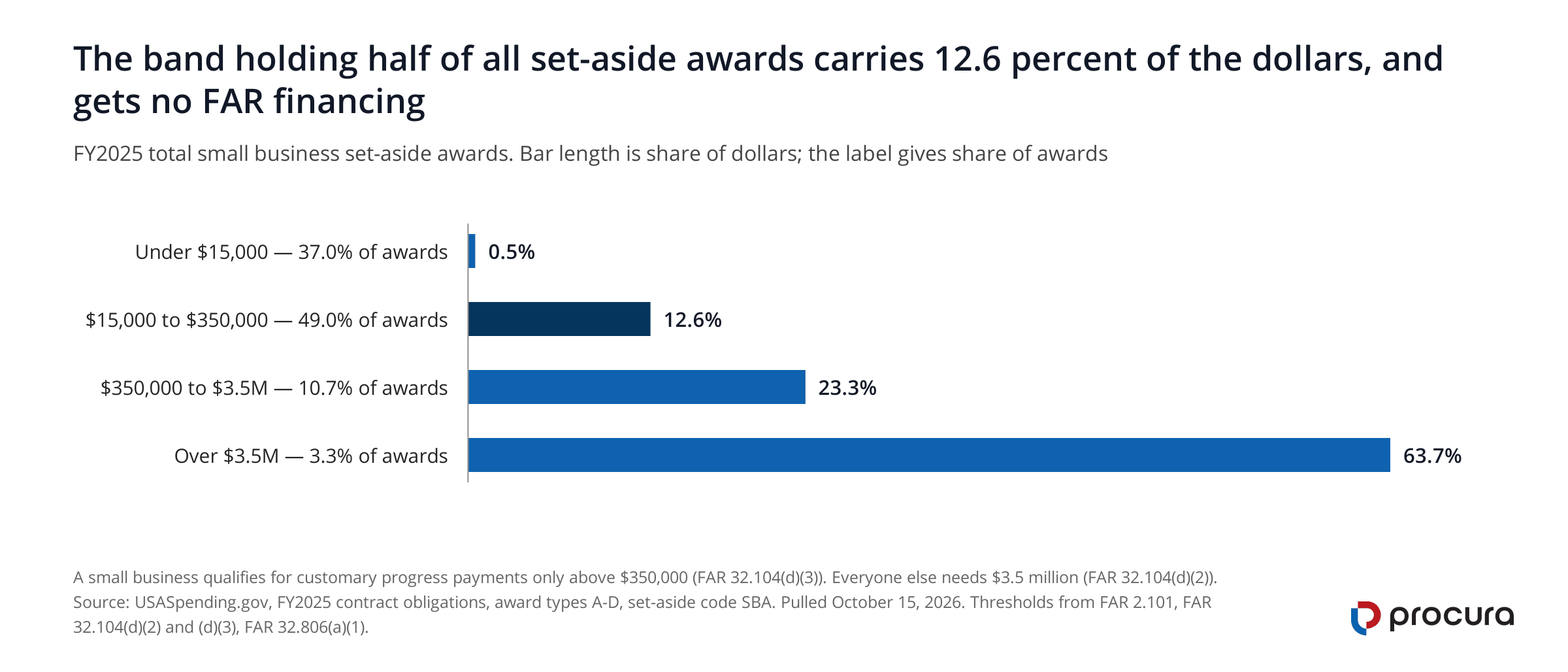
Data table: FY2025 small business set-aside awards by size band
| Award size band | Awards | Share of awards | Obligations | Share of dollars | What financing is available |
|---|---|---|---|---|---|
| Under $15,000 | 61,957 | 37.0% | $151.6M | 0.5% | No FAR financing. Below the micro-purchase threshold, so FAR 52.232-23 is not even inserted |
| $15,000 to $350,000 | 82,029 | 49.0% | $4,118.7M | 12.6% | No FAR financing. FAR 52.232-23 is inserted above $15,000, but it is not required in purchase orders, so read your award |
| $350,000 to $3.5M | 17,981 | 10.7% | $7,630.7M | 23.3% | A small business qualifies for progress payments. Below $3.5 million a large business does not |
| Over $3.5M | 5,494 | 3.3% | $20,906.3M | 63.7% | Every contractor qualifies, small or not |
Read the two middle rows as your real market. In the $15,000 to $350,000 band no contracting officer can give you progress payments. FAR 32.003 also blocks financing on the simplified-acquisition buys inside that band, unless agency regulations permit otherwise. Private money is your only money there. Above $350,000, ask for progress payments or performance-based payments before you sign a factoring agreement. Those 23,475 awards hold 87.0 percent of the dollars.

Why can you not just hand a federal invoice to any factor?
Factoring a federal receivable is legally different from factoring a commercial one. The difference starts with a prohibition. Under 41 U.S.C. 6305(a) a contractor cannot transfer a federal contract or order to another party. Nor can it transfer an interest in one.
A transfer that violates the subsection annuls the contract so far as the government is concerned. The Assignment of Claims Act is the exception which makes federal factoring possible at all.
The exception is narrow about who can receive the money. 41 U.S.C. 6305(b)(1) permits assignment to a bank, trust company, federal lending agency, or other financing institution. FAR 32.802(b) repeats the restriction.
Five conditions for a valid assignment
You cannot assign a federal receivable to whichever funder offers first. Neither the statute nor the FAR defines the term other financing institution. In practice the test is whether the contracting officer accepts the notice of assignment. FAR 32.805(d)(4) adds a second condition which catches contractors. The assignee must be registered separately in SAM, unless an exception in FAR 4.1102 applies.
Five conditions in FAR 32.802 must all hold before an assignment works:
- The contract specifies payments of $1,000 or more
- The assignee is a bank, trust company, or other financing institution, including any federal lending agency
- The contract does not prohibit assignment
- The assignment covers all unpaid amounts, goes to only one party, and is not subject to further assignment, unless the contract expressly permits otherwise
- The assignee sends written notice and a true copy of the assignment to the contracting officer or agency head, the surety on any bond, and the designated disbursing officer.
Read the clause list in your contract first. FAR 32.806(a)(1) inserts FAR 52.232-23, Assignment of Claims, in solicitations expected to exceed the micro-purchase threshold of $15,000. That trigger sits far below the simplified acquisition threshold. But FAR 32.803(b) lets an agency prohibit assignment when it determines the prohibition is in the government’s interest. FAR 32.806(b) then inserts FAR 52.232-24 instead. One clause makes factoring possible and the other forecloses it. Where FAR 52.232-23 is in the contract, FAR 32.803(a) also lets your funder further assign or reassign to another qualifying financing institution.
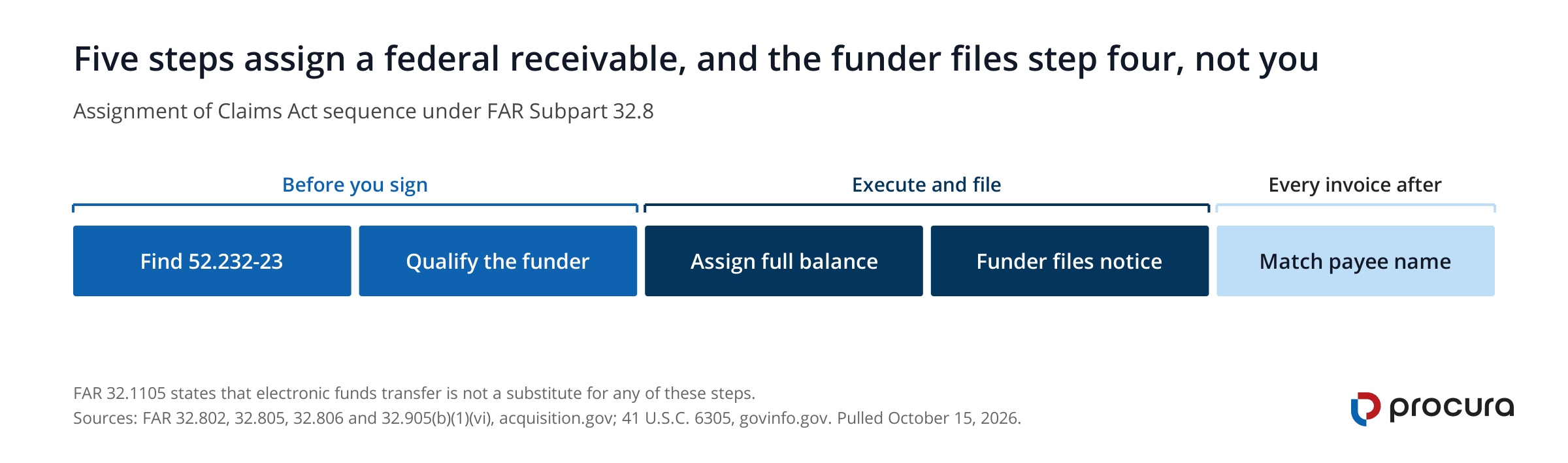
Setoff and the details lenders check
Two mechanical details decide whether the paperwork holds. FAR 32.805(b) requires the assignee to send each party an original and three copies of the notice. One certified duplicate or photostat copy of the assignment instrument goes with them.
FAR 32.1105 then closes the obvious shortcut. Electronic funds transfer is not a substitute for a proper assignment. EFT data which routes payment to somebody other than the contractor, with no assignment behind it, counts as incorrect EFT information. That suspends payment.
The risk a lender prices is setoff, and you must understand it before you negotiate a rate. FAR 32.803(e) lets the government apply a liability you owe it against payments to the assignee. The liability can arise independently of the assigned contract. It counts if it existed when the notice of assignment arrived, even if it had not yet matured.
A no-setoff commitment removes most of that exposure under FAR 32.804(b). But FAR 32.803(d) makes one available only on an agency-head determination published in the Federal Register. Assume you do not have one.
When does the government actually have to pay you?
Before you buy money, price the wait. The federal payment clock is shorter than most contractors assume. FAR 32.904(b)(1) sets the invoice due date at the later of two dates. One is the 30th day after the designated billing office receives a proper invoice. The other is the 30th day after the government accepts the supplies or services. For the purpose of computing interest, acceptance happens constructively on the 7th day after delivery, under FAR 32.904(b)(1)(ii)(B)(1).
Late payment carries automatic interest. FAR 32.907(a) directs the payment office to pay an interest penalty with no request from you. Treasury sets the rate every six months.
For July 1 through December 31, 2026 it is 4.75 percent, published at 91 FR 42594. It was 4.125 percent for the first half of 2026. The rate resets on January 1, 2027. Check the Treasury rates page rather than this sentence.
Faster payment for small businesses
Small business status buys a faster clock here too. FAR 32.009-1(a)(1) requires agencies other than the Department of Defense to accelerate payments to small business contractors. The duty runs to the fullest extent permitted by law, with a goal of 15 days. FAR 32.009-1(a)(2) applies the same rule to Defense under 10 U.S.C. 3801(b).
Congress added the authority in the FY2020 National Defense Authorization Act at 31 U.S.C. 3903(a)(10) and (a)(11). One limit matters. FAR 32.009-1(b) states that the acceleration creates no new rights under the Prompt Payment Act. A missed 15-day goal thus triggers no interest.
If you work as a federal subcontractor, FAR 52.232-40 is in your prime’s contract. FAR 32.009-2 inserts it in all solicitations and contracts, with no dollar threshold and no exceptions. The clause requires the prime to pay its small business subcontractors within 15 days after the prime receives an accelerated payment. That duty runs to the maximum extent practicable, with no fees charged to the subcontractor. Read the condition closely. No accelerated payment to the prime means no 15-day obligation to you.
Federal payment deadlines at a glance
| Payment situation | Due date | Citation |
|---|---|---|
| Standard invoice payment, no date in the contract | The later of the 30th day after a proper invoice is received or the 30th day after acceptance | FAR 32.904(b)(1) |
| Small business contractor, accelerated | A 15-day goal, to the fullest extent permitted by law. No interest penalty attaches | FAR 32.009-1(a), 31 U.S.C. 3903(a)(10) |
| Construction progress payment on an approved estimate | 14 days after the billing office receives a proper payment request | FAR 32.904(d)(1)(i) |
| Billing office failed to stamp the receipt date | The 30th day after the date on your invoice | FAR 32.904(b)(3) |
| Defective invoice returned to you | Within 7 days of receipt, or the due date is adjusted in your favor | FAR 32.905(b)(3) |
| Progress payments and performance-based payments | No Prompt Payment due date and no interest penalty. These are contract financing payments | FAR 32.901(b), 32.1001(d) |
Two habits recover more cash than a financing product does. Date every invoice on the day you transmit it. FAR 32.904(b)(3) starts the clock from your invoice date when the billing office fails to stamp its own receipt date. Then match the payee name and address to the contract or to a proper notice of assignment. FAR 32.905(b)(1)(vi) requires that match for the invoice to count as proper at all. A mismatch there resets the 30 days.
Interest you can claim
One more lever is worth knowing when a payment goes quiet. FAR 32.907(c)(1) adds a penalty on top of the interest. Three conditions must hold. The payment office owes you an interest penalty of $1 or more. It fails to pay that penalty within 10 days. You send a written demand postmarked within 40 days of payment.
Under 5 CFR 1315.11 the additional penalty equals 100 percent of the original interest penalty, with a floor of $25 and a ceiling of $5,000. FAR 32.909(b) also points small business concerns at the agency Office of Small and Disadvantaged Business Utilization.
How do SBA-backed loans compare with factoring government contracts?
Between free government contract financing and private factoring sits a middle tier of government-guaranteed credit. The SBA 7(a) Contract CAPLine is the product built for this problem. SBA describes it as a line which finances the costs of one or more specific contracts. Overhead and general and administrative expenses allocable to those contracts are eligible too.
The line revolves, or it does not, at the lender’s option. Maximum maturity is 10 years. 13 C.F.R. 120.151 caps a 7(a) loan at $5 million. It also caps total SBA guaranty exposure to one borrower and its affiliates at $3.75 million.
Rate caps on SBA loans
Regulation caps the pricing, and that is the real difference from factoring government contracts through a private funder. 13 C.F.R. 120.214(d) sets the variable-rate spread over the base rate. It is 3.00 points for loans above $350,000 and rises to 6.50 points for loans of $50,000 or less.
The bank prime loan rate was 7.00 percent on October 1, 2026, per the Federal Reserve H.15 release. At that prime the ceiling on a line above $350,000 is 10.00 percent. Maximum fixed rates are published too, and ran from 12.00 to 15.00 percent effective October 1, 2026.
SBA guarantee fees
The fees are published as well, so model them before you apply. SBA Information Notice 5000-881797 sets the FY2027 upfront guaranty fee on the guaranteed portion of the loan. It is 2 percent for loans of $150,000 or less and 3 percent from $150,001 to $700,000. Above $700,000 it is 3.5 percent of the guaranteed portion up to $1 million, plus 3.75 percent of the guaranteed portion above $1 million. Maturities of 12 months or less pay 0.25 percent. The lender pays an annual service fee of 0.55 percent and cannot pass it to you.
One carve-out zeroes that fee, and it covers a lot of this audience. In FY2027 a loan of $700,000 or less pays no upfront fee at all, if the borrower sits in one of three categories. Those are a manufacturer in NAICS sectors 31 through 33, a food supply chain business, and a business in a rural area.
Work one example through. Take a $500,000 Contract CAPLine at the 75 percent guaranty rate in 13 C.F.R. 120.210, for a borrower outside those three categories. The 3 percent fee lands on a $375,000 guaranteed portion and comes to $11,250.
Options for exporters
Exporters have two more doors to try. The SBA Export Working Capital Program runs to $5 million with a 90 percent guaranty, capped at $4.5 million, under 13 C.F.R. 120.340. Read 13 C.F.R. 120.344 before you sign. SBA does not cap the interest rate or the extraordinary servicing fee on that product.
EXIM Bank is the second door. It guarantees 90 percent of a working capital loan, including principal and interest, and advances up to 90 percent against export receivables. EXIM charges a facility fee. Its published guides state that fee as low as 0.25 percent and as high as 1.75 percent, plus a $100 processing fee.
Bonding and surety guarantees
Bonding capacity is the adjacent constraint, and SBA guarantees that too. Under 13 C.F.R. 115.12(e)(3) the Surety Bond Guarantee Program reaches contracts up to $9 million. That ceiling rises to $14 million where a contracting officer certifies in writing that the SBA guarantee is necessary.
The guarantee covers 80 percent of the loss. It rises to 90 percent when the contract is $100,000 or less, or when the firm is 8(a), HUBZone, or veteran-owned. The fee is 0.6 percent of the contract amount, and bid bonds are free. If bid and performance bonds block your bid, that program moves first.
Government contract factoring vs. other financing routes
| Route | What it costs | Ceiling | Gate | Source type |
|---|---|---|---|---|
| Progress payments or performance-based payments | Nothing. No fee and no interest | 85% of cost, or 90% of price | Contract price must exceed $350,000 for a small business. Not available on FAR Part 13 buys unless agency regulations permit | FAR 32.501-1, 32.1004, 32.104(d)(3), 32.003 |
| SBA 7(a) Contract CAPLine | Prime plus 3.00 to 6.50 points, so 10.00% to 13.50% at a 7.00% prime, plus an upfront guaranty fee of 2% to 3.75%, or zero at $700,000 or less for manufacturers, food supply chain and rural borrowers | $5 million | Bank credit underwriting, and the contract must support an assignment | 13 C.F.R. 120.151, 120.210, 120.214(d); SBA Notice 5000-881797 |
| SBA Export Working Capital Program | Rate not capped by SBA. Servicing fees not capped either | $5 million, 90% guaranty capped at $4.5 million | Export transactions, one year in business, 100% collateral | 13 C.F.R. 120.340 to 120.344 |
| EXIM working capital guarantee | A facility fee EXIM publishes as 0.25% to 1.75%, depending on the guide, plus the bank rate and a $100 processing fee | No stated facility ceiling | Export content of at least 10%, fully collateralized | exim.gov Working Capital |
| Private invoice factoring | Roughly 12% to 42% a year on government paper, plus lockbox, wire, origination, minimum-volume and termination fees | Set by the factor | An assignable contract, and an assignee that qualifies as a financing institution | Third-party estimates. No government source publishes factoring pricing |
Which financing route fits your contract?
Financing government contracts works best in cost order, because the cheapest options also take the longest to arrange. Ask the contracting officer about performance-based payments or progress payments during negotiation, not after award. Under FAR 32.107(b), a failure to raise the need before award is not by itself a reason to disqualify you. While you are still bidding, apply for a Contract CAPLine. Bank underwriting outlasts most performance periods. Treat factoring as the answer in the $15,000 to $350,000 band, where the FAR gives you nothing.
Three traps catch contractors who move in the wrong order. A factoring agreement with a blanket lien can disqualify you from the SBA line you wanted next. Commercial financing under FAR 32.202-1 requires adequate security. Where that security is a lien, it outranks a later lender. A minimum volume commitment signed before you know your award timing converts a cash-flow fix into a fixed cost.
Your contract type decides more than your balance sheet does. Fixed-price work above the threshold points at performance-based payments. Interim payments on cost-reimbursement service work are due 30 days after a proper invoice, under FAR 32.904(e). That work thus rarely needs financing. Federal construction work runs on 14-day progress payments against approved estimates. Trucking and freight contracts sit almost entirely in the sub-$350,000 band. That is why factoring is standard in that market and not in others.
What do you need before you can finance anything?
The prerequisites are short and almost all free. Do these five things in order:
- Complete your SAM.gov registration and get a UEI and a CAGE code
- Check every solicitation for FAR 52.232-23 and for its opposite, FAR 52.232-24
- Build an accounting system that survives a government review, because FAR 32.503-3 gates progress payments on one
- Write a one-page capability statement that states your bonding capacity and your working capital
- Ask about financing terms in negotiation, before award.
None of that is the hard part. The hard part is step two. Three facts decide your financing, and all three sit in the attachments rather than the opportunity description. The three are the assignment clause the contract carries, the price, and whether the contracting officer already wrote progress payments into the solicitation. Across 167,461 set-aside awards a year, a small firm reads those attachments by hand, loses a week, and still signs the expensive financing.
That is the problem Procura was built for. It reads every solicitation and every attachment, then scores the opportunity against your capability statement. Payment terms, the assignment clause and the rest of the compliance requirements come flagged. Procura costs $399/month. The legacy market-intelligence platforms charge five figures a year. The easiest federal contracts to win are often the ones nobody read closely enough to price.
Explore the data yourself. If you’re weighing financing against a specific buyer, look at that buyer first. Procura’s free agency pages show prime obligations by office and by week of the fiscal year, and contractor profiles show a company’s buyers, current contracts and end dates. It’s all free to browse; create a free account to save your research and export the tables.
Frequently asked questions
Can you factor a government contract invoice?
Yes, through the Assignment of Claims Act, and only on those terms. Your contract must promise at least $1,000, must not forbid assignment, and must carry FAR 52.232-23 rather than FAR 52.232-24. Your funder must be a bank or another qualifying financing institution, and must hold its own SAM registration. Only one funder can take the receivable, and it takes the whole unpaid balance. That funder files the notice, not you.
How much does government contract factoring cost?
Published third-party figures put the discount at 1 to 3 percent of invoice value per 30 days on federal receivables. Factors advance 85 to 97 percent. That works out near 12 to 42 percent a year before fees. Lockbox charges, wire fees, origination costs, minimum volume commitments and termination fees all add to it. None of them appears in a quoted discount rate.
What is the minimum contract size for progress payments?
For a small business concern the contract price must exceed the simplified acquisition threshold of $350,000, under FAR 32.104(d)(3). Every other contractor needs $3.5 million, under FAR 32.104(d)(2). You must also pass FAR 32.104(d)(1), which offers two routes. Either a first billable delivery sits months away and predelivery spending strains your working capital. Or you show actual financial need, or that private financing is not available. For a small business the billing gap is normally four months.
Does the government pay interest when it pays late?
Yes, automatically, with no request from you. The Treasury rate is 4.75 percent for July 1 through December 31, 2026, and it resets every six months. Interest runs from the day after the due date until payment. Under 5 CFR 1315.10 accrual stops after one year, and it stops when you file a Contract Disputes Act claim for the penalty. Progress payments and performance-based payments are the exception, because FAR 32.901(b) puts contract financing payments outside the Prompt Payment Act.
Can a factoring agreement block an SBA loan later?
It can, and the order you borrow in matters. Many factoring agreements take a lien on all assets, which leaves nothing for a lender that needs collateral. A government lien under FAR 32.202-4(b)(1) is worse for a later lender. It ranks ahead of every other lien and takes effect on the first payment, with no filing at all. Map your collateral before you sign the first agreement.
Do I get paid faster because I am a small business?
You are supposed to. FAR 32.009-1 sets a 15-day accelerated goal for small business contractors, against the standard 30 days. But FAR 32.009-1(b) withholds any new Prompt Payment Act right from that goal. No interest penalty thus attaches when an agency misses 15 days. The enforceable clock is still the 30-day one.
Book a demo
Bring a solicitation you must still find the money for. On the call we will pull the financing and assignment clauses out of its attachments. You can then judge the score against what you found by hand.