An IDIQ contract is an indefinite-quantity contract under FAR 16.504. Specifically, it obliges the government to order a stated minimum and caps what it can order at a stated maximum. Until an agency places an order against it, the contract buys nothing.
In FY2025 the orders placed against vehicles like that one carried $457.8 billion. In other words, that is 58.8 percent of every dollar federal agencies obligated on contracts, per USASpending.gov.
Most contractors meet that fact backward. They find a good opportunity, read it twice, and then learn that only the companies already holding the vehicle can bid on it.
I run a small veteran-owned engineering firm and I read federal solicitations every week. However, the split is easy to state and expensive to learn late. Agencies awarded 76,027 definitive contracts in FY2025, and a newcomer can bid those cold. They issued 4,211,444 delivery orders, and a newcomer cannot.
What does IDIQ stand for, and what is an IDIQ contract?
IDIQ stands for indefinite delivery, indefinite quantity. Specifically, the term names one of three contract types that FAR 16.501-2(a) groups together as indefinite-delivery contracts. The other two are definite-quantity contracts and requirements contracts.
That same section records the names contractors actually hear. Under 10 U.S.C. 3401 and 41 U.S.C. 4101, requirements contracts and indefinite-quantity contracts are also known as delivery-order contracts or task-order contracts. An IDIQ contract, a task order contract and a delivery order contract are thus the same animal under different labels.
The minimum and maximum in an IDIQ contract
One sentence in FAR 16.504(a)(1) separates an IDIQ contract from every softer arrangement in federal buying. The contract “must require the Government to order and the contractor to furnish at least a stated minimum quantity of supplies or services.” FAR 16.504(a)(2) then explains why that floor exists. The minimum “must be more than a nominal quantity” so that the contract is binding.
Read the two halves of the range differently, because the FAR treats them differently. In short, the minimum is an obligation the government takes on. The maximum is only a ceiling, and FAR 16.504(a)(1) tells the contracting officer to set it “based on market research, trends on recent contracts for similar supplies or services, survey of potential users, or any other rational basis.”
That asymmetry is the single most misread feature of an IDIQ contract. However, a $50 billion ceiling is a statement about how much work the vehicle can absorb. It is not a statement about how much work exists. FAR 16.501-2(b)(3) is blunt about the floor: indefinite-quantity contracts “limit the Government’s obligation to the minimum quantity specified in the contract.”
Indefinite-delivery contract types compared
| Type | What the government commits to | How work arrives | Citation |
|---|---|---|---|
| Definite-quantity | A definite quantity of specific supplies or services, for a fixed period | Deliveries scheduled at designated locations upon order | FAR 16.502(a) |
| Requirements | All actual purchase requirements of designated government activities, from one contractor | Orders for whatever those activities actually need | FAR 16.503(a) |
| Indefinite-quantity (IDIQ) | An indefinite quantity within stated limits, floored at a minimum that must exceed a nominal quantity | Task orders or delivery orders, competed among awardees | FAR 16.504(a) |
How much federal money actually moves through contract vehicles?
Federal agencies obligated $778.6 billion across 5,783,237 contract awards in FY2025. Then sort those by how the money reached the contractor and the market splits in two.
Delivery orders alone carried $434.4 billion, or 55.8 percent of the total. Blanket purchase agreement calls moved another $23.4 billion, so orders against an existing vehicle account for $457.8 billion together. Definitive contracts, the standalone awards a new bidder can chase, carried $302.4 billion. Purchase orders carried $18.4 billion.
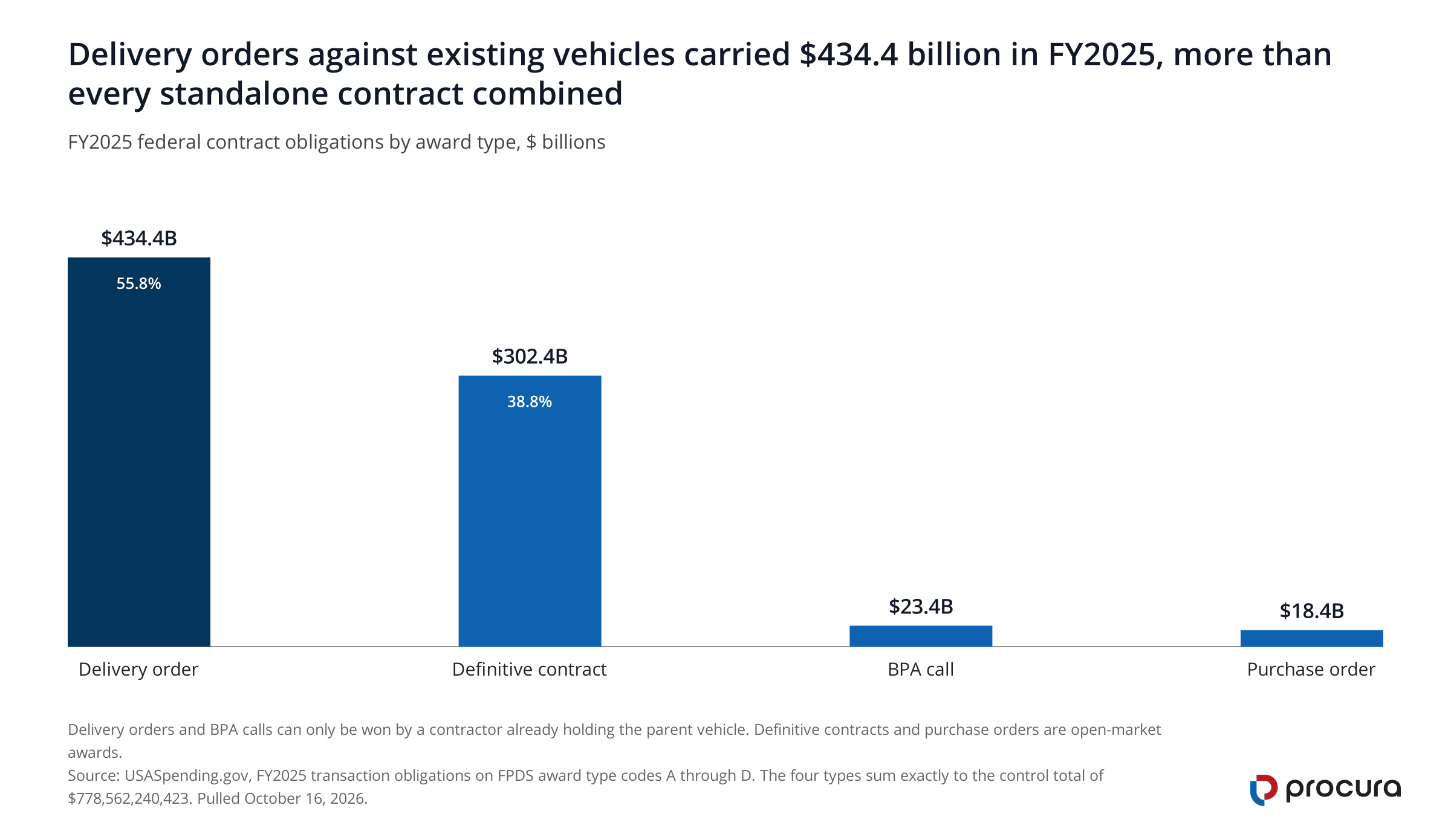
Data table: FY2025 federal contract obligations by award type
| Award type | Awards | Obligations | Share of dollars | Can a newcomer bid it? |
|---|---|---|---|---|
| Delivery order (C) | 4,211,444 | $434.38B | 55.8% | No. Only awardees on the parent vehicle compete |
| Definitive contract (D) | 76,027 | $302.41B | 38.8% | Yes. This is the open-market channel |
| BPA call (A) | 781,730 | $23.41B | 3.0% | No. Only BPA holders are solicited |
| Purchase order (B) | 714,036 | $18.36B | 2.4% | Yes. Mostly simplified acquisition buys |
| All contracts | 5,783,237 | $778.56B | 100.0% | — |
The vehicle share is still rising
Count transactions instead of dollars and the imbalance gets worse. Similarly, orders against vehicles made up 4,993,174 of the 5,783,237 awards, or 86.3 percent. A contractor with no vehicle is shut out of six federal purchases in every seven.
The share also rose for four straight years before slipping in FY2025. Meanwhile, in FY2021 orders against vehicles carried 53.2 percent of contract dollars. The figure peaked at 60.7 percent in FY2024 and settled at 58.8 percent a year later.
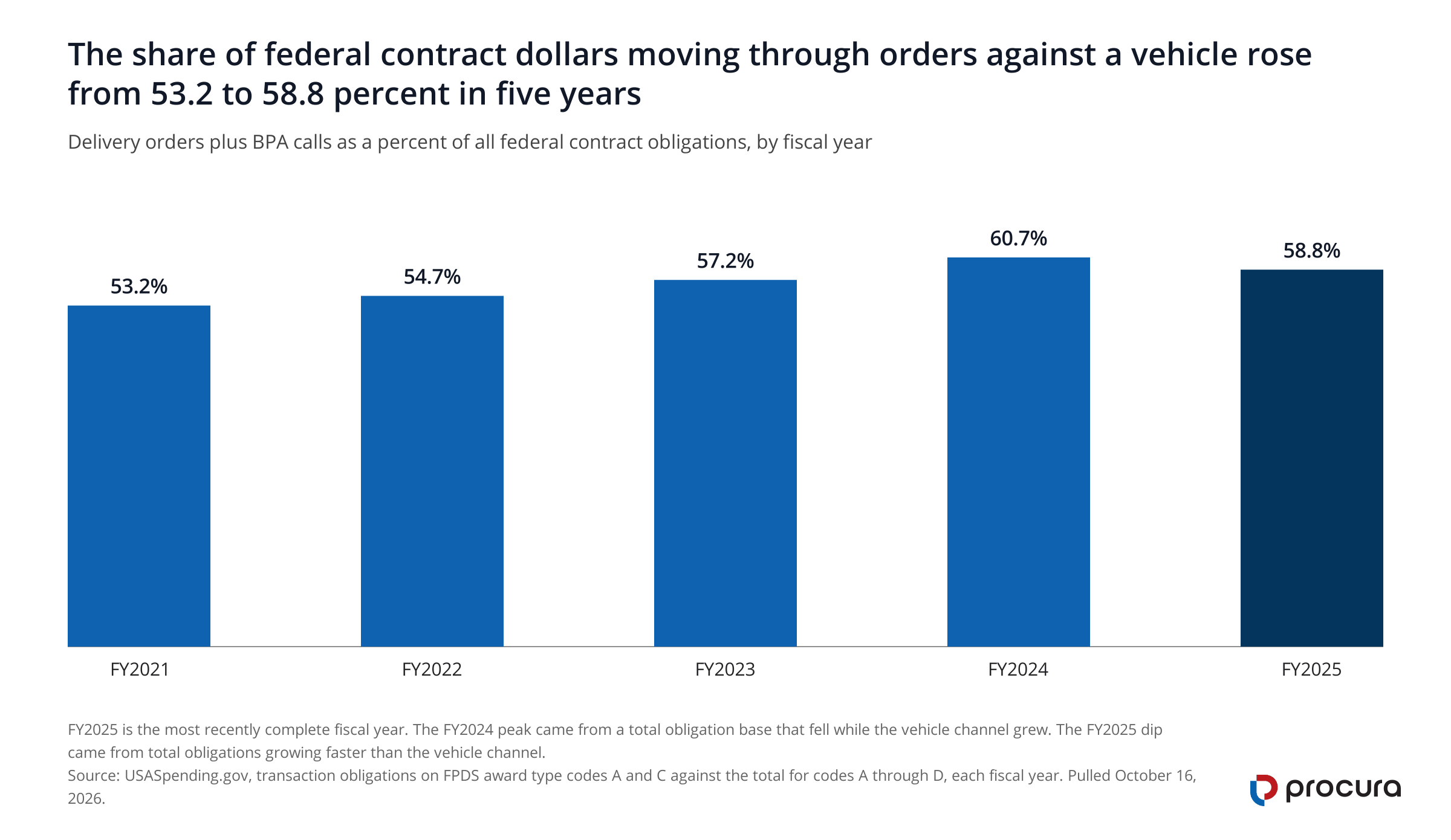
Data table: vehicle-order share of federal contract obligations, FY2021 to FY2025
| Fiscal year | All contract obligations | Orders against a vehicle | Vehicle share |
|---|---|---|---|
| FY2021 | $633.18B | $336.92B | 53.2% |
| FY2022 | $680.56B | $371.96B | 54.7% |
| FY2023 | $746.50B | $427.07B | 57.2% |
| FY2024 | $740.57B | $449.48B | 60.7% |
| FY2025 | $778.56B | $457.79B | 58.8% |
Do small businesses do better or worse on contract vehicles?
Better, and by a wide margin. In fact, this is the finding that changes how a small firm spends its capture budget.
Small business recipients took $113.1 billion of the $434.4 billion that moved through delivery orders in FY2025. In other words, that is 26.0 percent of the channel. On definitive contracts they took $41.8 billion of $302.4 billion, or 13.8 percent.
So the open-market channel a newcomer can actually bid is the channel where small firms win the smallest share. Small businesses earned 2.7 times more money through delivery orders than through standalone contracts.
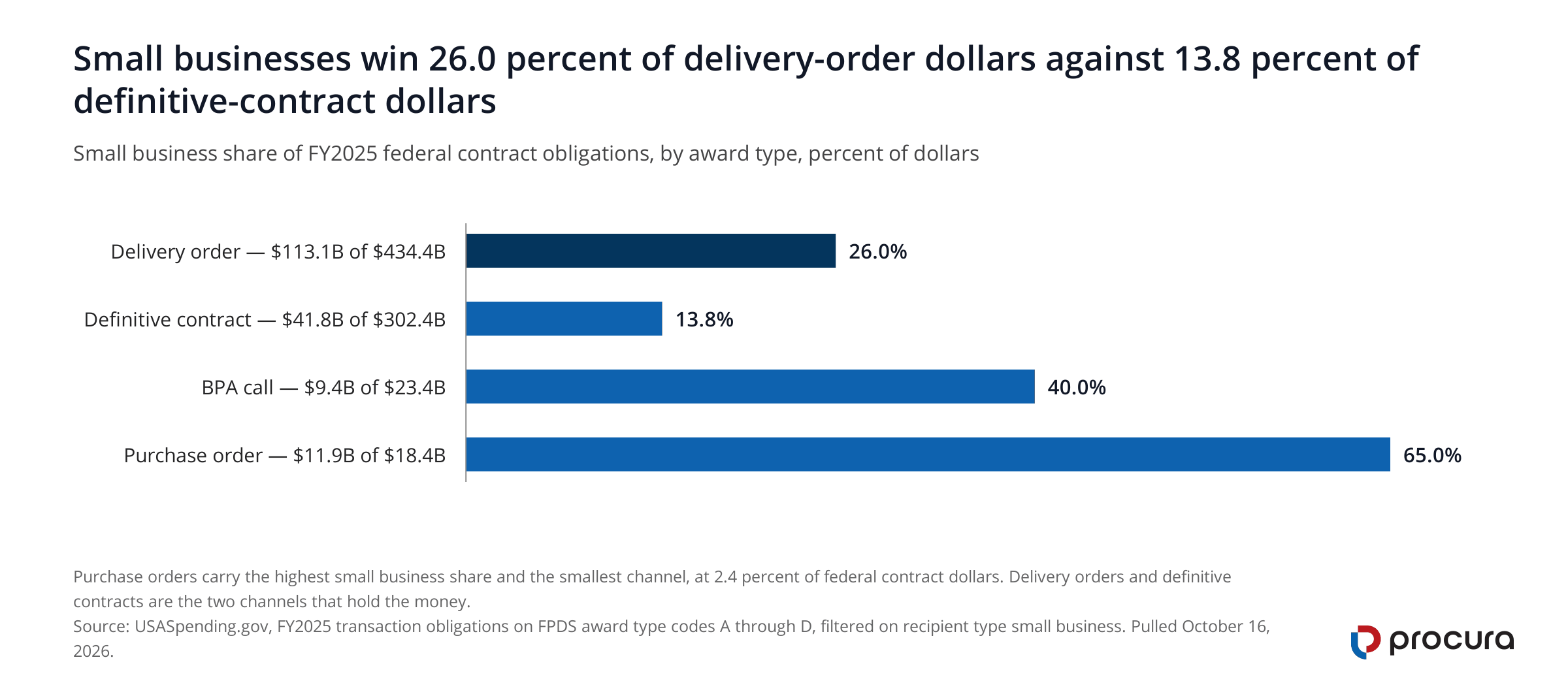
Data table: FY2025 small business share by award type
| Award type | All obligations | Won by small business | Small business share |
|---|---|---|---|
| Delivery order | $434.38B | $113.05B | 26.0% |
| Definitive contract | $302.41B | $41.81B | 13.8% |
| BPA call | $23.41B | $9.36B | 40.0% |
| Purchase order | $18.36B | $11.94B | 65.0% |
Purchase orders are the outlier at 65.0 percent, and the reason is size rather than preference. However, that channel is mostly simplified acquisition work below $350,000, and it carries 2.4 percent of federal contract dollars. Small firms dominate the small money.
Set-aside dollars tell the same story from the other direction. Also, agencies obligated $32.81 billion under a total small business set-aside in FY2025, across 167,475 awards. Only 46.2 percent of those dollars moved as orders against a vehicle, against 58.8 percent government-wide. Set-asides still lean on the standalone award, while the money as a whole has moved the other way.
What are the types of federal contract vehicles?
Agencies recorded activity on 121,227 indefinite-delivery vehicles in FY2025. The population is far less exotic than the acronyms suggest. Meanwhile, plain indefinite-quantity contracts account for 67,049 of them, or 55.3 percent. Government-wide acquisition contracts account for 2,409, or 2.0 percent.
| Vehicle | What it is | Who can order from it | FY2025 count | Authority |
|---|---|---|---|---|
| IDIQ (indefinite-quantity) | A contract with a guaranteed minimum and a ceiling, filled by task or delivery orders | The awarding agency, unless the contract says otherwise | 67,049 | FAR 16.504 |
| BPA (blanket purchase agreement) | A charge account for anticipated repetitive needs | The establishing activity | 22,547 | FAR 13.303, FAR 8.405-3 |
| FSS / MAS | A GSA-awarded schedule contract with pre-negotiated terms | Any ordering activity | 17,031 | FAR Subpart 8.4 |
| Requirements contract | All of a designated activity’s actual needs, from one contractor | The designated activities only | 6,456 | FAR 16.503 |
| Definite-quantity contract | A fixed quantity, scheduled by order | The awarding agency | 4,131 | FAR 16.502 |
| GWAC | A task-order or delivery-order contract for information technology, run by an OMB-designated executive agent for government-wide use | Any federal agency | 2,409 | FAR 2.101, 40 U.S.C. 11302(e) |
| BOA (basic ordering agreement) | An agreement on terms, with prices negotiated per order | The establishing activity | 1,500 | FAR 16.703 |
| Indefinite-delivery contract, subtype not coded | An indefinite-delivery vehicle FPDS does not break out further | The awarding agency | 104 | FAR 16.501-2 |
| MAC (multi-agency contract) | A task-order or delivery-order contract for use by more than one agency, with no IT restriction and no executive-agent designation | The participating agencies | No separate FPDS code. MACs appear under the indefinite-delivery codes above | FAR 2.101 and the Economy Act, see FAR 17.502-2. 40 U.S.C. 11314(a)(2) for IT MACs |
What the GWAC definition means
Two words in the GWAC definition do more work than the rest of the sentence. FAR 2.101 defines a GWAC as “a task-order or delivery-order contract for information technology established by one agency for Governmentwide use.” The statute behind it is narrower still. 40 U.S.C. 11302(e) directs the Director of the Office of Management and Budget to designate executive agents “for Government-wide acquisitions of information technology.”
A vehicle that does not buy information technology thus cannot be a GWAC, whatever the trade press calls it. For example, OASIS+ is the case that catches people out. GSA sells professional services through it. So GSA’s own seller pages call those awards “multi-agency contracts (MACs),” and the GSA GWAC page omits OASIS+ entirely. The practical difference is small, because both are IDIQ vehicles ordered against by multiple agencies. Use the right word anyway, because a contracting officer will notice.
IDIQ vs BPA: which one actually owes you anything?
The IDIQ owes you a minimum. The BPA owes you nothing but eligibility to be asked.
That is the whole comparison, and the FAR states both halves plainly. Specifically, under FAR 16.504(a)(1) the government must order at least the stated minimum. FAR 16.504(a)(2) ties that floor to the contract being binding at all. Every BPA must carry the opposite statement. FAR 13.303-3(a)(2) requires it to say that “the Government is obligated only to the extent of authorized purchases actually made under the BPA.”
Be careful with the shorthand that follows from this. Still, people say a BPA is not a contract. The FAR never says that in those words, and an individual BPA call is a binding contract once an agency places it. The defensible claim is the one the regulation makes: a BPA creates no purchase obligation, and an indefinite-quantity contract does.
Where a BPA wins
Where the BPA wins is on the size of a single buy, and the rule here is widely misstated. For example, FAR 13.303-5(b) caps individual purchases under an ordinary BPA at the simplified acquisition threshold, which FAR 2.101 sets at $350,000. Agency regulations can set a higher one. Two carve-outs sit in the same paragraph. BPA calls under subpart 13.5 for commercial products and services are capped at $9 million, or $15 million for the acquisitions described at 13.500(c). And FAR 13.303-5(b)(1) exempts one kind of BPA from both limits. Where a BPA sits against a Federal Supply Schedule contract, the threshold and the $9 million limit “do not apply.” FAR 13.303-2(c)(3) defines that category. A schedule BPA thus has no call-level dollar cap at all.
IDIQ contract vs BPA at a glance
| Instrument | Cap on one order or call | Guaranteed minimum? | Duration rule | Citation |
|---|---|---|---|---|
| IDIQ contract | The contract maximum | Yes. More than a nominal quantity | No government-wide cap, except 5 years for advisory and assistance services. DoD, NASA and the Coast Guard are capped at 5 years plus options to 10 | FAR 16.504(a), 10 U.S.C. 3403(f) |
| Ordinary BPA under FAR 13.303 | $350,000, the simplified acquisition threshold, unless agency regulations set a higher one | No | A stated time period. Reviewed at least annually | FAR 13.303-5(b), 13.303-6(b)(1) |
| Commercial BPA under FAR Subpart 13.5 | $9 million, or $15 million for acquisitions described at 13.500(c) | No | A stated time period | FAR 13.303-5(b)(2) |
| BPA against a Federal Supply Schedule contract | No call-level cap. FAR 13.303-5(b)(1) makes the SAT and the $9 million limit inapplicable, and FAR 8.405-3 sets none | No | Multiple-award BPAs generally 5 years. A single-award BPA is 1 year plus four 1-year options | FAR 13.303-5(b)(1), FAR 8.405-3(d) |
One guardrail in FAR 13.303-5(c) is worth memorizing if you compete for BPA calls. The existence of a BPA “does not justify purchasing from only one source or avoiding small business set-asides.” FAR 13.303-5(d) goes further. However, above the micro-purchase threshold, a contracting officer who holds too few BPAs to get real competition must go find more sources.
Which GWACs are open to new contractors in 2026?
None of them, as of October 2026. In fact, no GSA or NASA GWAC has an open solicitation or an announced on-ramp. The table below is thus a map of where the work sits, not a list of doors you can walk through this quarter.
The number of doors is also falling, and the consolidation is the story of 2026. Executive Order 14240, signed March 20, 2025, directs OMB to designate the GSA Administrator as executive agent for government-wide IT acquisition contracts. It also tells GSA to “rationalize Government-wide indefinite delivery contract vehicles for information technology.”
The first casualty is already dated. A NITAAC notice of June 9, 2026 records that the HHS Senior Procurement Executive decided “all NITAAC GWACs will sunset on October 29, 2026.” That covers CIO-SP3, CIO-SP3 Small Business and CIO-CS. October 29, 2026 is the last day to award a new order against any of them. Orders awarded on or after June 8, 2026 cannot run past December 31, 2028, and HHS ends all NITAAC program functions after that date. GSA now directs those customers to its own schedules and GWACs.
Current GWACs and their status
| GWAC | Run by | Scope | Ceiling | Ordering period | Small business status |
|---|---|---|---|---|---|
| Alliant 3 | GSA | Complex, enterprise-wide IT solutions | No ceiling | March 10, 2026 to March 9, 2031, option to March 9, 2036 | Unrestricted. Subcontracting credit at order level |
| Alliant 2 | GSA | Comprehensive IT solutions, hardware, software and services | $90.75 billion | July 1, 2018 to June 30, 2028, option exercised. Orders may perform to June 30, 2033 | Unrestricted |
| 8(a) STARS III | GSA | IT services and IT services-based solutions | $50 billion | July 2, 2021 to July 1, 2029 | 8(a) set-aside. Fully awarded and closed to new contractors |
| VETS 2 | GSA | IT services and solutions | $6.1 billion | February 23, 2018 to February 22, 2028 | SDVOSB set-aside |
| Polaris | GSA | IT services and IT services-based solutions | No ceiling | 5-year base plus 5-year option, by pool | Small business GWAC. HUBZone, WOSB and SDVOSB pools are open for business |
| SEWP VI | NASA | IT products, and for the first time a full scope of IT services | $20 billion per contract holder | November 1, 2026 to October 31, 2036 | Awarded in three categories. Category C, mission-based IT services, is small business only. Categories A and B hold both |
| CIO-SP3, CIO-SP3 SB, CIO-CS | NIH / NITAAC | IT services and commodities | — | Sunset October 29, 2026. Orders awarded on or after June 8, 2026 end by December 31, 2028 | Closing |
Read the phrase “open for business” the way GSA means it. On the Polaris pages it marks a pool where agencies can issue task orders, against conformed contracts and a published partner list. It does not mean the pool is taking new contractors.
What the set-aside column shows
Notice what the set-aside column does for a small firm anyway. Three of GSA’s five GWACs are reserved for small business. Polaris runs four pools, and GSA states that the HUBZone, WOSB and SDVOSB pools are open for business. A fourth Polaris pool is for small business with no socioeconomic certification. STARS III is an 8(a) vehicle and is already fully awarded.
Two cautions before you build a plan on this table. GSA’s Polaris page carries no ordering period, contract document or partner list for the Small Business pool, so treat that pool as unconfirmed. And OMB has published no document completing the consolidated designation Executive Order 14240 directs. That is the designation which would make the GSA Administrator executive agent for every IT GWAC. GSA already holds designations for its own five. Cite the order’s directive, not an accomplished transfer.
How does a task order get competed once you are on the vehicle?
Through fair opportunity, which is a weaker protection than its name suggests. FAR 16.505(b)(1)(i) requires the contracting officer to give each awardee “a fair opportunity to be considered for each order exceeding the micro-purchase threshold.” FAR 2.101 puts that threshold at $15,000.
What fair opportunity requires then rises in three steps with the value of the order. One sentence in FAR 16.505(b)(1)(ii) explains why holding a vehicle feels so different from open-market bidding: “The competition requirements in part 6 and the policies in subpart 15.3 do not apply to the ordering process.”
| Order value | What the contracting officer must do | Citation |
|---|---|---|
| At or below $15,000 | Nothing. No fair opportunity requirement attaches | FAR 16.505(b)(1)(i) |
| Above $15,000 to $350,000 | Give fair opportunity, but need not contact every awardee if other information makes the opportunity fair | FAR 16.505(b)(1)(ii) |
| Above $350,000 | Place the order on a competitive basis. Fair notice and a fair opportunity to submit an offer | FAR 16.505(b)(1)(iii) |
| Above $7.5 million | Add a clear statement of requirements, a reasonable response period, disclosure of significant evaluation factors and their relative importance, a written award basis for best-value awards, and a postaward debriefing | FAR 16.505(b)(1)(iv) |
Exceptions to fair opportunity
Seven statutory exceptions let a contracting officer skip fair opportunity altogether, and FAR 16.505(b)(2)(i) lists them. The ones that cost incumbents work are urgency, a unique or highly specialized capability, and the logical follow-on. That third exception lets an agency place a sole-source follow-on order, in practice with the incumbent on the original order. Two conditions attach. The sole-source route must serve “economy and efficiency,” and every awardee must have had a fair shot at the original order. Losing the first order on a vehicle can thus cost you the next five.
Task order protests
Now the part that surprises contractors who assume a protest is always available. FAR 16.505(a)(10)(i) bars a protest “in connection with the issuance or proposed issuance of an order” with only two openings. The first is a protest that the order increases the scope, period or maximum value of the contract. The second is a protest of an order above a dollar threshold.
Read the statute for that threshold rather than the FAR, because the two disagree right now. For civilian agencies the figure is $10 million, under 41 U.S.C. 4106(f). At the Department of Defense, NASA and the Coast Guard, 10 U.S.C. 3406(f)(1)(B) sets it at $35 million. The codified FAR still prints $25 million, because nobody has conformed it to the December 2024 amendment in Public Law 118-159. The FAR overhaul text at 16.508(a)(2) has the current figure.
Where you file is fixed by statute too. FAR 16.505(a)(10)(ii) sends these protests to the Government Accountability Office only. 10 U.S.C. 3406(f)(2) gives the Comptroller General “exclusive jurisdiction” over them, notwithstanding 31 U.S.C. 3556. That last clause is what keeps the Court of Federal Claims out.

How does a small business get on a contract vehicle?
Four routes exist. Three of them win you a seat, and Part 19 writes all three into the vehicle itself: a partial set-aside, a reserve, and an on-ramp. The fourth is an order-level set-aside, which only helps once you already hold the vehicle. Before any of them works you need a current SAM.gov registration with a UEI and a CAGE code.
Order-level set-asides
The order-level set-aside comes first here. It is the one most small firms have never heard of, and it shapes what a seat is worth. FAR 19.504(a) implements 15 U.S.C. 644(r)(2) and lets contracting officers “at their discretion, set aside orders placed under multiple-award contracts” for small business concerns. FAR 16.505(b)(2)(ii) adds that no justification is needed for that choice. A contracting officer can thus set aside an order under an unrestricted vehicle with no paperwork penalty.
FAR 19.504(a)(3) then sequences the decision in a way that rewards certification. Above $350,000 the contracting officer must consider the small business socioeconomic contracting programs first. A general small business set-aside comes only after that. Those programs are 8(a), HUBZone, SDVOSB and WOSB. A certification moves you to the front of that queue.
Two more mechanisms sit at the contract level. Under FAR 19.502-4(a) a contracting officer can set aside a portion of a multiple-award contract for small business. FAR 19.504(b)(2)(i) then restricts orders under that portion to the firms that won it. A reserve works differently, and FAR 19.503(a) allows it: one or more awards on an otherwise full-and-open vehicle are held for small business. When only one firm of a given type holds a reserve award, FAR 19.504(c)(1)(ii) lets the agency issue orders directly to it. FAR 16.500(e) collects all three mechanisms in a single sentence.
Getting on the IDIQ contract itself
The fourth route is to get on the vehicle, and the door is called an on-ramp. Here the regulation you read matters, because the codified FAR says nothing about on-ramps. I searched the live Part 16 text for eight variants of the term and found none. On-ramps have been a practice built on general modification authority, constrained only by FAR 16.505(a)(2), which requires orders to stay “within the scope, issued within the period of performance, and be within the maximum value of the contract.”
The FAR overhaul changes that, and the new text is worth reading closely. A new section 16.504-4 lets a solicitation and contract provide for “adding new contractor (on-ramp) and increasing the maximum quantity during open seasons.” It also covers removal of a contractor through an off-ramp. The overhaul text at 16.504-5(h)(3) goes further and makes on-ramps close to mandatory on long multiple-award vehicles. That rule bites where multiple awards are anticipated and the ordering period exceeds five years. A contract must then provide for on-ramps, “unless the contracting officer documents that on-ramps are not in the best interests of the Government.”
The off-ramp cuts the other way, and it is a warning to incumbents. The same section allows removal of a contractor for underperforming. It also allows removal for “failure to actively participate in order competitions.” A seat you never bid from is a seat you can lose. That makes your CPARS record a seat-retention issue rather than a filing chore.
Practical paths to a vehicle seat
Two practical paths build toward a seat rather than waiting idle for an open season. A joint venture or a mentor-protégé arrangement can bid a vehicle your firm could not qualify for alone. The joint venture carries the combined past performance. Or you can subcontract to a prime that already holds a seat. That builds the relevant past performance you will need at the next on-ramp.
Two more vehicles are easier to join than any GWAC and get overlooked for that reason. A GSA Multiple Award Schedule contract is continuously open and carries 17,031 active vehicles in the FY2025 data. It is also the base an agency needs before it can set up the uncapped schedule BPA described above.
OASIS+ is the other one, and it is the live answer for a services firm. GSA takes proposals on an ongoing basis through the OASIS+ submission portal and makes awards on a rolling schedule. OASIS+ buys professional services rather than information technology. It is thus a multi-agency contract and not a GWAC, which is why it never appears on the GWAC list above.
What is changing for contract vehicles in 2026?
Three FAR parts that govern vehicles are being rewritten: Parts 8, 13 and 16. Two versions of the rules are operative at the same time right now. Which one applies to you depends on which agency is buying.
The FAR overhaul issued model deviation text for Part 16 on September 30, 2025, and updated it on July 1, 2026. That text is not in the Code of Federal Regulations. It sits in FAR Case 2026-006, a proposed rule published September 18, 2026, whose comment period closes October 19, 2026.
But a proposed rule still governs where an agency adopts it by class deviation, and most of the government has. The deviation guide on acquisition.gov lists 32 agency deviations for Part 16, among them DoD, GSA, NASA, VA, DHS, HHS, Treasury, DOJ, USDA and DOT. DoD issued Class Deviation 2026-O0045 on February 20, 2026. The Department of Energy issued PF 2026-21, which tells its contracting officers to follow the overhaul text for Part 16 “in lieu of 48 Code of Federal Regulations” Part 16.
Four differences in the proposed rule
Four differences matter to a contractor chasing orders:
- On-ramps and off-ramps get a dedicated section at 16.504-4, and become the default on vehicles with an ordering period over five years
- The protest thresholds in the overhaul text match the statute, where the codified FAR does not. See the fair-opportunity section above
- The seven fair-opportunity exceptions become six, because the small business set-aside moves out of the exception list and into a carve-out at 16.507-6(c). The authority is unchanged
- Schedule ordering procedures leave the FAR entirely. GSA class deviation RFO-2025-FSS-GSAR 538 of August 13, 2025 moves the ordering procedures of FAR subpart 8.4 into GSAR subpart 538.71. It removes both the agency-head determination for large single-award BPAs and the BPA duration caps.
The practical reading follows from that count. Check the deviation guide for the buying agency before you cite a section number. The codified 48 CFR Part 16 now governs only where no deviation has been issued. Expect the numbering to move again when the rule becomes final.
Where the vehicle stops helping
A seat on an IDIQ contract changes which competition you are in. It does not reduce the number of competitions, and that is the part nobody warns you about.
Agencies issued 4,211,444 delivery orders in FY2025. A firm with three or four vehicles sees order solicitations arrive continuously. Each one carries its own scope, its own evaluation factors and its own attachments. The ordering process also runs faster than open-market bidding. FAR 16.505(b)(1)(ii) exempts it from the Part 6 competition requirements and the subpart 15.3 source-selection policies. Most of those orders are wrong for your firm, and the cost of finding out is reading them.
Three facts decide whether an order is worth a bid, and all three live in the attachments rather than the notice. Those are the actual scope against your labor categories, the evaluation factors and their relative importance, and the compliance requirements the statement of work carries. A small firm reads them by hand, spends a day per order, and still bids the wrong ones.
That is the problem Procura was built for. It reads every solicitation and every attachment, scores the opportunity against your capability statement, and flags the compliance requirements it finds. Procura costs $399/month, against five figures a year for the legacy market-intelligence platforms. The easiest federal contracts to win are usually the ones your competitors never read closely enough to price.
Before you chase a vehicle, see who already holds the work. Procura’s free contracts explorer lists the largest contracts ending in the next 6 to 18 months, and each of the agency pages shows which offices, industries and contractors that agency’s money flows to. No login is needed to browse, and a free account adds saving and data exports.
Frequently asked questions
What does IDIQ stand for?
Indefinite delivery, indefinite quantity. FAR 16.501-2(a) treats it as one of three indefinite-delivery contract types, alongside definite-quantity and requirements contracts. Under 10 U.S.C. 3401 and 41 U.S.C. 4101 the same instrument is also called a delivery-order contract or a task-order contract.
Is an IDIQ contract guaranteed work?
Only up to the minimum. FAR 16.504(a)(1) obliges the government to order at least the stated minimum quantity. FAR 16.504(a)(2) requires that minimum to exceed a nominal quantity, so that the contract binds. Everything above the minimum is a ceiling the government can use or ignore. FAR 16.501-2(b)(3) states the limit directly. Read the minimum in your award, not the headline ceiling.
What is the difference between an IDIQ and a BPA?
An IDIQ contract commits the government to buy a minimum quantity. A BPA commits it to nothing. FAR 13.303-3(a)(2) makes every BPA say that the government owes only for purchases it actually makes. The trade-off runs the other way on order size. FAR 13.303-5(b) caps an ordinary BPA call at $350,000. A BPA established against a Federal Supply Schedule contract has no call-level cap at all.
Can you protest a task order award?
Rarely. FAR 16.505(a)(10)(i) bars protests of order issuance except on two grounds. One is that the order reaches past the vehicle’s scope, ordering period or ceiling. The other is order value. The figure is $10 million at civilian agencies, under 41 U.S.C. 4106(f). At DoD, NASA and the Coast Guard it is $35 million, under 10 U.S.C. 3406(f). Read the statute rather than the FAR here, for the reason given in the fair-opportunity section above. Those protests go only to the Government Accountability Office.
Can a small business get on a GWAC?
Yes in principle, but not today. Three of GSA’s five GWACs are small business vehicles. Polaris is a small business GWAC with four pools, and VETS 2 is an SDVOSB set-aside. 8(a) STARS III is an 8(a) set-aside that is fully awarded. None of them has an open solicitation or an announced on-ramp as of October 2026. A certification is the entry requirement for STARS III, VETS 2 and three of the four Polaris pools.
What is the difference between a GWAC and a MAC?
Scope and authority. FAR 2.101 limits a GWAC to information technology and requires an executive agent designated by OMB under 40 U.S.C. 11302(e). A multi-agency contract has no subject-matter limit and needs no such designation. That is why GSA calls OASIS+, which buys professional services, a multi-agency contract rather than a GWAC.
How long can an IDIQ contract run?
There is no government-wide cap. For DoD, NASA and the Coast Guard, 10 U.S.C. 3403(f) sets one. A base period runs up to five years, and the total up to ten, unless the agency head finds exceptional circumstances in writing. The civilian statute at 41 U.S.C. 4103 sets no contract-period limit. The codified FAR caps only advisory and assistance services, at five years under FAR 16.505(c)(1). That absence is why Alliant 3 can run to 2036, with orders that last to 2041.
Book a demo
Bring an order solicitation from a vehicle you already hold, or one you must still decide about. On the call we will pull the scope, the evaluation factors and the compliance requirements out of its attachments. You can then judge the score against what you found by hand.