
HUBZone certification gives a small business access to HUBZone set-aside contracts and a 10 percent price evaluation preference in open competition. In fiscal 2025, federal agencies obligated $920.1 million through HUBZone set-asides and sole-source awards, per USASpending.gov. That is a real number, but it is a small one. By comparison, the 8(a) program moved $13.7 billion the same way in the same year.
I have watched firms spend a year on this certification without once checking whether their NAICS codes see any HUBZone work at all. The firms that get value from the program answer two questions first: where does your office sit, and where do your people sleep. In both cases the answer is geographic, and neither one is negotiable with SBA.
What is a HUBZone, and what counts as one?
A HUBZone is a place, not a quality of your business. Under 13 CFR 126.103, SBA recognizes seven categories of qualified area, and each one has its own lifespan. For example, a firm that qualifies through a Redesignated Area is on a three-year clock. In contrast, a firm on a closed military base has at least eight years.
| Designation type | What qualifies it | How long it lasts |
|---|---|---|
| Qualified census tract | 50 percent or more of households earn under 60 percent of area median gross income, or the poverty rate is at least 25 percent | Until the next five-year map update |
| Qualified non-metropolitan county | Median household income under 80 percent of the state median, or unemployment at least 140 percent of the U.S. or state average | Until the next five-year map update |
| Lands within an Indian reservation | Land inside the external boundaries of a reservation | Ongoing |
| Redesignated area | A tract or county that stopped qualifying | Three years from the release of the data that ended the designation |
| Qualified base closure area | Land on a base closed under BRAC | At least eight years |
| Qualified disaster area | An area covered by a declared disaster | Until SBA next updates the map |
| Governor-designated covered area | A rural area outside an urbanized area with a population of 50,000 or fewer | Per designation |
When does the HUBZone map change?
The current HUBZone map took effect on July 1, 2023, built on 2020 Census data. SBA updates qualified census tracts and non-metropolitan counties on a five-year cycle set by the FY2018 National Defense Authorization Act. As a result, the next scheduled update is July 2028.
One line on SBA’s program page matters more than the rest. SBA states that the map will also be updated in 2026 to reflect expiring Redesignated Areas. As of September 23, 2026, the agency has published no date for that update. However, the same page still lists July 1, 2023 as the current map date. If a Redesignated Area is what makes you eligible, check the map before you sign anything.
How do I check if my address is in a HUBZone?
First, use the SBA HUBZone map at maps.certifications.sba.gov and the SBA HUBZone Calculator at calculator.certifications.sba.gov. In fact, those two tools are the versions SBA checks against. Therefore, a third-party lookup that disagrees with them is wrong by definition.
Check two sets of addresses, not one. First, check the location where the largest number of your employees do their work. Second, check the home address of every single employee, because the residency test counts people, not job titles. Firms that check only the office address learn about the second test after they apply.
What are the HUBZone certification requirements?
HUBZone certification rests on seven tests at 13 CFR 126.200, and a firm must pass all of them at application and hold them afterward. Four of the seven are paperwork. However, two of them are geography, and those two are where applications fail.
| Test | What SBA requires | Cite |
|---|---|---|
| Ownership | At least 51 percent owned and controlled by U.S. citizens, or by an Alaska Native Corporation, Indian Tribal Government, Community Development Corporation, small agricultural cooperative, or Native Hawaiian Organization | 13 CFR 126.200(a) |
| Size | Small, with affiliates, under the size standard for a NAICS code in your SAM profile | 13 CFR 126.200(b) |
| Principal office | Located in a HUBZone, with an alternative test for tribally owned firms | 13 CFR 126.200(c) |
| Employee residency | At least 35 percent of employees qualify as HUBZone resident employees | 13 CFR 126.200(d) |
| Attempt to maintain | Certify that you will keep 35 percent residency during performance of a HUBZone contract | 13 CFR 126.200(e) |
| Exclusions | No active exclusion in SAM for the firm or any owner | 13 CFR 126.200(f) |
| Federal obligations | No unresolved significant financial obligations owed to the federal government | 13 CFR 126.200(g) |
How does SBA count the 35 percent for HUBZone certification?
The arithmetic is simple and the definitions are not. 13 CFR 126.103 defines an employee as anyone who generally works at least 10 hours per week. SBA measures that over the four weeks before the date it reviews. However, a person who works fewer hours in one of those weeks can still count. In that case, the total must reach 40 hours across the four-week period, with a legitimate business reason for the schedule.
That 10-hour floor catches people by surprise in both directions. For instance, temporary staff, leased staff, and people employed through a professional employer organization all count. Similarly, an owner who works 10 hours a week counts whether or not the owner takes pay. By contrast, independent contractors on a 1099 do not count, and neither do subcontractors or uncompensated non-owners.
What does it mean to reside in a HUBZone?
To reside in a HUBZone means to live there full-time for at least 90 calendar days before the review date. SBA looks at the address on a driver’s license or other government identification first, then at deeds, leases, and utility bills. In other words, a rental property you own but do not live in proves nothing.
- SBA rounds the 35 percent to the nearest whole number. A firm with 25 employees needs 9 HUBZone residents, because 8.75 rounds up.
- A firm with 95 employees needs 33, because 33.25 rounds down.
- A firm with one employee needs that employee to live in a HUBZone.
- Up to four Legacy HUBZone Employees keep counting after they leave a HUBZone address.
- Each legacy employee must have lived in a HUBZone for 180 days after your certification date and must work at least 30 hours a week.
- At least one other HUBZone employee must stay on staff for a legacy employee to count.
What counts as your principal office for HUBZone certification?

Your principal office is the location where the greatest number of your employees at any one location do their work. For a firm with one office, of course, that is trivial. For a construction or services firm, however, it is the single most common reason a HUBZone application fails.
When your primary industry is services or construction, the principal-office count excludes every employee who does more than half of the work at job sites. The regulation gives the case plainly: a construction firm with 78 employees, 75 of them on job sites, is judged on the three people left. Its three-person office in a HUBZone becomes the principal office. On the other hand, the other side of that rule is harsher. A firm whose entire workforce spends more than half its time at job sites does not comply with the principal office requirement at all.
What proof of a principal office does SBA want?
Equally important, documentation is specific. SBA wants a deed, or a lease that meets two dates. The lease must start at least 30 calendar days before the review date. It must also run at least 60 calendar days past that date. SBA can also ask for photographs or a walk-through. For shared workspace, it can also demand proof of dedicated desks and equipment for the headcount you claim.
One provision rewards commitment. For example, buy a building in a HUBZone, or sign a lease of at least 10 years there. SBA then treats that address as a HUBZone principal office for up to 10 years. Moreover, it holds even if the area loses its designation. However, this rule does not cover a Redesignated Area, a Qualified Disaster Area, shared space, or a personal residence. It also does not cover an investment made within 180 calendar days of a designation expiring.
How do you apply for HUBZone certification?

Apply through MySBA Certifications at certifications.sba.gov. That portal is the only place SBA accepts a HUBZone application. In fact, consultants who charge four figures to file one fill in the same web form you can open yourself.
Your SAM registration must be active and accurate before the application means anything. After all, SBA reads your size representation and your NAICS codes straight out of it. Our guide to registering on SAM.gov covers that step. In addition, expect to produce payroll records for the four weeks before review. You also need proof of residence for each HUBZone employee and the deed or lease for your office.
However, SBA does not publish a processing time on its HUBZone program page. Therefore, plan around the certification you already hold rather than around a date SBA has not promised. Firms working the 8(a) certification track at the same time often find that one program clears long before the other.
What does HUBZone certification actually get you?
Three mechanisms carry the value. Under FAR 19.1305, a contracting officer can set a requirement aside for HUBZone firms. Two or more must be expected to bid at a fair market price. Alternatively, under FAR 19.1306 a contracting officer can award sole source. And in full and open competition, FAR 19.1307 and 13 CFR 126.613 give a certified firm the 10 percent price evaluation preference.
Read the sole-source thresholds carefully, because the two rulebooks disagree. FAR 19.1306 sets the ceiling at $8.5 million for manufacturing and $5.5 million for everything else. SBA’s own regulation at 13 CFR 126.612 still reads $7 million and $4.5 million. However, the FAR figures are the inflation-adjusted ones a contracting officer applies.
How does the 10 percent price preference work?
The price preference is worth an example, because the name misleads people. It does not give you 10 percent more money. Instead, it adds 10 percent to the otherwise winning large-business price and then compares.
| Offeror | Price offered | Price after the 10 percent factor | Result |
|---|---|---|---|
| Large business | $93 | $102.30 | Displaced |
| Certified HUBZone firm | $98 | $98.00 | Wins |
| Certified HUBZone firm, alternate bid | $103 | $103.00 | Loses |
That last limit removes the preference from most of the work small firms chase. In other words, on any requirement where a small business is already the low bidder, the HUBZone preference does nothing.
How much HUBZone work is there really?
Less than the other socioeconomic programs, and the gap is not close. The figures below are transaction obligations on prime contract award types A through D, filtered to HUBZone set-aside and HUBZone sole-source codes.
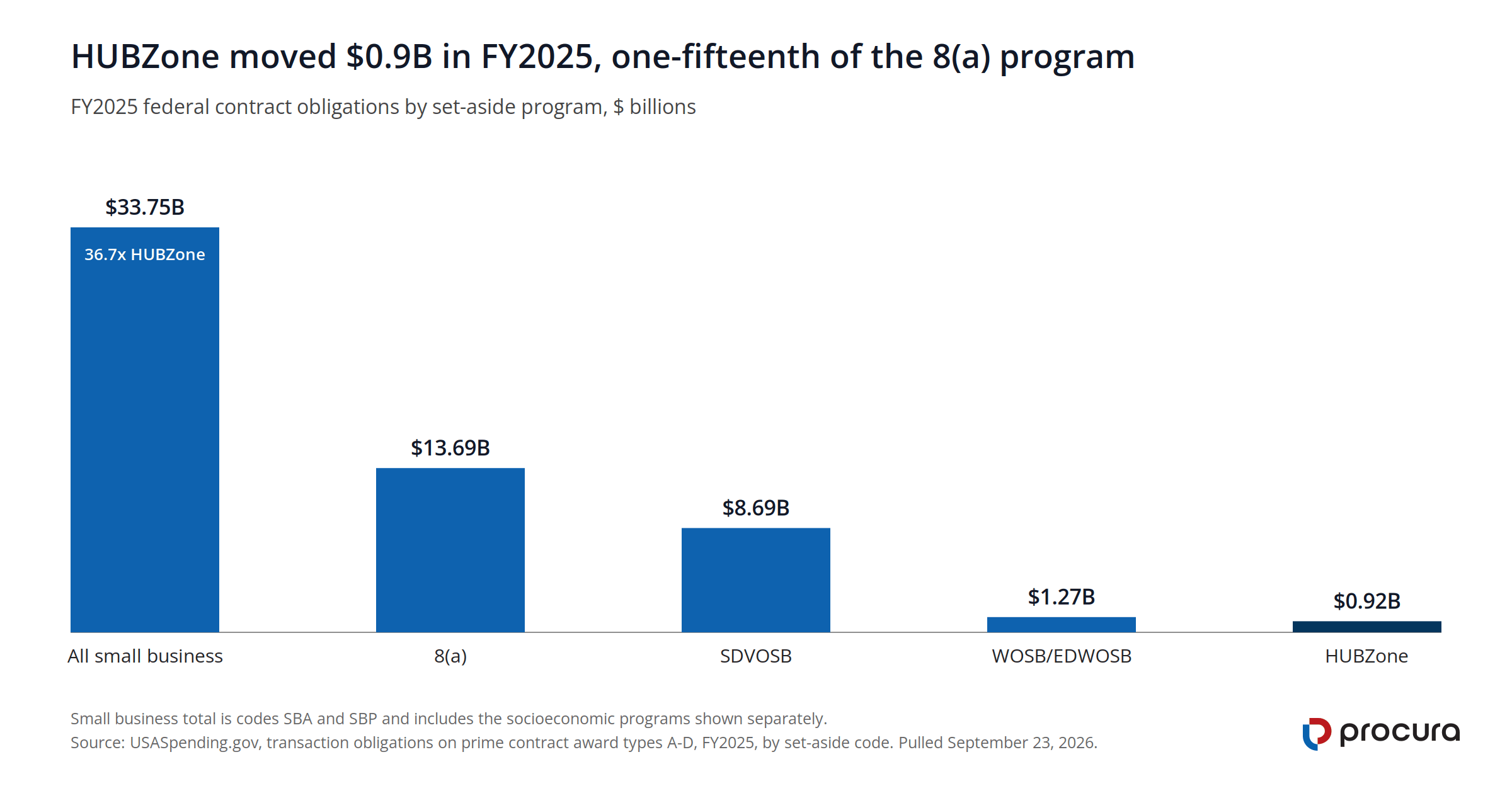
Data table: FY2025 obligations by set-aside program
| Set-aside program | FY2025 obligations | Multiple of HUBZone |
|---|---|---|
| All small business set-asides | $33.75 billion | 36.7x |
| 8(a), competed and sole source | $13.69 billion | 14.9x |
| SDVOSB, set-aside and sole source | $8.69 billion | 9.4x |
| WOSB and EDWOSB | $1.27 billion | 1.4x |
| HUBZone, set-aside and sole source | $0.92 billion | 1.0x |
The trend inside the program runs the wrong way too. HUBZone obligations peaked at $1.068 billion in FY2023. Since then, they have fallen in every year after that, to $920.1 million in FY2025. Sole-source awards held roughly flat near $60 million across the whole period, so the decline sits entirely in competed set-asides.
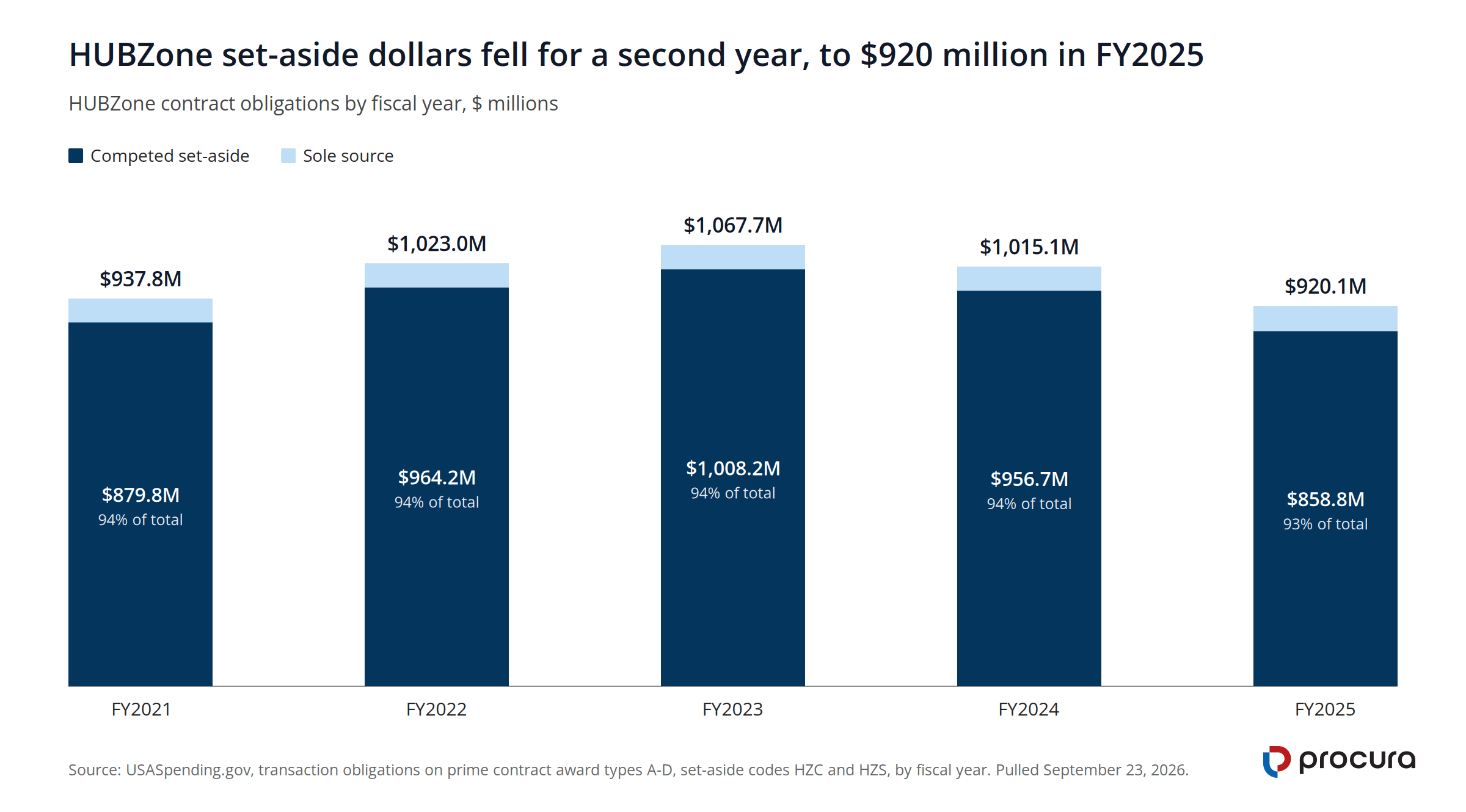
Data table: HUBZone obligations by fiscal year and award method
| Fiscal year | HUBZone set-aside | HUBZone sole source | Total |
|---|---|---|---|
| FY2021 | $879.8M | $58.0M | $937.8M |
| FY2022 | $964.2M | $58.9M | $1,023.0M |
| FY2023 | $1,008.2M | $59.4M | $1,067.7M |
| FY2024 | $956.7M | $58.3M | $1,015.1M |
| FY2025 | $858.8M | $61.3M | $920.1M |
How many certified HUBZone firms are there?
The pool of firms shrank alongside the dollars. The Congressional Research Service counted 4,678 certified HUBZone firms in SBA’s Dynamic Small Business Search on October 15, 2024, down from 7,461 in July 2020. Congress set the government-wide HUBZone goal at 3 percent of prime and subcontract dollars, at 15 U.S.C. 644(g)(1)(A). However, the government has never met it. SBA’s FY2025 scorecard release of June 25, 2026 reports 8(a) dollars at $24.3 billion and small disadvantaged business dollars at $75.3 billion. It reports no HUBZone figure at all.
Read that honestly and it cuts both ways. Fewer certified competitors chase each HUBZone set-aside than chase an 8(a) award. But the total addressable pool is under a billion dollars a year, spread across every agency and every industry code in the country.
Which agencies and codes buy HUBZone work?
The Department of Defense obligated $494.0 million through HUBZone set-asides and sole-source awards in FY2025, which is 54 percent of the program total. By comparison, Homeland Security is a distant second at $120.5 million. After those two the numbers drop fast. A firm outside the top five agencies is fishing in a very small pond.
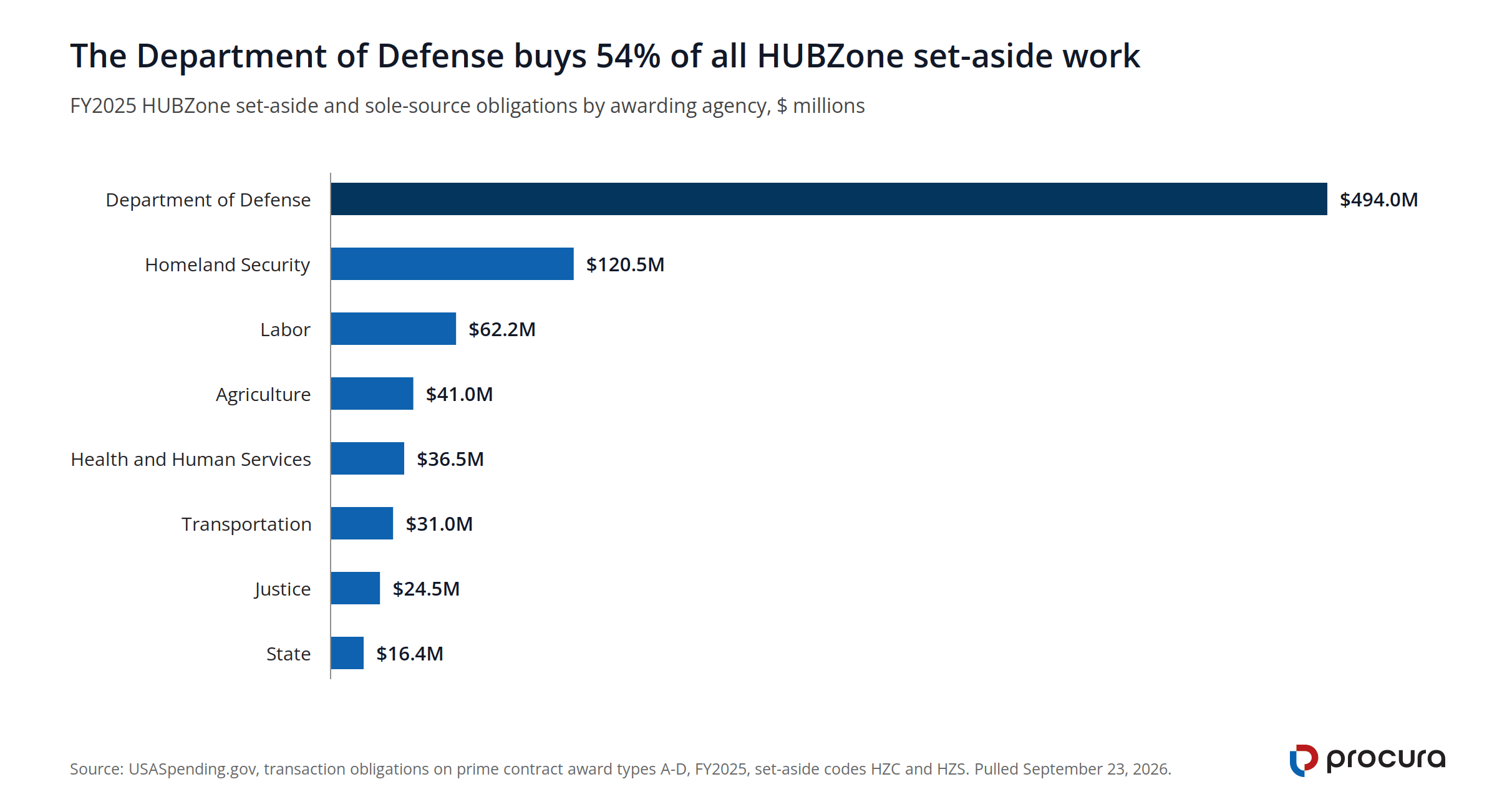
Data table: FY2025 HUBZone obligations by agency
| Agency | FY2025 HUBZone obligations |
|---|---|
| Department of Defense | $494.0M |
| Department of Homeland Security | $120.5M |
| Department of Labor | $62.2M |
| Department of Agriculture | $41.0M |
| Department of Health and Human Services | $36.5M |
| Department of Transportation | $31.0M |
| Department of Justice | $24.5M |
| Department of State | $16.4M |
Which NAICS codes see the most HUBZone dollars?
By industry code the program leans construction and information technology. Therefore, check your own code against this list before you invest in HUBZone certification. In short, a code with no HUBZone history is telling you something.
| NAICS | Industry | FY2025 HUBZone obligations |
|---|---|---|
| 236220 | Commercial and Institutional Building Construction | $224.1M |
| 541519 | Other Computer Related Services | $200.3M |
| 561210 | Facilities Support Services | $65.3M |
| 611519 | Other Technical and Trade Schools | $55.5M |
| 541512 | Computer Systems Design Services | $51.8M |
| 238210 | Electrical Contractors and Other Wiring Installation | $33.0M |
| 237310 | Highway, Street, and Bridge Construction | $23.2M |
| 541511 | Custom Computer Programming Services | $22.7M |
| 311513 | Cheese Manufacturing | $22.6M |
| 541611 | Administrative Management Consulting | $19.1M |
Construction leading the table is not an accident, and it collides with the job-site rule above. If you run crews, our guide to government construction contracts and the bonding requirements matter as much to your win rate as the certification does.
How do you keep HUBZone certification?
HUBZone certification must be renewed every three years. However, a great deal of published guidance still says annual, and that guidance is out of date. SBA replaced annual recertification with a triennial cycle in the final rule at 89 FR 102501. That rule published on December 17, 2024.
- File your recertification in the 90 calendar days before the triennial anniversary of your HUBZone certification date, under 13 CFR 126.500(a)(2).
- Miss the window and SBA decertifies you at the end of the eligibility period. Recertify within 30 days of that date and SBA reinstates you.
- SBA conducts a program examination of every certified firm at least once every three years, and more often for firms a risk-based analysis selects.
- Give SBA evidence of continued eligibility within 30 calendar days of a merger or acquisition closing.
- A proposed decertification letter gives you 30 calendar days to respond in writing.
What if residency drops during a contract?
One relief valve exists for firms already performing. If you hold a HUBZone contract and your residency falls below 35 percent, you can still recertify. At least 20 percent of your total employees must live in a HUBZone. You must also document real hiring efforts. If you fall under 20 percent during performance, however, SBA treats that as a failure to attempt to maintain, full stop. Job advertisements, written offers, and job-fair attendance are the evidence SBA names.
Is HUBZone certification worth it?
It is worth it when the geography is already true. Your office sits in a qualified area and a third of your staff lives nearby. In addition, your NAICS codes appear in the tables above with real dollars next to them. In that case, the certification costs you paperwork and buys you a thinner field of competitors.
It is not worth it when you would have to manufacture the geography. The national pool is less than a billion dollars a year. So moving an office and hiring by ZIP code to chase it is a poor trade. A services firm whose whole crew works at customer sites cannot satisfy the principal office test at all. Instead, firms in that position usually do better on a GSA Schedule. The ordinary small-business set-asides in our guide to the easiest government contracts to win are another route.
Certified is the easy part
The HUBZone certification letter arrives and the work does not. Every founder I have talked to hits that wall about a month in. Less than a billion dollars of HUBZone set-asides gets scattered across a dozen agencies and hundreds of industry codes each year. In addition, each one arrives as a notice with an attachment stack behind it. Yet the clause that rules you out is almost never in the notice.
That is why Procura Federal exists. It opens each solicitation with its attachments and scores the requirement against your capability statement. It also marks the compliance clauses that decide whether you can bid at all. A HUBZone opportunity worth a week of your time and one that wastes a week look the same in the notice. Pricing runs $399/month, well under the annual license the legacy platforms quote, which we compare in our review of federal contracting tools.
Frequently asked questions about HUBZone certification
How long is HUBZone certification good for?
Three years, and there is no cap on how many cycles you run. Indeed, 13 CFR 126.502 puts no limit on how long a firm can stay certified as long as it keeps qualifying.
Can I hold HUBZone and 8(a) certification at the same time?
Yes. 13 CFR 126.205 allows participants in other SBA programs to be certified. In addition, 13 CFR 126.609 bars a buying agency from restricting a HUBZone competition to firms that hold a second certification.
Do all of my offices have to be in a HUBZone?
No. 13 CFR 126.207 lets a firm hold offices in several HUBZones, or outside one entirely. In fact, the principal office test is the only one that must hold.
Does HUBZone certification help on subcontracts?
It can. The statutory 3 percent goal at 15 U.S.C. 644(g)(1)(A) covers subcontract dollars as well as prime dollars. Thus large primes carry HUBZone targets in their subcontracting plans.
What happens if my area loses its HUBZone designation?
A tract that stops qualifying becomes a Redesignated Area and keeps HUBZone treatment for three more years. The 10-year investment rule at 13 CFR 126.200(c)(1) is the only way to hold an address longer. However, it does not cover Redesignated Areas.
Book a demo
Bring your NAICS codes to a 30-minute call. We will show what HUBZone and open-market work is live for them right now. In addition, every item comes scored against your capability statement. If your codes are dry, we will tell you that too. Our step-by-step guide to winning government contracts covers what comes after the first award.