

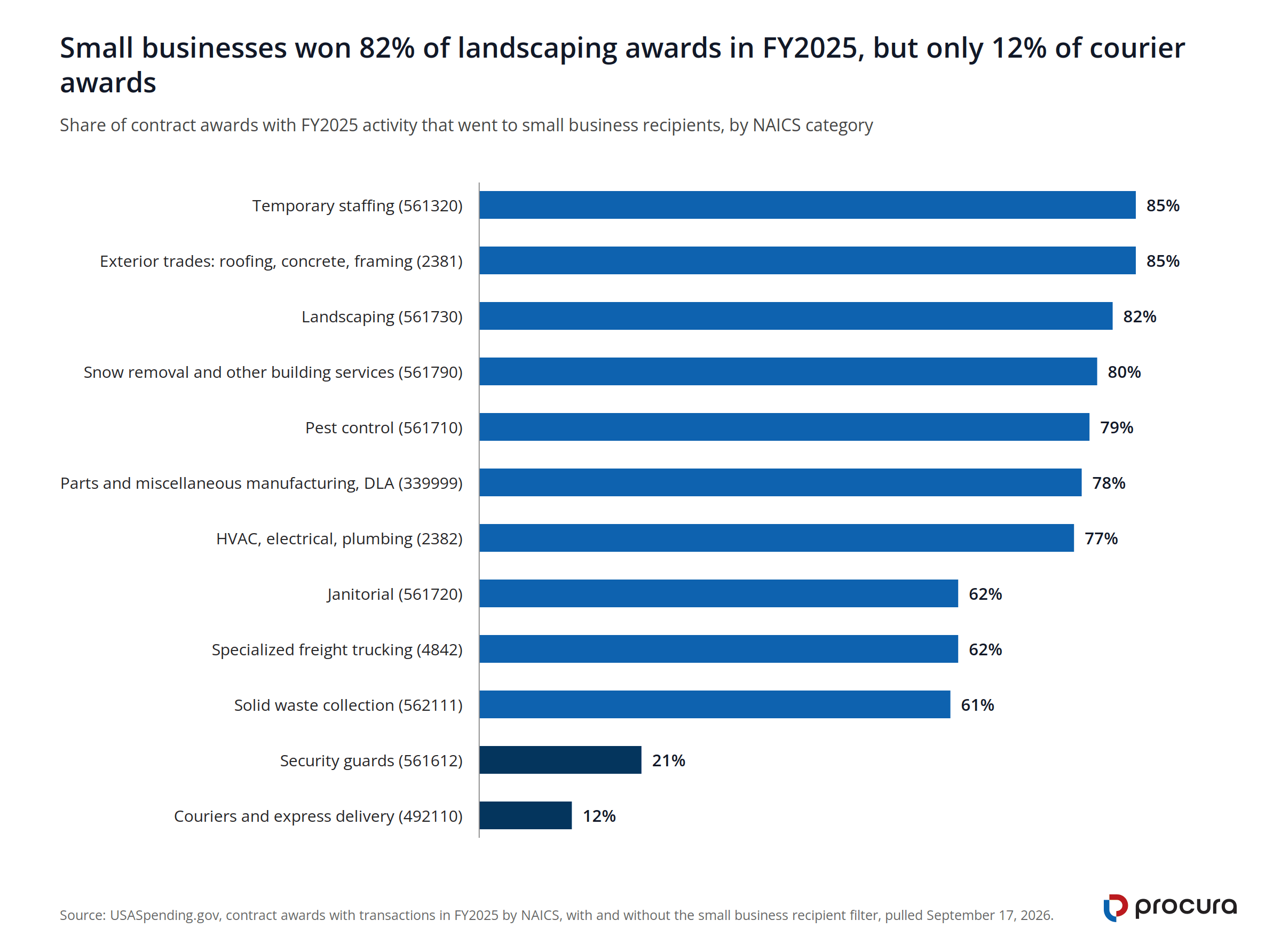
The easiest government contracts to win in 2026 are small, set aside for small business, and awarded thousands of times a year. For example, landscaping, snow removal, pest control, janitorial work, and parts for the Defense Logistics Agency lead the list. Small businesses won 82 percent of the 4,625 federal landscaping awards with activity in fiscal year 2025, per USASpending.gov. In contrast, they won only 12 percent of courier awards in the same year. This guide measures the gap between those two numbers.
Most lists of easy government contracts are opinion. This one, however, is ranked with federal award data, and each category links to the full guide for that trade. I read federal solicitations every week, and the pattern holds: the easiest government contracts to win are the ones the rules reserve for a new firm.
What makes a government contract easy to win?
A contract is easy to win when the rules limit the competition and the buyer awards often. Four signals in the award data measure that, so the ranking below uses all four:
- The share of awards that go to small businesses. Above 75 percent generally means the category belongs to small firms.
- The share of awards valued at $350,000 or less. Those buys use simplified procedures and are also reserved for small business by default.
- The number of awards each year. As a result, more awards means more chances to win one.
- The barrier to entry. A license, a bond, or a facility clearance keeps competitors out, but it can keep you out too.
Dollar totals matter less than the listicles suggest. Federal agencies obligated $778.5 billion on contracts in fiscal year 2025, per USASpending.gov, but a first contract is not a share of that number. Instead, it is one purchase order from one buying office. In the categories below, that first order is also the most likely.
Which rules reserve contracts for small businesses?
Two dollar thresholds in the Federal Acquisition Regulation (FAR) do most of the work. Buys at or below the micro-purchase threshold of $15,000 require no competitive quotes when the buyer considers the price reasonable. The buyer must also spread those buys “equitably among qualified suppliers” (FAR 13.203). In addition, buys above $15,000 and up to the simplified acquisition threshold of $350,000 are set aside for small business by rule. The only exception is when the contracting officer expects fewer than two competitive small business offers (FAR 19.502-2). Those figures took effect on October 1, 2025.
In fact, those two bands hold almost every federal award. Federal agencies had 5.78 million contract awards with activity in fiscal year 2025, per USASpending.gov. Of those, 84 percent were valued at $15,000 or less. Another 12 percent fell between $15,000 and $350,000, and only 4 percent were larger. Overall, small businesses received 51 percent of all awards by count and $20.7 billion of the $39.2 billion obligated on awards of $350,000 or less.
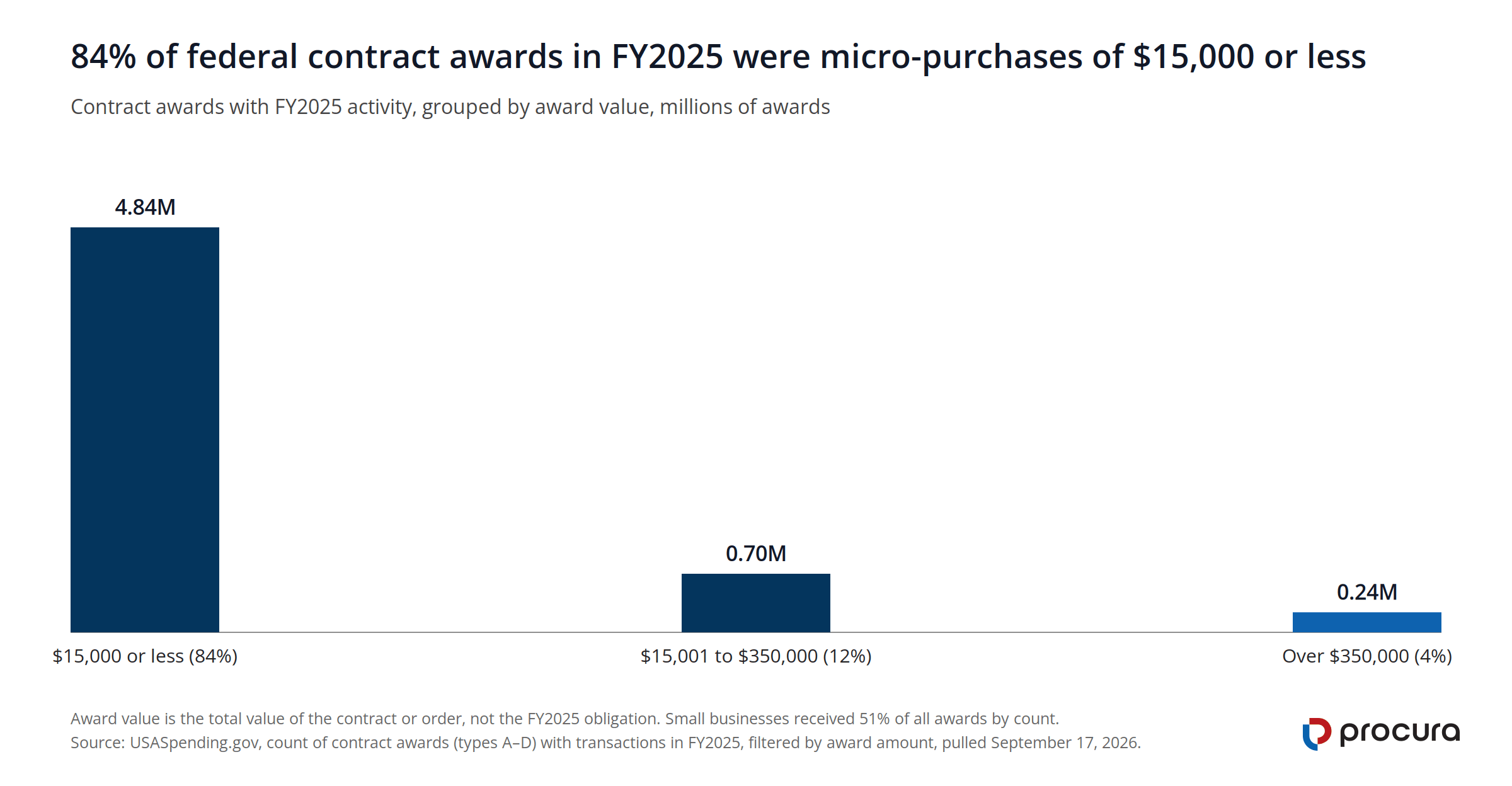
Data table: federal contract awards with FY2025 activity, by award value
| Award value | Awards with FY2025 activity | Share of all awards |
|---|---|---|
| $15,000 or less | 4,839,167 | 84% |
| $15,001 to $350,000 | 701,797 | 12% |
| Over $350,000 | 243,640 | 4% |
| All awards | 5,784,604 | 100% |
Which FAR thresholds decide who can bid?
| Rule | Threshold | What it means for a new contractor |
|---|---|---|
| Micro-purchase threshold (FAR 2.101, 13.203) | $15,000 | No competitive quotes required. Paid by purchase card. Buyers must distribute these buys among qualified suppliers. |
| Micro-purchase threshold for construction and for services under the Service Contract Act | $2,000 and $2,500 | Labor-law coverage starts far below $15,000 for construction and most service work. |
| Simplified acquisition threshold (FAR 2.101, 19.502-2) | $350,000 | Buys between $15,000 and $350,000 are set aside for small business by default. |
| Rule of two (FAR 19.502-2(b)) | Above $350,000 | Set aside when the buyer expects offers from at least two responsible small businesses at fair market prices. |
| 8(a) sole source (FAR 19.805-1) | $5.5 million, or $8.5 million for manufacturing | An 8(a) firm can receive a direct award below these amounts. |
| HUBZone sole source (FAR 19.1306) | $5.5 million, or $8.5 million for manufacturing | Same mechanism for certified HUBZone firms. |
| SDVOSB sole source (FAR 19.1406) | $5 million, or $8.5 million for manufacturing | Same mechanism for SBA-certified service-disabled veteran-owned firms. |
| Performance and payment bonds (FAR 28.102-1) | Construction above $150,000 | Bonds are mandatory. Between $35,000 and $150,000 the buyer picks alternative payment protections. |
That set-aside rule is why the ranking of the easiest government contracts to win counts awards in that band. In other words, a large company cannot bid in that band at all. Your competition is other small firms, and in the categories that follow, there are fewer of them than you think.
What are the easiest government contracts to win in 2026?
The table ranks ten categories by the share of fiscal year 2025 awards that small businesses won. The barrier to entry then moves a category up or down. In short, every row is a trade where the government buys often, buys small, and buys from firms like yours.
| Rank | Contract type | NAICS | FY2025 obligations | Awards with FY2025 activity | Awards of $350,000 or less | Awards won by small business | Barrier to entry |
|---|---|---|---|---|---|---|---|
| 1 | Landscaping and grounds maintenance | 561730 | $637.2 million | 4,625 | 83% | 82% | Equipment, insurance, wage determinations |
| 2 | Snow removal and other building services | 561790 | $62.6 million | 970 | 90% | 80% | Seasonal, equipment |
| 3 | Pest control | 561710 | $43.7 million | 860 | 89% | 79% | State applicator license |
| 4 | Parts and miscellaneous manufacturing (DLA) | 339999 | $4.30 billion | 23,662 | 89% | 78% | DIBBS registration, drawings, export controls |
| 5 | Temporary staffing | 561320 | $883.0 million | 5,841 | 73% | 85% | Payroll capacity, Service Contract Act |
| 6 | Building equipment trades: HVAC, electrical, plumbing | 2382 | $2.15 billion | 11,212 | 76% | 77% | Trade license, bonds above $150,000 |
| 7 | Exterior trades: roofing, concrete, framing | 2381 | $585.5 million | 2,085 | 66% | 85% | Bonds above $150,000, Davis-Bacon wages |
| 8 | Janitorial services | 561720 | $1.79 billion | 6,065 | 74% | 62% | AbilityOne competition, wage determinations |
| 9 | Specialized freight trucking | 4842 | $213.0 million | 1,746 | 89% | 62% | Authority, insurance, equipment |
| 10 | Solid waste collection | 562111 | $302.7 million | 3,097 | 84% | 61% | Trucks, disposal agreements |
1. Landscaping and grounds maintenance
Landscaping tops the list because it scores high on every signal at once. Small businesses won 82 percent of the 4,625 awards, and 83 percent of the awards were $350,000 or less. Buyers also coded 1,334 of them as total small business set-asides. Demand is steady, since military bases, national cemeteries, and federal buildings all mow grass on a schedule. For the buyers, the wage determinations, and the recurring solicitations, read the landscaping contracts guide.
2. Snow removal and other building services
NAICS 561790 covers snow plowing, pressure washing, and other exterior building services. It is a small code, though, at $62.6 million in fiscal year 2025. But 90 percent of its 970 awards were $350,000 or less, and 80 percent went to small businesses. Snow work is therefore the seasonal entry point. Agencies post plowing solicitations in the fall, so a firm with a truck and a plow can bid the first year. Timing is in the snow removal contracts guide.
3. Pest control
Pest control has the highest micro-purchase share of any service on this list. Of 860 awards, 28 percent were $15,000 or less and 79 percent went to small firms. Every federal building has a pest control requirement, but most of them are too small for a national company to chase. As a result, a state applicator license is the only real barrier. However, agencies write these solicitations in integrated pest management language, which the pest control contracts guide decodes.
4. Parts and miscellaneous manufacturing through DLA
NAICS 339999 is where the Defense Logistics Agency codes thousands of small parts buys. Small businesses received $4.1 billion of the $4.3 billion obligated under the code, and 47 percent of its 23,662 awards were micro-purchases. In fact, no proposal is involved. Instead, you quote a price and a delivery on the DLA bid board, then a computer awards the low qualified quote. Registration, the automated evaluation, and the export-control rules for drawings are in the DLA DIBBS guide.
5. Temporary staffing
Temporary help services had the highest small business award share in the data, 85 percent of 5,841 awards. Agencies buy clerical, medical, and administrative staff on short contracts, while the Service Contract Act sets the wage floor. Payroll is the barrier: you fund two to four weeks of wages before the first invoice clears.
6. Building equipment trades
HVAC, electrical, and plumbing contractors (NAICS 2382) won 77 percent of 11,212 awards, and 2,265 of those were total small business set-asides. Repair and replacement work on federal buildings runs below the $150,000 bonding line more often than new construction does. Bonding and wage rules for all the trades are in the construction contracts guide.
7. Exterior trades
Roofing, concrete, and framing contractors (NAICS 2381) had the highest small business dollar share of any construction code: $543 million of $585 million. Awards are larger here, so only 66 percent were $350,000 or less, and bonds apply above $150,000. Still, a firm that can bond a $200,000 roof replacement finds little large-company competition below $1 million.
8. Janitorial services
Janitorial is the largest service category on the list, $1.79 billion across 6,065 awards, and it ranks eighth for one reason. The largest recipients in fiscal year 2025, including Skookum Educational Programs, Didlake, and Chimes, are nonprofit agencies in the AbilityOne program. Because of that program, their contracts are not open to competition. The remaining work is still 62 percent small business by award count. To find the buildings that are not on the AbilityOne list, start with the government cleaning contracts guide.
9. Specialized freight trucking
Specialized freight (NAICS 4842) covers flatbed, tanker, and household goods moves. Small businesses won 62 percent of 1,746 awards, and 89 percent of awards were $350,000 or less. General freight trucking (NAICS 4841), however, is a different story: small firms won only 26 percent of its 359 awards. Authority, insurance, and the freight programs that post the loads are in the trucking contracts guide.
10. Solid waste collection
Refuse and recycling collection (NAICS 562111) is a local service that every installation needs. Small businesses won 61 percent of 3,097 awards, and 634 awards were total small business set-asides. Trucks are the barrier. Even so, a hauler with a disposal agreement and two vehicles can serve a base for years on a recurring contract.
Which government contracts look easy but are not?
However, some categories appear on every “easy contracts” list and fail the data test. Their award shares tell the story:
| Contract type | NAICS | Awards with FY2025 activity | Awards won by small business | Why it is hard |
|---|---|---|---|---|
| Couriers and express delivery | 492110 | 3,224 | 12% | National carriers hold the volume. Small firms received 5% of $839.4 million. |
| Security guard services | 561612 | 7,572 | 21% | Large incumbents, armed-guard licensing, and multi-year contracts. |
| General freight trucking | 4841 | 359 | 26% | Few awards, and most go to brokers and large carriers. |
| Food service contractors | 722310 | 1,561 | 48% | Small firms received 15% of $1.38 billion. Dining facility contracts are large and long. |
| Commercial building construction | 236220 | 24,567 | 82% | Only 42% of awards were $350,000 or less. Bonding capacity decides who can bid. |
| Computer services | 541519 | 48,693 | 71% | The most awards of any code, and the most competitors. Set-asides go to firms with cleared staff and past performance. |
Courier work is the clearest case, and the courier contracts guide shows where a local firm can still win. For example, medical specimen routes, same-day legal delivery, and buys under $15,000 rarely reach a national carrier. Building construction shows the other trap. Small businesses win 82 percent of the awards, but 58 percent of the awards are larger than $350,000. Therefore, a new firm without a surety line cannot bid those.
Which set-aside programs move the most money?
Total small business set-asides carried $32.8 billion in fiscal year 2025, more than every socioeconomic set-aside combined, per USASpending.gov. The 8(a) program was second, with $9.7 billion in sole-source awards and $4.0 billion in competed awards. Service-disabled veteran-owned set-asides carried $8.3 billion. Meanwhile, set-asides for the WOSB and HUBZone programs were each about $1 billion.
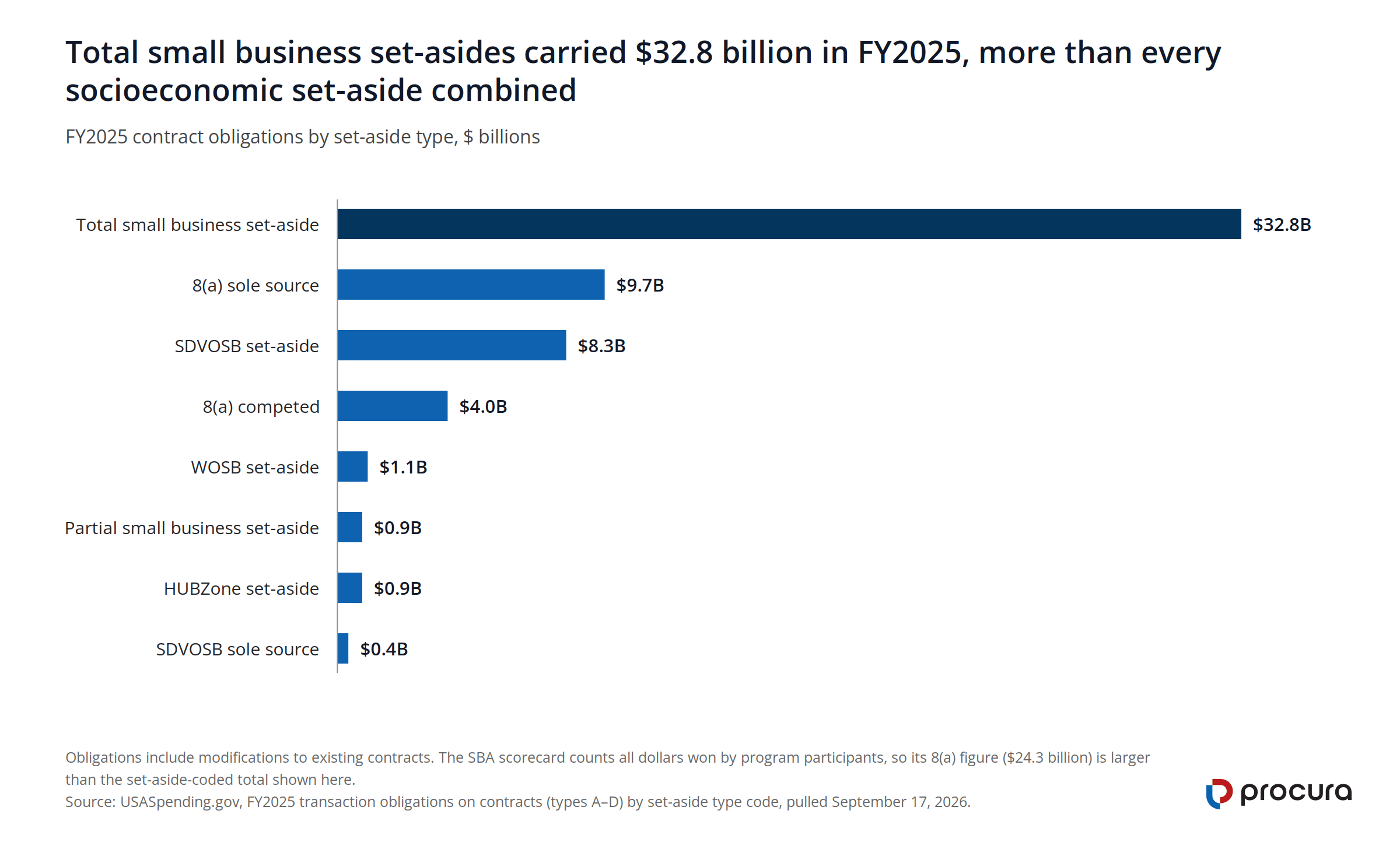
Data table: FY2025 contract obligations by set-aside type
| Set-aside type | FY2025 obligations |
|---|---|
| Total small business set-aside | $32.8 billion |
| 8(a) sole source | $9.7 billion |
| SDVOSB set-aside | $8.3 billion |
| 8(a) competed | $4.0 billion |
| WOSB set-aside | $1.1 billion |
| Partial small business set-aside | $0.9 billion |
| HUBZone set-aside | $0.9 billion |
| SDVOSB sole source | $0.4 billion |
| WOSB sole source | $0.1 billion |
| HUBZone sole source | $0.06 billion |
| EDWOSB set-aside and sole source | $0.03 billion |
That order matters for a new firm. A total small business set-aside needs only an active SAM.gov registration and a size below the NAICS standard. The socioeconomic programs, however, need a certification, and each one takes months. Get the first contracts on size alone, then apply for the program that fits. For the 2026 eligibility rules and the sole-source path, read the 8(a) certification guide.
How do you get government contracts with no experience?
You get the first one on price and responsiveness, not past performance. Buys at or below the micro-purchase threshold need no past performance review, so the buyer can award to any responsible supplier with a reasonable price. Similarly, buys up to $350,000 under simplified procedures are evaluated on price and a short technical description. As a result, a firm with no federal history competes on equal terms in both bands. This sequence works:
- First, register in SAM.gov. Our SAM.gov registration guide covers the UEI, the CAGE code, and the steps that cause delays.
- Then pick your NAICS codes and confirm that you are small under each size standard.
- Write a one-page capability statement with your codes, your CAGE code, and your service area.
- Send it to the small business specialist at the three installations nearest you. After all, micro-purchase buyers call the vendors they know.
- Quote every set-aside solicitation under $350,000 in your codes for six months.
- Finally, use the first two awards as past performance for the larger set-asides.

Subcontracting is also a way in. For instance, a prime on a large janitorial or construction contract often needs a local firm for one building or one trade. That work does not appear in the award data under your name, but it builds the references that the larger set-asides require.
Where do you find the easiest government contracts to win?
Solicitations above $25,000 are posted on SAM.gov, and the search filters do most of the sorting. Filter by your NAICS codes, set the set-aside type to “Total Small Business,” and sort by response date. Then add “Sources Sought” notices to the search. Those notices are the buyer asking whether two small firms exist before the set-aside decision. DLA parts buys post on the DLA bid board instead, and the guide to finding federal contracts lists the other agency portals.
Micro-purchases work differently, though. Most buys of $15,000 or less never post anywhere. The buyer holds a purchase card and a list of vendors, and the FAR tells that buyer to spread the work among qualified suppliers. So you get on the list by asking. That is also why step four in the sequence above is a visit, not a search.
Finding small contracts is the easy part. Qualifying them takes the time.
A SAM.gov search for total small business set-asides below the simplified acquisition threshold in five NAICS codes returns hundreds of notices a month. Each one has a work statement, a wage determination, a place of performance, and often a site visit date. Those details sit in three to eight attachments. The firms that win the easiest government contracts are not the ones that find the most. They are the ones that read the attachments before they quote and skip the solicitations that do not fit.
Procura Federal does that reading for you. First, you upload your capability statement once. Procura then reads every new solicitation and its attachments and scores the match against your statement from 0 to 3 stars. It also flags the compliance requirements, such as bonds, wage determinations, and certifications. It costs $399/month, which is less than one lost afternoon a week spent on solicitations that a large company was always going to win. Once the match is confirmed, the step-by-step guide to winning government contracts covers the rest of the process.
Frequently asked questions
Is it easy to win government contracts?
No contract is easy, but the easiest government contracts to win are winnable in your first year. Winnable ones share three traits. The buy is below the simplified acquisition threshold, the category has hundreds of awards a year, and small businesses already win most of them. For example, landscaping, pest control, and DLA parts meet all three. In contrast, security guard work and courier routes do not.
What is the easiest government contract to get for a beginner?
A micro-purchase from a nearby installation. That is because the buyer needs no competition, no past performance, and no proposal, only a reasonable price from a registered vendor. For a firm with a truck, snow plowing and grounds work are the usual first awards. Similarly, for a machine shop or distributor, a DLA quote on a part you already stock is the fastest path.
Do I need 8(a) or another certification to win easy government contracts?
No. Some of the easiest government contracts to win are total small business set-asides, which moved $32.8 billion in fiscal year 2025 and need only size eligibility and a SAM.gov registration. Certifications add sole-source paths and more set-asides, so apply once you have a contract or two, but do not wait for one to start bidding.
What are the best government contracts for small business by dollar value?
By dollars, computer services and building construction: $17.0 billion and $13.6 billion to small businesses in fiscal year 2025. By winnability for a new firm, however, the easiest government contracts to win are the ten categories in the ranking above. The two lists overlap only in the building trades, where a licensed contractor with a bond line can move from repairs to new construction.
Book a demo below and bring a solicitation from your trade. We will then score it on the call and show you which attachment decides the bid.