

Under FAR 9.601, a teaming agreement is a written deal between companies that plan to win one federal contract together. That rule recognizes two forms. Two or more firms form a joint venture that bids as the prime, or a prime commits in advance to named subcontractors. As a result, every later choice about size, work share, and past performance follows from which of the two you sign.
I run a small veteran-owned engineering firm, and the teaming agreement is the document I read most slowly before a bid. It decides who signs the contract, whose size the set-aside tests, and who gets paid first. Two of the rules most often quoted about joint ventures changed years ago. A third also changes under the FAR overhaul this year.
What is a teaming agreement in government contracting?
A teaming agreement is a contract between companies about a future contract with the government. FAR 9.602 says these arrangements let firms complement each other’s capabilities. They also let the team offer a better combination of performance, cost, and delivery than either firm alone. Firms normally sign before the offer, but the rule also allows a team to form later, including after award.
Two conditions come with the arrangement. The team must identify itself and disclose the company relationships in the offer, or before the arrangement takes effect if it forms later. In addition, under FAR 9.604, the government can hold the prime fully responsible for performance, whatever the team agreed among itself. That section also keeps the government’s right to require consent to subcontracts and to judge the prime’s responsibility on the basis of the team.
One change is in progress. The FAR overhaul model text for Part 9, last updated September 23, 2026 on acquisition.gov, carries subparts 9.1 through 9.5 and no subpart 9.6. Yet the codified FAR at 48 CFR 9.6 still contains the team arrangement rules. Agencies move to the new text as they issue class deviations.
Teaming stays legal under both versions. What the overhaul text drops is the written promise that the government will recognize the validity of the arrangement. For this reason, check the clause list in the solicitation to learn which text your contracting officer applies.
Is a teaming agreement legally binding?
A teaming agreement binds only as far as its terms are definite. In Cyberlock Consulting v. Information Experts, a federal district court in Virginia held that a teaming agreement was an unenforceable agreement to agree. The prime had promised to negotiate a subcontract after award, and the court found no binding promise to issue one. Later, on appeal, the Fourth Circuit affirmed in 2014. In other words, a promise to negotiate later protects nobody.
What should a teaming agreement include?
Specific terms make it binding. Attach the statement of work you will do, your share of the work, and your labor categories and rates. Then state the conditions that oblige the prime to issue the subcontract. These clauses decide whether the document protects you or only describes a hope.
| Clause | What it must say | Why it matters |
|---|---|---|
| Scope and work share | Your tasks from the statement of work, with a percentage or labor-hour share | Without it, the prime can shrink your role after award |
| Obligation to subcontract | The prime issues a subcontract on award, on stated terms | An obligation only to negotiate can be unenforceable |
| Exclusivity | Whether either party can join another team for the same solicitation | Stops a teammate from bidding against you with your pricing |
| Size and status | Each party’s size under the solicitation NAICS code, and each certification | Your status is often the reason the prime chose you |
| Limitations on subcontracting | How the team meets FAR 52.219-14 on a set-aside | A team that exceeds the cap invites a size protest |
| Proposal costs and data | Who pays bid costs, and how each party protects proprietary data | Proposal work is unpaid, so the split is agreed first |
| Termination | The events that end the agreement: loss of award, no award by a set date, a protest result | Frees both parties to pursue other bids |
| Governing law and disputes | The state law and the forum | Decides how a court reads the promises above |
What is the ostensible subcontractor rule?
On a set-aside, a prime-subcontractor team carries one risk that a joint venture does not. Specifically, under 13 CFR 121.103(h)(3), SBA can find that a teammate is an ostensible subcontractor. SBA then treats the small prime as ineligible for the award.
An ostensible subcontractor is a subcontractor that is not similarly situated and does the primary and vital requirements of the contract. SBA also finds one where the prime is unusually reliant on the subcontractor. The rule still lets a small prime use a large teammate’s experience and past performance in the proposal, including an incumbent’s record.
The regulation gives a safe harbor for most work. It covers set-asides for services, specialty trade construction, and supplies. There, a prime that meets the limitations on subcontracting in 13 CFR 125.6 is not unduly reliant on its subcontractors. On general construction, however, the primary and vital requirement is management and supervision of the project, not the physical work. Our guide to government subcontracting and the similarly situated rule explains the 50, 75, and 85 percent caps.
What is the difference between a teaming agreement and a joint venture?
A prime-subcontractor team puts one company on the contract. A joint venture puts a new entity or an informal partnership on the contract, and the size rules then look at every partner. That single difference decides who the contracting officer calls, whose past performance counts, and whose size the set-aside tests.
| Question | Prime-subcontractor team | Joint venture of small firms | SBA mentor-protégé joint venture |
|---|---|---|---|
| Who signs the contract | The prime | The joint venture | The joint venture |
| Size test on a set-aside | The prime alone, unless SBA finds an ostensible subcontractor | Each partner is small under the contract NAICS code | Only the protégé is small |
| Work share rule | The prime meets the limitations on subcontracting | The managing partner does at least 40 percent of the joint venture’s work | The protégé does at least 40 percent of the joint venture’s work |
| SBA approval | None | None, except for a sole-source 8(a) award | SBA approves the mentor-protégé agreement before the offer |
| SAM.gov registration | Each firm registers | The joint venture registers with its own UEI and CAGE code | The joint venture registers with its own UEI and CAGE code |
| Time limit | The contract term | New offers for two years after the first award | New offers for two years after the first award, inside the mentor-protégé term |
How does a small business joint venture qualify for a set-aside?
Under 13 CFR 125.8(a), a joint venture can bid as small when each partner is small for the contract’s NAICS code. On a small business set-aside, two firms that each qualify as small need no specific form of agreement. However, the 8(a), HUBZone, SDVOSB, and WOSB programs each carry their own list of mandatory provisions. A mentor-protégé joint venture carries a list of twelve.
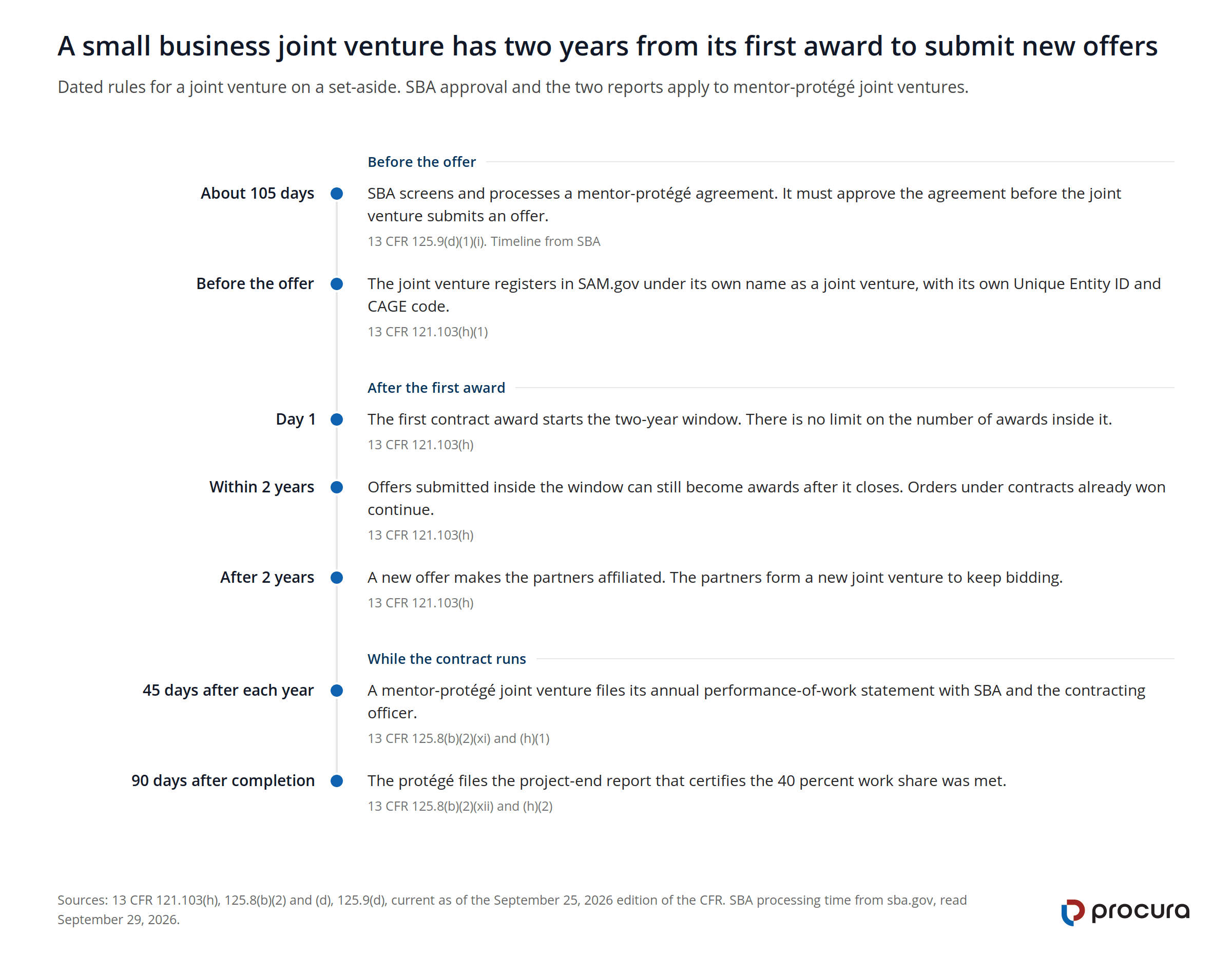
Three structural rules in 13 CFR 121.103(h) apply to every set-aside joint venture:
- It is in writing, does business under its own name, and is registered in SAM.gov as a joint venture.
- It is unpopulated. A separate legal entity can employ administrative staff and a facility security officer, but not the people who do the contract work, unless every partner is similarly situated.
- It submits new offers for two years from its first award, with no limit on the number of awards inside that window.
That last rule is the one most often misquoted. The old limit of three awards in two years is gone, and the regulation’s own example shows a joint venture receiving its fifth contract. An offer submitted before the two-year mark can still become an award after it, and orders under contracts already won continue. After the window closes, a new offer makes the partners affiliated, so the partners form a new joint venture instead.
How does past performance work in a joint venture?
Past performance is where a joint venture pays off for a newer firm. When an agency evaluates a set-aside joint venture, it must consider the work each partner did individually as well as the joint venture’s own record. It also cannot require a protégé to meet the same past performance criteria as other offerors, per 13 CFR 125.8(e). Similarly, Part 9 of the FAR overhaul text points the same way. Where a joint venture has no record, the contracting officer considers the record of each party. From the first award on, the joint venture builds a CPARS rating of its own.
How much set-aside money goes to joint ventures?
Joint ventures received about $2.5 billion of FY2025 set-aside contract obligations, per USASpending.gov. That count covers only recipients registered under a name that contains “JV” or “Joint Venture”, so the true figure is higher. Moreover, the share varies by program far more than most firms expect.
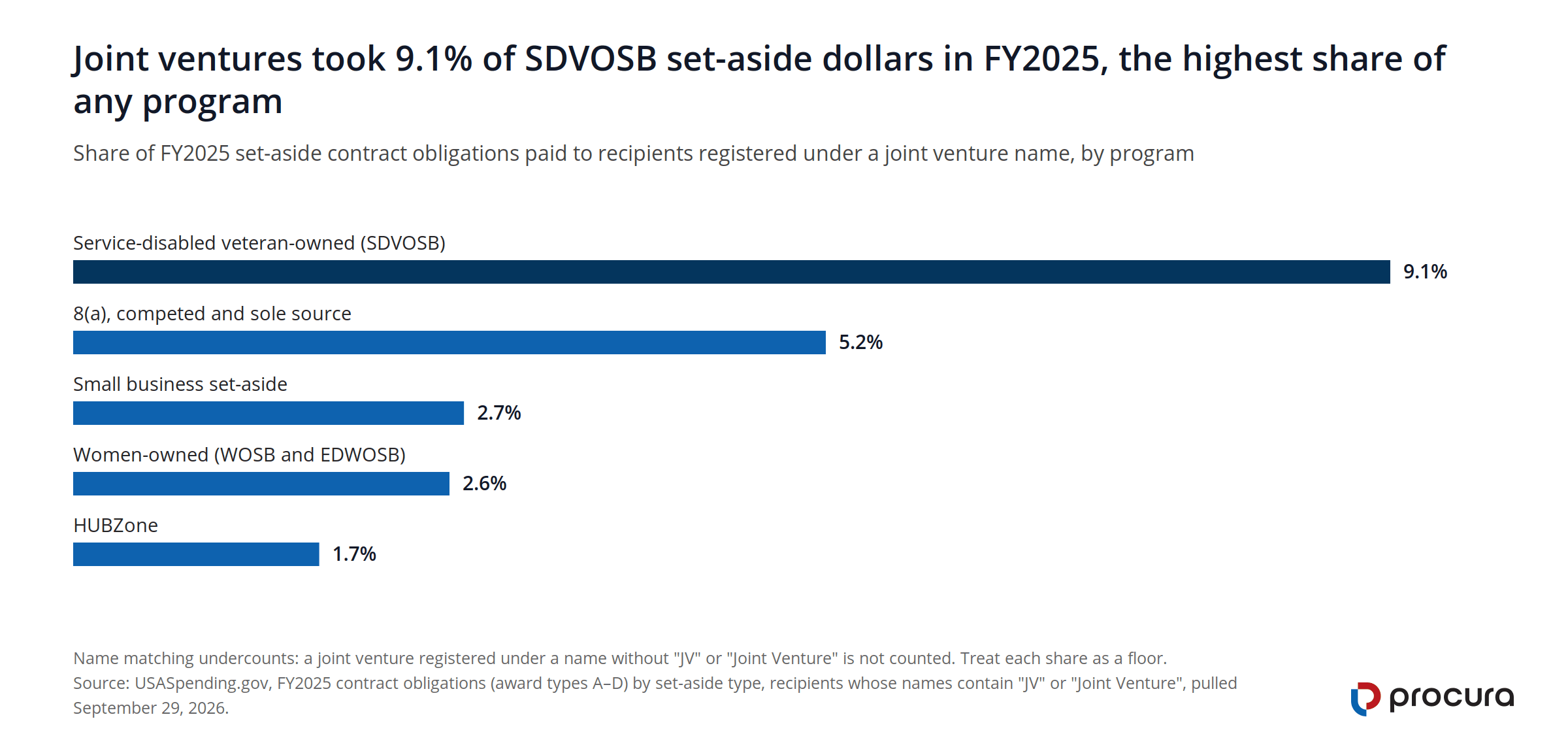
Data table: FY2025 set-aside obligations to joint ventures, by program
| Set-aside program | FY2025 set-aside obligations | To recipients named as joint ventures | Share | Joint venture recipients |
|---|---|---|---|---|
| Service-disabled veteran-owned (SDVOSB) | $8.69B | $787.1M | 9.1% | 136 |
| 8(a), competed and sole source | $13.69B | $711.1M | 5.2% | 242 |
| Small business set-aside | $33.75B | $911.0M | 2.7% | 300 |
| Women-owned (WOSB and EDWOSB) | $1.27B | $33.6M | 2.6% | 16 |
| HUBZone | $0.92B | $15.7M | 1.7% | 21 |
| Total | $58.32B | $2.46B | 4.2% | 715 |
In the SDVOSB program, 136 joint venture recipients shared $787.1 million, about one dollar in eleven. In 8(a), by comparison, 242 shared $711.1 million. If you hold a veteran or 8(a) certification, assume that some of your competitors on the next large set-aside are joint ventures. Our guides to 8(a) certification and HUBZone certification cover how each status works on its own.
How does the SBA Mentor-Protégé Program work?
The SBA Mentor-Protégé Program pairs a small business with an experienced contractor, and its largest commercial benefit is the joint venture. Under 13 CFR 125.9(d), a mentor and its SBA-approved protégé can joint venture as a small business. In other words, what counts is whether the protégé alone qualifies as small for the contract. That joint venture can pursue any set-aside the protégé qualifies for, including 8(a), HUBZone, SDVOSB, and WOSB awards.
SBA merged its 8(a) and All Small programs into this single program on November 16, 2020. It is not a matchmaking service, so the protégé applies through SBA’s certification site with a mentor already identified, and both firms complete SBA’s online tutorial first. Its primary terms come from 13 CFR 125.9:
- A protégé is small under its primary NAICS code, or under a secondary code where it already has related experience.
- A mentor is any for-profit firm, large or small, that is not debarred and can show value to offer. It generally has no more than three protégés at one time.
- Each agreement lasts up to six years. A protégé can have two agreements, or renew once with the same mentor, for no more than 12 years in total.
- The mentor commits to at least one year of assistance, and SBA reviews the relationship every year.
- The mentor can take an equity stake of up to 40 percent in the protégé to supply capital.
What is the 40 percent work rule?
The 40 percent work rule is the part to plan around. In a mentor-protégé joint venture, the protégé does at least 40 percent of the work done by the partners. In addition, under 13 CFR 125.8(c), that work must be more than administrative. Work by the mentor’s affiliates at any tier counts as the mentor’s. Work by a similarly situated subcontractor does not count toward the protégé’s share. The protégé also supplies the Responsible Manager, and the mentor cannot transfer one of its own employees to fill the job.
SBA enforces these terms. A mentor-protégé joint venture that fails its agreement or its work share can face suspension or debarment under 13 CFR 125.8(i). Similarly, a mentor that fails to deliver the promised assistance, and cannot explain why, loses the agreement. It then cannot act as a mentor again for two years.
What is the DoD Mentor-Protégé Program?
The Department of Defense runs a separate program under 10 U.S.C. 4902. Its protégés include disadvantaged, women-owned, service-disabled veteran-owned, and HUBZone small businesses. An agreement runs up to three years, or five years in unusual circumstances, and the mentor earns reimbursement or credit toward its subcontracting goals. However, the joint venture exception in 13 CFR 121.103(h)(2)(ii) covers only SBA-approved pairs. A DoD protégé that wants to bid set-asides jointly with its mentor thus needs an SBA agreement as well.
Which teaming agreement structure fits your firm?
The right structure depends on the size of the gap between the solicitation and your record:
- A prime-subcontractor team fits when you can do the primary and vital work yourself and need a partner for one scope. It is the fastest structure to set up, and the contract and the past performance record stay in your name.
- A joint venture of two small firms fits when neither firm alone has the capacity for the award and both are small under the NAICS code.
- A mentor-protégé joint venture fits when the award is larger than your record and your best partner is large. It is the only structure that lets a large firm share a set-aside award with you. SBA quotes 105 days to approve the agreement, so start about four months before the offer is due.
- A subcontract fits when the prime work is out of reach this year. Our subcontracting guide shows where primes look for small partners.
Two readers need a different answer. For example, consider janitorial, landscaping, and guard services. Federal buyers award most of that work directly to small firms, so a joint venture adds cost without adding access. That path runs through direct awards, and our list of the easiest federal contracts for small firms ranks them. If you are new to federal work, start with the SAM.gov registration walkthrough and win one prime award first. After all, a prospective partner reads your capability statement and your record, not your plans.
The hard part is finding the solicitation before the teams form

Every structure above starts from one specific solicitation that is too large or too broad for your record alone. As a result, finding those solicitations early is the real constraint. A team needs weeks to agree on work share, and a mentor-protégé joint venture needs SBA approval before the first offer. By the time most firms read the statement of work, the strong teams are already set. The steps to win a government contract start with a bid you can still staff.
Procura Federal reads each solicitation and its attachments and scores the fit against your capability statement. It also flags the compliance requirements, including the set-aside type and the limitations on subcontracting clause. You see which awards need a partner while there is still time to build a team. It costs $399/month. In contrast, the intelligence platforms that large primes buy cost five figures a year.
Frequently asked questions
Is there a government teaming agreement template?
No. No FAR clause prescribes one. However, SBA publishes a template for the mentor-protégé agreement, which is a different document from a joint venture agreement or a teaming agreement.
Can a teaming agreement be exclusive?
Yes, and many are. FAR 9.604 states that the team arrangement rules authorize nothing that violates antitrust law. Get legal advice before you sign an exclusive agreement that locks you out of a whole market.
Can a large business be an SBA mentor?
Yes. Under 13 CFR 125.9(b), any for-profit firm that can assist a protégé qualifies, including firms that are other than small.
Does a mentor-protégé joint venture keep its contract after the protégé grows?
Generally yes, for the life of the contract. The exception is a contract longer than five years. There, size recertification near year five can end the small status for that contract, per 13 CFR 125.9(d)(1)(iii).
Does SBA approve joint ventures for competitive 8(a) awards?
No. SBA approves an 8(a) joint venture only for a sole-source 8(a) award, per 13 CFR 124.513(e). For a competitive 8(a) award, the joint venture instead certifies its own compliance.
Book a demo
See which open solicitations in your NAICS codes are too large to bid alone. See which set-aside each one carries, before your competitors build their teams.