
WOSB certification is free through the SBA, takes up to 90 days, and opens set-asides in 733 NAICS codes. What it does not do, however, is move most of the money. Federal agencies spent $29.4 billion with women-owned small businesses in FY2025, and only about $2.0 billion of that came through a WOSB set-aside. That does not make the certification worthless. It makes it worth having for the right reasons, and this guide gives you the numbers to decide.
What does WOSB certification mean?
It means SBA has confirmed two things. One or more women who are United States citizens own at least 51 percent of your company, and they control it. Control covers day-to-day management and the long-term decisions. Ownership must be direct and unconditional under 13 CFR 127.201. For example, a holding company or an irrevocable trust between you and the business breaks that test.
Two tiers sit inside the program. A WOSB meets the ownership and control test, while an EDWOSB meets that test and adds a personal financial test for economic disadvantage. Both tiers run through the same portal, and every EDWOSB is also a WOSB.
Certification buys you two things. A contracting officer can set a requirement aside for your tier when two or more certified firms are expected to bid. A contracting officer can also award you a sole-source contract when only one qualified firm is expected. 13 CFR 127.503 caps those awards at $7 million for a manufacturing NAICS code and $4.5 million for everything else. Those ceilings are the reason the certification matters more to a services firm than the headline goal number suggests.
One point gets missed often. A women-owned firm that does not want set-asides can still self-certify in SAM, still win contracts, and still count toward an agency’s WOSB goal. You need certification only to receive a WOSB or EDWOSB set-aside or sole-source award.
Is WOSB certification worth it?
For a firm in the right NAICS code, yes. For a firm that expects the 5 percent goal to generate a pipeline, no. The government-wide goal for prime contracts to women-owned small businesses is 5 percent, written into 15 U.S.C. 644(g). However, agencies have missed it every year for five years.
FY2025 was the worst of the five. Women-owned small businesses took 4.52 percent of federal prime contract dollars, down from 4.97 percent in FY2024. Total dollars also fell from $31.7 billion to $29.4 billion. The number of women-owned firms winning prime contracts dropped 7.44 percent, from 12,584 to 11,648. That was the steepest fall of any socioeconomic category in the FY2025 scorecard.
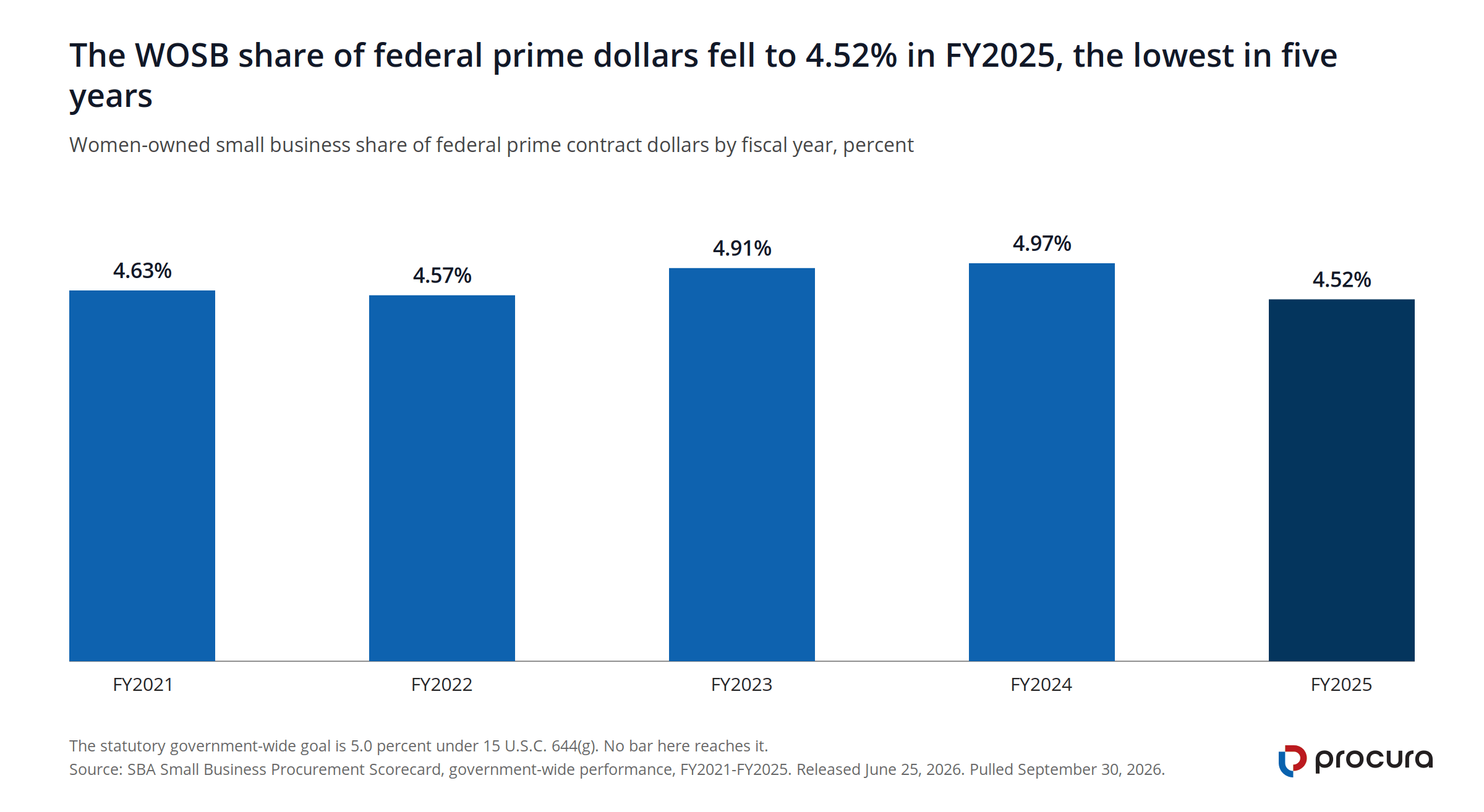
Data table: WOSB share of federal prime contract dollars, FY2021-FY2025
| Fiscal year | WOSB share of prime dollars | Statutory goal | Goal met |
|---|---|---|---|
| FY2021 | 4.63% | 5.00% | No |
| FY2022 | 4.57% | 5.00% | No |
| FY2023 | 4.91% | 5.00% | No |
| FY2024 | 4.97% | 5.00% | No |
| FY2025 | 4.52% | 5.00% | No |
Subcontracting is the quieter half of the picture, and it is the half that met its target. Agencies reported $16.3 billion in WOSB subcontract dollars in FY2025, or 5.67 percent against the same 5 percent goal. If prime set-asides look thin in your market, the path through a prime contractor is the one carrying the volume.
How much of that money comes through a set-aside?
Now the number that must drive your decision. Of those prime dollars, about $2.0 billion arrived through an actual WOSB set-aside or sole-source award. In other words, that is roughly 7 percent. The other 93 percent was won in full and open competition, in small business set-asides, or under another socioeconomic program. In short, certification is a key to one specific door, not a share of the whole market.
Which NAICS codes allow a WOSB set-aside?
733 of them, and the list is the first thing to check. A contracting officer can restrict competition under this program only in industries where SBA has found women-owned firms to be underrepresented. SBA publishes that list by NAICS code, and it splits into two categories that decide which tier can bid:
- 626 codes are designated substantially underrepresented. Every certified WOSB can receive a set-aside or sole-source award in these codes.
- 107 codes are designated underrepresented. Only a certified EDWOSB can receive a set-aside or sole-source award in these codes.
An EDWOSB can bid in all 733. In contrast, a WOSB that does not hold the EDWOSB tier is limited to the 626. That sounds like a strong argument for taking the harder financial test, but the spending data says otherwise. In FY2025, 96.3 percent of WOSB program set-aside obligations landed in the 626 WOSB codes and 1.9 percent landed in the 107 EDWOSB-only codes. The extra access the EDWOSB tier buys is worth about $25 million a year across the whole federal government.
Where did the WOSB set-aside money go in FY2025?
Look at the industries behind those two lists and the reason is obvious. EDWOSB-only codes cluster in landscaping, janitorial work, waste collection, and pest control. WOSB codes, on the other hand, carry the professional-services work where the program actually spends. Here is where the money went last year.
| NAICS | Industry | FY2025 obligations | Who can bid |
|---|---|---|---|
| 541519 | Other Computer Related Services | $292.2M | WOSB |
| 541330 | Engineering Services | $185.1M | WOSB |
| 541511 | Custom Computer Programming Services | $126.8M | WOSB |
| 541611 | Administrative and General Management Consulting | $90.5M | WOSB |
| 336419 | Other Guided Missile and Space Vehicle Parts | $77.5M | WOSB |
| 236220 | Commercial and Institutional Building Construction | $62.9M | WOSB |
| 541512 | Computer Systems Design Services | $47.1M | WOSB |
| 622110 | General Medical and Surgical Hospitals | $29.2M | WOSB |
| 561210 | Facilities Support Services | $25.6M | WOSB |
| 561730 | Landscaping Services | $4.1M | EDWOSB only |
| 561720 | Janitorial Services | $3.4M | EDWOSB only |
One caution about the list itself. It took effect on October 1, 2022, and it rests on a disparity study of FY2016 through FY2019 spending. The Small Business Act directs SBA to repeat that study every five years. However, as of September 30, 2026, no newer designation notice has appeared in the Federal Register. The list your contracting officer uses describes a market that closed seven years ago. Check your code against the current file before you build a capture plan around it.
What are the WOSB certification requirements?
Six tests, and most denials come from two of them. Your company must qualify as small for at least one NAICS code listed in its SAM profile. It must also clear the ownership and control rules in 13 CFR 127.201 and 127.202. The two that catch firms are unconditional direct ownership and real control, because both look at documents rather than intent.
| Requirement | WOSB | EDWOSB |
|---|---|---|
| Ownership by women who are U.S. citizens | At least 51%, direct and unconditional | At least 51%, direct and unconditional |
| Control of daily operations and long-term decisions | Yes | Yes |
| Small under the SAM-listed NAICS size standard | Yes | Yes |
| Personal net worth of the qualifying woman | No limit | Under $850,000 |
| Adjusted gross income, three-year average | No limit | $400,000 or less |
| Fair market value of all personal assets | No limit | $6.5 million or less |
| NAICS codes open to a set-aside | 626 | All 733 |
| Cost to certify through SBA | $0 | $0 |
What counts as economically disadvantaged for EDWOSB?
Three limits in 13 CFR 127.203, and the exclusions matter as much as the numbers. Personal net worth must be under $850,000, and that figure excludes your ownership interest in the business and the equity in your primary home. Adjusted gross income averaged over the previous three years above $400,000 creates a presumption against you, and the presumption can be rebutted. Fair market value of all your assets, this time including the house and the business, must stay at or under $6.5 million. In addition, money in a qualified retirement account does not count in either test.
Two details trip people up. SBA can look at a spouse’s finances when the spouse works in the business, lent it money, or guaranteed its loans. Assets you transferred to an immediate family member within two years of certification get counted back to you. The exception is a transfer that paid for education, medical care, or another form of essential support.
How do I get WOSB certified?

Through certifications.sba.gov, in five steps, with no fee at any point. Register your entity in SAM first, because SBA reads your size representation and your NAICS codes from that profile. Our SAM.gov registration walkthrough covers the mismatches that stall a new registration.
- Finish your SAM registration and confirm the NAICS codes and size representation are correct.
- Create an account at certifications.sba.gov and start a WOSB or EDWOSB application.
- Upload the corporate, financial, and tax records the portal asks for. The majority woman owner signs for their accuracy.
- Answer SBA requests for clarification inside the deadline given. SBA can read missing information against you.
- Wait for the determination. SBA makes it within 90 calendar days of a complete package whenever practicable.
Three shortcuts exist, and they are worth checking before you assemble a full package. A women-owned firm already in the 8(a) Business Development program qualifies as an EDWOSB. It can support the application with its most recent annual review. Similarly, a women-owned firm certified as a veteran-owned or service-disabled veteran-owned small business can use that certification as evidence. A firm certified by an SBA-approved third-party certifier submits that certification instead of building the file again. Read our breakdown of the 8(a) application before you decide which to pursue first.
Neither a denial nor a decertification is permanent. A declined firm can reapply after 90 days, once it has fixed the reason for decline. Decertified firms can reapply as soon as the problem is cured.
Is WOSB certification free?
Through SBA, yes. WOSB certification costs nothing at any stage, and the regulation makes the point unusually bluntly. 13 CFR 127.300 states that there is no cost to apply to SBA. However, 13 CFR 127.353 permits an approved third-party certifier to charge a reasonable fee. That certifier must first tell applicants in writing that SBA offers certification for free. SBA must also approve the wording of that notice.
Four organizations are currently approved to certify firms for this program:
- El Paso Hispanic Chamber of Commerce
- National Women Business Owners Corporation
- U.S. Women’s Chamber of Commerce
- Women’s Business Enterprise National Council
A paid certifier can still be the right choice. Several of them also issue the private Women’s Business Enterprise credential that corporate supplier-diversity programs ask for, so one process can serve two markets. SBA does not publish their fees. But SBA does say that third-party certification alone is not enough. You still upload proof of citizenship and the certifier’s documentation to SBA before you bid a set-aside.
How long does WOSB certification last?
Three years, measured from your certification date, and the renewal deadline arrives earlier than most firms expect. SBA or a third-party certifier runs a program examination every three years. You must recertify with SBA within 90 calendar days of the end of your eligibility period. Telling SBA that a third-party examination is finished does the same job. Miss that and SBA decertifies you on the end date, although a firm that recertifies within 30 days of the end date gets reinstated.
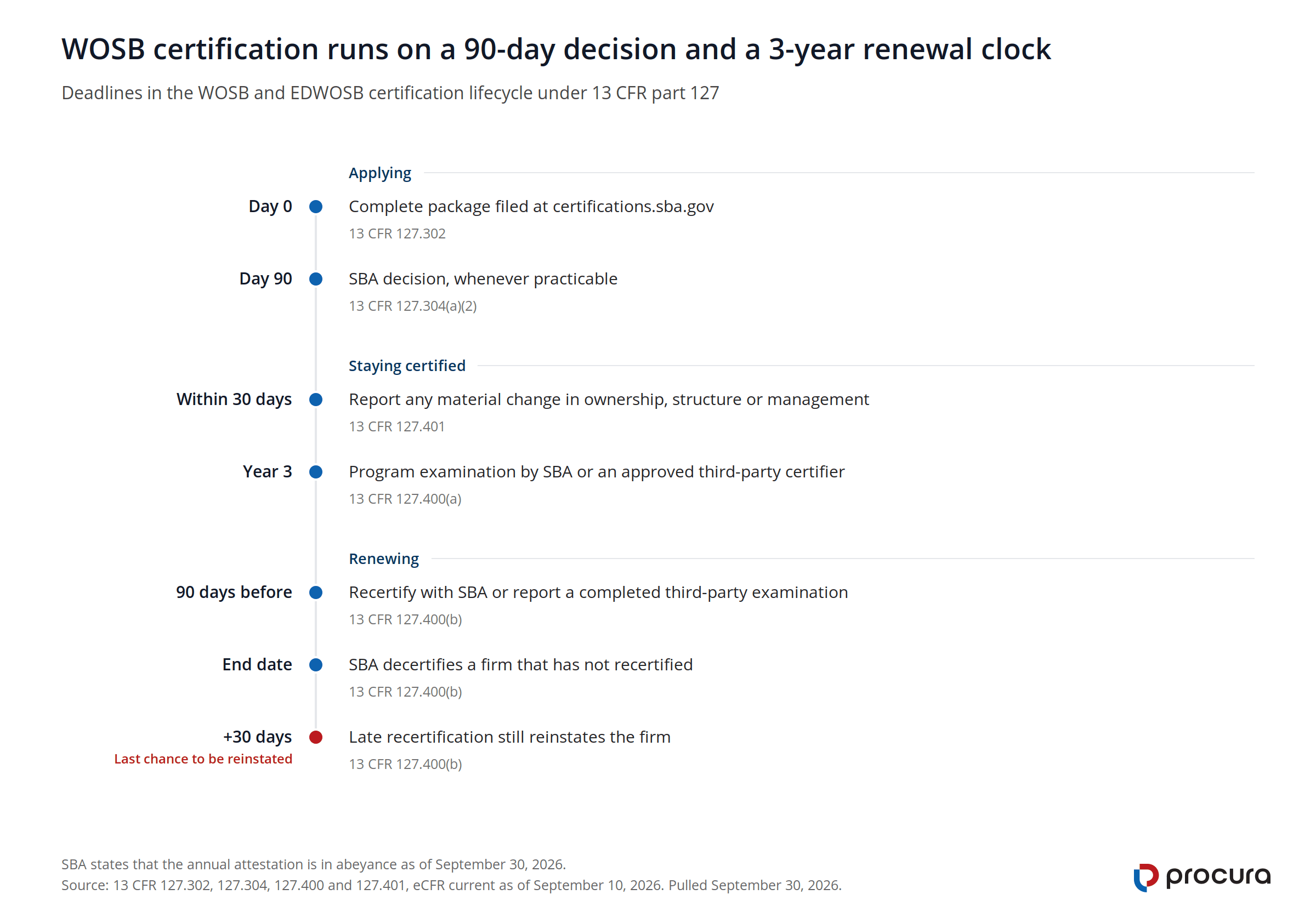
Two obligations run in between. A material change in ownership, business structure, or management must reach SBA in writing within 30 calendar days. SBA also requires an annual attestation within 30 days of your certification anniversary. However, as of September 30, 2026, SBA states on its own program page that the attestation is in abeyance. Check that page before you assume it is still paused.
A status protest resets the clock. When SBA confirms your eligibility after a competitor protests you, the date of that decision becomes your new certification date. A fresh three-year period then starts from there.
Which agencies actually buy through WOSB set-asides?
Mostly one. The Department of Defense obligated $693.3 million of the $1.28 billion that ran through WOSB program set-asides in FY2025, or 54 percent of the total. Homeland Security and Health and Human Services follow at $118.0 million and $113.2 million. No other department cleared $75 million.
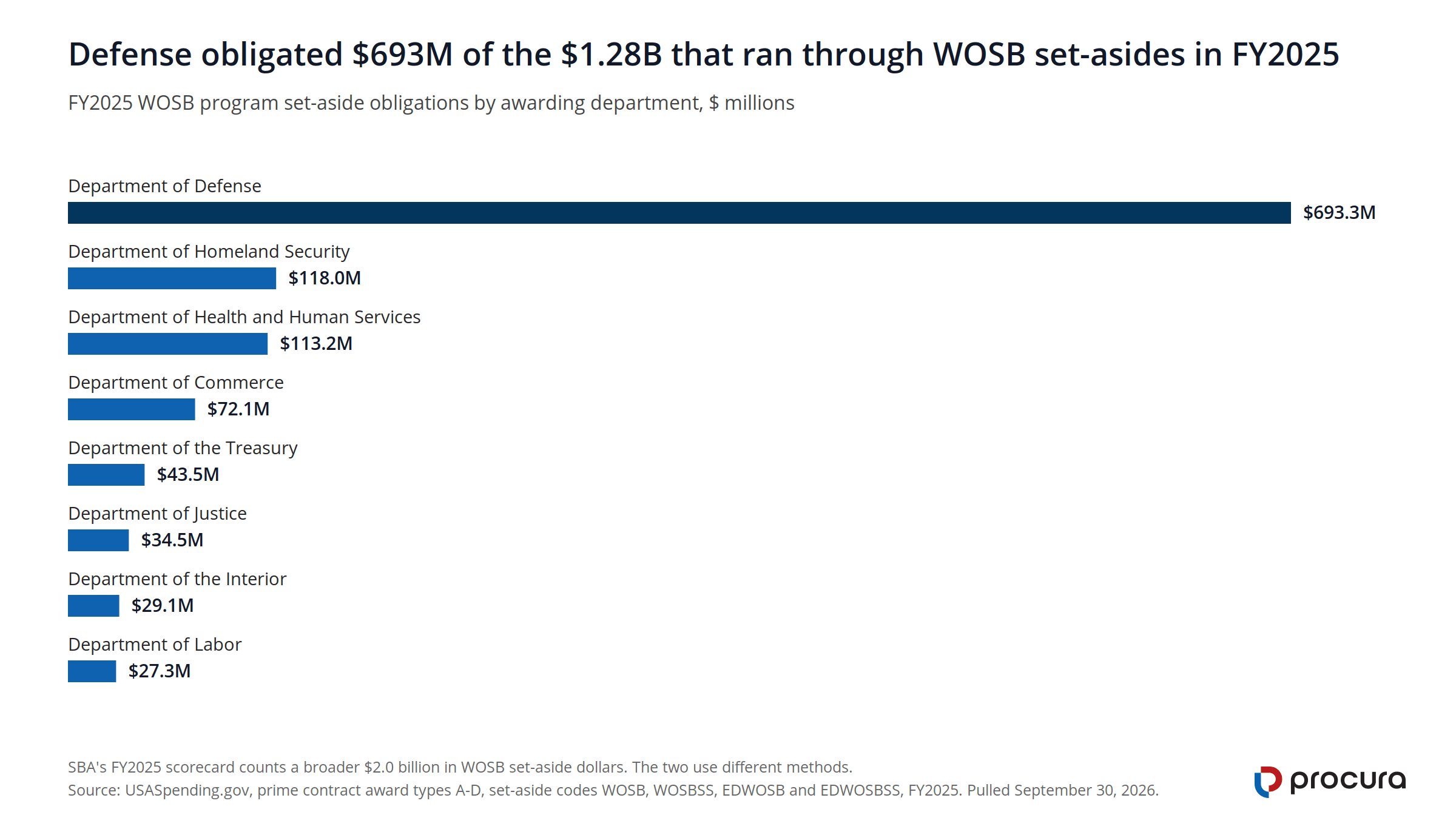
Data table: FY2025 WOSB set-aside obligations by awarding department
| Department | FY2025 WOSB set-aside obligations | Share of total |
|---|---|---|
| Defense | $693.3M | 54.4% |
| Homeland Security | $118.0M | 9.3% |
| Health and Human Services | $113.2M | 8.9% |
| Commerce | $72.1M | 5.7% |
| Treasury | $43.5M | 3.4% |
| Justice | $34.5M | 2.7% |
| Interior | $29.1M | 2.3% |
| Labor | $27.3M | 2.1% |
| All other agencies | $143.7M | 11.3% |
Individual awards are small. Those obligations were spread across 3,916 contract actions, which puts the average near $326,000. That number matches the shape of the program. A $4.5 million sole-source ceiling and a services-heavy NAICS list produce many modest awards, not a few large ones. If your capture plan assumes one $10 million WOSB set-aside will carry the year, the data does not support it. Instead, a realistic plan wins six or eight of these, which makes a clean past-performance record and fast, repeatable bidding the things that compound.
Two structural points follow from this. A WOSB set-aside can be used at or below the simplified acquisition threshold, so the micro-purchase and simplified acquisition lanes are open to you. A WOSB can also bid inside a joint venture, including one with an SBA-approved mentor. The WOSB must manage the venture and hold at least 51 percent of it. Our guide to joint ventures and mentor-protege agreements lists the clauses SBA checks.
What does the FAR overhaul change for WOSB set-asides?

Where the rules live, not what they say. Codified FAR puts the WOSB program in subpart 19.15, and that subpart is intact under FAC 2026-01. However, the FAR overhaul model text for Part 19, updated on September 23, 2026, has no subpart 19.15. Instead, it moves the program to section 19.107, next to HUBZone at 19.105 and 8(a) at 19.108. The substance survives the move. EDWOSB set-asides stay in underrepresented codes, WOSB set-asides stay in substantially underrepresented codes, and the two-offer test and SAM verification both remain.
One thing to watch. The codified FAR 19.203 says there is no order of precedence among the 8(a), HUBZone, SDVOSB, and WOSB programs. It tells contracting officers to consider all four before a plain small business set-aside. The overhaul model text carries no equivalent provision.
That absence is worth watching rather than acting on, because the overhaul is a model deviation document rather than codified regulation. Nothing has changed for the bid on your desk this week. Read the solicitation’s clause list instead of assuming that either version applies to it.
Everything else in the program held steady through 2026. SBA last amended part 127 in January 2025, and the 5 percent goal is statutory. The rulemaking that removed the 8(a) rebuttable presumption in August 2026 applies to 8(a) eligibility only. Compared with the churn in adjacent programs, that is worth saying plainly.
Certified. Now find the contracts that fit.
Certification is the easy half. Harder is the fact that 3,916 awards a year, spread across 320 NAICS codes and a dozen departments, do not announce themselves. A WOSB set-aside looks like every other solicitation until you open it. The facts that decide the bid sit in the attachments. The wage determination, the security requirements, the past-performance minimums, and the place of performance are all in there. Reading those by hand is what eats a small firm’s week.
Procura reads every solicitation and every attachment, scores the match against your capability statement, and flags the compliance requirements before you commit to a bid. The subscription runs $399/month. Legacy market-intelligence platforms quote five figures a year for the same shelf. When your awards average $326,000, that gap decides how many bids a week you can afford to work.
Two other doors lead into the same buildings. Our ranking of the easiest federal contracts for a new firm to win and our HUBZone requirements guide lay out each one. A strong capability statement is what makes each of them useful.
Questions about the WOSB program
Can I self-certify as a woman-owned small business?
You can self-certify in SAM, and that self-certification counts toward an agency’s WOSB goal. However, it does not qualify you for a WOSB or EDWOSB set-aside or sole-source award. Self-certification for set-aside purposes ended in October 2020.
Is WOSB certification the same as WBE certification?
No. WOSB is a federal contracting certification issued by SBA at no cost. By contrast, Women’s Business Enterprise is a private credential for corporate supplier-diversity programs. The organizations that issue it charge a fee. Some of those organizations run the two programs, which is why buyers confuse them.
Does 8(a) certification make me an EDWOSB?
If the 8(a) firm is owned and controlled by one or more women, yes. 13 CFR 127.300 treats a women-owned 8(a) participant as qualifying for EDWOSB. The firm can support its application with its most recent 8(a) annual review.
How long does WOSB certification take?
Plan on up to 90 days once your file is complete, and see the five steps above for what “complete” means. An incomplete upload is the most common cause of a long wait.
Can a WOSB set-aside be used for a small purchase?
Yes. 13 CFR 127.507 lets a contracting officer set aside a requirement at or below the simplified acquisition threshold, or award it sole-source. The same rules apply above and below that line.
Book a demo
See what Procura surfaces for your NAICS codes and your capability statement. Bring a solicitation you are unsure about and we will read it together.