Federal agencies obligated $1.41 billion on government catering contracts and food service work in fiscal 2025, per USASpending.gov. However, small businesses took $226.9 million of it, or 16.1 percent. Half of that small-business money came from a single buyer that almost no guide on this subject names.
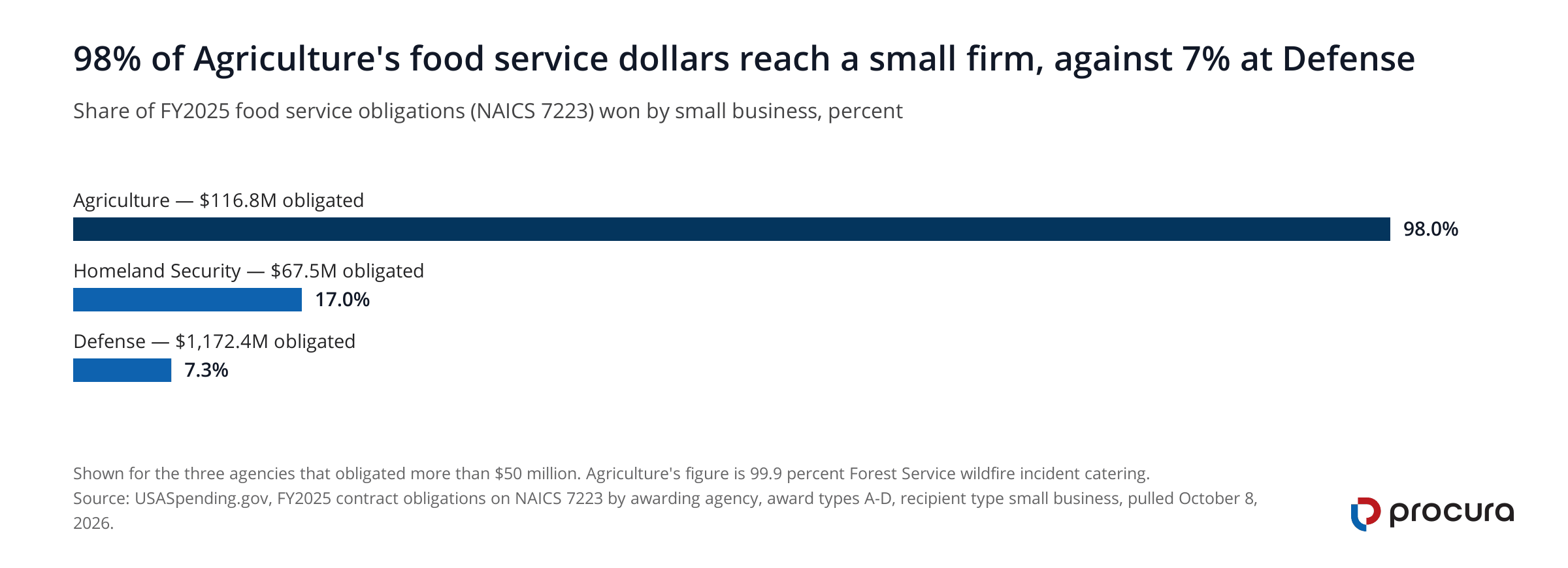
I run a small veteran-owned engineering firm and I read federal solicitations every week. In fact, the buyer that matters here is the Forest Service, and the work is feeding wildfire incident camps. It obligated $116.8 million in fiscal 2025 and sent 98 percent of it to small businesses. The Department of Defense obligated ten times as much and sent 7.3 percent. Most firms chase the big number and lose for two years.
How much does the government spend on catering and food service?
The food services industry group, NAICS 7223, carried $1.41 billion of federal contract obligations in fiscal 2025. In fact, almost all of it sits in one code. Food service contractors, NAICS 722310, took $1.38 billion of that total. Caterers, NAICS 722320, took $35.6 million, and mobile food services, NAICS 722330, took $1.3 million.
The money grows slowly and steadily. Specifically, obligations on NAICS 722310 moved from $1.16 billion in fiscal 2021 to $1.38 billion in fiscal 2025, a rise of 19 percent across four years. No single year jumped. A market like that rewards a firm that wins an incumbent position and holds it.
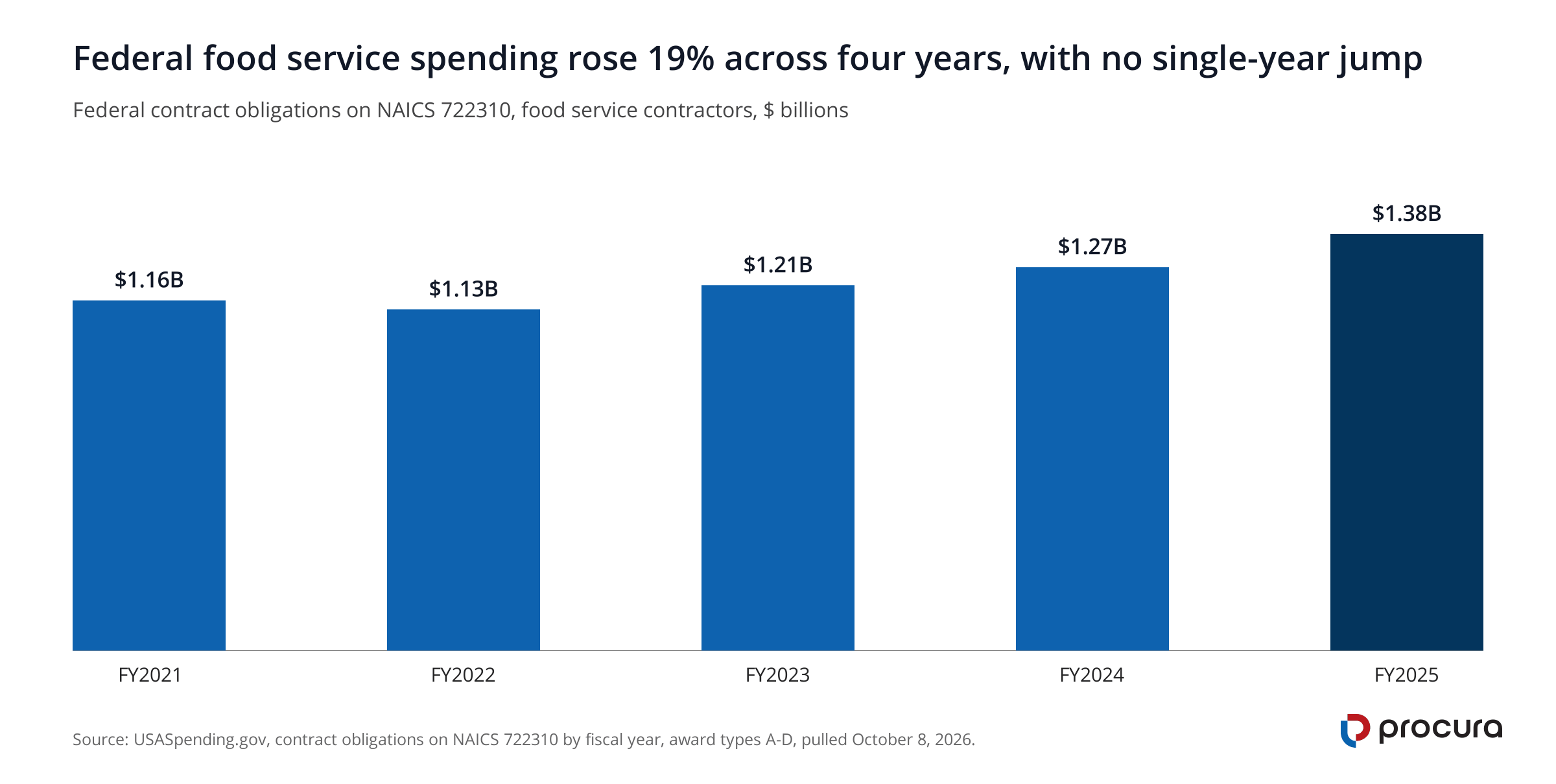
Data table: federal obligations on NAICS 722310 food service contractors by fiscal year
| Fiscal year | NAICS 722310 obligations | Change on the year |
|---|---|---|
| FY2021 | $1.16B | — |
| FY2022 | $1.13B | −2.6% |
| FY2023 | $1.21B | +7.1% |
| FY2024 | $1.27B | +5.0% |
| FY2025 | $1.38B | +8.7% |
Which agencies buy the most food service
One buyer dominates the spending. Specifically, the Department of Defense obligated $1.17 billion of the $1.41 billion, which is 83 percent. Agriculture came second at $116.8 million, and Homeland Security third at $67.5 million. Every civilian agency below Homeland Security is in single-digit or low-double-digit millions.
Add one more column and the ranking inverts. However, of the Pentagon’s $1.17 billion, small businesses took 7.3 percent. Of Agriculture’s $116.8 million, they took 98.0 percent. Homeland Security sits between the two at 17.0 percent. Size of budget and openness to a small firm run in opposite directions here.
| Awarding agency | FY2025 obligations, NAICS 7223 | Share of the total | Share won by small business |
|---|---|---|---|
| Department of Defense | $1.17B | 83.0% | 7.3% |
| Department of Agriculture | $116.8M | 8.3% | 98.0% |
| Department of Homeland Security | $67.5M | 4.8% | 17.0% |
| Department of Justice | $13.0M | 0.9% | — |
| Department of the Treasury | $10.1M | 0.7% | — |
| Department of State | $9.2M | 0.7% | — |
| Department of Veterans Affairs | $9.0M | 0.6% | — |
| Department of Transportation | $6.1M | 0.4% | — |
| General Services Administration | $2.7M | 0.2% | — |
| Department of the Interior | $2.5M | 0.2% | — |
Military food service contracts also carry base access, security vetting and head-count swings that a federal office building never will. Also, the same holds for the other large base-services markets, including government cleaning contracts.
Who actually wins government catering contracts?
Not the companies a newcomer expects. On the fiscal 2025 recipient list for NAICS 7223, eight of the top ten names are state agencies or nonprofit agencies rather than commercial caterers.
Two commercial firms do appear. Sodexo Management took $285.2 million, the largest single share, and Southern Foodservice Management took $32.5 million. Between and around them sit six state vocational rehabilitation or workforce agencies and two nonprofit agencies.
Those eight organizations collected $506.4 million, or 36 percent of all federal food service money. In fact, they are not winning on price or on proposal quality. Two federal programs put them ahead of you in line before a solicitation is written.
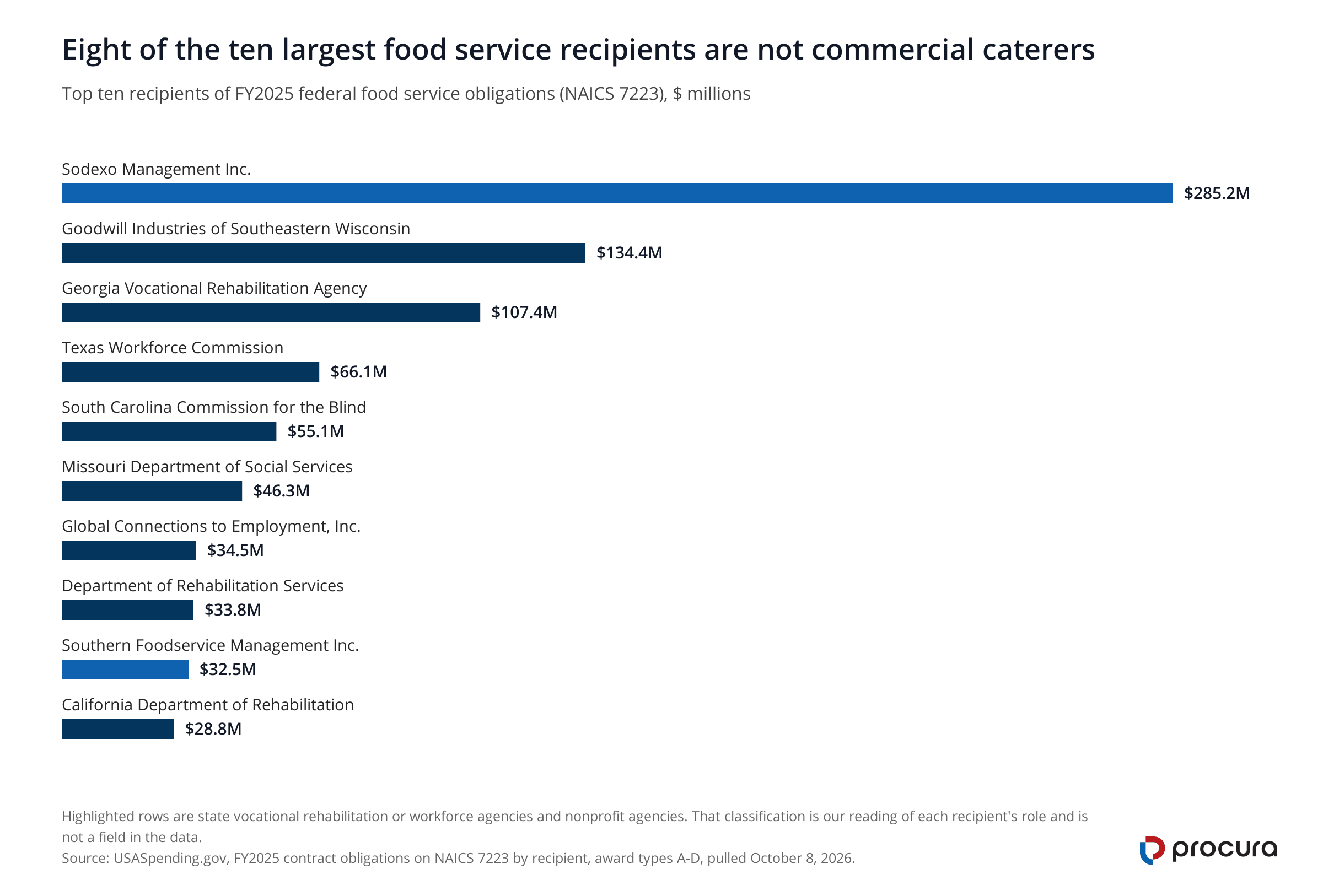
Data table: top ten recipients of federal NAICS 7223 obligations, fiscal 2025
| Recipient | FY2025 obligations | Organization type |
|---|---|---|
| Sodexo Management Inc. | $285.2M | Commercial food service contractor |
| Goodwill Industries of Southeastern Wisconsin, Inc. | $134.4M | Nonprofit agency |
| Georgia Vocational Rehabilitation Agency | $107.4M | State agency |
| Texas Workforce Commission | $66.1M | State agency |
| South Carolina Commission for the Blind | $55.1M | State agency |
| Missouri Department of Social Services | $46.3M | State agency |
| Global Connections to Employment, Inc. | $34.5M | Nonprofit agency |
| Department of Rehabilitation Services | $33.8M | State agency |
| Southern Foodservice Management Inc. | $32.5M | Commercial food service contractor |
| California Department of Rehabilitation | $28.8M | State agency |
Why does the AbilityOne list outrank your set-aside?
The only mandatory source for services
FAR 8.002 lists the mandatory government sources an agency must satisfy a requirement from, in descending order of priority. However, for supplies the list has five entries. For services it has exactly one: services on the Procurement List kept by the Committee for Purchase From People Who Are Blind or Severely Disabled. That is the AbilityOne Program, and its statute is 41 U.S.C. chapter 85.
Read what that ranking does. In practice, a small-business set-aside under FAR Part 19 is a competition among small firms. The AbilityOne priority is not a competition at all.
Here is the sequence. First, a named service at a named installation goes onto the Procurement List by Committee decision. Your contracting officer must then order that service from the designated nonprofit agency. No solicitation appears on SAM.gov, so no bid of yours gets to the contracting officer. AbilityOne reports that its nonprofit agencies serve 25 million meals a year.
The practical rule is short. Before you spend a week on a dining facility opportunity, read the Procurement List. Make sure that the site and the service are not already on it. The Committee publishes the list, and each addition appears in the Federal Register as a procurement list addition notice.
What happened to the Randolph-Sheppard priority at Army dining facilities?
Program two is older, and it moved twice in the last year. The Randolph-Sheppard Act, 20 U.S.C. 107, gives blind vendors a priority on federal property. State licensing agencies administer that priority in the rules at 34 C.F.R. Part 395. Courts and arbitration panels have long read that priority to cover the operation of a military dining facility. The six state agencies in the recipient table are those licensing agencies.
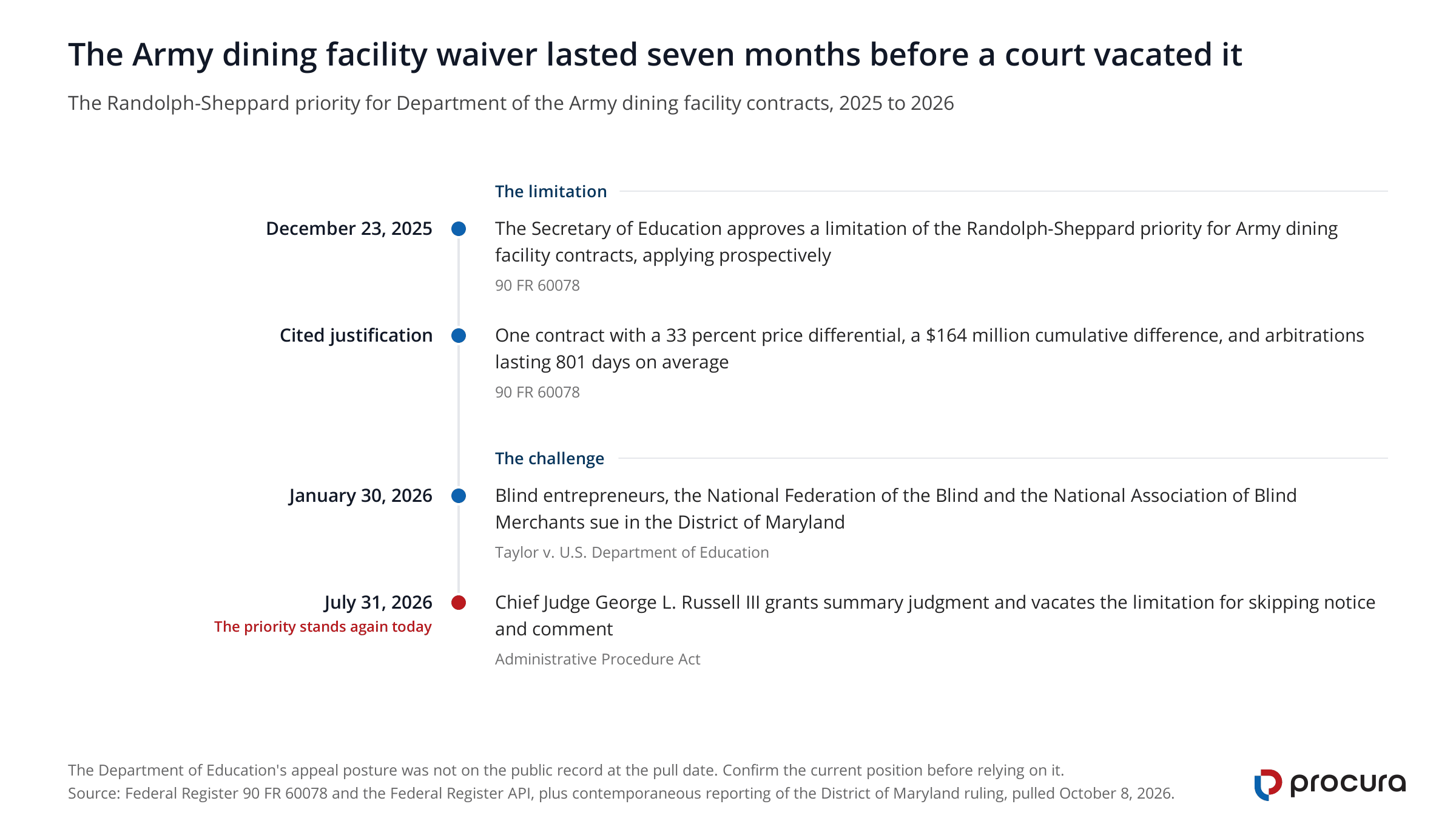
On December 23, 2025 the Secretary of Education approved a limitation of that priority for Army dining facility contracts, published at 90 FR 60078. Specifically, the notice found that the priority “adversely affects the interests of the United States” as applied to those contracts. It cited one contract with a 33 percent price difference, a $164 million cumulative difference across five years, and arbitrations that averaged 801 days. The limitation applied only to Army contracts entered into after publication.
The court ruling on the Army dining facility waiver
It did not survive. However, blind entrepreneurs and two advocacy groups sued in the District of Maryland on January 30, 2026. The plaintiffs were the National Federation of the Blind and the National Association of Blind Merchants. On July 31, 2026 Chief Judge George L. Russell III granted them summary judgment and vacated the Secretary’s decision. The court held that the Department of Education skipped the notice-and-comment process the Administrative Procedure Act requires. The opinion added that the decision was also arbitrary and capricious, but the court did not rule on that question.
So the priority stands today. As a result, a plan built on its removal is a plan built on one district court docket. Confirm the current posture before you price an Army dining facility bid.

Which federal buyer gives small businesses the most food service work?
The Forest Service, and the work is wildfire catering. Specifically, of Agriculture’s $116.8 million on NAICS 7223 in fiscal 2025, the Forest Service awarded $116.7 million. That is 99.9 percent of the department’s food service spending, and it is 8.3 percent of the entire federal total. Small businesses took 98.0 percent of it.
Put those two facts together. In fact, the Forest Service alone accounts for 50.4 percent of every small-business dollar in federal food service. Strip Agriculture out of the national figures and the small-business share of the remaining $1.30 billion falls to 8.7 percent. One agency, feeding fire camps, is half of this market for a small firm.
Most government catering contracts in this lane are mobile catering at wildfire incident base camps. In practice, a contractor brings a kitchen unit, staff and supplies to a staging area and feeds crews for the length of an incident. Recipient names in the fiscal 2025 data read like what they are. The list includes Big Sky Mobile Catering, Thunder Mountain Catering, Mother Lode Firecamp Services and D F Zee’s Firefighting Catering. Not one of them is a national food service company.
The vehicle you need for Forest Service work
One caution keeps this from being a free lunch. Specifically, delivery orders carried $108.0 million of the $116.8 million, which is 92.5 percent. A delivery order runs against a contract you already hold, so that money goes to firms already on a Forest Service incident catering vehicle. Purchase orders, the path open to a firm with no vehicle, carried $8.6 million.
The vehicle is the whole game, and the field is small. Overall, those 272 awards went to 59 distinct recipients, at a median award of $222,566, with 49 awards above $1 million. Getting onto the vehicle during a solicitation cycle matters more than any single bid. Watch for the Forest Service national incident catering solicitations and treat the off-cycle purchase orders as practice.
Data table: Agriculture NAICS 7223 obligations by award type and NAICS code, fiscal 2025
| Cut | Category | FY2025 obligations | Share |
|---|---|---|---|
| Award type | Delivery order | $108.04M | 92.5% |
| Award type | Purchase order | $8.56M | 7.3% |
| Award type | Other (type A) | $0.17M | 0.1% |
| NAICS | 722310 Food service contractors | $111.63M | 95.6% |
| NAICS | 722320 Caterers | $4.71M | 4.0% |
| NAICS | 722330 Mobile food services | $0.44M | 0.4% |
Which food service NAICS code should you bid under?
Code choice matters less than most guides claim, because NAICS 722310 holds both markets described above. For example, fire camp catering and a Fort Bragg dining facility are both coded 722310. So the national small-business share of that code, 14.5 percent, averages a wide-open market with a closed one. Narrow it to the Pentagon and the figure falls to 5.7 percent.
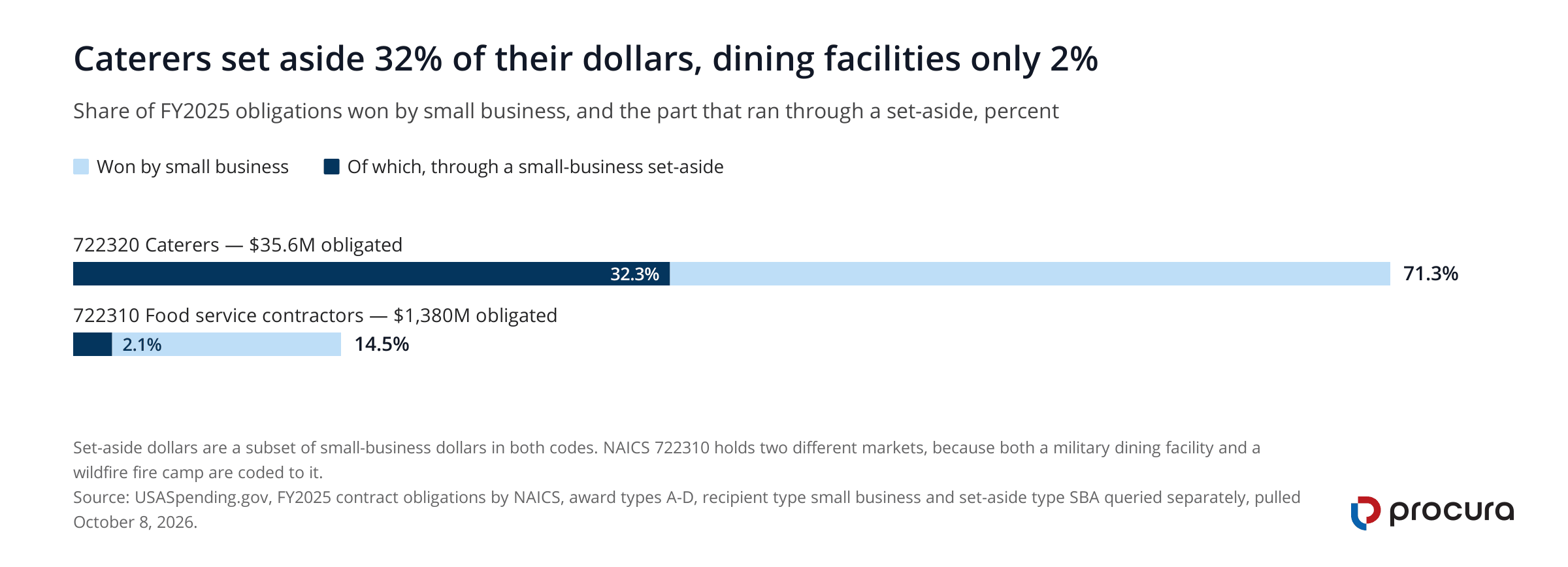
Set-aside rates add the other half of the picture. However, only $29.4 million of the food service contractor money, 2.1 percent, ran through a total small-business set-aside. On the caterer code the figure was $11.5 million of $35.6 million, or 32.3 percent. The Forest Service used no set-aside at all, because it does not need one.
Size standards for government catering contracts
Size standards cut the other way, and the gap is wide. For example, a food service contractor stays small up to $47.0 million in average annual receipts. A caterer stays small at $9.0 million. So the code with the open set-aside lane also carries the tightest ceiling. A growing caterer leaves the small-business category five times sooner than a dining facility operator.
| NAICS | Industry | SBA size standard | FY2025 obligations | Small-business share | Set-aside share |
|---|---|---|---|---|---|
| 722310 | Food service contractors | $47.0M in receipts | $1.38B | 14.5% | 2.1% |
| 722320 | Caterers | $9.0M in receipts | $35.6M | 71.3% | 32.3% |
| 722330 | Mobile food services | $9.0M in receipts | $1.3M | — | — |
| 722511 | Full-service restaurants | $11.5M in receipts | — | — | — |
| 722514 | Cafeterias, grill buffets and buffets | $34.0M in receipts | — | — | — |
Pick the code that matches the work you really do, and never pick a code to win a size argument. In practice, a contracting officer assigns the code to the requirement, not to your preference. Our guide to the easiest government contracts to win runs the same test across other federal markets.
Where are government food contracts posted?
Two different markets hide behind the phrase government food service contracts, and firms waste months in the wrong one. Food service is labor. It is posted on SAM.gov under the NAICS 7223 codes above and under product service code S203. Food products are commodities. The Defense Logistics Agency buys those as the Department of Defense Executive Agent for Subsistence. It runs much of that buying through its own Troop Support systems rather than only through SAM.gov.
The distinction changes everything downstream. As a result, a labor contract brings wage determinations, installation access and staffing risk. A commodity contract brings packaging specifications, delivery windows and a technical data package. Our guide to bidding on DLA DIBBS explains the quoting rhythm on the commodity side. Note that Agriculture’s school and nutrition program food purchases are commodity buys and do not appear in the 7223 service codes at all.
Register once before either path. Then the entity registration in SAM.gov issues your Unique Entity ID and the representations every solicitation reads. Our SAM.gov registration guide gives the timeline and the data mismatches that stall it.
What does a federal food service contract require that a private job does not?
Labor law, mostly, and it arrives earlier than most owners expect. The McNamara-O’Hara Service Contract Act, 41 U.S.C. chapter 67, applies to a prime service contract over $2,500. It obliges you to pay each service employee the prevailing wage and fringe benefits in a wage determination the agency attaches to the contract. Cooks, food service workers and dining attendants all carry their own labor categories in that determination.
That $2,500 figure does double duty, and the second job surprises people. FAR 2.101 sets the micro-purchase threshold at $15,000, but for services subject to the Service Contract Act it drops to $2,500. For example, a government credit-card buy of a catered lunch above $2,500 is no longer a simple micro-purchase. Our Service Contract Act compliance guide works through the wage determination mechanics.
Labor thresholds that apply to food service
| Threshold or rule | Current value | What it means for a food contract | Citation |
|---|---|---|---|
| Micro-purchase threshold | $15,000 | Below it a card buy needs no competition, but see the next row. | FAR 2.101 |
| Micro-purchase threshold, Service Contract Act services | $2,500 | Catering labor above this figure leaves the simple card-buy path. | FAR 2.101 |
| Service Contract Act applies | Over $2,500 | A wage determination governs what you must pay your staff. | 41 U.S.C. 6702 |
| Simplified acquisition threshold | $350,000 | Up to this figure the buy must be set aside for small business unless the contracting officer expects fewer than two competitive small-business offers. | FAR 2.101, FAR 19.502-2(a) |
| Above the simplified acquisition threshold | No ceiling | The rule of two still requires a set-aside when two responsible small businesses are expected to offer fair market prices. | FAR 19.502-2(b) |
One correction worth making, because it circulates widely. Also, there is no DFARS subpart on military dining facility food services. The Department proposed one in 2016 under DFARS Case 2015-D012, and it was never finalized. DFARS 237.73 today covers services of students at research laboratories. The rules that bind an Army dining facility bid live in the statutes and in 34 C.F.R. Part 395, not in a defense acquisition subpart.
Which small businesses win this work, and what do their contracts look like?
They exist, they are few, and they are bigger than a local caterer. Specifically, the largest set-aside awards on NAICS 7223 in fiscal 2025 went to Rice Services, which held two Defense contracts at $33.9 million and $33.4 million. Below those two the awards drop sharply. Native Resource Development took $9.9 million, and the rest of the top ten sit between $2.1 million and $3.6 million.
Read the shape of that list rather than the names. In fact, two awards carry two thirds of the set-aside money in the top ten, and everything else is a single-site contract in the low millions. The realistic first win for a new entrant is one of those small ones, at one installation, on one dining facility or one catering requirement.
Data table: largest small-business set-aside awards on NAICS 7223, fiscal 2025
| Award ID | Recipient | FY2025 obligations | Awarding agency |
|---|---|---|---|
| N0018922C0016 | Rice Services, Inc. | $33.9M | Department of Defense |
| W911SD22C0003 | Rice Services, Inc. | $33.4M | Department of Defense |
| FA820120C0005 | Native Resource Development Co Inc | $9.9M | Department of Defense |
| FA480024C0009 | Leota Professional Resources, LLC | $3.6M | Department of Defense |
| FA282321C0009 | Crystal Enterprises, Inc. | $3.6M | Department of Defense |
| FA483020C0012 | International Service Contractors LLC | $3.3M | Department of Defense |
| N6883625C0003 | Crystal Enterprises, Inc. | $2.9M | Department of Defense |
| 70Z08418CA1151300 | Selrico Services Inc | $2.8M | Department of Homeland Security |
| W81K0220P0096 | Dilligas Corp | $2.3M | Department of Defense |
| 70B03C22P00000488 | Western Foods Group Inc | $2.1M | Department of Homeland Security |
Two paths to a first award
Two paths shorten the wait for that first contract. Second, a subcontract under a commercial incumbent puts your staff on a base without a prime award. Our guide to winning government subcontracts explains that approach. The second path is uncomfortable for some owners and worth naming plainly. A state licensing agency or an AbilityOne nonprofit agency that holds a dining facility contract still needs an operating partner. A teaming agreement with the organization that holds the priority beats a competition against it.
Registered, sized and compliant: the hard part is still ahead
Everything above is setup work with a clear finish. However, the part with no finish is the weekly question of which food service posting deserves a bid. A dining facility solicitation carries a performance work statement and a wage determination with dozens of labor categories. It also carries a head-count history, sanitation standards and installation access terms. The term that kills your margin is almost always in an attachment and not in the posting summary. On a market where the largest buyer sends 7.3 percent of its money to small business, a wasted bid costs more than it does elsewhere.
That reading is the work Procura does. Specifically, it opens every attachment on a posting and scores the requirement against the capability statement you wrote. The wage and compliance terms that move your price get flagged on the same pass. Procura costs $399/month. A legacy market-intelligence seat for the same job runs into five figures a year. Our guide to the tools that find federal contracts prices them vendor by vendor.
Research this market for free. Procura’s free explorer has pages for NAICS 722310 (food service contractors) and NAICS 722320 (caterers), with the agencies that buy each code, the largest contractors and open opportunities. The Forest Service page shows that buyer’s spending by office and industry. Browsing is free and needs no login, and a free Procura account lets you save what you find and export the data.
Frequently asked questions
How do you get catering contracts with the government as a small company?
Through the caterer code, because that is where the odds sit. Also, event and off-site meal work under NAICS 722320 is a $35.6 million federal market, and small firms hold most of it. Start with buys below the simplified acquisition threshold at a nearby installation or federal building. Those are the awards a single-site caterer can staff.
What is the difference between full food service and dining facility attendant work?
Management responsibility. Specifically, full food service means a contractor runs the facility and makes the daily decisions, including the menu and the ordering. Dining facility attendant work, also called mess attendant service, is support labor on the serving line and in sanitation under government management. The two scopes attract different buyers and different competition, so read which one a solicitation actually asks for.
Does the Service Contract Act apply to a one-day catered event?
It applies when the prime contract exceeds $2,500, and a single large event clears that figure easily. However, duration is not the test. Price the wage determination into a one-day job exactly as you would price a five-year dining facility contract. The labor categories and fringe rates are identical.
How do you get government food contracts for products rather than labor?
Through the Defense Logistics Agency and the Agriculture Department, under manufacturing and wholesale codes instead of the 7223 service codes. Those buys turn on specifications, packaging and delivery performance. A food manufacturer or distributor must treat the commodity path as its primary market, and treat the service codes as a different business.
Is a federal dining facility contract worth bidding if the Randolph-Sheppard priority applies?
Sometimes, because the priority is conditional rather than absolute. A state licensing agency must submit a responsive proposal and meet the solicitation criteria to receive it. When no licensing agency competes at a given site, the award follows normal procedures. Confirm the position at that installation before you commit proposal money.
Book a demo
Bring a real food service posting to a 20-minute call. We will run it through Procura while you watch. You will see the fit score and the wage and compliance terms it found in the attachments. Then judge whether that reading is worth $399 a month.
By Jacob Grass · Published October 16, 2026 · Last updated October 16, 2026