
How to respond to an RFP from a federal agency comes down to four things. Also, the proposal must arrive on time. It must be organized the way Section L demands. It must answer every factor in Section M at a price the contracting officer can defend. To see what you are up against, I pulled a population of federal awards. It is every definitive contract of $1 million or more awarded under a competed small-business set-aside in fiscal 2023, 2024 and 2025. Of those, 4,950 used negotiated-proposal procedures, which are the FAR Part 15 competitions this guide is about. The median number of offers received was three, and 53.2% drew three or fewer.
That number changes the math on a bid decision. I run a small veteran-owned engineering firm, and I read federal solicitations every week. The fear that stops firms from bidding is a picture of forty polished competitors. The data says the room usually holds three or four, and one of them did not read the instructions.
What is an RFP in government contracting?
An RFP, or request for proposals, is the solicitation a federal agency issues under FAR Part 15. An agency uses it when the award turns on more than price. It asks for a written proposal, it names the evaluation factors in advance, and it allows negotiation before award. In other words, that makes it different from the two documents small firms see more often.
A request for quotations, or RFQ, is the instrument for simplified acquisitions and for orders against vehicles you already hold. Specifically, below the $350,000 simplified acquisition threshold it runs under FAR Part 13. For commercial products and services, FAR Subpart 13.5 carries the same simplified procedures up to $9 million. The ceiling rises to $15 million for the contingency and emergency buys at FAR 13.500(c). RFQs also run with no dollar ceiling against Federal Supply Schedules under FAR 8.405 and against multiple-award contracts under FAR 16.505. Award usually turns on price, delivery and technical acceptability.
By contrast, an invitation for bids, or IFB, runs under FAR Part 14 sealed bidding. Then the low responsive bid wins and no negotiation happens. Finally, a request for information, or RFI, buys the agency market research and awards nothing.
Of the 8,109 contracts in that population with reported data, 4,950 used negotiated-proposal procedures, 2,215 used sealed bidding, and 648 used simplified acquisition. That split describes definitive contracts of $1 million or more and nothing else. The filter excludes the purchase orders and the vehicle orders that most quotations produce.
RFP vs RFQ vs IFB: which instrument you face
Which instrument you face decides how much work a response takes and what recourse you keep after you lose. However, the Part 15 competition is where you get discussions, a debriefing as a matter of right, and a documented trade-off decision you can test. Task and delivery orders above $7.5 million carry a FAR 15.506 debriefing as well, under FAR 16.505(b)(6).
| Document | Authority | What wins | Negotiation | What you submit |
|---|---|---|---|---|
| RFP (request for proposals) | FAR Part 15 | Best value against stated factors | Yes, with the competitive range | Technical, past performance, price volumes |
| RFQ (request for quotations) | FAR Part 13, to $9M for commercial items under Subpart 13.5; FAR 8.405 and 16.505 for orders | Price, delivery, technical acceptability | No formal discussions | A quote, often one page plus attachments |
| IFB (invitation for bids) | FAR Part 14 | Lowest responsive, responsible bid | None | A sealed bid on the agency form |
| RFI / market research | FAR 15.201(e); sources-sought notices under FAR Part 10 and FAR 5.204 | Nothing is awarded | Not applicable | A capability statement |
How many offers does a federal RFP actually draw?
Half of the competitions I measured drew three or fewer. Overall, across the 4,950 definitive contracts awarded under negotiated-proposal procedures in fiscal 2023 through fiscal 2025, 53.2% received three offers or fewer. The median count was three. That is every award in the population and not a sample of it. The scope is worth stating plainly: $1 million and up, definitive contracts only, competed small-business set-asides only.
One caveat belongs with that headline. For example, research and development codes make up 2,779 of those awards, with 2,584 of them in NAICS 541715 alone. Many are Small Business Innovation Research awards, where a single offer is the design of the program and not a sign of weak competition. Remove every 5417 research code and 2,171 awards remain. A median of three holds, and 54.1% still drew three offers or fewer. The share that drew exactly one offer falls from 29.4% to 18.8%.
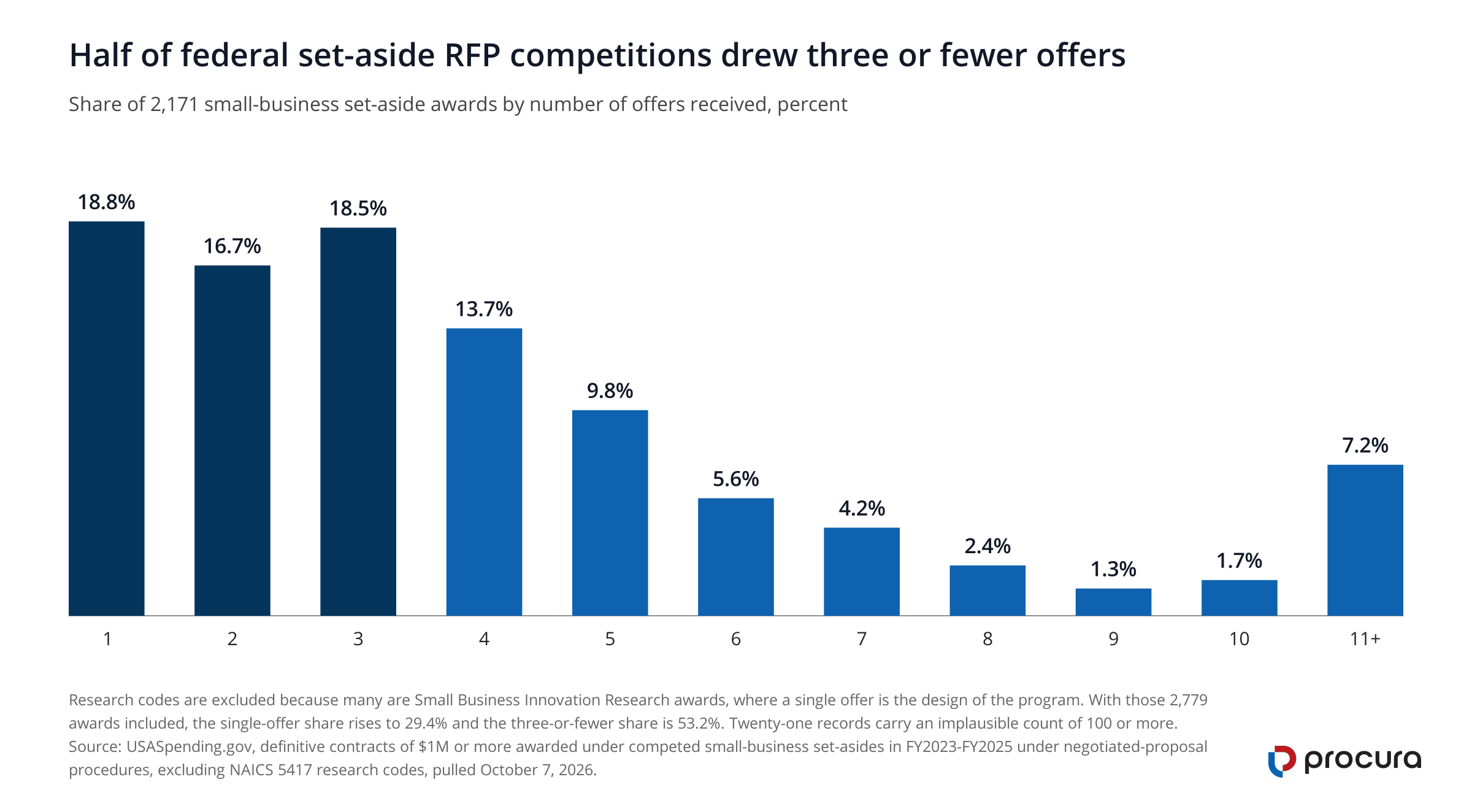
Data table: number of offers received, awards and share
| Offers received | Awards | Share | Cumulative |
|---|---|---|---|
| 1 | 409 | 18.8% | 18.8% |
| 2 | 363 | 16.7% | 35.6% |
| 3 | 402 | 18.5% | 54.1% |
| 4 | 297 | 13.7% | 67.8% |
| 5 | 212 | 9.8% | 77.5% |
| 6 | 122 | 5.6% | 83.1% |
| 7 | 91 | 4.2% | 87.3% |
| 8 | 53 | 2.4% | 89.8% |
| 9 | 29 | 1.3% | 91.1% |
| 10 | 37 | 1.7% | 92.8% |
| 11 or more | 156 | 7.2% | 100.0% |
Offer counts by award size
The size pattern inside that population surprised me, because it runs the wrong way. In other words, small awards are the least competed, not the most. Among the non-research awards, 20.4% of contracts between $1 million and $5 million drew a single offer. Above $25 million the single-offer share falls to 14.6%. A firm that skips the $2 million set-aside because it assumes a crowd skips the thinnest competition on the board.
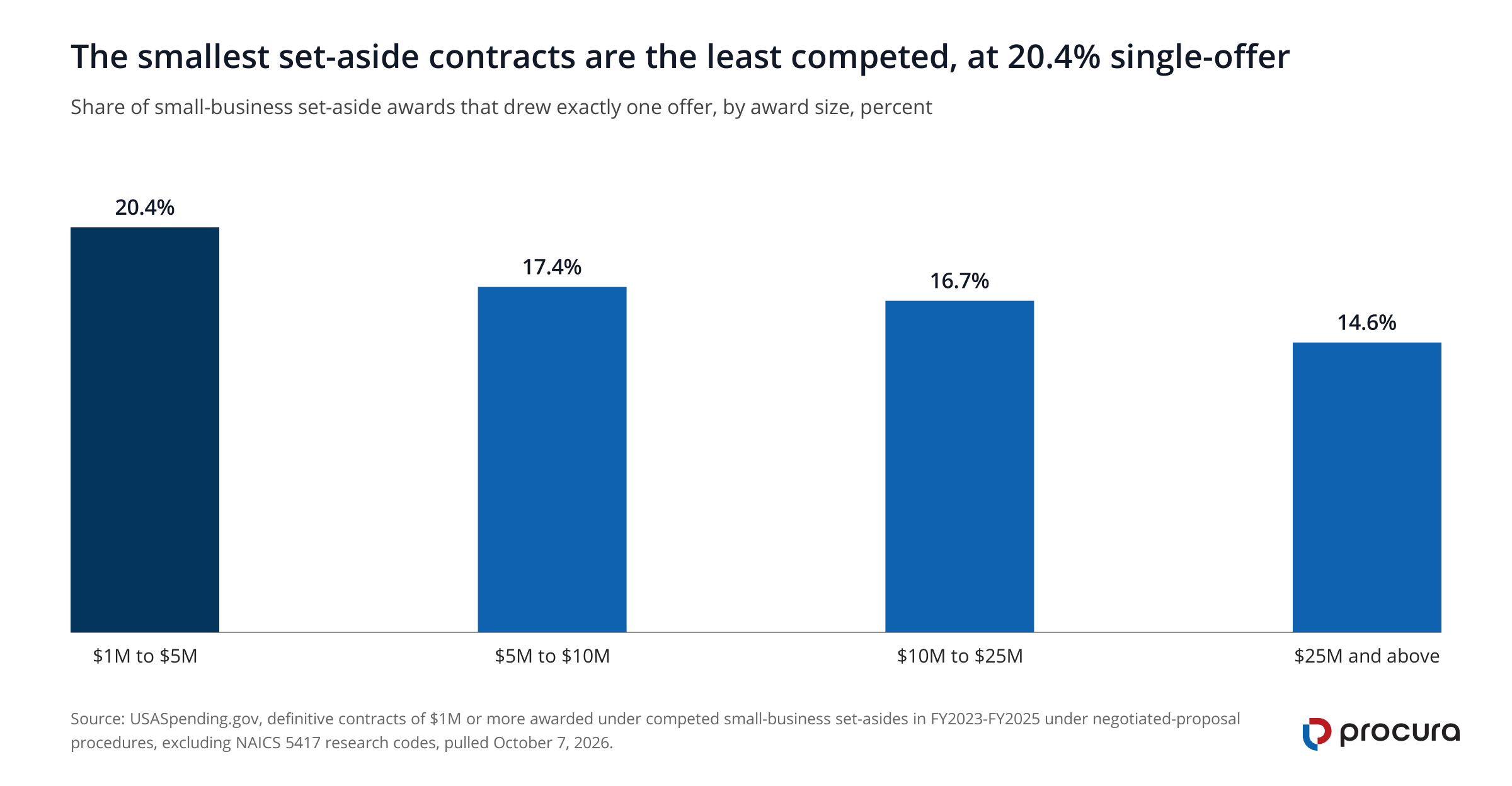
Data table: awards, median offers, single-offer share and three-or-fewer share by award size
| Award size | Awards | Median offers | One offer only | Three or fewer |
|---|---|---|---|---|
| $1M to $5M | 1,280 | 3 | 20.4% | 53.1% |
| $5M to $10M | 380 | 3 | 17.4% | 57.4% |
| $10M to $25M | 353 | 3 | 16.7% | 56.1% |
| $25M and above | 158 | 4 | 14.6% | 49.4% |
Two things hold that number down. The set-aside rule is the first. First, FAR 19.502-2(b) tells a contracting officer to set an acquisition aside for small business above the simplified acquisition threshold. The test is a reasonable expectation of offers from at least two responsible small firms at fair market prices. Two, not twenty.
Scope is the second. In short, a narrow statement of work narrows the bidder pool on its own. The agencies that write the narrowest scopes already know who does the work.
Where small-business set-aside dollars go
Scale matters for the other half of the decision. Overall, Federal agencies obligated $778.5 billion on contracts in FY2025, and $58.3 billion of that carried a small-business set-aside or sole-source code. The largest single code is the total small business set-aside, at $32.8 billion. Its award-type mix decides how a firm reaches the money. Delivery orders carried 42.3% of it and calls against blanket purchase agreements another 3.9%, so 46.2% went to firms that already held the vehicle. Definitive contracts took 39.7% and purchase orders 14.2%.
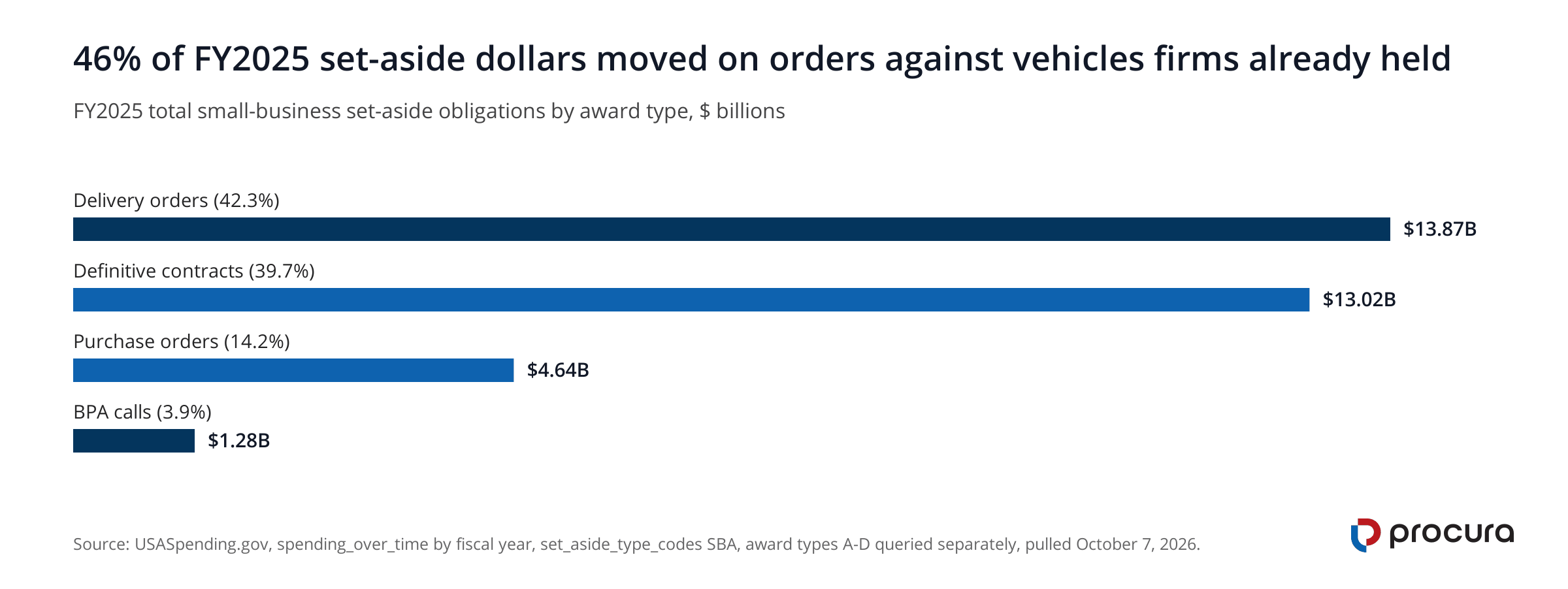
Data table: FY2025 small-business set-aside obligations and share by award type
| Award type | FY2025 obligations | Share | Needs an existing vehicle |
|---|---|---|---|
| Delivery orders | $13.87B | 42.3% | Yes |
| Definitive contracts | $13.02B | 39.7% | No |
| Purchase orders | $4.64B | 14.2% | No |
| BPA calls | $1.28B | 3.9% | Yes |
| Total | $32.81B | 100.0% | — |
Thus the competition a newcomer can enter cold is the $13.0 billion of definitive contracts plus the $4.6 billion of purchase orders. The rest is an argument for getting on a GSA Schedule or winning federal subcontracts first.

Where are the rules hiding in the solicitation?
How to respond to an RFP begins with two sections of the document, and not with the writing. In fact, they decide whether your proposal gets read and how it gets scored. FAR 15.204-1 requires contracting officers to build solicitations on the uniform contract format in Table 15-1. In that format, Section L holds the instructions and Section M holds the evaluation factors. Everything a rival needs to beat you sits in those two sections, which are also the two that first-time bidders skim.
How to respond to an RFP using Section L and Section M
Section L carries the title “Instructions, conditions, and notices to offerors or respondents.” It sets the volume structure, the page limits, the font, the file-naming convention, and the submission portal. For example, FAR 15.204-5 allows the agency to demand the proposal in severable parts: administrative, management, technical, past performance, and certified cost or pricing data. Miss a volume and the contracting officer gets a reason to stop reading.
Section M carries the title “Evaluation factors for award,” and it is the scoring rubric. Also, FAR 15.304(d) requires the agency to state all factors and significant subfactors, with their relative importance, in the solicitation. Under FAR 15.304(e) the solicitation must also rank the non-price factors against price: significantly more important, approximately equal, or significantly less important. One narrow exception at FAR 15.304(c)(1)(ii)(A) covers certain multiple-award buys. FAR 15.305(a) then binds the evaluators. An agency must assess proposals “solely on the factors and subfactors specified in the solicitation.” The word doing the work is solely.
That one word is the reason the most useful hour of proposal work is not writing. Build a compliance matrix first. Then give every Section L instruction and every Section M factor its own row. Against each row, name the page and paragraph of your proposal that answers it. Leave no row blank.
Then write the technical volume in Section M order, under Section M headings, in Section M vocabulary. In practice, an evaluator with a checklist will not hunt for your answer, and nothing outside the stated factors can earn you a point.
The uniform contract format, section by section
| Section | Title | What it governs |
|---|---|---|
| A | Solicitation/contract form | The cover form and the closing date |
| B | Supplies or services and prices/costs | The pricing schedule you fill in |
| C | Description/specifications/statement of work | The work itself |
| D | Packaging and marking | Delivery packaging |
| E | Inspection and acceptance | How the agency accepts the work |
| F | Deliveries or performance | Schedule and period of performance |
| G | Contract administration data | Invoicing and the administering office |
| H | Special contract requirements | Clauses written for this buy |
| I | Contract clauses | The FAR clauses that bind you |
| J | List of attachments | The wage determination, the drawings, the specs |
| K | Representations, certifications, and other statements of offerors or respondents | Your size and socioeconomic status |
| L | Instructions, conditions, and notices to offerors or respondents | How to build and submit the proposal |
| M | Evaluation factors for award | How the proposal is scored |
Section J deserves its own warning, because it is a list and not a document. However, the requirements that decide your margin arrive as attachments. A wage determination resets your labor rates, a drawing package changes your material take-off, and a specification can name a qualified-products list.
A Service Contract Act wage determination in a janitorial RFP changes the price of the same scope. So does a Davis-Bacon determination in a construction RFP. For example, bid at your commercial rate and the determination takes the difference out of your margin for the life of the contract.
What makes a proposal late, and what saves it?
A proposal that arrives after the exact time in the solicitation is late. FAR 15.208(b)(1) says it “will not be considered” unless three conditions all hold. The agency has not yet made award. The contracting officer decides that acceptance would not unduly delay the acquisition. And one of three narrow exceptions applies. All three legs are necessary, which is why the late-proposal rule almost never rescues anybody.
Read the first exception closely, because it is the only one you control. An electronic proposal is excused only when it reached the first point of entry to the government infrastructure in time. That time is 5:00 p.m. one working day before proposals are due. A proposal uploaded at 1:55 p.m. for a 2:00 p.m. deadline, which then fails in the portal, has no exception. The rule rewards exactly one behavior: submit a day early.
Exceptions to the late rule
| Exception | What it requires | Cite |
|---|---|---|
| Early electronic receipt | Received at the initial point of entry to the government infrastructure by 5:00 p.m. one working day before the due date | FAR 15.208(b)(1)(i) |
| Government control | Acceptable evidence that it reached the designated installation and was under government control before the deadline | FAR 15.208(b)(1)(ii) |
| Only proposal received | It was the only proposal the agency received | FAR 15.208(b)(1)(iii) |
| Favorable late modification | A late change to an otherwise successful proposal that improves the terms for the government | FAR 15.208(b)(2) |
Two details catch firms that work the two sides of the threshold. When a solicitation names no time, FAR 15.208(a) sets a default of 4:30 p.m. local time at the designated office. A silent solicitation is not a solicitation without a deadline. The commercial-item rule at FAR 52.212-1(f)(2)(i)(C) is narrower still. It limits the only-offer exception to solicitations that are requests for proposals, so a sole late quote under an RFQ has no exception.
What happens between your submission and the award?
The agency either awards on initial proposals or opens discussions, and the two paths demand different things from you. FAR 52.212-1(g) states the commercial default plainly. The government intends to award without discussions, so the initial offer must carry your best price and technical terms. Many Part 15 solicitations say the same. Write the first submission as the only submission.
When the agency does open discussions, it first builds a competitive range. FAR 15.306(c)(1) requires that range to hold all of the most highly rated proposals. FAR 15.306(c)(2) allows the contracting officer to cut it for efficiency, but only when the solicitation gave notice of that possibility. Inside the range, FAR 15.306(d)(3) obliges the contracting officer to raise three things with you. Those are your deficiencies, your significant weaknesses, and adverse past performance you have not yet answered. Outside the range you get a notice and nothing else.
Those terms carry definitions, and the definitions decide what the agency owes you. FAR 15.001 makes a weakness a flaw that increases the risk of unsuccessful performance. A significant weakness is a flaw that appreciably increases that risk. A deficiency is a material failure to meet a government requirement. It can also be a group of significant weaknesses that push risk to an unacceptable level. One adverb separates a flaw the contracting officer must raise from a flaw that sinks your score in silence.
What the award notice tells you
The notice that follows award carries more than most firms read. FAR 15.503(b)(1) requires written notice within three days of award to each offeror that was in the competitive range and did not win. That notice must state five things. They are the number of offerors solicited and the number of proposals received. They are also the name and address of each awardee. The last two are the items and quantities and stated unit prices of each award, and the general reason your proposal failed.
The fourth item is the one nobody asks about. In writing, the government tells you what the winner charged, line by line where that is practicable, or at minimum the total contract price. Offeror counts are public in FPDS, and the whole data section above is built on that field. Unit prices from the awardee usually are not public, and they are the figure that sets your price-to-win next time. If you were notified before award that you were out of the competitive range, FAR 15.503(b)(3) gives you the same information on request.

How do you get a debriefing, and when is a protest worth it?
Request the debriefing in writing within three days, every time you lose. Under FAR 15.506(a)(1) a written request received within three days of the award notice earns a debriefing as a matter of right. The agency target for delivery is five days. FAR 15.506(a)(3) holds the trap. Miss the window and you lose the entitlement, though FAR 15.506(a)(4)(i) lets an agency accommodate a late request if it chooses. FAR 15.505(a)(3) adds the other limit: no proposal earns more than one debriefing.
FAR 15.506(d) specifies what a post-award debriefing must contain, and it is more than a courtesy call. The agency must show how it evaluated the significant weaknesses and deficiencies in your proposal. It must give the evaluated cost or price and the technical rating for you and for the awardee. It must give the rationale for award, and the overall ranking when the agency developed one. FAR 15.506(d)(6) adds one more duty. The agency must give reasonable responses to relevant questions about whether it followed its own source selection procedures. That paragraph, and not the ratings, is where a protest ground is usually found. FAR 15.506(e) sets the limit. No point-by-point comparison with other proposals, and no cost breakdowns, profit, or indirect rates that belong to another firm.
Enhanced debriefings on Defense awards
Department of Defense awards valued at $15 million or more add one more step. At that threshold DFARS 215.506(b) makes a debriefing necessary on request. DFARS 215.506-70 then gives you two business days after the debriefing to submit more written questions. The agency must answer in writing within five business days. The debriefing is not concluded until that written answer arrives. On a DoD award above $15 million and up to $150 million, a small business can also request the source selection decision document. The agency redacts it for other firms’ proprietary information.
Below $15 million none of that applies, and most of the competitions in the size bands above fall below it. Where it does apply, two days of drafting questions buys real decision time, because the protest clocks run from the conclusion of the debriefing.
Protest deadlines after a debriefing
One detail here costs firms their remedy. Timeliness and the automatic stay run on two different clocks, and the shorter clock is not the one firms watch. Under 4 C.F.R. 21.2(a)(2) a protest is timely when you file it after the offered debriefing date. You must also file it within ten days after the debriefing is held. That rule applies where you requested a debriefing and the debriefing was necessary. Under 31 U.S.C. 3553(d)(4)(A) the stay of contract performance attaches on a different deadline. It is the later of ten days after award or five days after the offered debriefing date.
On a common schedule the debriefing lands around day 11 after award, so the operative deadline is the offered debriefing date plus five. A protest filed on day eight after that debriefing is perfectly timely, the stay never attaches, and the awardee keeps working. The practical value of winning falls hard.
The stay rule that changes the timing
One rule reverses that arithmetic. Under 31 U.S.C. 3553(d)(4)(B), the five-day period on a Department of Defense procurement starts later. It starts on the day the government delivers its written answers to enhanced-debriefing questions. On a DoD award at or above $15 million where you asked questions, the stay window can run well past day eight. The safe practice is the same either way. Calendar the offered debriefing date, add five days, and file inside that window. Do not file before the debriefing date.
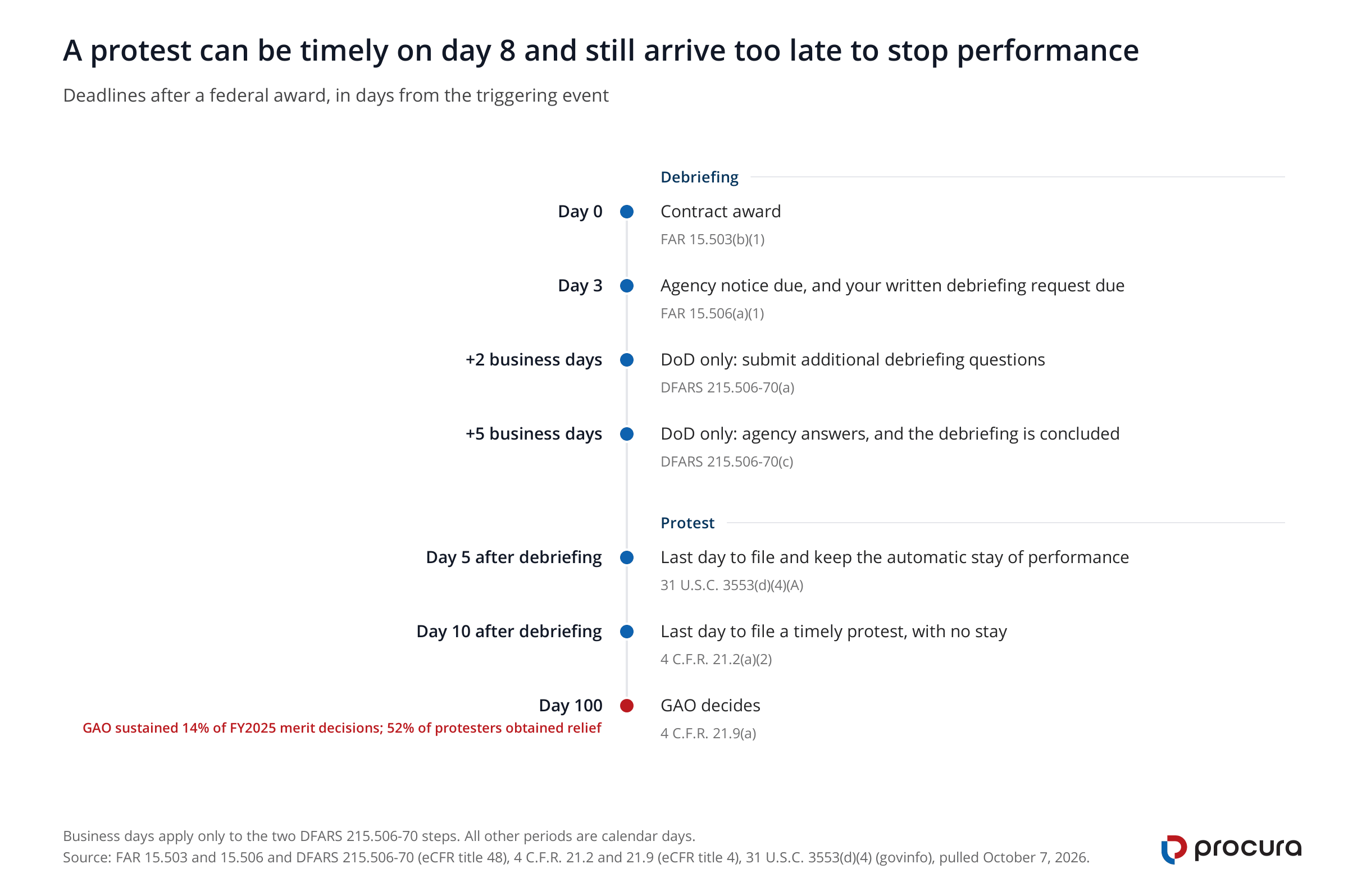
| Action | Deadline | Clock starts | Cite |
|---|---|---|---|
| Protest a defect in the solicitation | Before the closing time for receipt of proposals | When the defect is apparent | 4 C.F.R. 21.2(a)(1) |
| Request a post-award debriefing | 3 days | Receipt of the award notice | FAR 15.506(a)(1) |
| Request a pre-award debriefing | 3 days | Notice of exclusion from the competition | FAR 15.505(a)(1) |
| Submit enhanced debriefing questions (DoD awards of $15M or more) | 2 business days | Receipt of the debriefing | DFARS 215.506-70(a) |
| File a protest that is timely | Not before the offered debriefing date, and not later than 10 days after the debriefing is held | The debriefing, where one was requested and was required | 4 C.F.R. 21.2(a)(2) |
| File a protest that stays performance | Later of 10 days after award or 5 days after the offered debriefing date | Award, or the debriefing date | 31 U.S.C. 3553(d)(4)(A) |
| GAO decides | 100 days | The date the protest is filed | 4 C.F.R. 21.9(a) |
How often bid protests succeed
The odds are better than the folklore suggests, and worse than a hopeful reading of them. GAO took in 1,688 cases in FY2025, down 6% from the year before, and issued 380 decisions on the merits. It sustained 53 of those, a sustain rate of 14%.
But the figure that matters to a protester is the effectiveness rate. That rate counts every protester who obtained some form of relief, including the ones whose agency took corrective action instead of defending the award. In FY2025 it was 52%. GAO held a hearing in three cases.
Why GAO sustained those 53 protests is the most useful line in the report for a bidder. The three most prevalent grounds in FY2025 were unreasonable technical evaluation, unreasonable cost or price evaluation, and unreasonable rejection of a proposal. Each one is an agency error in applying its own Section M, and not a defect in the loser’s writing. That is the second argument for the compliance matrix. A proposal mapped line by line to the stated factors is the record that makes an unreasonable evaluation visible.
What does government proposal writing cost a small firm?
Government proposal writing costs a small firm one to three weeks of senior time on a first serious Part 15 response. That cost is more recoverable than most owners realize. FAR 31.205-18 defines bid and proposal costs as the costs of preparing, submitting, and supporting bids and proposals. FAR 31.205-18(c) makes them allowable as an indirect expense where they are allocable and reasonable.
Put them in the right pool. FAR 31.205-18(b)(2)(i) allocates bid and proposal costs on the same basis as your general and administrative expense, and not your overhead. A DCAA auditor looks for exactly that. There is also no deferral, because the relief at FAR 31.205-18(d) covers independent research and development alone. So the cost lands in the accounting period where you incur it, and on a cost-reimbursement or rate-based contract it flows through your G&A rate. Our guide to DCAA compliance explains the accounting system that makes that allocation survive an audit.
Thresholds that change proposal costs
Two thresholds change the shape of the work before you start. FAR 15.403-4(a)(1) sets the certified cost or pricing data threshold at $2.5 million. In a competitive RFP the exception at FAR 15.403-1(b)(1) usually applies, because adequate price competition bars the contracting officer from demanding certified data. Expect a full cost volume when you are the only credible offeror, on a cost-reimbursement buy, or where the agency finds competition inadequate. Above the $350,000 simplified acquisition threshold, FAR 15.304(c)(3)(i) makes past performance an evaluation factor in almost every negotiated competitive buy.
A firm with no federal history then needs references it can document. FAR 15.305(a)(2)(iv) protects a firm with no record at all. An offeror without relevant past performance cannot be evaluated favorably or unfavorably on it, and a neutral rating beats a bad one.
Bid discipline is the rest of the answer. Price the proposal effort first. Compare it against the odds the figures above support. Then no-bid every competition where Section M demands a past-performance profile you cannot show. Four careful proposals a year into fields of three or four offers beat twelve careless ones. And the CPARS rating from the first win is the asset that makes the next five easier.
The proposal is not the hard part. Finding the right RFP is.
How to respond to an RFP is a learnable procedure, and everything above is mechanical. Learn Section L, build a compliance matrix, submit a day early, and ask for every debriefing. None of that work is beyond a two-person firm.
The hard part sits earlier, and it is a reading problem. SAM.gov publishes tens of thousands of active notices. The compliance requirements live in attachments that no search engine indexes. A small firm must open hundreds of documents to find the four worth a proposal. That is where the bid year is really lost.
Procura Federal was built for that step. It opens every RFP and every Section J attachment, rates each requirement against your capability statement, and marks the compliance terms that decide the price. At $399/month it costs a fraction of a legacy market-intelligence seat. Those seats run keyword search on notice titles and leave the attachments to you.
An honest comparison owes those platforms this much: they carry deeper historical award analytics and larger teaming databases. A firm with a full-time capture manager gets real value from that depth. When the capture manager is you, after hours, the reading is the constraint.
Two things come first. Keep an active SAM.gov registration, and write a capability statement that names the codes you want. Then pick one competition in the size band above. Read Section M before Section C. Write the proposal the evaluator holds a checklist to score.
Research the buyer and the incumbent before you write a word. Procura’s free agency pages show which offices buy what, contractor profiles show an incumbent’s current contracts and end dates, and the contracts explorer surfaces large contracts ending soon. No login is needed to browse, and a free account adds saving and data exports.
Frequently asked questions
What is the difference between an RFP and an RFQ?
An RFP runs under FAR Part 15 and evaluates stated factors beyond price, with negotiation available. An RFQ runs under FAR Part 13 and generally turns on price and delivery. The comparison table above gives the authority and the submission for each.
How long does a government RFP give you to respond?
Two clocks, not one. FAR 5.203(a) requires the presolicitation notice at least 15 days before the agency issues the solicitation. FAR 5.203(c) then requires at least a 30-day response time from the date the solicitation is issued. That applies to any action expected to exceed the simplified acquisition threshold. Commercial products and services are excepted under FAR 5.203(b), and research and development actions get at least 45 days under FAR 5.203(e). Section A carries the exact date and time, and an amendment can move it.
Can you ask the contracting officer questions about an RFP?
Yes, and Section L sets the cut-off date and the format. Submit questions in writing by that date. The answers arrive as a formal amendment to every offeror. So a well-aimed question improves the solicitation for your competitors as well.
What should you do before responding to a government RFP?
Read Section M first, then Section L, then the Section J attachment list. Read the statement of work last. How to respond to a government RFP is decided in those three places. They tell you what gets scored, how the proposal must be submitted, and which attachment resets your price. A bid-or-no-bid call made after reading them costs an hour and saves a week.
What is a response to an RFP called?
A proposal, and the firm that submits one is an offeror. Call the response to an RFQ a quotation, and the response to an invitation for bids a bid. The FAR uses the three words precisely, and so do contracting officers.
Should a brand new company respond to a government RFP?
Sometimes, and the deciding factor is Section M rather than your age. A neutral past-performance rating under FAR 15.305(a)(2)(iv) is survivable, but a factor that demands three similar federal contracts is not. New firms generally do better starting with the competitions that ask least of a first-time bidder or with a subcontract.
Do you need a teaming agreement to bid a large RFP?
Only when a Section M factor or a Section C requirement exceeds what your firm can show on its own. The instrument matters as much as the decision, and our guide to teaming agreements and joint ventures covers which structure keeps your small-business status intact.