

The Service Contract Act applies to every federal service contract in excess of $2,500. In FY2025 those contracts covered $361.2 billion in federal service obligations, per USASpending.gov. However, two of the rules on most compliance checklists are now gone. First, Executive Order 14236 revoked the federal contractor minimum wage in March 2025. Second, Executive Order 14148 revoked the right of first refusal for successor contractors in January 2025, and the Department of Labor then struck its regulation from the Code of Federal Regulations in December 2025.
I read federal janitorial, grounds, and support-services solicitations every week. Yet the number that decides these jobs is never in the price schedule. Instead, it is the occupation code on the wage determination, plus the fringe stack underneath it. Miss by forty cents an hour on a crew of thirty, and a five-year base operations contract hands that money back to the government one shift at a time.
What does the Service Contract Act apply to?
To begin with, coverage starts at 41 U.S.C. 6702(a). The statute reaches any contract in excess of $2,500. First, that contract must have services as its principal purpose. Second, service employees must perform those services in the United States. Because the dollar figure has not moved in decades, nearly every federal services action clears it.
In particular, two words in that sentence do the work. Principal purpose separates a services buy from a supply buy that happens to include labor. Meanwhile, service employee excludes bona fide executive, administrative, and professional employees, which is why a pure engineering-consulting contract often carries no wage determination at all.
Service Contract Act coverage above $2,500
Once you clear $2,500, the full statute applies. The agency must request a Department of Labor wage determination, and FAR 52.222-41 goes into the contract. You then owe the listed minimum wages and fringe benefits for each classification. By contrast, at or below $2,500, no wage determination and no fringe obligation attach. In that case only the Fair Labor Standards Act minimum of $7.25 per hour applies, under FAR 22.1002-4.
Service Contract Act versus Davis-Bacon
Meanwhile, the sibling statute is the one contractors confuse this with. While Davis-Bacon covers construction, alteration, and repair above $2,000, this statute covers services such as custodial work, grounds maintenance, guard services, food service, and logistics support. In practice a base operations contract routinely carries both, under two separate wage determinations. For the construction half, see our Davis-Bacon Act guide.
| Trigger | What it turns on | Citation |
|---|---|---|
| Service contract at or below $2,500 | Fair Labor Standards Act minimum wage only, currently $7.25 per hour | FAR 22.1002-4 |
| Service contract in excess of $2,500 | Wage determination, minimum monetary wages, fringe benefits, safety and health, recordkeeping | 41 U.S.C. 6702(a); FAR 22.1006(a) |
| A predecessor contractor’s collective bargaining agreement | Successor pays the agreement’s wages and fringe benefits instead of the wage determination | 29 CFR 4.1b |
| Classification missing from the wage determination | A conformance request on Standard Form 1444 | 29 CFR 4.6(b)(2) |
| A revised wage determination on an option exercise | A contract price adjustment for the increased labor cost | FAR 52.222-43 |
| Contract awarded 2015 through January 29, 2022 and never renewed since | Executive Order 13658 floor of $13.65 per hour, effective May 11, 2026 through December 31, 2026 | 91 FR 5783 |
What is the Service Contract Act health and welfare rate in 2026?
The standard health and welfare rate is $5.92 per hour, which All Agency Memorandum 252 set in August 2026. However, contracts covered by Executive Order 13706, which requires paid sick leave, carry a lower rate of $5.42 per hour. Hawaii also runs on its own schedule, because of the Prepaid Health Care Act.
In any case, check the prior year before you trust a competitor’s spreadsheet. The 2025 rate was $5.55, and the 2024 rate was $5.36. Even so, plenty of published guidance still quotes the 2024 figure. As a result, a $0.37 per hour error across one full-time employee costs $769.60 a year, and across a crew of forty it costs $30,784.
| Health and welfare rate | Per hour | Per week | Per month |
|---|---|---|---|
| Standard, not covered by EO 13706 | $5.92 | $236.80 | $1,026.13 |
| Covered by EO 13706 paid sick leave | $5.42 | $216.80 | $939.46 |
| Hawaii, employee covered by the Prepaid Health Care Act | $2.51 | $100.40 | $435.07 |
| Hawaii, Prepaid Health Care Act plus EO 13706 | $2.01 | $80.40 | $348.40 |
| Hawaii, employee not receiving Prepaid Health Care Act benefits | $5.92, or $5.42 under EO 13706 | — | — |
How the fringe obligation works in practice
In practice, three mechanics catch new contractors. First, you owe health and welfare for all hours paid. That covers vacation, sick leave, and holidays, up to 40 hours per week and 2,080 hours per year. At $5.92 that is $12,313.60 per full-time employee per year. Second, the obligation runs per individual employee under the fixed-rate method, so you cannot average a rich plan for one worker against a thin one for another. Third, a new rate does not apply to a contract already running. Instead, it lands at the next option exercise, and FAR 52.222-43 then gives you a price adjustment for the increase.

What is the minimum wage for federal contractors in 2026?
In fact, for almost every service contract awarded today, no executive-order minimum wage applies at all. Instead, the floor is the rate your wage determination lists for the classification. This is the single most out-of-date fact in published Service Contract Act guidance, so it is worth reading twice.
What happened to Executive Order 14026
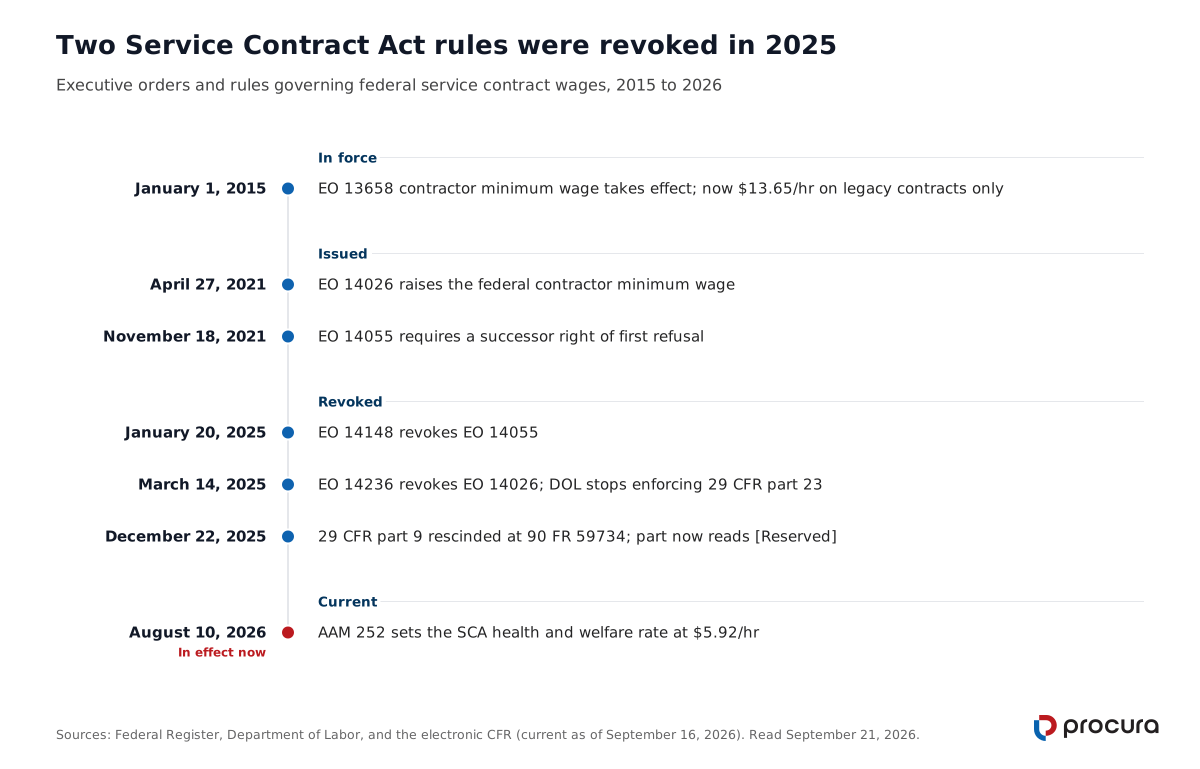
Executive Order 14026 set a contractor minimum wage that reached $17.75 per hour. However, Executive Order 14236 revoked it on March 14, 2025. The Department of Labor now states plainly that it no longer enforces Executive Order 14026 or its implementing rule at 29 CFR part 23. Still, one caution belongs here: as of the September 16, 2026 edition of the electronic Code of Federal Regulations, part 23 remains codified. In other words, the rule is revoked and unenforced, but nobody has struck the regulation yet.
Executive Order 13658 survives, though it is narrow. Its rate is $13.65 per hour, with a tipped cash wage of $9.55, and it steps again at the end of 2026. Moreover, it reaches only contracts awarded between January 1, 2015 and January 29, 2022 that nobody has renewed or extended since January 30, 2022, so that set shrinks every year. The current standard wage determination text carries the Executive Order 13658 note. By contrast, it carries no Executive Order 14026 note at all. Reading your own determination is the fastest way to confirm this.
Therefore, read the rate off the document in your solicitation rather than off any guide, including this one. Whatever wage determination your contract carries is the number that binds you.
Which agencies buy Service Contract Act covered services?
Overall, federal agencies obligated $361.2 billion in FY2025 on service contracts, after removing research and development and construction-type codes, per USASpending.gov. That came across 502,822 prime contract awards. In short, services are the larger half of federal contracting, not a niche.
Where small businesses actually win
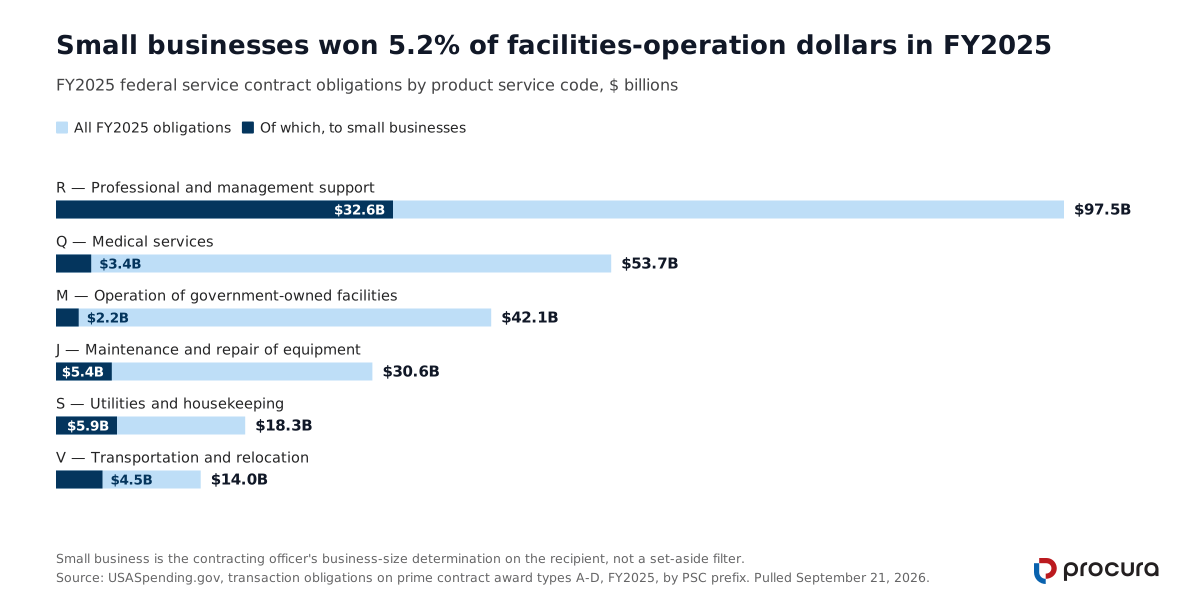
Still, the share numbers tell small firms something more useful than the totals. For example, in operation of government-owned facilities, small businesses won 44.8 percent of the awards but only 5.2 percent of the dollars. Medical services runs the same shape, at 51.7 percent of awards and 6.4 percent of dollars. In other words, the small-business count is healthy and the small-business dollars are not, because the large awards in those categories are multi-year base operations contracts that go to primes. Landscaping, however, inverts it: 80.4 percent of awards and 35.6 percent of dollars went to small businesses.
| Service category (PSC) | FY2025 obligations | Small-business dollars | Awards | Small-business award share |
|---|---|---|---|---|
| R — Professional and management support | $97.5B | 33.4% | 188,096 | 41.4% |
| Q — Medical services | $53.7B | 6.4% | 26,342 | 51.7% |
| M — Operation of government-owned facilities | $42.1B | 5.2% | 6,432 | 44.8% |
| J — Maintenance and repair of equipment | $30.6B | 17.7% | 49,777 | 45.8% |
| S — Utilities and housekeeping | $18.3B | 32.1% | 47,785 | 51.9% |
| V — Transportation and relocation | $14.0B | 32.2% | 21,571 | 43.7% |
| S206 — Guard services | $5.36B | 29.3% | 6,985 | 16.3% |
| S208 — Landscaping and groundskeeping | $3.16B | 35.6% | 4,454 | 80.4% |
| S201 — Custodial and janitorial | $1.71B | 40.5% | 6,388 | 66.0% |
| S203 — Food services | $0.50B | 16.3% | 1,746 | 62.1% |
Which service codes to start with
Notably, the S codes at the bottom of that table are where a first federal services win usually happens. Each one maps to a guide: federal janitorial work, grounds maintenance, and snow removal. Transportation work under the V codes runs through the same wage determinations, and our courier contracts guide covers that lane.
How do you read a Service Contract Act wage determination?
Wages, holidays, and vacation
First, a standard wage determination lists an hourly rate for each occupation code in a named locality. Under the rates sit the fringe benefits, and those are where the money hides. For instance, current determinations require a minimum of eleven paid holidays:
- New Year’s Day
- Martin Luther King Jr.’s Birthday
- Washington’s Birthday
- Memorial Day
- Juneteenth National Independence Day
- Independence Day
- Labor Day
- Columbus Day
- Veterans’ Day
- Thanksgiving Day
- Christmas Day
However, a contractor can substitute another paid day off under a plan the employees receive in writing.
Above all, eleven is the number to check. Congress added Juneteenth in 2021, and yet a great deal of training material, including one Department of Labor sample determination still in circulation, shows ten.

Vacation is a length-of-service ramp that typically runs two weeks after one year, three weeks after eight years, and four weeks after twenty. Still, the year thresholds vary by locality, so the Hawaii determination reads three weeks after ten years and four weeks after fifteen. Again, read the tiers off your own document.
One rule inside vacation costs incumbents and successors real money. Length of service counts continuous service with the present contractor wherever employed, and also with predecessor contractors performing similar work at the same federal facility. For example, hire the outgoing contractor’s twelve-year custodian and that person arrives with three weeks vested, not two. Vacation vests on the employee’s anniversary date, and you must grant it, or pay it in cash, before the next anniversary, the end of the contract, or termination, whichever comes first.
What if the job title you need is not on the wage determination?
That gap has a fix: a conformance. First you propose a title and a rate, then the contracting officer endorses it, and finally the Wage and Hour Division decides. The paperwork is Standard Form 1444, Request for Authorization of Additional Classification and Rate. Still, the order of operations matters more than the form:
- Identify the unlisted classification and compute a proposed rate while you prepare the bid
- Submit the written request to the contracting officer within 30 days after that class does contract work
- The contracting officer forwards the request with the agency recommendation to the Wage and Hour Division
- The Wage and Hour Division has 30 days from receipt to approve, change, or reject it
- That window can be extended, on notice to the contracting officer
- Furnish each affected employee a written copy of the decision, or post it with the wage determination
Meanwhile, two limits matter at bid time. First, a conformance cannot artificially split, combine, or subdivide a classification the determination already lists. Second, an approved rate reaches back to the first day the class did contract work, not to the approval date. Therefore, price that exposure rather than hoping for a low answer. The 30-day response window also has an escape hatch for the agency, and in practice conformances run longer than a month.
What happened to the right of first refusal on successor contracts?
In short, it is gone. Under Executive Order 14055, a successor service contractor had to offer the predecessor’s qualified employees a right of first refusal. However, Executive Order 14148 revoked it on January 20, 2025. The Department of Labor then rescinded the implementing regulation at 90 FR 59734 on December 22, 2025. As a result, part 9 of 29 CFR now reads “[Reserved]”.
Hiring the incumbent workforce is still usually the right commercial decision, because those people know the site and their service credit follows them. But it is a choice again, not an obligation. Even so, any checklist that still lists it as a requirement is at least a year out of date.
Section 4(c) and predecessor union agreements
One successor obligation did not go anywhere. Section 4(c) sits at 29 CFR 4.1b. A successor that does substantially the same services in the same locality inherits the predecessor’s collective bargaining agreement. It must pay that agreement’s wages and fringe benefits, including increases the parties already negotiated. In short, you inherit an agreement you never signed.
Fortunately, two things defeat that obligation. First, the Secretary of Labor can replace the agreement rates with a wage determination, which happens where those rates are substantially at variance with what prevails locally. Second, and more commonly, a late agreement does not bind the successor. Under sealed bidding, notice arriving fewer than 10 days before bid opening is too late, unless the agency finds time remains to notify bidders. In a negotiated procurement, notice arriving after award is too late where performance begins within 30 days of award. However, those protections apply only where the contracting officer gave the incumbent and the bargaining representative at least 30 days notice before the procurement date.
The practical consequence is a diligence question. Therefore, on any services recompete, ask the contracting officer whether a predecessor collective bargaining agreement exists and whether it arrived on time. After all, an incumbent has every reason to sit on a rich new agreement until your price is locked.
What happens if you get the Service Contract Act wrong?
First, the agency withholds accrued payments to cover the underpayment, under 41 U.S.C. 6705. Read the next sentence of that section closely, because it is the one that surprises the finance side. The government can withhold funds from accrued payments on the contract where the violation happened. Moreover, it can withhold on any other contract between the same contractor and the federal government. In other words, one bad janitorial contract can freeze payment on an unrelated award.
In addition, the agency can cancel the contract on written notice, complete the work elsewhere, and charge the original contractor the additional cost. Where withheld funds fall short, the government can sue the contractor and its sureties.
Debarment and your past-performance record
Then comes debarment, and the default cuts the wrong way. Under 41 U.S.C. 6706, a firm found in violation goes on a list. No agency can award that firm a federal contract until three years have elapsed. The bar also reaches any entity in which the firm holds a substantial interest. Furthermore, debarment follows automatically unless the Secretary of Labor recommends otherwise because of unusual circumstances, so the burden sits on the contractor. That is harsher than ordinary FAR Subpart 9.4 debarment, where an agency exercises discretion to impose it. Finally, a violation lands in your past-performance record, where it prices every bid you write for the next three years.

Which FAR clauses carry these obligations?
| Clause | Title | What it does |
|---|---|---|
| 52.222-41 | Service Contract Labor Standards | The core clause. Imposes minimum wages, fringe benefits, safety and health, notice, recordkeeping, and conformance duties on the contractor and its subcontractors |
| 52.222-42 | Statement of Equivalent Rates for Federal Hires | Tells bidders what federal employees in comparable positions earn under General Schedule or Wage Board systems |
| 52.222-43 | Price Adjustment, Multiple Year and Option Contracts | Adjusts the contract price when a revised wage determination raises your cost on an option exercise |
| 52.222-49 | Place of Performance Unknown | Incorporates a wage determination for the actual location after the fact, with no adjustment in the contract price |
Above all, 52.222-49 is the one to price defensively. Where the place of performance is unknown at solicitation, the agency incorporates the wage determination for your actual location later. However, the clause says plainly that no price adjustment follows.
Wage-compliant is table stakes. The bid list is the problem.
None of the above wins you anything. Rather, it only keeps you eligible. Once your SAM.gov registration is active and your payroll can carry a wage determination, federal services work turns into a reading problem. Specifically, four things decide the bid:
- The wage determination number and its revision
- The occupation codes you would have to conform
- The seniority you inherit from the incumbent crew
- Any predecessor collective bargaining agreement
All four live in attachments, and the summary page shows none of them. Consequently, working that out by hand costs an afternoon per solicitation, and most solicitations do not earn one.
That is where Procura Federal comes in. It opens every attachment on every solicitation, scores the opportunity against your capability statement, and surfaces the compliance requirements hidden in the documents. A bid or no-bid call then takes minutes. The price is $399/month. By comparison, legacy market intelligence platforms sell into the same lane on five-figure annual contracts. Our federal contracting tool comparison lists their real prices, and the places where they are still the better buy. If you are still picking a lane, the guide to the easiest government contracts to win starts one step earlier.
Frequently asked questions
Who is exempt from the Service Contract Act?
First, bona fide executive, administrative, and professional employees are not service employees, so the wage determination rates do not reach them. In addition, contracts at or below $2,500 carry no wage determination. Several contract types are exempt by statute. For example, construction under Davis-Bacon and freight carriage by common carrier under published tariff rates both fall outside it.
Where do I find my Service Contract Act wage determination?
At sam.gov/content/wage-determinations, free of charge. Your solicitation must attach the one that applies. If it does not, ask the contracting officer rather than picking one yourself.
Can I pay health and welfare in cash?
Yes. Specifically, you can furnish bona fide fringe benefits, pay the equivalent in cash, or combine the two. What you cannot do is average across the workforce, because the obligation runs per employee.
Does the SCA apply to subcontractors?
Yes. FAR 52.222-41 binds the contractor and its subcontractors, and the prime answers for subcontractor compliance. Therefore, flow the clause down and collect the payroll records.
What happens to my price when the health and welfare rate goes up?
Nothing mid-period. Instead, the revised wage determination arrives with the next option exercise, and FAR 52.222-43 then adjusts the contract price for the increase. Claim it. The adjustment is not automatic in practice, and the deadlines in the clause are short.
Put a real solicitation in front of us
Choose a federal services opportunity you are undecided about, then book a call. We will open the attachments live and read the wage determination together. Afterwards, you will see which occupation codes you do not yet have, and what a conformance would cost you. In short, thirty minutes is enough to know whether the job prices.