Government welding contracts carry no welding NAICS code. In fact, the only entry in the SBA size-standard table with welding in its name is 333992. That code is for Welding and Soldering Equipment Manufacturing, and it describes the firms that build welders. The work itself sits in twelve other codes. In FY2025 federal agencies obligated $716.1 million across those twelve codes, and small businesses took $579.1 million of it, or 80.9 percent, per USASpending.gov.
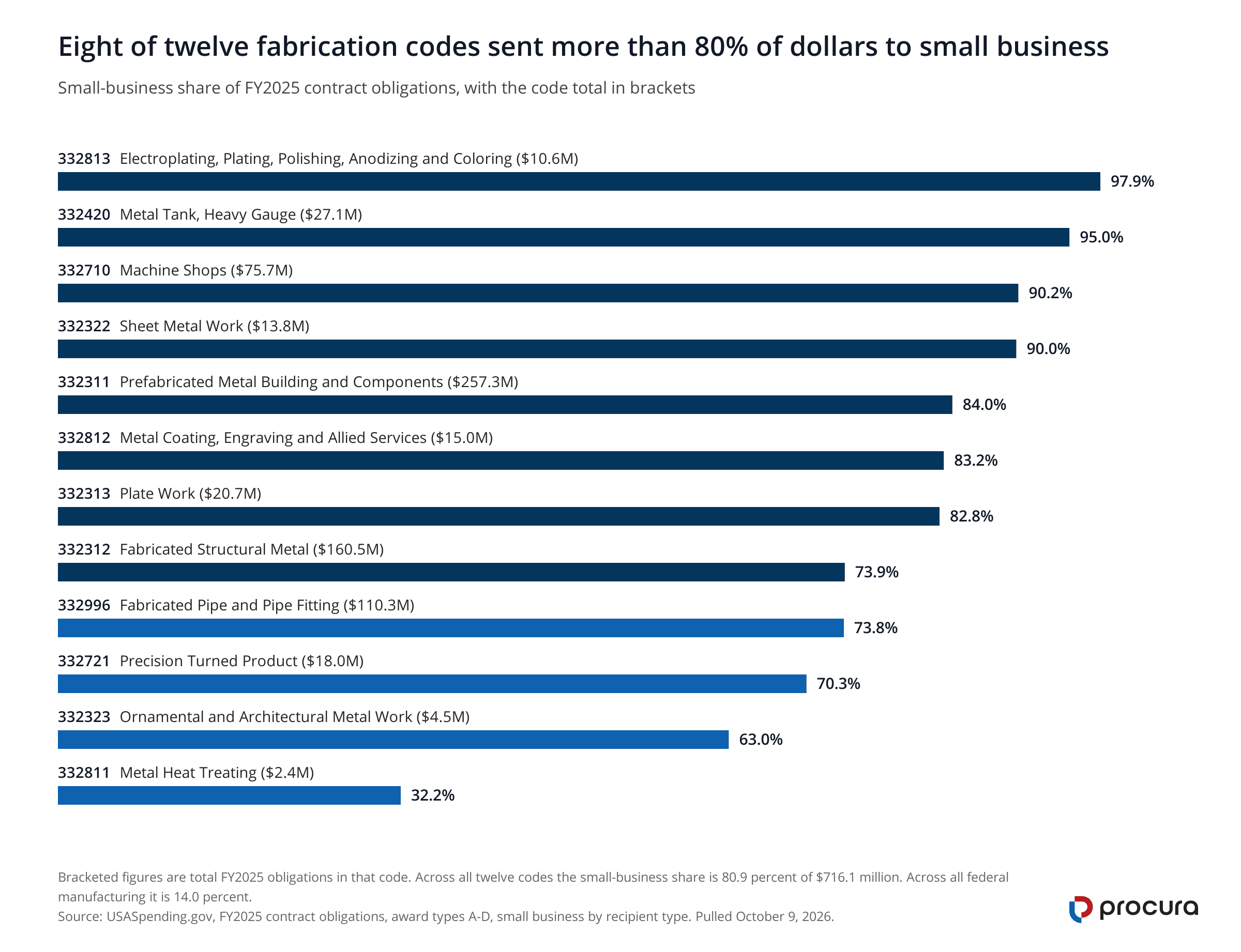
That 80.9 percent is the number worth knowing. However, across all of federal manufacturing, small firms win 14.0 percent of the dollars. In the codes that describe cutting, forming, welding, machining and finishing metal to a customer’s drawing, they win four fifths. I run a small veteran-owned engineering firm and I read federal solicitations every week. This is the widest gap I found between a market’s reputation and its data.
How much does the government spend on welding and fabrication?
Federal agencies obligated $296.2 billion on contracts coded to manufacturing in FY2025, across NAICS sectors 31, 32 and 33. Overall, small businesses received $41.6 billion of that, or 14.0 percent. The headline number is useless to a job shop, because almost none of it is job-shop work.
Narrow to NAICS 332, Fabricated Metal Product Manufacturing, and the total is $18.1 billion with a small-business share of 25.3 percent. However, four codes carry about 80 percent of that money, and none of them is open to a new shop.
Ammunition manufacturing (332993) alone took $9.1 billion at a 16.7 percent small-business share. Also, small arms and ordnance (332994) took $1.8 billion at 30.8 percent. Small arms ammunition (332992) took $1.3 billion at 3.1 percent. Power boilers and heat exchangers (332410) took $2.2 billion at 1.3 percent. These are qualified production lines with named incumbents.
Strip those out and what remains is the market a fabricator can actually bid: $716.1 million in FY2025 across twelve codes. In fact, small firms took 80.9 percent. The market has been flat for five years and the small-business share has stayed between 72 and 81 percent the whole time.
The one code that distorts the picture
One code distorts the picture, and it is worth naming. Prefabricated Metal Building and Component Manufacturing (332311) carries $257.3 million, about 36 percent of the twelve-code total. Inside that code, 57 percent is PSC 5410, prefabricated and portable buildings. That is a military shelter market served by eight integrators, not a job-shop market. Remove it and the remaining eleven codes carry $458.8 million at a 79.1 percent small-business share. The conclusion holds either way.
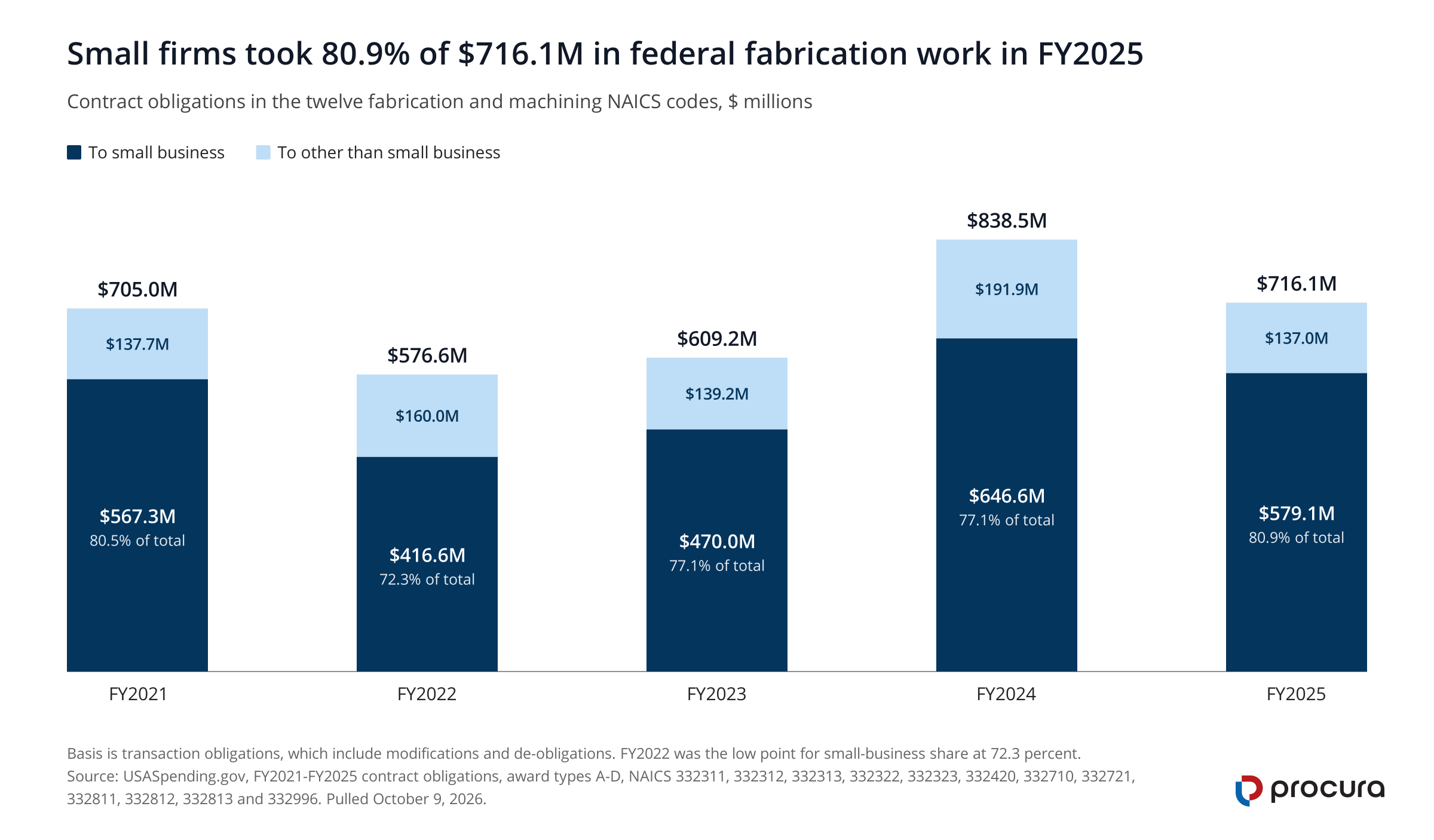
Data table: obligations by fiscal year, FY2021-FY2025
| Fiscal year | Obligations | To small business | Small-business share |
|---|---|---|---|
| FY2021 | $705.0M | $567.3M | 80.5% |
| FY2022 | $576.6M | $416.6M | 72.3% |
| FY2023 | $609.2M | $470.0M | 77.1% |
| FY2024 | $838.5M | $646.6M | 77.1% |
| FY2025 | $716.1M | $579.1M | 80.9% |
Which NAICS code should a welding shop bid under?
Twelve codes describe this work, and the one you pick changes your size standard, your labor rules and your competition. In short, the table below is the whole market in one view. Obligations and small-business dollars come from USASpending for FY2025. Size standards come from 13 C.F.R. 121.201 via eCFR, current to October 1, 2026.
Read the size-standard column carefully. Specifically, every manufacturing code uses an employee cap, not a revenue cap. A company with 450 employees and $90 million in sales is a small business under NAICS 332710. That cuts two ways. You stay small much longer than a service firm does, and the firms you bid against are far larger than the word small suggests.
The twelve NAICS codes for welding and fabrication
| NAICS | Industry | FY2025 obligations | To small business | Small-business share | Size standard |
|---|---|---|---|---|---|
| 332311 | Prefabricated Metal Building and Component Manufacturing | $257.3M | $216.3M | 84.0% | 750 employees |
| 332312 | Fabricated Structural Metal Manufacturing | $160.5M | $118.6M | 73.9% | 500 employees |
| 332996 | Fabricated Pipe and Pipe Fitting Manufacturing | $110.3M | $81.4M | 73.8% | 550 employees |
| 332710 | Machine Shops | $75.7M | $68.3M | 90.2% | 500 employees |
| 332420 | Metal Tank (Heavy Gauge) Manufacturing | $27.1M | $25.8M | 95.0% | 750 employees |
| 332313 | Plate Work Manufacturing | $20.7M | $17.2M | 82.8% | 750 employees |
| 332721 | Precision Turned Product Manufacturing | $18.0M | $12.6M | 70.3% | 500 employees |
| 332812 | Metal Coating, Engraving and Allied Services to Manufacturers | $15.0M | $12.5M | 83.2% | 600 employees |
| 332322 | Sheet Metal Work Manufacturing | $13.8M | $12.4M | 90.0% | 500 employees |
| 332813 | Electroplating, Plating, Polishing, Anodizing and Coloring | $10.6M | $10.4M | 97.9% | 500 employees |
| 332323 | Ornamental and Architectural Metal Work Manufacturing | $4.5M | $2.8M | 63.0% | 500 employees |
| 332811 | Metal Heat Treating | $2.4M | $0.8M | 32.2% | 750 employees |
| 238120 | Structural Steel and Precast Concrete Contractors (construction code) | $22.0M | $12.6M | 57.3% | $19.0M receipts |
| 811310 | Commercial and Industrial Machinery and Equipment Repair (service code) | $765.3M | $293.4M | 38.3% | $12.5M receipts |
Codes outside NAICS 332
Two codes outside NAICS 332 collect a lot of welding work. Each one uses a receipts cap instead. Structural Steel and Precast Concrete Contractors (238120) is a construction trade code with a $19.0 million standard. Commercial and Industrial Machinery and Equipment Repair and Maintenance (811310) is a service code with a $12.5 million standard. A shop with $15 million in receipts and 60 employees is small under 332710 and small under 238120, but large under 811310. The same business, three answers.
Why does the same weld job follow three different rulebooks?
Weld a handrail onto a federal building and you are a construction contractor under the Davis-Bacon Act. Repair a government-owned generator on site and you are a service contractor under the Service Contract Act. Fabricate the same weldment in your shop and ship it as a supply item. Now you are a manufacturer under the Walsh-Healey Public Contracts Act. Three statutes, three wage bases, three dollar triggers.
Walsh-Healey is the mildest of the three by a wide margin. Specifically, it applies to contracts in excess of $15,000 for the manufacturing or furnishing of materials, supplies, articles or equipment. The wage floor is the federal minimum wage under the Fair Labor Standards Act. Overtime runs at one and a half times the regular rate for more than 40 hours in a week. There is no wage determination to download and no locally prevailing rate to match.
Davis-Bacon prevailing wage rules bite at $2,000. Similarly, Service Contract Act wage determinations bite at $2,500.
Micro-purchase thresholds and the nonmanufacturer rule
The micro-purchase threshold moves with the statute too, and most contractors never notice. Specifically, FAR 2.101 sets it at $15,000 for supplies. For construction subject to Davis-Bacon it drops to $2,000. For services subject to the Service Contract Act it drops to $2,500. A $9,000 shop-fabricated bracket can be a card buy. The same $9,000 of welding done on site as federal construction work cannot.
One more rule follows the code, and it is the one that catches resellers. 13 C.F.R. 121.406 governs set-asides with a manufacturing or supply NAICS code. An offeror must be the manufacturer of the end item, and the end item must be made in the United States. The other route is to qualify as a nonmanufacturer.
A nonmanufacturer must have 500 or fewer employees and must be primarily engaged in wholesale or retail trade. Also, it must take ownership or possession of the item, consistent with industry practice. And it must supply the end item of a small business manufacturer made in the United States. SBA states plainly that a firm which does only minimal operations on the item does not qualify as the manufacturer. The rule does not apply to service or construction codes at all.
Labor statutes by NAICS code
| If the solicitation is coded | Labor statute | Trigger | Wage basis | Micro-purchase threshold | Nonmanufacturer rule |
|---|---|---|---|---|---|
| Construction or specialty trade (238120) | Davis-Bacon Act | Over $2,000 | Locally prevailing wage and fringes from a wage determination | $2,000 | Does not apply |
| Services (811310) | Service Contract Act | Over $2,500 | Service Contract Act wage determination for the locality | $2,500 | Does not apply |
| Supplies or manufacturing (332xxx) | Walsh-Healey Public Contracts Act | Over $15,000 | Federal minimum wage, plus 1.5x the regular rate over 40 hours | $15,000 | Applies |
Who actually wins government welding contracts?
Small shops win most of the awards and a minority of the dollars. Overall, Federal agencies made 15,917 awards in these twelve codes in FY2025. Of those, 15,453 were under $350,000, which is 97.1 percent of the count and 31.9 percent of the money. At the other end, 62 awards above $5 million carried $259.4 million, or 36.2 percent of the total.
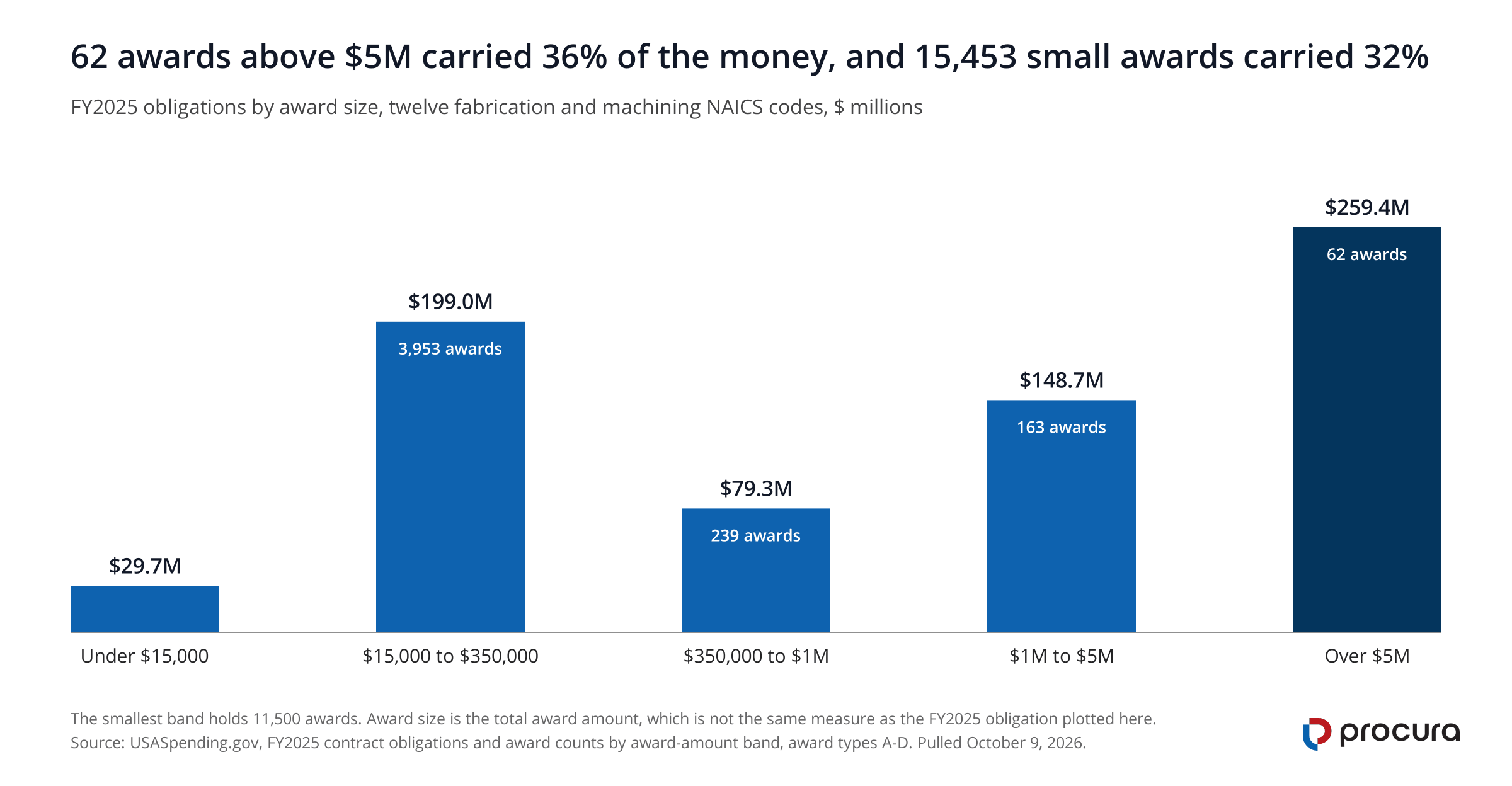
Data table: FY2025 awards by award size
| Award size | Awards | Share of awards | Obligations | Share of dollars |
|---|---|---|---|---|
| Under $15,000 | 11,500 | 72.2% | $29.7M | 4.1% |
| $15,000 to $350,000 | 3,953 | 24.8% | $199.0M | 27.8% |
| $350,000 to $1M | 239 | 1.5% | $79.3M | 11.1% |
| $1M to $5M | 163 | 1.0% | $148.7M | 20.8% |
| Over $5M | 62 | 0.4% | $259.4M | 36.2% |
Where the set-aside money goes
Machine Shops (332710) shows what a market with no incumbent looks like. Specifically, the code obligated $75.7 million in FY2025 and the largest single recipient, Loughmiller Machine, Tool & Design, took $4.49 million of it. That is 5.9 percent. The next names are Neodora, Chesapeake Machining & Fabrication, Chucking Machine Products and Winchester Tool. There is no prime to displace here.
The set-aside money goes where you would hope. These are the ten largest recipients of total small business set-aside dollars in the twelve codes in FY2025:
- Sealevel Construction, $12.27 million
- Agate Steel, $5.82 million
- Modular Management Group, $5.82 million
- Wingate Alloys, $5.48 million
- Edwards Design and Fabrication, $4.06 million
- Fabritex, $3.78 million
- Norcatec, $3.71 million
- Engineering and Software System Solutions, $3.67 million
- ITL, $3.08 million
- A & A Sheet Metal Products, $2.61 million.
Those are shops, and the names say so.
Do you need a set-aside to win government welding contracts?
No, and the data is emphatic about it. In fact, set-asides of every kind accounted for $265.5 million of the $716.1 million, or 37.1 percent. Small businesses took $579.1 million. At least $313.6 million of small-business money in these codes was thus won in competition open to every bidder. That is 54 percent of it.
Two FAR rules explain the pattern. First, FAR 19.502-2(a) reserves a band of work for small business. A contracting officer must set aside each acquisition above the micro-purchase threshold and not over the simplified acquisition threshold. The one exception is no reasonable expectation of offers from two or more responsible small firms.
That band runs from $15,000 to $350,000 and it holds 3,953 of the year’s awards. However, above $350,000, the reserve ends and unrestricted competition starts. Primes do not chase a $60,000 weldment order, so small firms keep winning anyway.
Why 8(a) works differently in manufacturing
The 8(a) numbers in this market are unusual enough to name. For example, sole-source 8(a) awards carried $93.4 million. Competed 8(a) awards carried $151,151. Almost the entire 8(a) channel here runs sole source. Three firms hold $82.5 million of the $93.4 million: Chugach Intelligence Solutions, STS Systems Defense and Goldbelt Security.
The mechanism is 13 C.F.R. 124.506. It sets the 8(a) competitive threshold at $7,000,000 for contracts assigned manufacturing NAICS codes, against $4,500,000 for everything else. It also exempts firms owned by an Indian Tribe or an Alaska Native Corporation from that ceiling. An 8(a) certification buys more room in a manufacturing code than it does anywhere else.
The other socioeconomic programs barely register. Meanwhile, SDVOSB set-asides carried $3.4 million, WOSB set-asides $2.2 million, and HUBZone certification produced $965,073. That is 0.13 percent of the market. Those certifications are worth holding for other reasons, but in these twelve codes they are not a bidding strategy.
Which agencies buy government manufacturing contracts of this kind?
Defense obligated $632.1 million of the $716.1 million, or 88.3 percent. Overall, the remainder is thin. The General Services Administration bought $25.9 million, Homeland Security $21.6 million and Interior $13.9 million. No other agency reached $5 million. If you sell metal to the federal government, you sell to the military.
Inside Defense the split is almost even, which surprised me. Meanwhile, the Air Force bought $174.8 million, the Defense Logistics Agency $173.3 million, the Army $147.1 million and the Navy $131.5 million. Those four buying activities carry 87.5 percent of the market between them, and no single one of them carries a quarter of it. A shop that registers and then watches one service misses three quarters of its market.
DLA is the buyer that works differently. Specifically, it buys spare parts by national stock number through its own bid board, not the ordinary solicitation flow. The drawings live in a separate system. Bidding DLA parts through DIBBS is a different workflow from bidding a Navy shipyard fabrication package. A shop that wants the $173.3 million must learn each one.
Why can you not download the drawing?
This is the complaint I hear most from machinists, and it has a specific answer. In fact, most military drawings are export-controlled unclassified technical data. A company cannot download them without a Joint Certification Program approval. DLA administers the program, and the application is DD Form 2345 through the JCP Portal.
DLA states the eligibility plainly. An applicant must meet all four of these conditions:
- Registration and a physical location in the United States or Canada
- A legitimate business need for unclassified military technical export-controlled data
- An active SAM registration and a CAGE or NCAGE code
- A NIST SP 800-171 assessment posted in SPRS.
There are two levels of certification. First, standard certification covers blueprints, drawings and software. Enhanced certification, marked DEV, unlocks cFolders data for DLA and DIBBS solicitations. DEV also takes separate approval from DLA headquarters.
The order of operations matters, because each step gates the next. Finish your SAM.gov registration and get a CAGE code. Post the self-assessment in SPRS, which is the same control set behind NIST SP 800-171 and CMMC Level 1. Then apply for JCP, and request DEV if you intend to quote DLA parts. A shop that skips SPRS learns this at the JCP application, not before.
Which material rules apply to a steel weldment?
Three regimes can touch a metal end item, and contractors routinely confuse them. Specifically, the Buy American statute is the one that always applies.
Start with an end product that does not consist wholly or predominantly of iron or steel. For example, FAR 25.003 requires domestic components to exceed 60 percent of the cost of all components. That percentage is 65 percent for items delivered in calendar years 2024 through 2028. It becomes 75 percent for items delivered from calendar year 2029. Commercially available off-the-shelf items are exempt from the test.
Steel gets a harder rule and no exemption. Then take an end product that consists wholly or predominantly of iron or steel. FAR 25.003 requires foreign iron and steel to cost less than 5 percent of the cost of all components. The commercial off-the-shelf waiver does not apply to such a product, except for fasteners.
Iron or steel components of unknown origin are treated as foreign. Scrap generated, collected and prepared for processing in the United States counts as domestic. In practice that means your mill certifications are the compliance file, and a bar of unknown provenance is a foreign bar.
Specialty metals and the Berry Amendment
Specialty metals are a separate DoD rule with a useful exception. DFARS 225.7003-2 implements 10 U.S.C. 4863. Specialty metals in aircraft, missiles, space systems, ships, tanks, automotive items, weapon systems and ammunition carry a melt rule. The metal must be melted or produced in the United States.
The definition covers ordinary alloy steel. Specifically, it covers steel with manganese above 1.65 percent, silicon above 0.60 percent or copper above 0.60 percent. It also covers steel with more than 0.25 percent of elements such as aluminum or chromium. The exception at DFARS 225.7003-3(a)(1) removes acquisitions at or below the simplified acquisition threshold. Most awards in this market sit below $350,000, so the melt rule never touches them.
The Berry Amendment is the rule contractors apply by mistake. DFARS 225.7002-1 implements 10 U.S.C. 4862. It restricts food, clothing and the materials in clothing, tents and tent structural components, tarpaulins and covers. It also restricts natural fiber products, silk, synthetic fabric, coated synthetic fabric, canvas, wool, individual equipment under PSC 8465, and hand or measuring tools. A steel weldment is not on that list. If you fabricate hand tools, Berry applies to you, and if you fabricate brackets it does not.
Material rules for government welding contracts at a glance
| Rule | What it requires | Citation | Main exception |
|---|---|---|---|
| Buy American, non-steel end product | Domestic components must exceed 65% of the cost of all components for 2024-2028 deliveries, and 75% from 2029 | FAR 25.003 | Commercially available off-the-shelf items are exempt |
| Buy American, iron or steel end product | Foreign iron and steel must cost less than 5% of the cost of all components | FAR 25.003 | No off-the-shelf exemption, except fasteners. Unknown origin counts as foreign |
| Specialty metals | Specialty metals in aircraft, missiles, ships, tanks, weapon systems and ammunition must be melted or produced in the United States | DFARS 225.7003-2, 10 U.S.C. 4863 | Acquisitions at or below the $350,000 simplified acquisition threshold |
| Berry Amendment | Food, clothing and textiles, tents, tarpaulins, covers, silk, wool, canvas, individual equipment and hand or measuring tools must be produced in the United States | DFARS 225.7002-1, 10 U.S.C. 4862 | Does not reach general steel fabrication |
When does the money actually move?
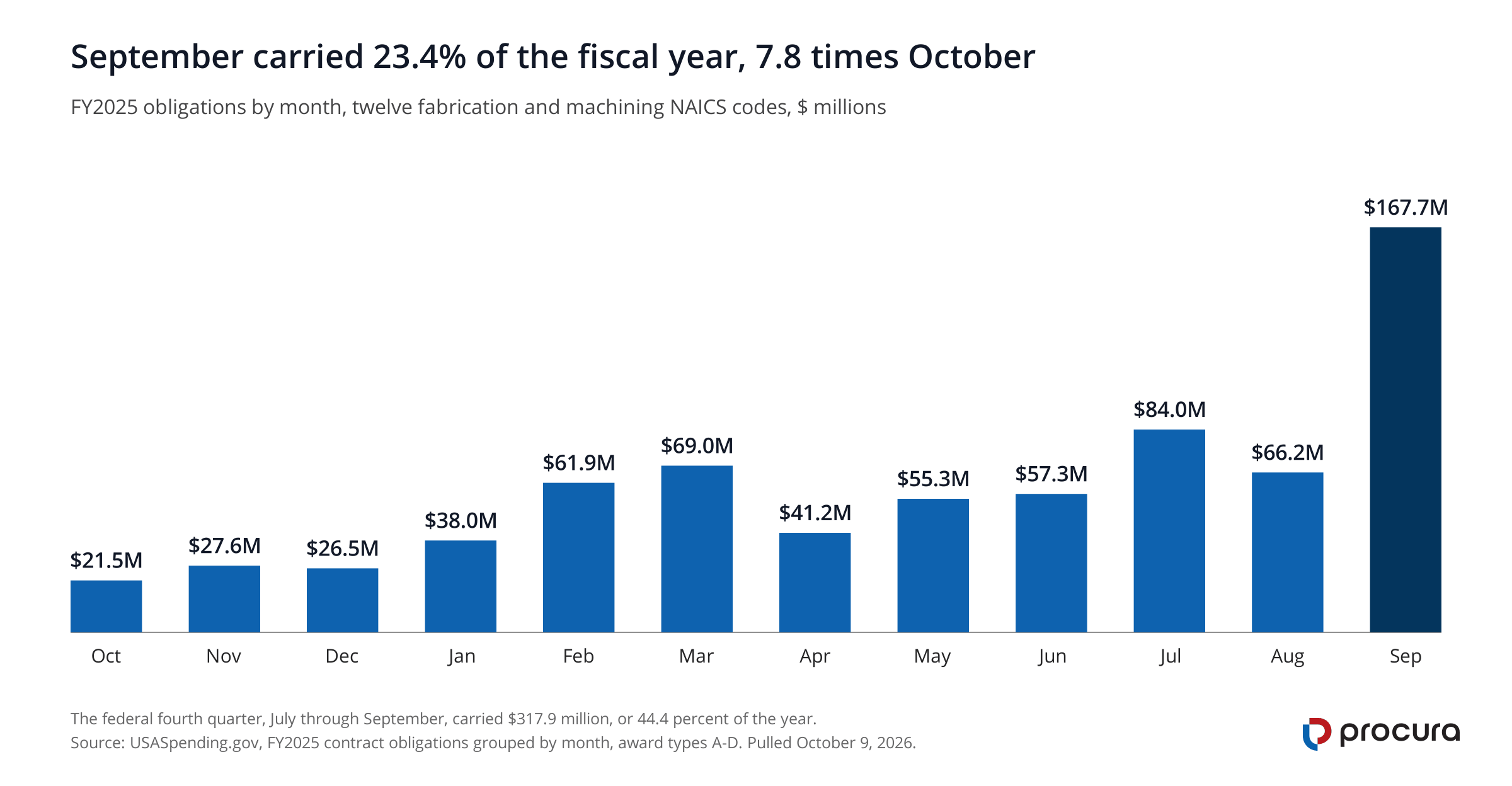
September is a quarter of the year. In FY2025 these twelve codes saw $167.7 million obligated in September alone, 23.4 percent of the annual total, against $21.5 million in October. That is a 7.8-fold swing between the last month of the fiscal year and the first. The federal fourth quarter, July through September, carried $317.9 million, or 44.4 percent.
Two practical consequences follow. Your shop capacity planning must assume a September crush, because contracting officers spend expiring money on short-lead fabrication work. As a result, a quote you submit in October competes against a thinner field. In September every shop in your NAICS code bids the same surge.
Data table: FY2025 obligations by month
| Month | Obligations | Share of year |
|---|---|---|
| Oct 2024 | $21.5M | 3.0% |
| Nov 2024 | $27.6M | 3.9% |
| Dec 2024 | $26.5M | 3.7% |
| Jan 2025 | $38.0M | 5.3% |
| Feb 2025 | $61.9M | 8.6% |
| Mar 2025 | $69.0M | 9.6% |
| Apr 2025 | $41.2M | 5.7% |
| May 2025 | $55.3M | 7.7% |
| Jun 2025 | $57.3M | 8.0% |
| Jul 2025 | $84.0M | 11.7% |
| Aug 2025 | $66.2M | 9.2% |
| Sep 2025 | $167.7M | 23.4% |
What does a shop need before it can bid?
The entry list for government machining contracts is short, and almost all of it is free. Do these six things in order:
- Register the entity in SAM.gov and get a UEI and a CAGE code
- Pick the NAICS codes that match what your equipment does, not what your marketing says
- Post a NIST SP 800-171 self-assessment in SPRS
- Apply for JCP certification, with DEV if DLA parts are the target
- Keep mill certifications on file for every heat you buy
- Write a one-page capability statement that names your machines, envelopes, tolerances and certifications.
None of that is the hard part. However, the hard part is the 15,917 awards. They sit across four Defense buying activities, two solicitation systems and twelve NAICS codes, and they arrive in bursts. The drawing package that tells you whether your machines can hold the tolerance is an attachment, not a description. Reading those attachments by hand is where shops lose their week and still miss the one job they were built for.
That is the problem Procura was built for. Specifically, it reads every solicitation including the attachments, and scores each opportunity against your capability statement. The compliance requirements that decide whether you can bid at all come flagged. Procura costs $399/month, against five-figure annual subscriptions for the legacy market-intelligence platforms.
Research this market for free. Open NAICS 332710 (machine shops) or NAICS 238120 (structural steel contractors) in Procura’s free explorer to see the top buyers, the largest contractors and where the work is performed, or start from the Defense Logistics Agency page. It’s all free to browse; create a free account to save your research and export the tables.
Frequently asked questions
What NAICS code do I use for welding government contracts?
There is no welding NAICS code, so match the activity instead. Shop fabrication to a drawing is 332312, 332313 or 332322. Machining is 332710 or 332721, pipe fabrication is 332996, and tanks and pressure vessels are 332420. Field welding on a structure is 238120, and on-site repair of government equipment is 811310. Register every code your equipment supports, because the code on the solicitation decides your size standard and your labor rules.
How much do government welding contracts pay?
Most of them are small. In fact, of the 15,917 FY2025 awards in these twelve codes, 11,500 were under $15,000 and 3,953 fell between $15,000 and $350,000. The dollars concentrate elsewhere: 62 awards above $5 million carried 36.2 percent of the money. A shop building a federal book starts in the thousands and the tens of thousands, not the millions.
Do I need a certification to bid?
No socioeconomic certification is necessary, and in this market none of them moves much money except 8(a). You must hold an active SAM registration and a CAGE code. JCP certification is necessary to receive export-controlled drawings. Welding procedure qualifications and AWS, ASME or NADCAP approvals are technical requirements written into individual solicitations, not program eligibility.
Can I buy the part and resell it on a set-aside?
Only as a qualified nonmanufacturer. On a set-aside carrying a supply or manufacturing code, 13 C.F.R. 121.406 applies to you. Either you built the end item, or you pass the nonmanufacturer test. That test turns on reselling a small business manufacturer’s United States product. Light finishing work on somebody else’s part does not make you the manufacturer.
Does Buy American block foreign steel outright?
Not outright, but the ceiling is low. A steel weldment can carry foreign iron and steel worth up to 5 percent of total component cost, and commercial fasteners sit outside the count. Material of unknown origin counts as foreign. Mill certifications are what decide compliance.
How do I get manufacturing contracts outside Defense?
Expect a small field. Outside Defense the twelve codes produced $84.0 million in FY2025, which is 11.7 percent of the market. Civilian buying follows facilities, vehicles and public works, so the opportunities sit at depots, parks, dams and ports rather than weapon programs. The General Services Administration is the largest civilian buyer.
Book a demo
Bring a drawing package you lost a week on. We will run the same solicitation through Procura and you can judge the fit score and the compliance flags against what you found by hand.