
Government staffing contracts are not one market: in FY2025 federal agencies obligated $915.2 million to the four employment-services NAICS codes. In fact, that is the number most readers mean by the phrase, and it is the smallest part of the story. Guard services alone, under a single different code, carried $6.0 billion in the same year. Facilities support carried $37.1 billion.
All three sets of dollars buy labor by the hour. Also, a staffing firm can bid all three. The code on the solicitation decides which rules apply to you and what your size standard is. It also decides whether the government can legally buy the way it wants to buy.
I run a small veteran-owned engineering firm and I read federal solicitations every week. However, the staffing ones are the clearest example I know of a market that looks simple from outside. It turns on three rules that almost nobody writes down.
One is a 120-workday cap in title 5 of the Code of Federal Regulations. Another is the ban on personal services contracts in FAR 37.104. Last comes a size standard that counts every dollar of pass-through payroll as your own revenue. In short, this guide is those three rules, plus the FY2025 numbers from USASpending.gov that show who buys and who wins.
What counts as a government staffing contract?
Four NAICS codes form the employment-services sector: 561311 Employment Placement Agencies, 561312 Executive Search Services, 561320 Temporary Help Services, and 561330 Professional Employer Organizations. Overall, in FY2025 those four took $915.2 million in federal contract obligations across 6,036 contracts, per USASpending.gov. Small businesses took $695.5 million of that, or 76.0 percent.
One code does nearly all of it. Temporary Help Services, 561320, carried $883.0 million, which is 96.5 percent of the sector. Employment Placement Agencies carried $15.7 million. Professional Employer Organizations carried $8.3 million. Executive Search carried $8.1 million, and only 11.3 percent of that went to small firms. If a contracting officer codes a labor award to a staffing code at all, the code is almost certainly 561320.
But the contracting officer usually does not code it to a staffing code. However, the government buys most of its contract labor under the code of the work, not the code of the industry that supplies the worker. A firm that places nurses bids under a clinical code. Cleared-analyst work goes under an information-technology code. Guard work goes under 561612. That choice is the single most consequential fact in this market, and the next section is the table that makes it concrete.
Which NAICS code do government staffing contracts actually sit under?
The table below lists the codes a staffing firm realistically competes in. Each row carries FY2025 obligations, the small-business share, and the size standard from 13 C.F.R. 121.201. Read the right-hand column first. The size standard decides whether you are allowed to call yourself small.
| NAICS | Code name | FY2025 obligations | Small business | Size standard |
|---|---|---|---|---|
| 561210 | Facilities Support Services | $37.1 billion | 14.5% | $47.0 million |
| 541519 | Other Computer Related Services | $24.9 billion | 68.3% | $34.0 million |
| 541611 | Administrative and General Management Consulting | $11.3 billion | 47.2% | $24.5 million |
| 621111 | Offices of Physicians (except Mental Health) | $8.5 billion | 6.1% | $16.0 million |
| 561612 | Security Guards and Patrol Services | $6.0 billion | 32.3% | $29.0 million |
| 622110 | General Medical and Surgical Hospitals | $1.5 billion | 49.5% | $47.0 million |
| 561320 | Temporary Help Services | $883.0 million | 76.3% | $34.0 million |
| 611430 | Professional and Management Development Training | $802.4 million | 56.0% | $15.0 million |
| 561110 | Office Administrative Services | $660.0 million | 71.4% | $12.5 million |
| 621511 | Medical Laboratories | $459.6 million | 11.2% | $41.5 million |
| 621112 | Offices of Physicians, Mental Health Specialists | $186.4 million | 33.8% | $13.5 million |
| 621399 | Offices of All Other Miscellaneous Health Practitioners | $162.7 million | 89.3% | $10.0 million |
| 621610 | Home Health Care Services | $66.6 million | 89.0% | $19.0 million |
| 561311 | Employment Placement Agencies | $15.7 million | 84.3% | $34.0 million |
| 561330 | Professional Employer Organizations | $8.3 million | 88.4% | $41.5 million |
| 561312 | Executive Search Services | $8.1 million | 11.3% | $34.0 million |
What the staffing NAICS table shows
Two things jump out of that table, and the first is scale. For example, guard services, one code, is 6.5 times the entire employment-services sector, and facilities support is 40.5 times it. Staffing money does not live in the staffing codes.
The second is the size standard, and it runs the opposite direction from the dollars. Temporary Help Services sets its ceiling at $34.0 million of average annual receipts. The clinical codes that buy the same clinicians set theirs at $10.0 million for 621399 and $13.5 million for 621112. A firm with $20 million in receipts is small under 561320 and large under the two clinical codes. The contracting officer picks the code, you do not, and that pick can cut your ceiling by 71 percent without anyone telling you. Read the code on every solicitation against 121.201 before you price it.
Small-business share by staffing code
Small-business share moves with the code too, and it moves hard. Meanwhile, clinical placement codes run above 84 percent small business. Physician-office work runs at 6.1 percent, because those dollars are hospital-scale managed-care awards and not placements. Facilities support runs at 14.5 percent because the work consolidates into base-wide contracts that only a large firm can bond and staff.
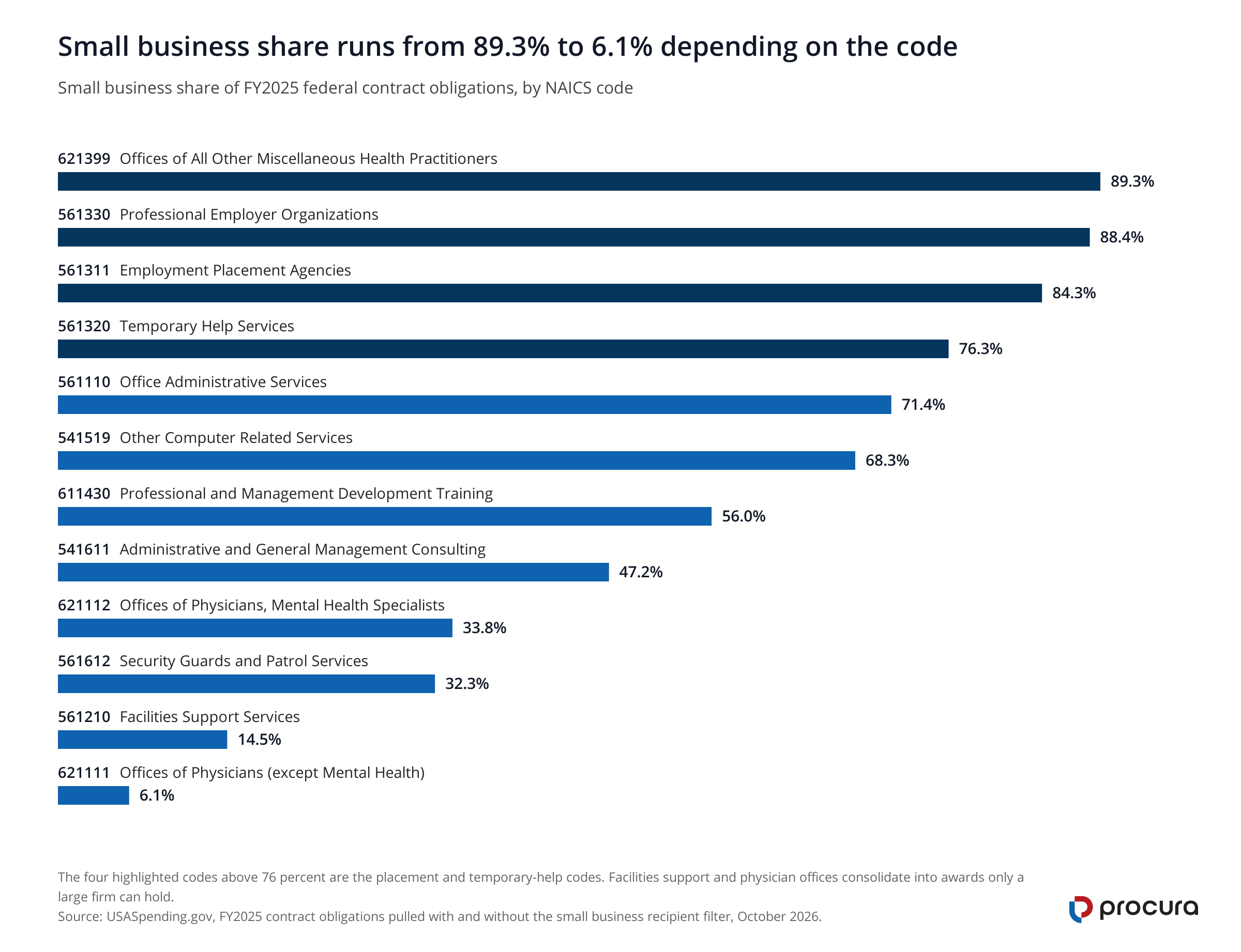
Data table: small business share of FY2025 obligations, by NAICS code
| NAICS | Code name | Small business share |
|---|---|---|
| 621399 | Offices of All Other Miscellaneous Health Practitioners | 89.3% |
| 561330 | Professional Employer Organizations | 88.4% |
| 561311 | Employment Placement Agencies | 84.3% |
| 561320 | Temporary Help Services | 76.3% |
| 561110 | Office Administrative Services | 71.4% |
| 541519 | Other Computer Related Services | 68.3% |
| 611430 | Professional and Management Development Training | 56.0% |
| 541611 | Administrative and General Management Consulting | 47.2% |
| 621112 | Offices of Physicians, Mental Health Specialists | 33.8% |
| 561612 | Security Guards and Patrol Services | 32.3% |
| 561210 | Facilities Support Services | 14.5% |
| 621111 | Offices of Physicians (except Mental Health) | 6.1% |
Why does a 120-workday cap limit a federal temp-help contract?
FAR 37.112 lets a contracting officer buy from a temporary help service firm. The purpose it names is narrow: “the brief or intermittent use of the skills of private sector temporaries.” The same rule sends the contracting officer to 5 CFR part 300, subpart E, for the conditions. Subpart E is four short sections. It is the reason the sector total above is as small as it is.
An agency cannot buy temp help because it is short of staff. It must first match one of two situations in 5 CFR 300.503(a). Either a named employee is absent for a temporary personal reason, or work exists that cannot wait because of a critical need. That rule then defines a critical need narrowly. It closes the obvious loophole in one sentence: “A recurring, cyclical peak workload, by itself, is not a critical need.”
The gates on federal temporary help
| Gate | What the rule requires | Citation |
|---|---|---|
| Trigger | A temporary absence for a personal reason, or work that cannot be delayed because of a critical need. Vacations do not qualify. | 5 CFR 300.503(a) |
| Critical need | A sudden occurrence, emergency, pressing necessity, or exigency. A recurring, cyclical peak workload by itself does not qualify. | 5 CFR 300.501(e) |
| Hiring first | No qualified candidate on the applicant supply file, on the reemployment priority list, or among 30-percent disabled veterans is available in time. | 5 CFR 300.503(b) |
| Position limits | No use for the Senior Executive Service and no use for managerial or supervisory positions. | 5 CFR 300.502(b) |
| Prohibited uses | Not in lieu of competitive hiring, not to displace a federal employee, not to get around employment-level controls. | 5 CFR 300.503(c) |
| Cap per situation | 120 workdays to start. If the situation continues, the agency can extend to a maximum of 240 workdays. | 5 CFR 300.504(a) |
| Cap per person | One temp can work at one major organizational element for 120 workdays in any 24-month period, extendable to 240 only to prevent significant delay. | 5 CFR 300.504(b) |
What the two caps mean together
Read the two caps together and the ceiling becomes obvious. As a result, a twelve-month staffing requirement does not sit inside 240 workdays. A two-year placement of one person does not sit inside 120 workdays per 24 months.
So an agency cannot buy a recurring requirement as temp help at all, whatever the program office wants. Instead, an agency has one of two choices left. It hires the person, or it buys the work as a nonpersonal services contract. That second path is where the real money is, and it has its own rule.
What is the difference between a personal and a nonpersonal services contract?
FAR 37.104(b) is blunt. It prohibits an agency from awarding a personal services contract unless a statute specifically authorizes one. Specifically, a personal services contract creates an employer-employee relationship between the government and your staff. FAR 37.104(c)(1) gives the test. The relationship exists when the contract terms, or the way the agency administers them, put your personnel under “the relatively continuous supervision and control of a Government officer or employee.”
That single clause is why federal staffing work does not read like commercial staffing work. In the commercial market you place a worker, the client supervises that worker, and you invoice hours. Do the same for a federal agency outside a statutory exception, and the contracting officer has awarded an illegal contract. A nonpersonal services contract buys an outcome described in a performance work statement, and your own supervisor directs your staff. You still bill by labor category and hour. What differs is who gives the daily direction.
A contracting officer must document it.
The health care exception
Health care is the large exception, and it is written into statute. Under 10 U.S.C. 1091 the Secretary of Defense can award personal services contracts for health care at military treatment facilities. Subsection (a)(2) extends that authority to work outside those facilities, such as medical screening at Military Entrance Processing Stations. One individual cannot be paid more in a year than the compensation level in section 102 of title 3, per subsection (b). Subsection (c)(2) lets the Secretary exempt these contracts from the competition requirements that would otherwise apply.
That exception shapes the whole market. However, the USASpending category breakdown spreads $919.2 million across 100 product-service codes in the four staffing codes. Of that, $670.0 million sits in Q-series medical services codes, or 72.9 percent. Nursing alone, code Q401, is $172.8 million. Medical evaluation and screening is $153.7 million, radiology is $48.6 million, and anesthesiology is $20.6 million. Federal temp-help buying is, to a first approximation, clinical staffing with an administrative tail.
Who buys government staffing contracts?
Health and Human Services is the largest buyer at $263.1 million, and 94 percent of that is one subagency. For example, the Indian Health Service obligated $247.2 million through the four staffing codes in FY2025, and $116.9 million of it bought nursing. That one subagency accounts for 67.7 percent of every federal nursing dollar in these codes. IHS staffs remote facilities where the local labor market cannot fill a schedule, and contract clinicians are how the schedule gets filled.
The Department of Veterans Affairs is second at $254.4 million. Then Homeland Security is third at $163.2 million, and $150.8 million of that is Customs and Border Protection. Finally, Defense comes fourth at $152.7 million. Inside it the Navy obligated $60.0 million and the Air Force $42.1 million. Army awards came to $27.7 million and Defense Health Agency awards to $12.3 million.
Justice obligated $38.3 million, nearly all of it through the Bureau of Prisons at $35.0 million. Also, the National Institutes of Health added $27.0 million and the Bureau of the Fiscal Service $13.6 million.
For a first target the useful pattern is not agency size. Instead, it is remoteness. In fact, IHS, CBP, and the Bureau of Prisons all operate facilities where local hiring fails. All three buy clinical and support labor again and again. A firm with a credentialing process and a recruiter who can staff rural Arizona competes against a much shorter list. A firm that chases the Washington market does not.
What does the Service Contract Act do to a staffing bid?
Almost every federal staffing contract is a service contract done in the United States through service employees. As a result, that puts it inside FAR subpart 22.10 and the Service Contract Labor Standards statute. However, that threshold is low. FAR 22.1002-1 requires the wage and fringe provisions in a service contract over $2,500. Buried in the same section is a limit most bidders miss.
Under 41 U.S.C. 6707(d), a service contract cannot exceed five years. Base plus four is not a convention. It is the statutory maximum.
Service Contract Act rules that move your price
| Rule | What it does to your price | Citation |
|---|---|---|
| Wage determination | Sets the minimum hourly wage and fringe benefit for each labor category in the locality. You price above it, never below. | FAR 22.1002-2 |
| Predecessor union contract | A successor must pay at least the wages and fringes in a bona fide collective bargaining agreement from the predecessor contract, including scheduled increases. Self-executing, whether or not the agreement is in your solicitation. | FAR 22.1002-3(a) |
| Five-year ceiling | A service contract cannot run longer than five years, so recompetes are frequent and predictable. | 41 U.S.C. 6707(d) via FAR 22.1002-1 |
| Price adjustment | On multiple-year and option contracts, the clause adjusts price for new wage determinations at each option exercise. | FAR 52.222-43 |
| Equivalent federal rates | The agency must state what it would pay federal employees in the same classes, which tells you how the government values the labor you are bidding. | FAR 22.1016 and FAR 52.222-42 |
| Individual exemption | The statute does not reach an employment contract for direct services to an agency by an individual, which is the personal-services lane and not yours. | FAR 22.1003-3(f) |
| Short extensions | An option can require continued performance at contract rates for a total extension of no more than six months. | FAR 37.111 |
The predecessor union contract
The predecessor union contract is the trap that costs the most money. Specifically, FAR 22.1002-3(a) calls the obligation self-executing. That rule calls the duty “not contingent upon incorporating” the predecessor agreement in the successor contract. So you can win a recompete, never see the incumbent union agreement, and still owe its rates for five years. Ask for the agreement in questions. If the agency does not hold a copy, say so in your proposal and price the risk.
Our Service Contract Act compliance guide works through wage determinations and conformance in detail. The Davis-Bacon Act guide does the same for the construction-side equivalent. Those two statutes use different thresholds and different wage bases. So a firm that places tradespeople and clerical staff prices under two sets of rules at once.
Is there still a right of first refusal on a staffing recompete?
No, and this changed recently enough that a lot of advice still gets it wrong. For years a successor on a service contract gave the predecessor’s qualified employees a right of first refusal before it hired anyone else. Specifically, the clause that did that was FAR 52.222-17, Nondisplacement of Qualified Workers, and the policy sat in FAR subpart 22.12.
In the October 1, 2026 edition of the Code of Federal Regulations, FAR subpart 22.12 reads “[Reserved]” and FAR 52.222-17 reads “[Reserved]” as well. Also, its underlying authority is gone too. Executive Order 14148 revoked Executive Order 14055 of November 18, 2021. That order is “Initial Rescissions of Harmful Executive Orders and Actions,” published at 90 FR 8237 on January 28, 2025. That revocation appears at section 2(qq).
This cuts two ways for a staffing firm. As a challenger you can now staff a won recompete with your own workers from day one. That removes a real barrier to displacing an incumbent. As an incumbent you have lost the rule that protected your workforce when you lost. Either way, read the clause list in the solicitation in front of you, not the one you remember. Agencies sometimes carry retired clauses forward in a recycled template.

Does the small business size standard count your payroll?
Yes, and for a staffing firm this is the harshest rule in the whole set. However, the staffing codes use a receipts-based size standard. 13 C.F.R. 121.104(a) defines receipts as total income plus cost of goods sold, with a short closed list of exclusions. That regulation then closes the door on everything else. It names “subcontractor costs” and “employee-based costs such as payroll taxes” among the items a firm cannot exclude from receipts.
Every wage dollar you bill the government and pass straight through to a nurse counts as your revenue. So does the employer payroll tax on it. For example, a staffing firm and a consulting firm with the same gross profit are nowhere near the same size under 121.201. Take a firm that bills $30 million and keeps $6 million of gross profit. It sits below the $34.0 million ceiling for 561320 on $6 million of real margin. It is already large against the $10.0 million clinical ceiling.
That arithmetic is an illustration rather than a benchmark. Underneath that example, the rule is not negotiable.
One provision works in your favor. 13 C.F.R. 121.104(c)(1) sets annual receipts for a firm with five or more completed fiscal years. It is the total over the most recent five years divided by five. A single large year does not end your small-business status on its own. Model the five-year average before you chase an award that doubles your top line. The award after that one is the award you lose eligibility for.
Which set-asides actually win federal staffing work?
Not the ones the general guidance points at. Meanwhile, in FY2025 only $154.9 million of the sector moved under a set-aside, which is 16.9 percent. Service-disabled veteran-owned small business took $95.4 million of that $154.9 million, or 61.6 percent of all set-aside dollars in the sector. The plain small-business set-aside took $30.2 million. The 8(a) program took $22.3 million across sole-source and competed awards together. SDVOSB beat those two channels combined by a factor of 1.8.
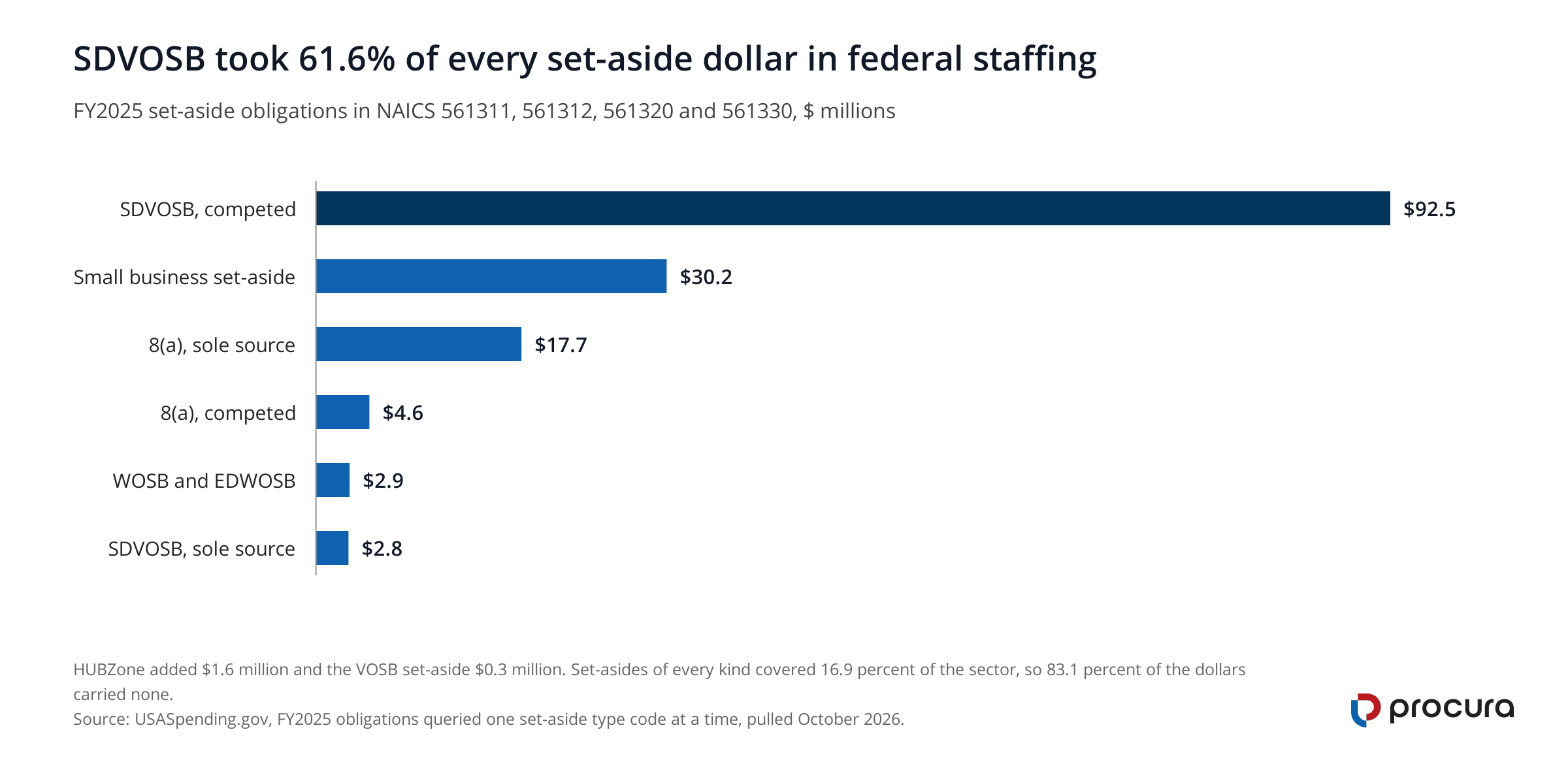
Data table: FY2025 obligations by set-aside type code, all twelve codes
| Set-aside type | USASpending code | FY2025 obligations |
|---|---|---|
| SDVOSB, competed | SDVOSBC | $92,539,978 |
| Small business set-aside | SBA | $30,186,882 |
| 8(a), sole source | 8AN | $17,677,563 |
| 8(a), competed | 8A | $4,605,283 |
| SDVOSB, sole source | SDVOSBS | $2,830,330 |
| Partial small business | SBP | $2,255,345 |
| WOSB | WOSB | $2,046,522 |
| HUBZone, competed | HZC | $1,554,301 |
| EDWOSB | EDWOSB | $860,826 |
| VOSB set-aside | VSA | $252,367 |
| HUBZone, sole source | HZS | $69,654 |
| WOSB, sole source | WOSBSS | -$4,194 |
| All set-asides | $154,874,857 |
Other set-aside programs in government staffing contracts
Other set-aside programs are near zero in this sector. Overall, the whole WOSB and EDWOSB family came to $2.9 million, and HUBZone came to $1.6 million across competed and sole-source awards. Those are real certifications with real value in other markets. In these four codes each one moved less than a third of one percent of the dollars.
Our WOSB certification guide and HUBZone requirements guide are still worth reading before you decide. However, the same certification that does nothing in temp help does a great deal in construction and facilities work.
A bigger number sits outside the set-asides. Overall, agencies awarded $760.3 million, or 83.1 percent of the sector, with no small-business set-aside at all. Small firms still took 76.0 percent of every dollar. In this market a certification is a tiebreaker rather than a gate. Full and open competition is the normal road. So your capability statement and your past performance carry more weight than your socioeconomic status.
When does the money actually move?
October, not September. However, every piece of general GovCon advice tells you the fourth quarter is where agencies spend down, and for supplies that is true. Staffing inverts it. In FY2025 the four codes obligated $105.3 million in October, the single largest month of the year, against $96.0 million in September. The first quarter, October through December, carried $296.2 million, or 32.4 percent of the year. The fourth quarter carried $249.0 million, or 27.2 percent.
April was the floor at $49.5 million, less than half of October.
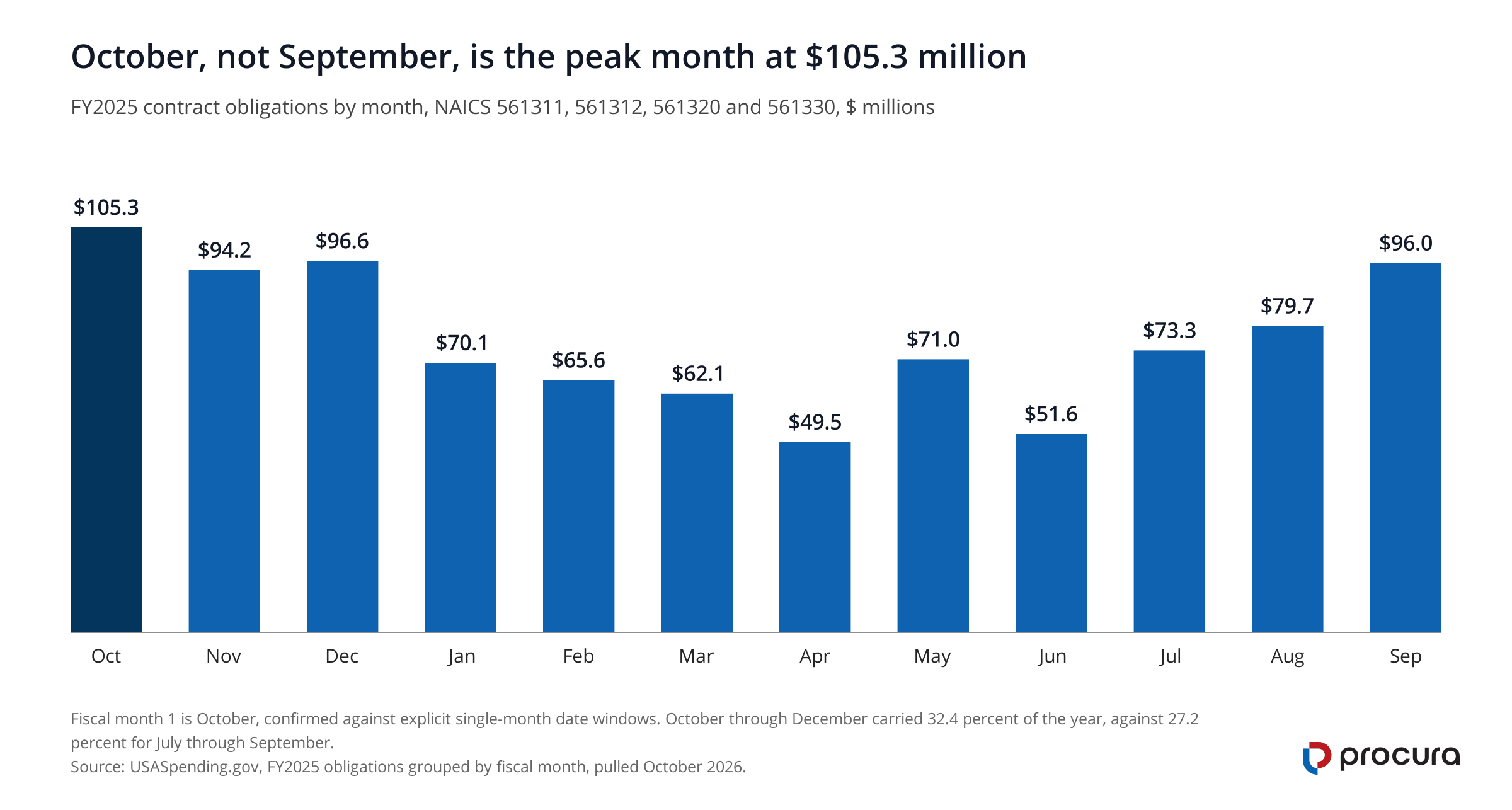
Data table: FY2025 obligations by month
| Month | FY2025 obligations | Share of year |
|---|---|---|
| October 2024 | $105,331,541 | 11.5% |
| November 2024 | $94,249,717 | 10.3% |
| December 2024 | $96,616,411 | 10.6% |
| January 2025 | $70,125,030 | 7.7% |
| February 2025 | $65,637,583 | 7.2% |
| March 2025 | $62,113,269 | 6.8% |
| April 2025 | $49,497,356 | 5.4% |
| May 2025 | $71,048,326 | 7.8% |
| June 2025 | $51,590,102 | 5.6% |
| July 2025 | $73,322,485 | 8.0% |
| August 2025 | $79,668,948 | 8.7% |
| September 2025 | $95,964,817 | 10.5% |
That pattern is structural. A staffing contract is a base period of recurring services, so its money lands when the period of performance starts. In fact, most periods of performance start at the top of the fiscal year. September still ranks third, because agencies exercise options and close coverage gaps then. But it is not the peak. Plan your capture calendar backwards from an October start, with proposals in the summer.
How big are the awards, and who holds them?
The dollars live in a small number of large awards while the count lives in small ones. However, awards above $1 million are 11.5 percent of the 6,036 contracts and carry 74.4 percent of the obligations. The 90 awards above $5 million are 1.5 percent of the count and carry 35.3 percent of the money.
| Total award size | Contracts | FY2025 obligations |
|---|---|---|
| Under $25,000 | 1,513 | -$11.8 million |
| $25,000 to $150,000 | 1,884 | $20.5 million |
| $150,000 to $350,000 | 977 | $56.5 million |
| $350,000 to $1 million | 971 | $169.3 million |
| $1 million to $5 million | 603 | $357.6 million |
| Above $5 million | 90 | $323.1 million |
Who holds the largest awards
Concentration at the top is high. Loyal Source Government Services took $138.0 million by itself, which is 15.1 percent of the sector. Together the top five took $250.0 million, or 27.3 percent, and the top ten took $345.6 million, or 37.8 percent. Behind Loyal Source the list runs Ansible Government Solutions at $35.7 million and Titan-Auxo at $29.6 million. Then come Tyonek Technical Services at $23.4 million and Bay Area Anesthesia at $23.3 million.
Read the names and the market tells you what it is. In short, these are clinical staffing firms and tribally affiliated holding companies, not general temp agencies.
Below the top ten the field opens up. The $350,000 to $1 million band holds 971 contracts and $169.3 million, and a single-site clinical or administrative requirement sits comfortably in it. That band is the realistic entry point. A firm that wins two of those awards has the past-performance record for the next tier up. The subcontracting route gets you there faster if a prime on a multi-site award needs coverage in your city.
Is the federal staffing market growing?
No. The four codes peaked at $1,348.1 million in FY2023 and fell to $915.2 million in FY2025, a drop of 32.1 percent in two years. FY2021 was $1,192.7 million and FY2022 was $1,283.1 million, so the current year is the lowest of the five.
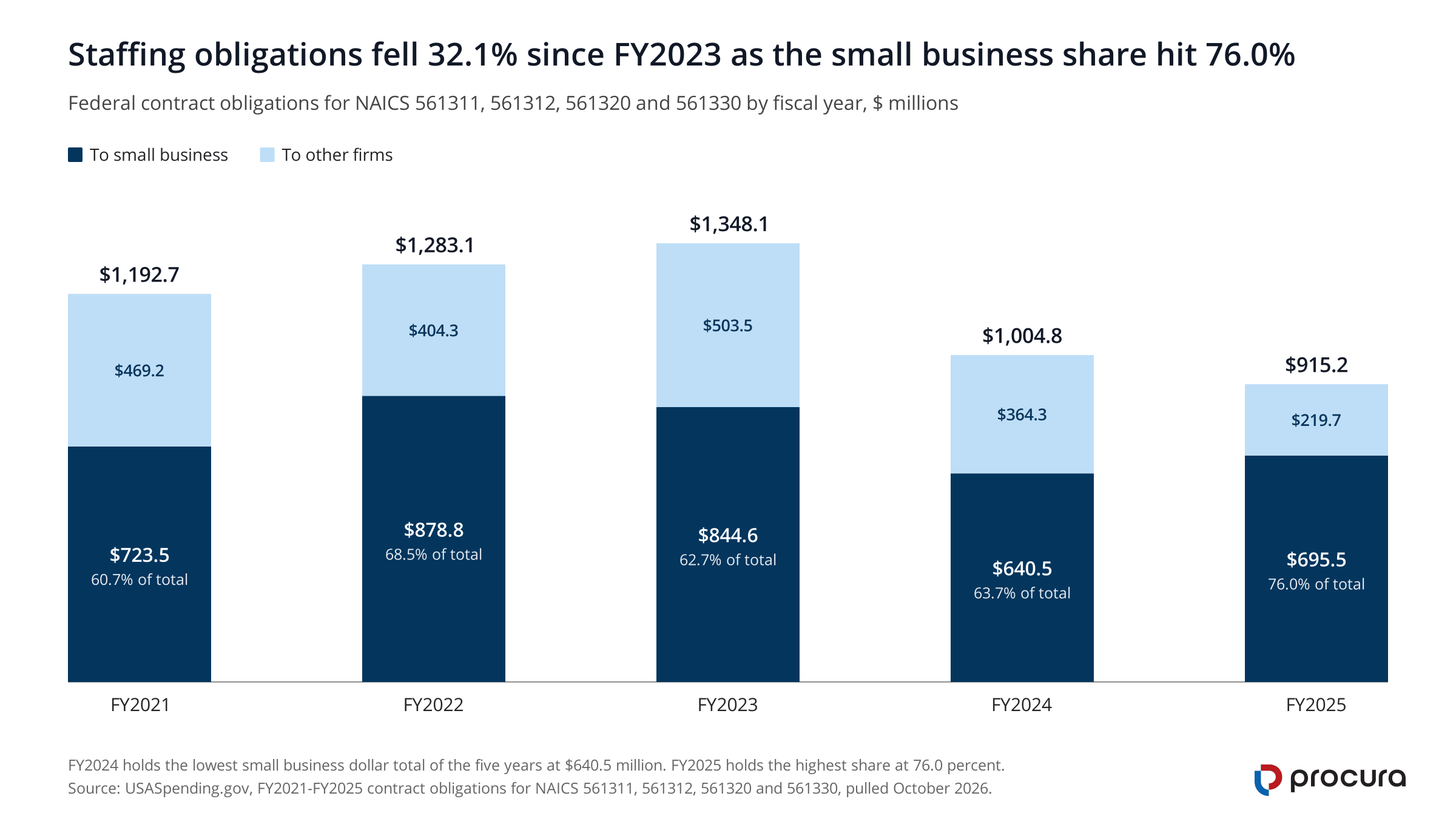
Data table: federal employment-services obligations by fiscal year, FY2021-FY2025
| Fiscal year | Total obligations | To small business | Small business share |
|---|---|---|---|
| FY2021 | $1,192.7 million | $723.5 million | 60.7% |
| FY2022 | $1,283.1 million | $878.8 million | 68.5% |
| FY2023 | $1,348.1 million | $844.6 million | 62.7% |
| FY2024 | $1,004.8 million | $640.5 million | 63.7% |
| FY2025 | $915.2 million | $695.5 million | 76.0% |
The small-business share moved the other way over the same period. It was 60.7 percent in FY2021 and 76.0 percent in FY2025, a gain of 15.3 percentage points. The FY2025 figure is the highest of the five years. A shrinking pot with a growing small-business slice is an unusual combination. USASpending shows that shape without explaining the cause. Two causes are plausible.
One is a shift of recurring requirements out of temp-help codes into occupational codes. The other is the normal post-pandemic decline in surge clinical buying. The data in front of me does not separate the two, so treat the trend as a reason to bid the occupational codes.
How do you get your first federal staffing award?
None of this sequence is optional.
- Register in SAM.gov and get your UEI and CAGE code. Our SAM.gov registration guide covers the data mismatches that cause most delays.
- Pick your primary NAICS code against the work you actually staff, then check your five-year average receipts against the size standard for every code you plan to bid.
- Build the credentialing file before you need it. Licensure by state, current certifications, background investigations, and immunization records are what a clinical solicitation evaluates, and assembling them after award is how firms miss a start date.
- Read the wage determination attached to the solicitation and price each labor category above it, with the option-year escalations modeled.
- Ask in questions whether a predecessor collective bargaining agreement applies, and get the answer in writing.
- Bid the $350,000 to $1 million band first, where 971 awards were made in FY2025.
Our step-by-step guide to winning government contracts works through the proposal mechanics for every vertical. The easiest contracts to win roundup compares staffing against the other service verticals on competition and barrier to entry.
The hard part is not registering. It is reading the solicitation.
Everything above is knowable. Registration is free and the size standard is a table. Every solicitation carries its own wage determination. The 120-workday cap is one paragraph of the Code of Federal Regulations. A staffing firm can learn all of it in a week.
What nobody solves in a week is the volume. One clinical staffing solicitation can carry a performance work statement, a wage determination, a position-description appendix, a credentialing matrix, and a past-performance questionnaire. The fact that decides whether you can bid usually sits inside an attachment rather than in the notice.
Look for the code in the notice. Its size standard sits in a different document. The answer on a predecessor union agreement arrives in a question-and-answer file eleven days later. A recruiter who reads all of that for forty solicitations a week is a recruiter who does no recruiting.
That is the job Procura Federal does. It opens the attachments a staffing solicitation hides its terms in, and grades each requirement against what your firm can actually deliver. Then it surfaces the clauses that decide whether a bid is even legal for you. The price is $399/month, against the five-figure annual contracts the legacy platforms sell. For a staffing firm the output is four things: the labor categories, the wage determination, the code with its size standard, and the credentialing requirements. You read those in a minute instead of an afternoon.
Research this market for free. Procura’s free explorer breaks down NAICS 561320 (temporary help services) and NAICS 561311 (employment placement) by buying agency, contractor and state, and agency pages such as the Department of Veterans Affairs page list each department’s small business specialists. No login is needed to browse, and a free account adds saving and data exports.
Frequently asked questions
How much does the federal government spend on government staffing contracts?
$915.2 million in FY2025 across the four employment-services NAICS codes. That figure counts transaction obligations, which include modifications and de-obligations, so it runs higher than a count of new prime awards only. The much larger labor spend sits in occupational codes instead, such as $6.0 billion in guard services and $37.1 billion in facilities support.
Do I need a GSA Schedule to sell staffing services to the government?
No. A Multiple Award Schedule contract gives agencies a faster path to buy from you, and it is one route among several. In FY2025 agencies awarded most dollars in these codes through ordinary competed procurements, with no set-aside. An active SAM.gov registration and a correct NAICS code are the real prerequisites.
Can a federal agency hire my temps for a full year?
Not as temp help under 5 CFR part 300, subpart E. One situation caps at 120 workdays and extends to 240. One individual caps at 120 workdays in a 24-month period at the same major organizational element. A year-long recurring requirement becomes a nonpersonal services contract instead.
What NAICS code should a staffing agency use for federal work?
Register the codes for the work you place, not only 561320. A nurse-placement firm wants the clinical codes, a cleared-analyst firm wants the information-technology codes, and a guard firm wants 561612. Read each code’s size standard separately. Clinical codes cut the ceiling to as little as $10.0 million of average annual receipts, against $34.0 million for Temporary Help Services.
Does the Service Contract Act apply to a staffing contract?
Almost always. It reaches service contracts over $2,500 done in the United States through service employees, which describes nearly every staffing award. The exception at FAR 22.1003-3(f) applies to an employment contract between an agency and one individual. That is a different arrangement from yours.
Which agency is the best first target for a small staffing firm?
Indian Health Service, on the numbers. It obligated $247.2 million through these codes in FY2025, including $116.9 million for nursing, and it staffs facilities in labor markets where local hiring fails. Customs and Border Protection at $150.8 million and the Bureau of Prisons at $35.0 million share that profile.
Book a demo
Bring a live staffing solicitation to the call. We will run it through Procura and return the labor categories, the wage determination, the size standard behind the code, and the credentialing requirements. It takes less time than opening the attachments by hand.
By Jacob Grass, founder of Procura Federal. Published October 16, 2026. Last updated October 16, 2026. Federal spending figures are FY2025 contract obligations pulled from USASpending.gov in October 2026. Regulatory citations are to the October 1, 2026 editions of titles 5, 13 and 48 of the Code of Federal Regulations.