A CAGE code is the five-character identifier that the Defense Logistics Agency normally assigns to one legal entity at one physical address. DLA issues it inside your SAM.gov registration, not through a separate application. FAR 4.1802 makes you give that code to the contracting officer before award, where the solicitation requires SAM registration or a unique entity identifier. The code is thus a precondition for award and not an advantage in the competition. However, that is the part most paid “CAGE registration” services leave out.
I register entities and read solicitations every week, and this five-character code causes two kinds of trouble. First, new contractors pay somebody to get one, then learn that DLA assigned it automatically. Second, established contractors discover at award time that their code points at an address they left two years ago.
What is a CAGE code, and who assigns it?
The CAGE code identifies a business location, not a business. FAR 52.204-16 defines it as an identifier assigned to entities in the United States or its outlying areas. The DLA CAGE Branch assigns it to identify an entity by unique location. As a result, two offices of one company carry two codes. Similarly, one company with two bank accounts in SAM carries two codes, because DFARS PGI 204.1870-2 gives each electronic-funds-transfer indicator record its own code.
That address rule has teeth. DLA does not assign a code to a mailing address, a P.O. box, or a commercial mail or shipping location. For example, a sole proprietor gets one code for one location. The legal name on that record is the individual’s personal name, and a trade name is filed as a DBA. Similarly, an agent or a broker gets a single code of its own, separate from the codes of the firms it represents. Two businesses in one building can each hold a code when the most specific address distinguishes them.
Where does the code appear after award?
The code also travels wider than most contractors expect. FAR 4.1802 makes the contracting officer write your code into the contract. Moreover, it goes into every electronic transmission of contract data to other systems as well. If another company owns or controls you, FAR 52.204-17 makes you supply that owner’s code and legal name too.
How do you get a CAGE code?
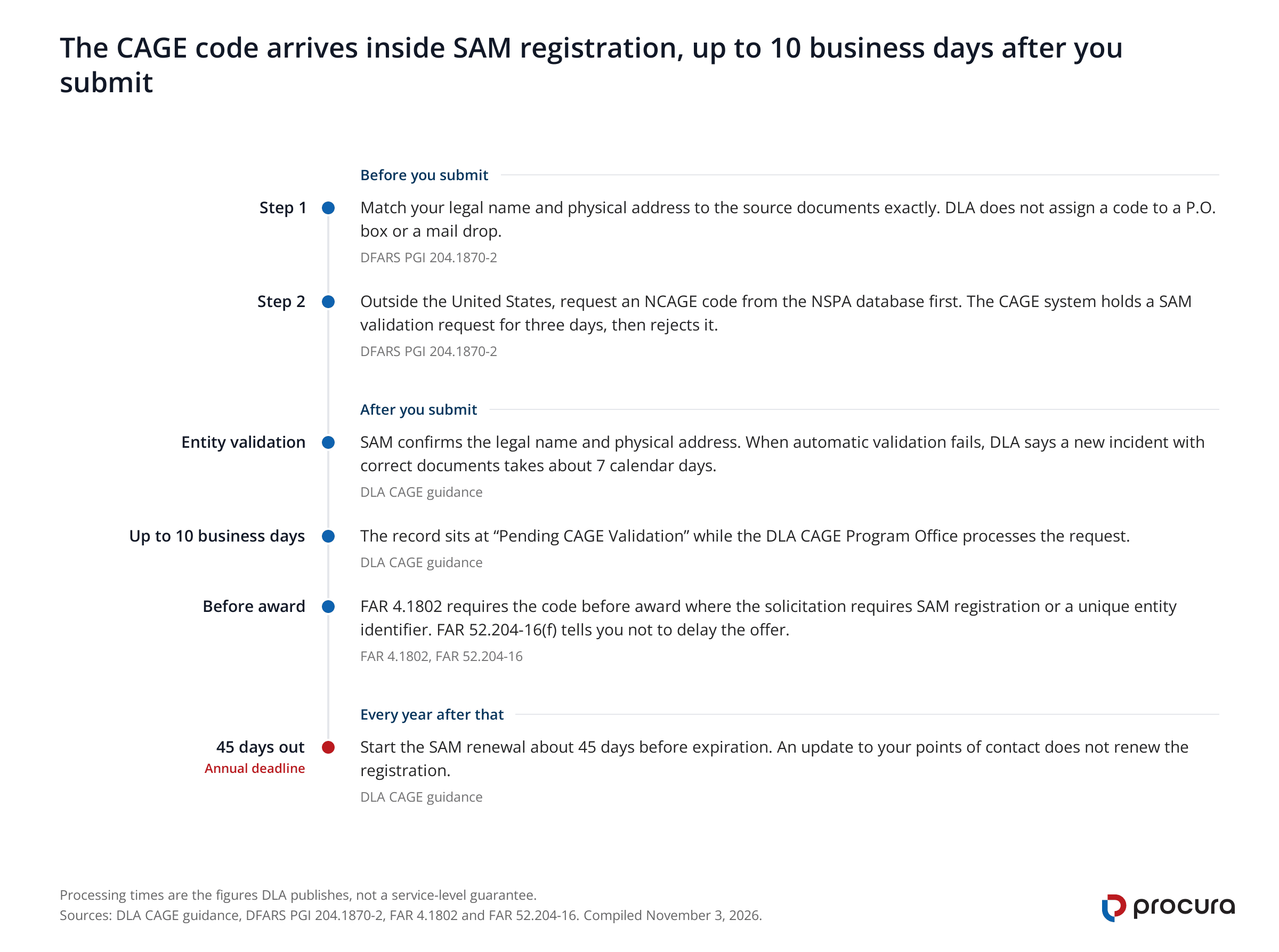
If you register in SAM, you do not apply for a code separately. FAR 52.204-16(c)(2) keeps a direct request open for an entity that the rules do not require to register. DD Form 2051 is that route. Everybody else, however, gets the code with the registration. DLA states the mechanism plainly: “During the registration process on SAM.gov, a new CAGE code will be assigned if one does not exist already.” In other words, the code arrives as a by-product of entity registration. Our SAM.gov registration guide walks that registration step by step.
Three parts of the sequence decide how long you wait. First, entity validation confirms your legal name and physical address against government records. Then the registration sits at a status of “Pending CAGE Validation” while DLA works it. DLA says that it can take up to 10 business days for the CAGE Program Office to process all CAGE requests. Meanwhile, a validation incident with the correct documents attached takes about 7 calendar days, and DLA warns that less tidy cases run to several weeks.
Can you bid while the code is pending?
One rule in FAR 52.204-16 is worth more than the rest of this section to a contractor with a bid due. Paragraph (f) tells the offeror not to delay an offer while it waits for a CAGE code. In other words, the code must exist before award, not before submission. Therefore, a pending code is not a reason to skip a solicitation you can win.
How much does it cost, and is it hard to get?
Neither DLA nor SAM.gov publishes a price for a CAGE code, and no step in the process asks you to buy anything. Instead, DLA assigns the code inside a SAM.gov registration that you complete yourself. In fact, the work is clerical rather than technical: an exact legal name, a physical address, a taxpayer identification number that matches IRS records, and banking details. Firms that sell “CAGE code registration” sell help with that clerical work. It is a real service, but it is not access to anything closed.
Difficulty concentrates in one place. For example, nearly every stuck registration I see is a name or address mismatch. Therefore, the fix is to make your SAM entry match the source document exactly, down to “Inc.” against “Incorporated”. DLA requires documentation for a legal name change, such as articles of incorporation, or a fictitious business name filing for a sole proprietor.
How do you look up a CAGE code?
Three routes answer three different questions. First, for your own code, open your SAM.gov entity record. FAR 4.1803 states that active registrations in SAM had the associated CAGE codes verified. For a code held by an entity with no SAM registration, FAR 4.1803 sends the contracting officer to the CAGE code search at cage.dla.mil. Moreover, that search is public as well, although FAR 4.1803 speaks only to the contracting officer’s step.
Our free CAGE code lookup and UEI lookup answer the third question. Specifically, each one returns the registered entity beside its award history.
A five-character code on a drawing or a packing list can belong to something other than a company. FAR 52.204-16 defines the code as identifying a commercial or a government entity by unique location, so government activities hold codes too. As a result, a code taken from a military part number can thus resolve to something you cannot buy from. Therefore, read the registered name before you treat a code as a supplier.
What is the difference between a CAGE code, a UEI, and a DUNS number?
SAM retired the DUNS number in 2022 and left two live identifiers. FAR 4.1800 separates them in one line: the unique entity identifier is a different identifier from the CAGE code, with its own rules. In short, the UEI names the registered entity and the code names the place.
| Identifier | Who assigns it | Format | How you get it | What it identifies | Upkeep |
|---|---|---|---|---|---|
| CAGE code | DLA CAGE Program Office | 5 characters | Assigned during SAM.gov registration for U.S. entities | One legal entity at one physical address, and one code per SAM electronic-funds-transfer indicator record | Maintained through SAM, under FAR 52.204-18 |
| NCAGE code | A NATO member nation’s codification bureau, or the NATO Support and Procurement Agency | 5 characters | Requested from your own country’s codification bureau, or from NSPA where the country is neither a NATO member nor NATO-sponsored | An entity outside the United States | Legal name and address must match the NSPA record |
| UEI | SAM.gov | 12 characters | Created when you register, or when you request a UEI alone | The registered entity | Renew the registration every year |
| DUNS number | Dun & Bradstreet | 9 digits | No longer issued for federal awards | The former federal entity identifier | Replaced by the UEI in 2022 |
How do you keep the record current?
Maintenance is a contract clause, not a courtesy. FAR 52.204-18 goes into every solicitation and contract that carries 52.204-16. As a result, it puts the duty to keep the CAGE record accurate on you. The practical work then splits by whether you hold a SAM registration.
A registered entity updates its CAGE data by updating and submitting its SAM registration for validation. By contrast, an entity with no SAM record files the change at cage.dla.mil or on DD Form 2051. That form goes to the DLA CAGE Branch in Battle Creek, Michigan. However, small corrections move fast. DLA processes a change such as “&” for “and” or an added “LLC” without the documentation that a true name change needs.
A real name change with work in hand is the slow case, and DFARS PGI 204.1870-2 splits it in two. For example, a plain name change needs a signed change-of-name agreement under FAR 42.1205, plus written confirmation that the contracting officers were told. Where the change follows an acquisition or a merger, DLA wants the executed novation agreement under FAR 42.1204. Alternatively, in either branch DLA can act on the cognizant contracting officer’s written confirmation. Where the update comes through SAM, DLA rejects it after 10 business days if neither document arrives.
Which deadlines apply after a change?
One deadline sits outside the two systems. FAR 52.204-18(b) requires you to report a CAGE change to the contracting officer within 30 days, so the contract can be modified to match. In short, that clause is what turns a stale record into contract risk.
Registration renewal is the other recurring deadline. SAM renewal runs annually from the date you last certified and submitted. However, an update to your points of contact does not count as a renewal. Therefore, DLA advises you to start about 45 days before expiration.
| What has gone wrong | Who owns it | How to reach them |
|---|---|---|
| Registration stuck at “Pending CAGE Validation” | DLA Customer Interaction Center | 1-877-352-2255, dlacontactcenter@dla.mil, open 24 hours |
| General questions about a CAGE code or record | DLA CAGE Program | 1-877-352-2255 or 1-269-961-7766 |
| Any other SAM registration status problem | Federal Service Desk | 866-606-8220, Monday to Friday, 8 a.m. to 8 p.m. ET |
| A CAGE change with no matching SAM record | DLA CAGE Branch | cage.dla.mil or DD Form 2051 to cagemail@dla.mil |
| Legal name change while contracts are active | Your contracting officer, then DLA | Change-of-name agreement under FAR 42.1205, or a novation agreement after a merger or acquisition |
Do you need one if your business is outside the United States?
A non-U.S. entity carries an NCAGE code instead, and the order of operations catches most first-time registrants. DFARS PGI 204.1870-2 requires the SAM record to carry an NCAGE from the NATO Support and Procurement Agency database. Moreover, the legal name and address must match that database. Therefore, get the NCAGE first. Where no NCAGE exists in that database, the CAGE system holds the SAM validation request for three days and then rejects it. NSPA update times vary by country, and the same rule notes that they can take up to a month.
What does a CAGE code actually get you into?
Federal agencies obligated $778.95 billion on contracts in fiscal year 2025, across 5,784,911 prime contract awards, per USASpending.gov. The shape of that volume explains why the agency behind your CAGE code matters. Most federal buying events are small, but most federal money is not.
4,681,878 of those 5.78 million awards, or 80.9 percent, were under $10,000. Together they carried $3.41 billion, which is a mean award of about $730. By contrast, the 36,289 awards of $10 million and above carried $606.84 billion, or 77.9 percent of the money in 0.6 percent of the events. As a result, a new contractor with a fresh code competes in the first group, where the work is real and each order is small.
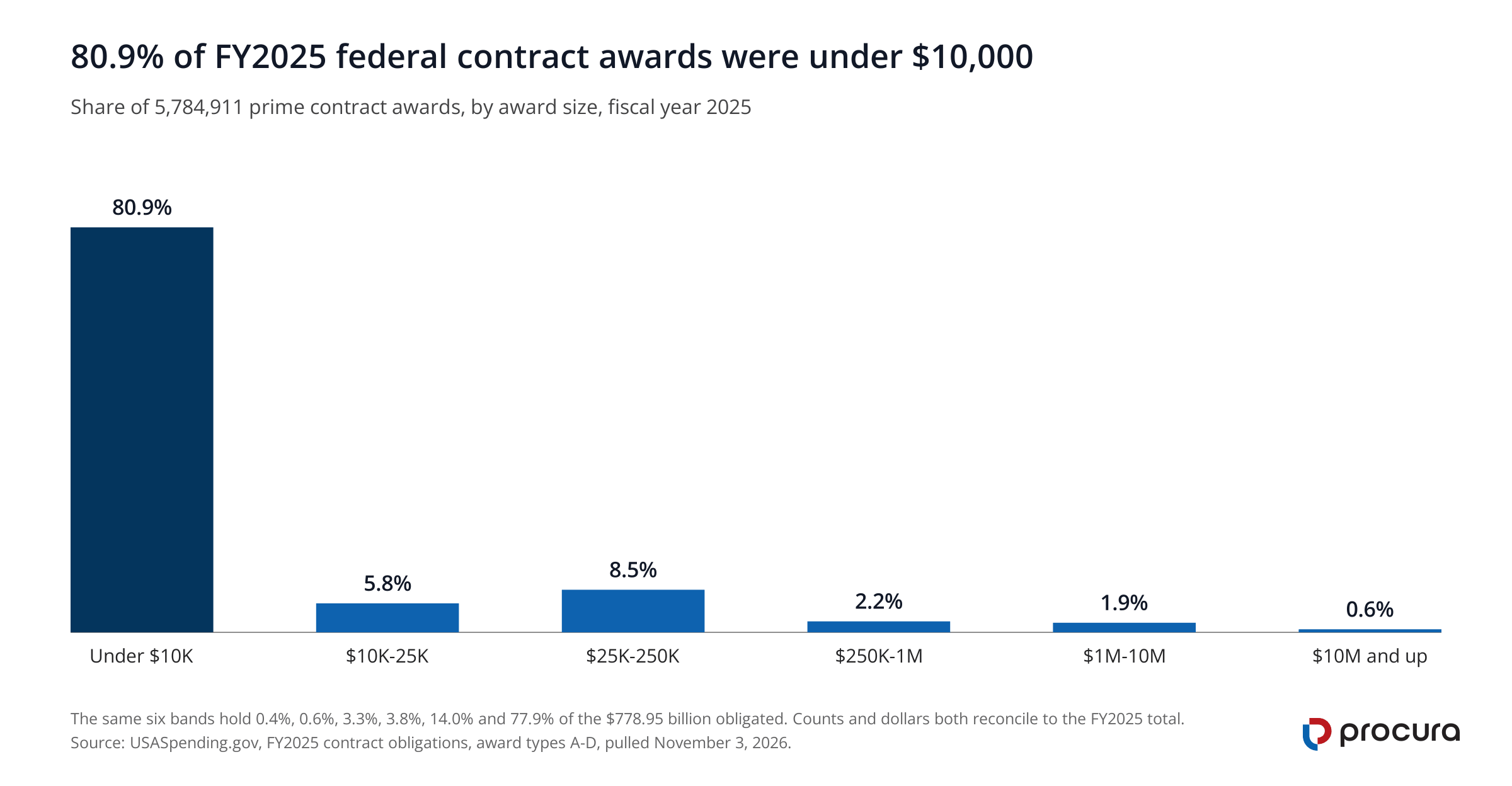
Data table: FY2025 federal prime contract awards and obligations by award size
| Award size | Prime contract awards | Share of awards | Obligations | Share of dollars |
|---|---|---|---|---|
| Under $10,000 | 4,681,878 | 80.9% | $3.41B | 0.4% |
| $10,000 to $24,999 | 335,194 | 5.8% | $4.61B | 0.6% |
| $25,000 to $249,999 | 489,911 | 8.5% | $25.96B | 3.3% |
| $250,000 to $999,999 | 129,236 | 2.2% | $29.34B | 3.8% |
| $1M to just under $10M | 112,403 | 1.9% | $108.80B | 14.0% |
| $10M and above | 36,289 | 0.6% | $606.84B | 77.9% |
| All prime contract awards | 5,784,911 | 100% | $778.95B | 100% |
Why does DLA matter to a new registrant?
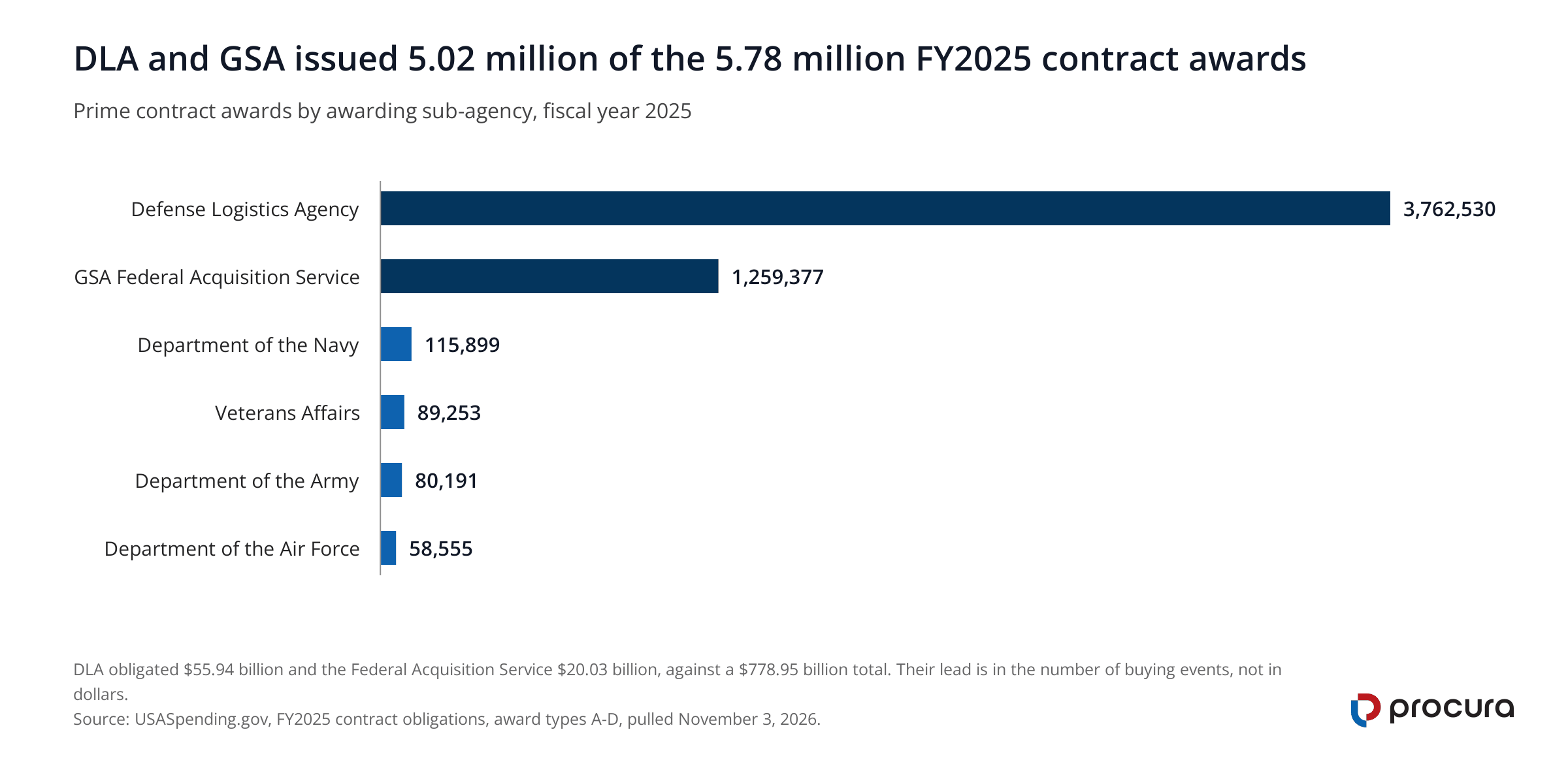
The Defense Logistics Agency sits at the center of that first group. For anybody who just received a code from DLA, that is a useful coincidence. DLA issued 3,762,530 prime contract awards in FY2025, and GSA’s Federal Acquisition Service issued 1,259,377. By comparison, the next largest by count is the Navy, at 115,899. DLA obligated $55.94 billion of the $778.95 billion total, so its share of the dollars is modest. However, its share of the buying events is close to two thirds, and 89 percent of its own awards were under $10,000.
If you make, stock or distribute parts, the route from a new code to a first award runs through the DLA RFQ system. Our guide to bidding on DLA DIBBS walks that channel.
In addition, set-asides change the arithmetic for a small business. Agencies made 167,631 awards worth $32.81 billion under the total small business set-aside in FY2025. However, those awards are closed to firms that do not carry the right representations in SAM. Our list of the easiest government contracts to win starts from that data.
A code is a filing step. The award records behind it are the part worth reading, and they are free to browse by company, agency and industry. Keep your own copy by exporting those tables with a free account.
The code is the easy part
Ten business days of DLA processing buys you the right to be considered. However, it does not tell you which of 5.78 million annual awards match what you make. Nor does it read the attachment set where the disqualifying requirement usually hides. That gap is the actual work, and it is where most new registrants stall for a year. A capability statement and a plan for winning government contracts close part of it.
Procura Federal closes the rest. It opens the attachment set behind each solicitation and ranks the requirement list against the work your capability statement claims. In addition, it marks the clauses that disqualify a bidder.
The price is $399/month. Published third-party estimates put the incumbent platforms in the five figures a year, which is directional rather than a quote. Compare it with the other tools that find government contracts first. If you would rather pay for none of them, read how to find federal contracts by hand.
Frequently Asked Questions
Can I get a CAGE code without registering in SAM.gov?
Entities that the rules do not require to register in SAM can hold a code. FAR 4.1803 tells contracting officers to validate those codes through the search at cage.dla.mil. However, if you plan to bid, register, because the award itself will require the registration.
How many characters is a CAGE code?
Five. DLA describes it as a five-character identifier. FAR 52.204-16 tells you to write the word “CAGE” in front of the number when you put it in an offer.
Do I need a new code if I move offices?
A code belongs to a physical location, so a move means a change to the record. Similarly, a second location that bids on its own means a second code. Update the SAM registration, and let the validation run before your next proposal depends on it.
Does a CAGE code expire?
The registration around it is what lapses. SAM renewal falls due one year after you last certified and submitted. As a result, an inactive registration stops you from receiving an award, even though the five characters still exist.
Can two companies share one code?
No. DLA assigns per legal entity at an individual physical address. Similarly, it treats an agent or a broker as its own entity rather than folding it into the firms it represents.
Which tools track a contractor by CAGE code?
SAM.gov entity search and cage.dla.mil answer the identity question. Meanwhile, USASpending.gov answers the history question. Procura joins the two, so a code resolves to an entity with its awards, its registered codes and its set-aside representations on one screen.
Get your first qualified opportunity
Bring your new code and your capability statement to a 30-minute demo. We will search live solicitations against what you do. We will open the attachment set on one of them, and point at the requirements that decide the bid. Pick a time below.