SDVOSB certification now comes from the Small Business Administration, not from the Department of Veterans Affairs. In fact, Congress moved the program on January 1, 2023. SBA counted 5,870 SDVOSB vendors with federal prime awards in FY2025. Meanwhile, self-certification is dead for every purpose that pays. A firm that still relies on it cannot win a set-aside award, and no agency can count its contract toward a goal.
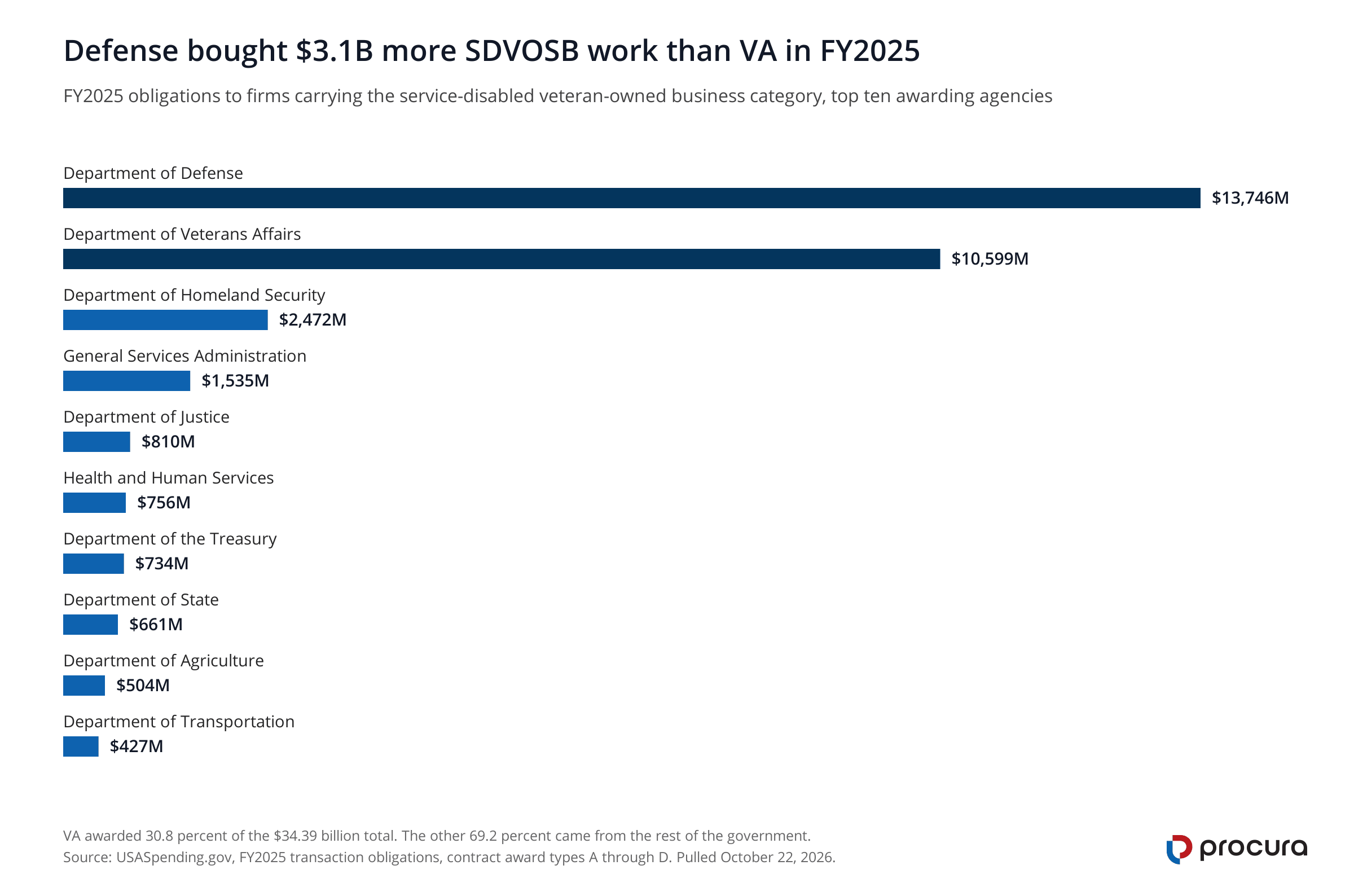
However, the money behind the certificate sits somewhere most veterans do not look. Federal agencies obligated $34.39 billion to service-disabled veteran-owned firms in FY2025, and VA awarded 30.8 percent of it. In fact, the Department of Defense awarded $3.15 billion more than VA did. Every spending figure here is FY2025 obligations from USASpending.gov, pulled on October 22, 2026. In addition, the rules come from 13 CFR part 128, 38 U.S.C. 8127, and the FY2025 SBA scorecard.
Who handles SDVOSB certification now, and what changed?
SBA certifies, and VA no longer does. Section 862 of the FY2021 National Defense Authorization Act, Public Law 116-283, created the Veteran Small Business Certification Program. Today that program is known as VetCert, and it runs under 13 CFR part 128. The same section abolished the VA Center for Verification and Evaluation on the transfer date of January 1, 2023. However, firms that VA had verified before that date stayed certified for the remainder of their own three-year term.
Two separate deadlines ended self-certification, and both are behind us. The first deadline closed on January 1, 2024, and it covers eligibility for an SDVOSB set-aside or sole-source award. A firm that did not have a complete application in by December 31, 2023 lost the right to bid those contracts. Then the second deadline closed on December 22, 2024, under section 864 of the FY2024 NDAA. From that date a prime contract or a subcontract counts toward an agency SDVOSB goal only if a certified firm holds it.
Can you still self-certify in SAM?
You can still check the veteran-owned box in the System for Award Management. However, without SDVOSB certification it earns nothing now, and it carries real risk. Under 13 CFR 128.600 that representation is an affirmative, willful, and intentional certification, which opens the door to False Claims Act liability. By contrast, note the Small Disadvantaged Business designation, which remains self-certified.
| Date | What changed | Authority |
|---|---|---|
| January 1, 2023 | SBA takes over certification; VA CVE abolished | Pub. L. 116-283, sec. 862; 87 FR 73400 |
| January 1, 2023 | Self-certification ends at VA, a year before it ends elsewhere | Pub. L. 116-283, sec. 862(f)(2); 13 CFR 128.200(c)(1) |
| January 1, 2024 | Self-certification ends for set-aside and sole-source awards outside VA | 13 CFR 128.200(c)(1); FAR 19.1403(b) |
| December 22, 2024 | Self-certification ends for prime and subcontract goal credit | 13 CFR 128.200(c)(2); Pub. L. 118-31, sec. 864 |
| December 22, 2023 | Government-wide SDVOSB goal raised from 3 to 5 percent | Pub. L. 118-31, sec. 863; 15 U.S.C. 644(g)(1)(A)(ii) |
Is the SDVOSB goal 3 percent or 5 percent?
That last row catches people out. In fact, the government-wide SDVOSB goal is 5 percent of prime and subcontract dollars, not the 3 percent that most published advice still quotes. Section 863 of the FY2024 NDAA raised it on December 22, 2023. Meanwhile, HUBZone is the program that still carries a 3 percent goal, which is where the confusion starts.
What are the SDVOSB certification requirements?
Ownership, control, and a verified service-connected disability. The SDVOSB certification requirements sit in 13 CFR part 128. In practice, they are stricter on control than most owners expect. However, they are also looser on the disability rating than almost every vendor blog claims.
First, start with ownership. One or more veterans must own at least 51 percent of the firm, unconditionally and directly. However, ownership through another business entity does not count. A revocable living trust can hold the interest when the qualifying veterans are the grantors, the trustees, and the current beneficiaries. SBA determines ownership without regard to community property laws.
Second, control is where applications fail. The qualifying veteran must hold the highest officer position, usually President or Chief Executive Officer. In addition, that veteran must also work full time during normal business hours. One rule inside 13 CFR 128.203 surprises nearly everyone. Specifically, no non-veteran can draw compensation above what the veteran in the top job draws. The firm can rebut that by showing the pay is commercially reasonable, or that the veteran chose to take less. If the top officer falls behind anyway, the firm must tell SBA within 30 calendar days.
What disability rating does SDVOSB certification need?
Third, the disability rating, because the common advice here is wrong. In fact, no minimum percentage exists. The test in 13 CFR 128.102 is registration in the Beneficiary Identification and Records Locator Subsystem as a service-disabled veteran. The disability must be service-connected as defined at 38 U.S.C. 101(16). VA establishes that status and SBA reads it. Under 15 U.S.C. 657f, SBA cannot certify a firm at all when VA cannot provide the verification. For example, a veteran rated at 0 percent who sits in the system qualifies. By contrast, a veteran rated at 100 percent whose records are not in the system does not.
| Requirement | The standard | Citation |
|---|---|---|
| Veteran ownership | At least 51 percent, held unconditionally and directly, not through another entity | 13 CFR 128.200, 128.202 |
| Highest officer position | A qualifying veteran holds it and normally works full time | 13 CFR 128.203(b), (i) |
| Compensation ceiling | No non-veteran out-earns the top veteran officer, absent a rebuttal | 13 CFR 128.203(h)(6) |
| Disability rating | No minimum percentage; VA registration as service-disabled | 13 CFR 128.102; 15 U.S.C. 657f(f)(2) |
| Size | Small under the size standard for a NAICS code in your SAM profile | 13 CFR 128.200(b)(1), 128.204 |
| Managerial experience | Matched to the extent and complexity of the business | 13 CFR 128.203(b) |
| Federal debts | No unresolved tax liens or defaults on federal loans | 13 CFR 128.201(b) |
| SAM standing | Active registration, and no active exclusion for the firm or its owners | 13 CFR 128.201; FAR 4.1102 |
| Surviving spouse | Eligibility continues 10 years at a 100 percent rating, otherwise 3 | 13 CFR 128.202(i) |
| Permanent and total disability | Where the veteran cannot manage daily operations, a spouse or caregiver can control | 13 CFR 128.200(b)(2), 128.102 |
What happens if the veteran dies or is disabled?
Two provisions carry a firm past the veteran. A surviving spouse who inherits the ownership interest keeps eligibility for 10 years. That term applies when the veteran was rated 100 percent disabling or died from a service-connected disability. Otherwise, the term is 3 years, and remarriage or sale of the interest ends it sooner. Second, where VA has rated a disability as permanent and total, a second route opens. If the veteran cannot manage daily operations, a spouse or one permanent caregiver can run the business and the firm stays eligible. That designation needs a written VA determination under 38 CFR 3.340.
How do you apply for SDVOSB certification, and what does it cost?
SDVOSB certification costs nothing, and the application moved. SBA now takes applications through MySBA Certifications at certifications.sba.gov, which is a single front door for VetCert, 8(a), HUBZone, and the women-owned programs. However, the older address at veterans.certify.sba.gov still appears in FAR 19.1403 and in a great deal of published advice. SBA charges no fee for any of its certification programs, and SBA states plainly that no capability statement is necessary to apply.
Therefore, get the SAM registration done first. The size test in 13 CFR 128.200 runs against a NAICS code in your SAM profile. Under 13 CFR 128.204, SBA accepts the size representation you make in SAM. As a result, without that profile there is nothing for SBA to evaluate. Our walkthrough of SAM.gov registration covers the entity validation step that holds up most first-time registrants.
SDVOSB certification runs for three years. You can recertify inside the 90 days before your eligibility period ends, under 13 CFR 128.306. If you miss the date, SBA decertifies the firm, though a recertification filed within 30 days brings it back. However, no statute and no regulation sets a processing deadline. In November 2025, SBA reported an average processing time of 12 days. By contrast, the figure at the end of 2024 was 81 days. SBA also reported that it cleared a backlog of more than 2,700 applications. Therefore, treat 12 days as a figure from one moment, not a promise.
What if SBA denies SDVOSB certification?
If SBA denies the application, the appeal goes to the SBA Office of Hearings and Appeals under 13 CFR part 134. However, one exception matters. A denial that rests on insufficient evidence of veteran or service-disabled status cannot be appealed there. In addition, a competitor can also protest your status after you bid. Under 13 CFR 128.500 that protest goes to the same office, and its decision is final agency action.
Already hold another certification? Under 13 CFR 128.303 an 8(a) participant can submit its most recent annual review, and a certified women-owned firm can reuse its documentation. By contrast, no such provision exists for HUBZone. Our guides to 8(a) certification, HUBZone certification, and WOSB certification cover those programs on their own terms. Finally, one more rule matters before you stack them. Under 13 CFR 128.404, a contracting officer cannot restrict an SDVOSB competition to firms that hold a second certification.
How do you get VA contracts with SDVOSB certification, and why is VA different?
VA is the only agency that must set work aside for veteran-owned firms. In short, that single word is the difference. Under 38 U.S.C. 8127(d) a VA contracting officer must restrict competition to veteran-owned small businesses. The condition is a reasonable expectation that two or more of them will bid at a fair and reasonable price. The government-wide authority at 15 U.S.C. 657f(d) is permissive instead. In other words, VA carries a duty, and every other agency has a choice. Moreover, that duty travels, within limits. Under 38 U.S.C. 8127(i), VA must push the same requirement onto any agency buying on its behalf. The statute words it as compliance to the maximum extent feasible.
| Authority | Who it binds | The operative words |
|---|---|---|
| 38 U.S.C. 8127(d) | VA contracting officers | “a contracting officer of the Department shall award contracts on the basis of competition restricted to” veteran-owned small businesses |
| 15 U.S.C. 657f(d) | Contracting officers at every other agency | “a contracting officer may award contracts on the basis of competition restricted to” SDVOSB concerns |
| VAAR 819.7006(a) | VA contracting officers | “the contracting officer shall set-aside a contract action exceeding the micro-purchase threshold” |
| 38 U.S.C. 8128(a) | The Secretary of Veterans Affairs | “the Secretary shall give priority to a small business concern owned and controlled by veterans” |
What did Kingdomware decide?
The Supreme Court settled the point in 2016. In Kingdomware Technologies, Inc. v. United States, 579 U.S. 162, a unanimous Court held that section 8127 is mandatory and not discretionary. VA cannot escape the Rule of Two because it already met its goals, and cannot escape it by ordering through the Federal Supply Schedule. Today VA implements the program in VAAR subpart 819.70 and calls it the Veterans First Contracting Program. The set-aside duty there attaches above the micro-purchase threshold.
How does VA rank veteran preferences?
VA also ranks the preferences. The order in 38 U.S.C. 8127(h) puts service-disabled veteran-owned firms first and other veteran-owned firms second. Then come 8(a) and HUBZone, and then every other small business preference. Section 8128 tells the Secretary to give priority to veteran-owned small businesses inside any other contracting preference VA uses.
One trap sits in the regulation itself. The codified VAAR at 819.7003 still sends contracting officers to the VA Vendor Information Pages. Similarly, part 74 of 38 CFR still describes the Center for Verification and Evaluation as a going concern. VAAR part 819 has not been amended since November 2022, and part 74 not since 2018. A VA class deviation signed on February 16, 2023, effective January 1, 2023, replaced that database reference with the SBA certification database. Therefore, read the deviation rather than the printed regulation. It runs until VA folds it into the VAAR or rescinds it.
Where do the dollars go after SDVOSB certification?
Mostly outside VA, which inverts how this market is usually described. Of the $34.39 billion that reached service-disabled veteran-owned firms in FY2025, VA awarded $10.60 billion, or 30.8 percent. The other 69.2 percent came from the rest of the government, where 60 departments and agencies obligated money to these firms. For example, the Department of Defense alone awarded $13.75 billion, and the Air Force, the Navy, and the Army each awarded more than $3 billion.
How much do set-asides change the picture?
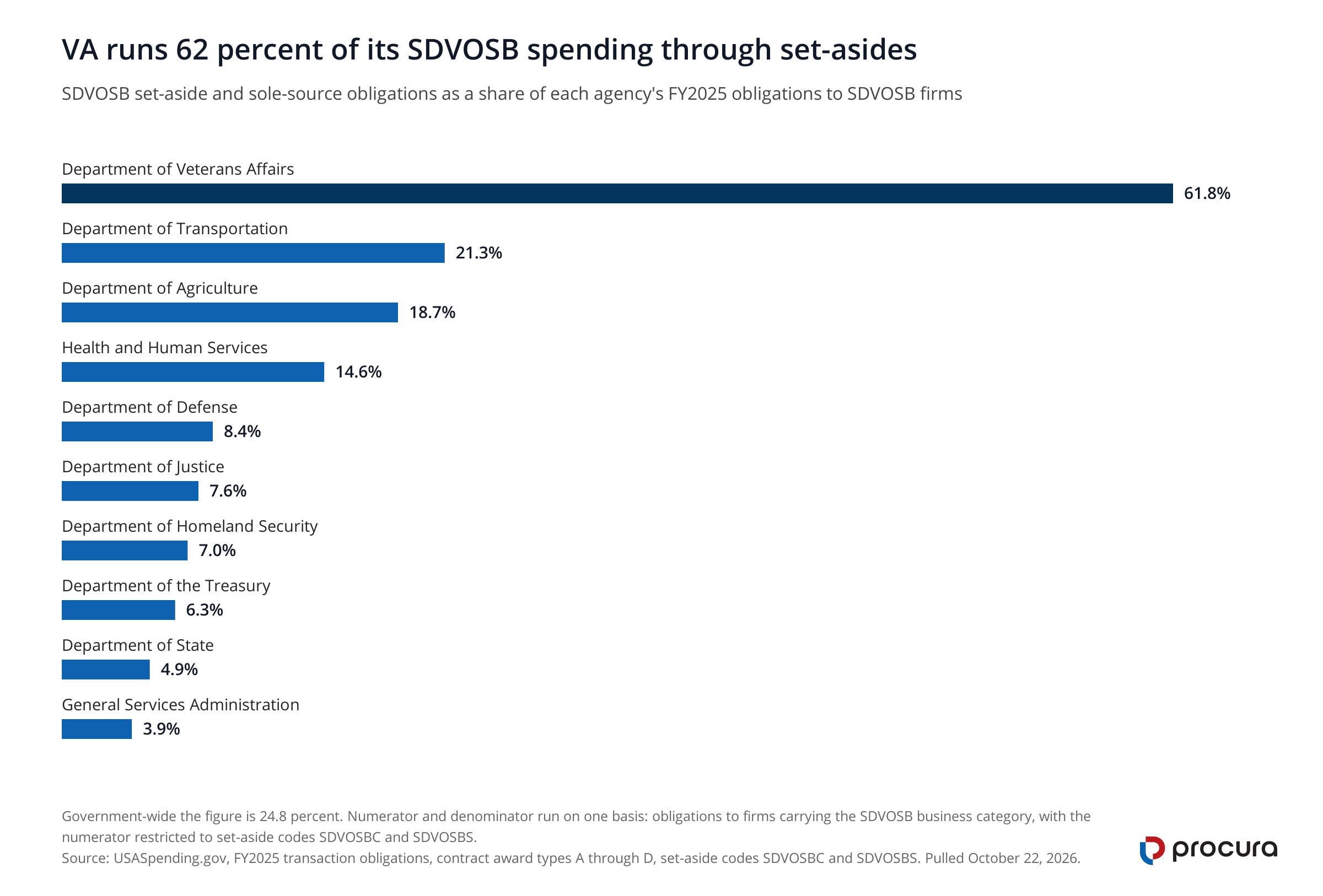
However, flip to set-asides and the picture reverses. VA wrote $6.68 billion of the $8.69 billion obligated under SDVOSB set-aside and sole-source codes, which is 76.9 percent. In fact, the Rule of Two explains both halves at once. VA has a mandate, so VA writes three-quarters of the restricted competitions. Meanwhile, everyone else buys from veteran firms in open competition, at twice the volume.
| Awarding agency | Obligations to SDVOSB firms | Share | Won on an SDVOSB set-aside | Set-aside share |
|---|---|---|---|---|
| Department of Defense | $13,745,747,455 | 40.0% | $1,149,544,759 | 8.4% |
| Department of Veterans Affairs | $10,599,178,514 | 30.8% | $6,545,383,989 | 61.8% |
| Department of Homeland Security | $2,471,989,547 | 7.2% | $172,854,249 | 7.0% |
| General Services Administration | $1,535,158,174 | 4.5% | $60,059,941 | 3.9% |
| Department of Justice | $810,001,642 | 2.4% | $61,746,268 | 7.6% |
| Health and Human Services | $756,409,215 | 2.2% | $110,368,967 | 14.6% |
| Department of the Treasury | $734,086,885 | 2.1% | $45,883,268 | 6.3% |
| Department of State | $661,122,401 | 1.9% | $32,423,463 | 4.9% |
| Department of Agriculture | $503,870,624 | 1.5% | $94,371,235 | 18.7% |
| Department of Transportation | $427,174,861 | 1.2% | $91,036,490 | 21.3% |
| All agencies | $34,387,822,332 | 100% | $8,537,068,125 | 24.8% |
Why do the SDVOSB numbers disagree?
The two dollar columns are different measures, and conflating them is the most common error in this market. First, one counts every dollar that reached a veteran firm. Second, the other counts only the dollars that ran through an SDVOSB set-aside. The gap between them is $25.85 billion.
Finally, SBA reports the same market from a third angle. SBA released the FY2025 federal procurement scorecard on June 25, 2026. It put government-wide SDVOSB prime achievement at 5.01 percent, or $32.5 billion, against the 5 percent goal. Meanwhile, VA scored 21.68 percent, or $10.1 billion. Both earned an A.
Two details in that scorecard deserve more attention than they get. The government-wide figure cleared the goal by a single basis point, and it fell from 5.14 percent in FY2024. By contrast, on the subcontracting side the government reached 2.42 percent against the same 5 percent target. The scorecard and the spending data do not match, and they are not meant to. Specifically, SBA counts firms it has certified and scores them against an eligibility-adjusted base. The figures elsewhere in this article count every firm carrying the SDVOSB designation in SAM, against all contract obligations. That is why VA appears at $10.1 billion here and $10.60 billion above.
How much of the money runs through an SDVOSB set-aside?
About one dollar in four. Of the dollars SDVOSB firms won in FY2025, $8.54 billion came on an SDVOSB set-aside or sole-source award. The remaining $25.85 billion, or 75.2 percent, was won outside the SDVOSB set-aside lane. In other words, SDVOSB certification gets you into the restricted quarter. However, it does not win the other three.
Still, outside that lane does not mean open to everyone. Of that remainder, $5.98 billion came through a different set-aside program. A total small business set-aside carried $4.45 billion of it and the 8(a) codes carried $1.28 billion. What remains, about $19.87 billion, carries either no set-aside code or an explicit code of none. A large part of that sits in delivery orders that inherit their terms from a parent vehicle.
Read the extent-competed codes with care before you draw a conclusion from them. Full and open competition carried $11.16 billion, which is 32.5 percent of the universe. However, the larger bucket at $17.84 billion is full and open after exclusion of sources. That is the code FPDS records when a set-aside excluded somebody. Competed under simplified procedures carried $2.50 billion. Awards coded not competed or not available for competition carried $2.08 billion, and not competed under simplified procedures a further $801 million.
Is the SDVOSB set-aside lane shrinking?
The restricted lane is also shrinking in count while growing in size. SDVOSB set-aside awards fell from 23,237 in FY2021 to 19,460 in FY2025, a drop of 16.3 percent. Obligations ran from $7.18 billion in FY2021 to $8.69 billion in FY2025, with a peak of $9.08 billion in FY2023. As a result, dollars per award rose 44 percent across the five years, from $309,136 to $446,556. Moreover, the fall is not spread evenly, and that matters. Four years took 5.7 percent of it and FY2025 alone took 11.2 percent. That single year lines up with the January 2024 self-certification cutoff and the processing backlog behind it. By contrast, award counts across the wider SDVOSB universe rose over the same period, from 162,627 to 170,841. The contraction looks like a shortage of certified bidders rather than a structural change.
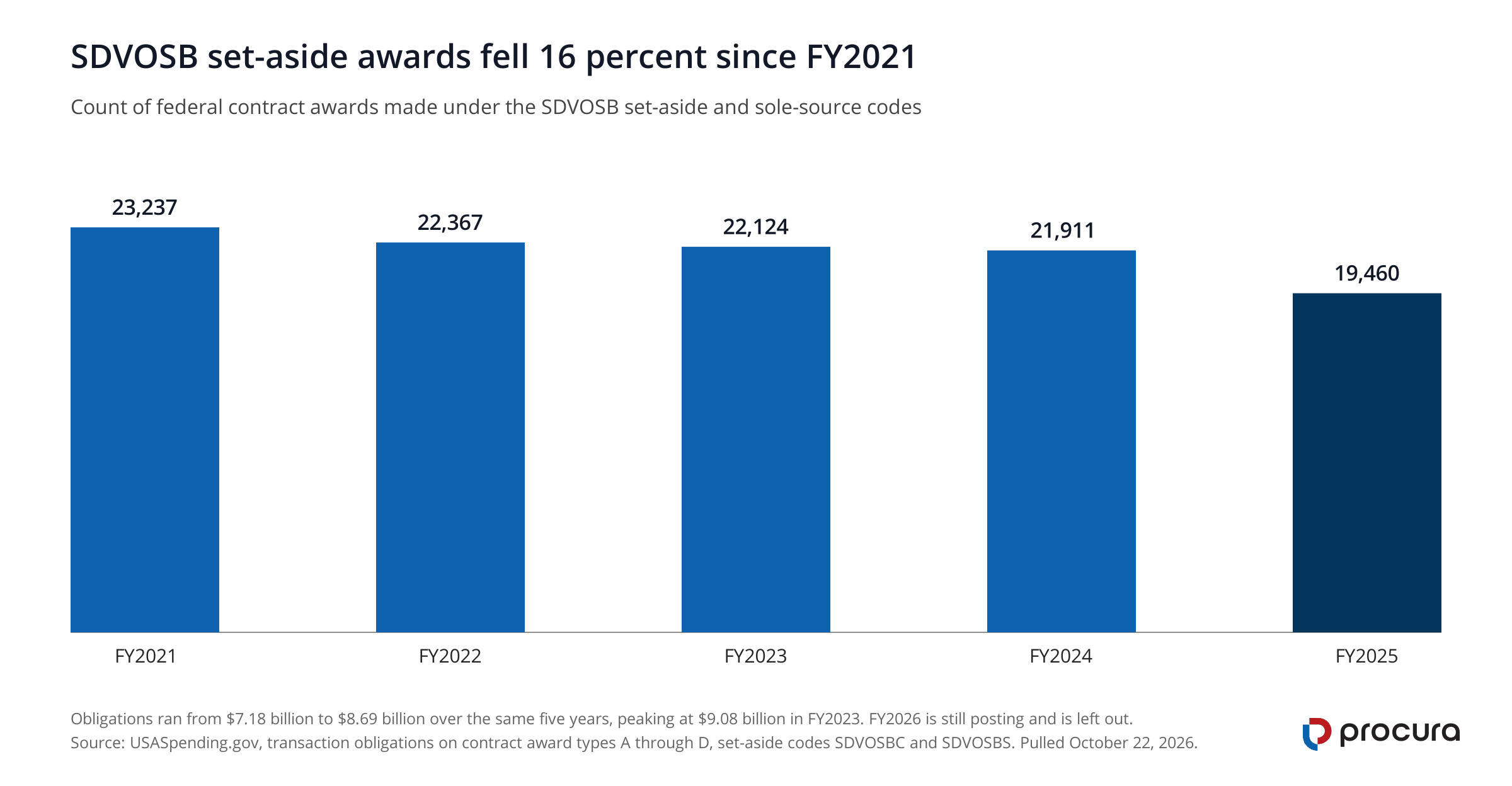
Data table: SDVOSB set-aside awards and obligations by fiscal year
| Fiscal year | SDVOSB set-aside awards | SDVOSB set-aside obligations |
|---|---|---|
| FY2021 | 23,237 | $7,183,405,048 |
| FY2022 | 22,367 | $7,992,973,435 |
| FY2023 | 22,124 | $9,076,092,203 |
| FY2024 | 21,911 | $8,795,661,728 |
| FY2025 | 19,460 | $8,689,988,444 |
| FY2026 | 15,794 | $10,044,500,244 |
Which industries win SDVOSB set-asides?
A second inversion is worth your attention. Specifically, the work inside the set-aside lane does not look like the work outside it. Across the whole SDVOSB universe, Other Computer Related Services under NAICS 541519 is the largest industry at $6.57 billion. By contrast, inside the set-aside lane, Commercial and Institutional Building Construction under NAICS 236220 leads at $2.42 billion. Plumbing and HVAC contractors, janitorial services, security guards, and temporary help all appear in the set-aside top twelve. However, in the open market they rank between twelfth and twenty-eighth.
What size awards follow SDVOSB certification?
Small ones, in enormous numbers. Of the 170,841 awards that reached SDVOSB firms in FY2025, 136,060 were worth under $150,000. That is 79.6 percent of the awards and 5.55 percent of the dollars. By contrast, at the other end, 2,444 awards at $10 million or more carried 53.17 percent of the dollars.
Those small awards are the realistic entry point, and most of them are not new contracts. Delivery orders carried $22.67 billion across 105,379 actions, purchase orders $1.95 billion across 41,508, and calls against blanket purchase agreements $2.21 billion across 15,278. Meanwhile, definitive contracts, the thing most people picture when they say federal contract, accounted for 8,676 awards. Competition happened upstream on the vehicle, which is why our guide to IDIQ vehicles, GWACs, and BPAs matters more here than the certification paperwork does.
| Award size band | Awards | Share of awards | FY2025 obligations | Share of dollars |
|---|---|---|---|---|
| Under $25,000 | 98,239 | 57.5% | $379,691,140 | 1.1% |
| $25,000 to $150,000 | 37,851 | 22.2% | $1,529,569,242 | 4.4% |
| $150,000 to $1 million | 20,197 | 11.8% | $3,390,123,498 | 9.9% |
| $1 million to $10 million | 12,155 | 7.1% | $10,818,503,917 | 31.5% |
| $10 million to $100 million | 2,333 | 1.4% | $12,600,574,112 | 36.6% |
| $100 million and above | 111 | 0.1% | $5,682,573,424 | 16.5% |
Which thresholds and sole-source limits apply?
Two thresholds decide which of those awards a contracting officer can hand you quickly. FAR 2.101 sets the micro-purchase threshold at $15,000 for most buys, $2,500 for work under the Service Contract Labor Standards, and $2,000 for covered construction. In addition, the simplified acquisition threshold is $350,000. For example, below $15,000 a purchase card can buy from you outright. Between the two figures a contracting officer can award on quotes under simplified procedures. At VA the Rule of Two applies above the micro-purchase threshold.
Sole-source ceilings are the one place where four authorities disagree, so check which applies. At VA, 38 U.S.C. 8127(c) caps an SDVOSB sole-source award at $5 million. By contrast, outside VA, FAR 19.1406 carries $8.5 million for manufacturing and $5 million for everything else. Those inflation-adjusted figures are the ones a contracting officer applies. However, the underlying numbers in 13 CFR 128.405 and 15 U.S.C. 657f are lower and out of date.
Award size is the number most firms get wrong before their first bid. The records that produce these bands are free to browse and filter. Open a free account to export your own size cut and price against it.
Which codes and buyers should a firm with SDVOSB certification watch?
Pick them from where the dollars land, not from what the firm calls itself. For example, information technology dominates the open market. Other Computer Related Services took $6.57 billion in FY2025 and Commercial and Institutional Building Construction took $3.91 billion. Engineering Services took $2.99 billion and Computer Systems Design Services took $2.69 billion.
| NAICS | Industry | SDVOSB obligations, all buyers | Inside SDVOSB set-asides | Set-aside share | Size standard |
|---|---|---|---|---|---|
| 541519 | Other Computer Related Services | $6,570,000,000 | $1,998,597,142 | 30.4% | $34.0 million |
| 236220 | Commercial and Institutional Building Construction | $3,910,000,000 | $2,420,432,446 | 61.9% | $45.0 million |
| 541330 | Engineering Services | $2,990,000,000 | $517,464,307 | 17.3% | $25.5 million |
| 541512 | Computer Systems Design Services | $2,690,000,000 | $567,418,386 | 21.1% | $34.0 million |
| 541511 | Custom Computer Programming Services | $952,000,000 | $431,381,014 | 45.3% | $34.0 million |
| 561210 | Facilities Support Services | $897,200,000 | $143,845,619 | 16.0% | $47.0 million |
| 238220 | Plumbing, Heating, and Air-Conditioning Contractors | $329,419,638 | $199,185,605 | 60.5% | $19.0 million |
| 561720 | Janitorial Services | $185,560,194 | $88,947,020 | 47.9% | $22.0 million |
Which trades reach set-asides most often?
Note what the last column does. Plumbing and HVAC work runs 60.5 percent of its SDVOSB dollars through a set-aside, janitorial services 47.9 percent, and building construction 61.9 percent. By contrast, engineering services runs 17.3 percent and facilities support 16.0 percent. The trades reach a restricted competition far more often than the ranking alone suggests.
Size standards also deserve a second look before you file. Those ceilings are generous, so a veteran firm can stay small by federal definition long after it feels large. Still, some outgrow them anyway. Firms carrying both the SDVOSB and the other-than-small category took about $3.11 billion in FY2025, which is roughly 9 percent of the universe. Treat that share as directional, because a small number of transactions carry both size categories at once.
Where is the SDVOSB work?
Geography concentrates hard. Virginia leads at $7.06 billion of place-of-performance obligations. The District of Columbia follows at $2.61 billion and Maryland at $2.32 billion. California takes $2.25 billion and Texas $2.20 billion. However, concentration among firms runs the other way, and that is good news. The largest single recipient, M1 Support Services, took 2.82 percent of the universe, and the top ten took 18.23 percent.
When in the year do these awards land?
September, more sharply than in most markets. Agencies obligated $8.08 billion to SDVOSB firms in September 2025, which is 23.5 percent of the fiscal year in one month. The July through September quarter carried 42.7 percent. By contrast, November was the slowest month at $1.57 billion.
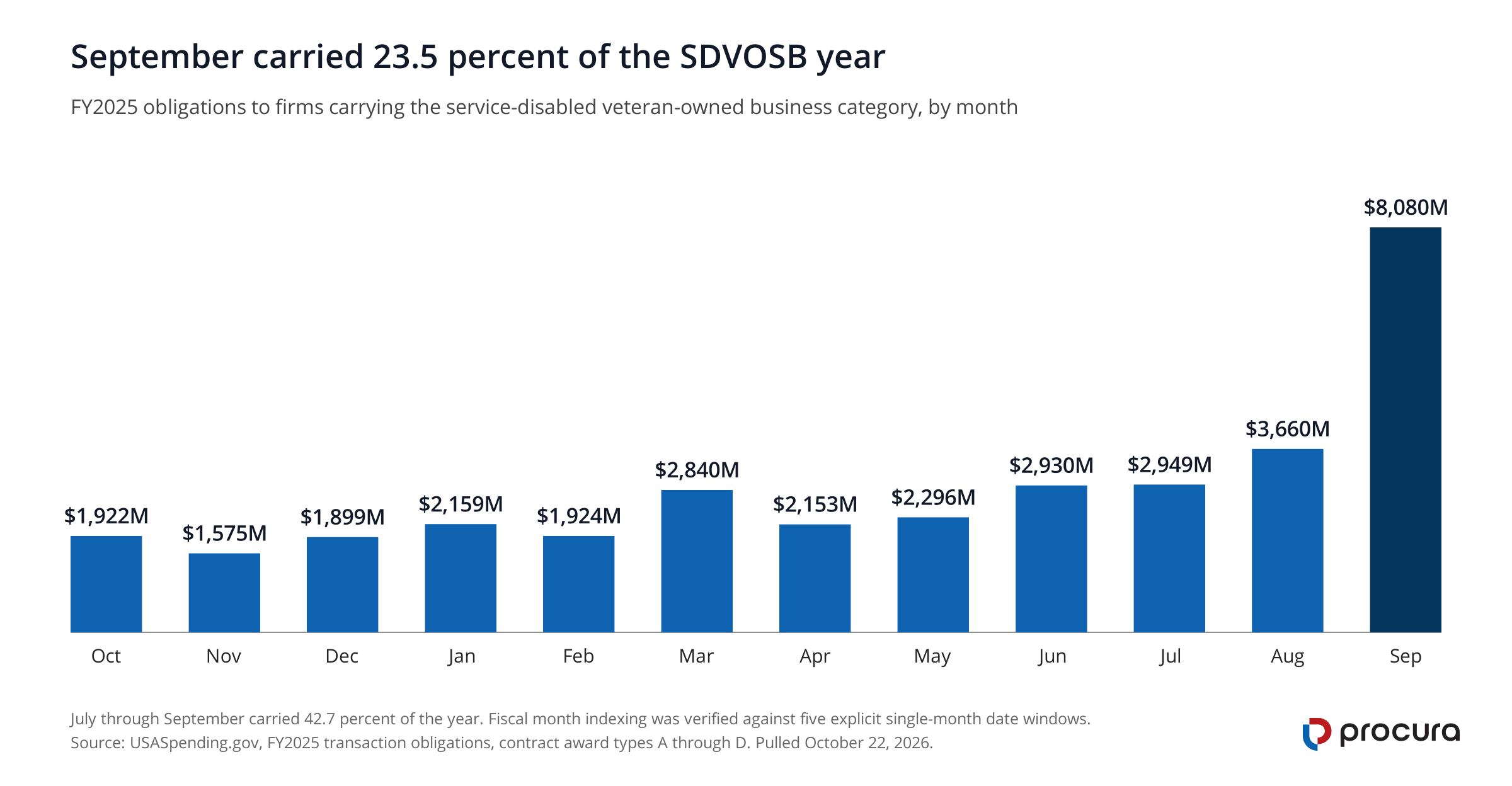
Data table: FY2025 obligations to SDVOSB firms by month
| Month | FY2025 obligations to SDVOSB firms | Share |
|---|---|---|
| October 2024 | $1,921,822,545 | 5.6% |
| November 2024 | $1,574,966,701 | 4.6% |
| December 2024 | $1,899,276,848 | 5.5% |
| January 2025 | $2,158,613,723 | 6.3% |
| February 2025 | $1,923,943,192 | 5.6% |
| March 2025 | $2,839,998,921 | 8.3% |
| April 2025 | $2,153,266,049 | 6.3% |
| May 2025 | $2,295,616,263 | 6.7% |
| June 2025 | $2,930,419,077 | 8.5% |
| July 2025 | $2,949,312,915 | 8.6% |
| August 2025 | $3,660,248,171 | 10.6% |
| September 2025 | $8,080,337,926 | 23.5% |
| Total | $34,387,822,332 | 100% |
Work backward from that peak. A September award on a competed action needs a proposal in hand by midsummer, and SDVOSB certification in hand well before that. As a result, firms that file in August are bidding the following year.
The hard part is not SDVOSB certification. It is finding the work.
Suppose your SDVOSB certification is in hand. SBA has approved the application, SAM shows the designation, and the three-year clock runs. However, the data then tells you something uncomfortable. Three-quarters of the dollars that get to firms like yours arrive outside the SDVOSB set-aside lane. They come from dozens of agencies other than VA, in industries that your own NAICS code can miss.
That is a search problem rather than a paperwork problem. A saved search built on VA misses 69.2 percent of the money. Similarly, a saved search built on the SDVOSB set-aside code misses 75.2 percent of the dollars. The two obvious searches fail in opposite directions, and neither failure is visible from inside the tool that runs it.
Procura Federal was built for that shape of problem. First, it reads every solicitation and every attachment, including the wage determination and the past-performance annex. Each one gets scored against your capability statement, and the clauses that disqualify a bid get flagged. Procura Federal costs $399 per month. By contrast, the legacy market intelligence platforms carry deeper historical databases and are built for capture teams rather than for owner-operators.
Frequently asked questions about SDVOSB certification
Do I need a minimum disability rating to qualify?
No. In fact, the regulation sets no percentage. What matters is that VA records you as a service-disabled veteran with a service-connected disability under 38 U.S.C. 101(16). SBA must be able to read that record. A 10 percent rating and a 100 percent rating both qualify.
Is VOSB certification the same as SDVOSB certification?
They run through the same application and the same part of the regulation, and they buy different things. VOSB status needs veteran ownership without a service-connected disability, and it is useful mainly at VA, where 38 U.S.C. 8127 covers both. However, outside VA there is no government-wide VOSB set-aside authority. Veteran-owned firms that are not service-disabled took $7.78 billion in FY2025, which is under a quarter of the service-disabled figure.
Can I still self-certify as an SDVOSB?
Not for anything that pays. Set-aside and sole-source eligibility closed on January 1, 2024, and goal credit closed on December 22, 2024. The box still exists in SAM, and checking it without SDVOSB certification exposes the firm to False Claims Act liability under 13 CFR 128.600.
Which agency should a newly certified firm approach first?
VA for a restricted competition, and the Department of Defense for volume. VA wrote 76.9 percent of FY2025 SDVOSB set-aside dollars, so the Rule of Two works in your favor there. Meanwhile, Defense awarded more to SDVOSB firms overall than VA did, and almost all of it in open competition. Our guide to military and defense contracts covers the program offices behind those awards.
Does the Rule of Two apply outside VA?
No, and this is the most widely repeated error about the program. Kingdomware construed 38 U.S.C. 8127, which binds VA and reaches another agency only when it buys on VA’s behalf. Section 657f(d) of title 15 leaves the decision to each contracting officer. In other words, another agency can restrict a competition to SDVOSB firms, and never has to.
Is subcontracting worth pursuing as an SDVOSB?
The numbers argue yes, because primes are missing their target. Government-wide SDVOSB subcontracting reached 2.42 percent in FY2025 against a 5 percent statutory goal, and the same certification now counts for that credit. Our guide to winning federal subcontracts explains how to approach a prime with that gap in mind.
Next steps
Confirm your SAM registration and the NAICS codes in it, because the size test runs against that list. Then file for SDVOSB certification at certifications.sba.gov while the records are in front of you. Next, build saved searches that get past VA and past the set-aside code. Use the industries in the table above. Read our walkthrough of federal proposal writing before the first matching solicitation lands. Put your certification and past performance at the front of your capability statement.
Book a demo
Book a demo and bring a solicitation you are unsure about. We will read it against your capability statement on the call. You will see the compliance flags before you spend a week on the response.