
The simplified acquisition threshold is $350,000, and the micro-purchase threshold is $15,000. The two figures went up on October 1, 2025, under Federal Acquisition Circular 2025-06. However, most of the internet still prints the old $250,000 and $10,000, and so does the Army’s own threshold table. Meanwhile, the band between those two figures carries the highest small-business dollar share in federal contracting. Yet in my experience few vendors can state its boundaries. In FY2025 it held $34.0 billion across 702,084 prime awards, and small firms took 53.4 percent of the dollars in it.
I am a Navy veteran, and my company supports Air Force Research Laboratory programs as a defense contractor. What surprised me most when I started bidding on federal work was how few small firms knew the band existed. Instead, they chased $5 million recompetes against incumbents with 20 years of past performance. Meanwhile they ignored the $80,000 purchase orders that the law reserves for them by default.
What is the simplified acquisition threshold in 2026?
The simplified acquisition threshold is $350,000 for a normal federal purchase. FAR 2.101 carries the definition, and two numbered exceptions inside it produce three higher figures. In total, five situations trigger them. Two of them are a contingency operation and a defense against a cyber or nuclear attack. Similarly, biological, chemical and radiological attacks sit in that same case. International disaster assistance and a response to a major disaster are the other two. In those four cases the figure is $1 million inside the United States and $2 million outside it. By contrast, a humanitarian or peacekeeping operation outside the United States raises it to $650,000.
Below the threshold the government can buy with FAR Part 13, which is a short and fast process. In other words, a contracting officer does not run a full source selection here. There is no formal proposal evaluation, no cost-realism analysis, and no lengthy debriefing cycle. In fact, many of these buys close on a quotation of two pages or less.
To see real awards on either side of the threshold, open Procura’s federal contract index, which covers 27,300,018 prime contracts and orders from FY2021–FY2025, or look up any vendor in the contractor directory (data updated Oct 20, 2026).
| Threshold | Before 2025-10-01 | Now | Citation |
|---|---|---|---|
| Micro-purchase threshold | $10,000 | $15,000 | FAR 2.101 |
| Simplified acquisition threshold | $250,000 | $350,000 | FAR 2.101 |
| Commercial simplified procedures ceiling | $7.5 million | $9 million | FAR 13.500(a) |
| Same ceiling, emergency and disaster buys | $15 million | $15 million (no change) | FAR 13.500(c) |
| Micro-purchase, contingency, inside US | $20,000 | $25,000 | FAR 2.101 |
| Micro-purchase, contingency, outside US | $35,000 | $40,000 | FAR 2.101 |
| Simplified acquisition, contingency, inside US | $800,000 | $1 million | FAR 2.101 |
| Simplified acquisition, contingency, outside US | $1.5 million | $2 million | FAR 2.101 |
| Public display of a solicitation | $15,000 to $25,000 | $20,000 to $25,000 | FAR 5.101(a)(2) |
| Synopsis in SAM.gov | Over $25,000 | Over $25,000 (no change) | FAR 5.101(a)(1) |
The synopsis threshold stayed at $25,000 for a specific reason. Specifically, the rule preamble says that the FAR part 5 notice thresholds remain at $25,000 because of trade agreements. FAR 1.109(c) holds trade-agreement figures out of the inflation adjustment.
What is the micro-purchase threshold, and what are the exceptions?
The micro-purchase threshold is $15,000, and four exceptions sit inside the definition. However, two of them are much lower than the base figure, and they catch the trades first. Construction work under the Wage Rate Requirements statute drops to $2,000. Similarly, services under the Service Contract Labor Standards drop to $2,500. Thus a roofing repair at $4,000 is not a micro-purchase. Likewise, a janitorial job at $3,000 is not one either.
| Type of purchase | Micro-purchase threshold |
|---|---|
| Normal supplies or services | $15,000 |
| Construction subject to 40 U.S.C. chapter 31, subchapter IV | $2,000 |
| Services subject to 41 U.S.C. chapter 67 | $2,500 |
| Contingency, attack, disaster assistance or emergency, inside the United States | $25,000 |
| Same, outside the United States | $40,000 |
| Higher education and affiliated nonprofit research entities | $15,000, or higher by agency-head determination |
Why does the $15,000-to-$350,000 band matter to a small business?
Because the law reserves that band for small business, and the burden of proof runs in your favor. Yet no one told me this when I started on the vendor side, and I have found few vendors who know it. Two FAR sections say the same thing from two directions.
| Section | What it says, verbatim |
|---|---|
| FAR 19.502-2(a) | “Each acquisition of supplies or services that has an anticipated dollar value above the micro-purchase threshold, but not over the simplified acquisition threshold, shall be set aside for small business unless the contracting officer determines there is not a reasonable expectation of obtaining offers from two or more responsible small business concerns that are competitive in terms of fair market prices, quality, and delivery.” |
| FAR 13.003(b)(1) | “Acquisitions of supplies or services that have an anticipated dollar value above the micro-purchase threshold, but at or below the simplified acquisition threshold, shall be set aside for small business concerns (see 19.000, 19.203, and subpart 19.5).” |
| FAR 19.502-2(b) | Above the threshold, the contracting officer sets the work aside “when there is a reasonable expectation” of two or more competitive small business offers. |
Read the two tests side by side. First, below the threshold, the reservation is the default, and the contracting officer must make a negative finding to escape it. By contrast, above it, the reservation is a positive test that the contracting officer must satisfy before it applies. Silence favors small business below the threshold. However, silence does not favor you above it.
One more line in FAR 19.502-2(a) matters to a one-person shop. Where a set-aside draws one offer that the contracting officer can accept, the quoted text above makes award to that firm the expected outcome. As a result, your competition in this band is often nobody at all.
How big is the market under the simplified acquisition threshold?
In FY2025, federal agencies obligated $34.0 billion on awards of $15,000 through $349,999.99, per USASpending.gov. That is the measured band, and it approximates the statutory one, which runs above $15,000 and at or below $350,000. That came across 702,084 prime awards. By contrast, the same year, 4,840,200 reported prime awards fell below $15,000, and they carried only $5.1 billion. Above $350,000 the picture inverts: 241,977 awards carried $739.7 billion.
| Band | FY2025 obligations | Share of dollars | Awards | Share of awards |
|---|---|---|---|---|
| Below $15,000 (micro-purchase) | $5,117,204,199 | 0.7% | 4,840,200 | 83.7% |
| $15,000 to $350,000 (the reserved band) | $34,008,895,111 | 4.4% | 702,084 | 12.1% |
| Above $350,000 | $739,737,852,413 | 95.0% | 241,977 | 4.2% |
| All prime awards | $778,868,145,203 | 100% | 5,784,269 | 100% |
That table holds two facts that deserve a second look. First, the reserved band is 12.1 percent of all federal prime awards, which is one award in eight. And 83.7 percent of every reported federal prime award is a micro-purchase worth less than $15,000.
What did the October 2025 increase actually do to the band?
It redrew both edges at once, and the two edges moved money in opposite directions. To show this, I measured the effect on a fixed year of real activity. I took FY2025 volumes and cut them twice, first at the old boundaries and then at the new ones.
| Band, FY2025 activity | Old boundaries | New boundaries | Change |
|---|---|---|---|
| Micro-purchase dollars | $3,411,159,009 | $5,117,204,199 | +$1,706,045,190 |
| Micro-purchase awards | 4,681,703 | 4,840,200 | +158,497 |
| Reserved band dollars | $30,565,720,411 | $34,008,895,111 | +$3,443,174,700 |
| Reserved band awards | 824,848 | 702,084 | -122,764 |
| Above-threshold dollars | $744,887,072,303 | $739,737,852,413 | -$5,149,219,890 |
| Above-threshold awards | 277,710 | 241,977 | -35,733 |
Reading down that table, the reserved band gained $3.44 billion and lost 122,764 awards. Both halves of that sentence are good news for a small firm, and the second half is the one worth acting on. Specifically, the awards that left the band went below the micro-purchase threshold. That is the part of the market where a contracting officer can buy from you with a card and no competition.
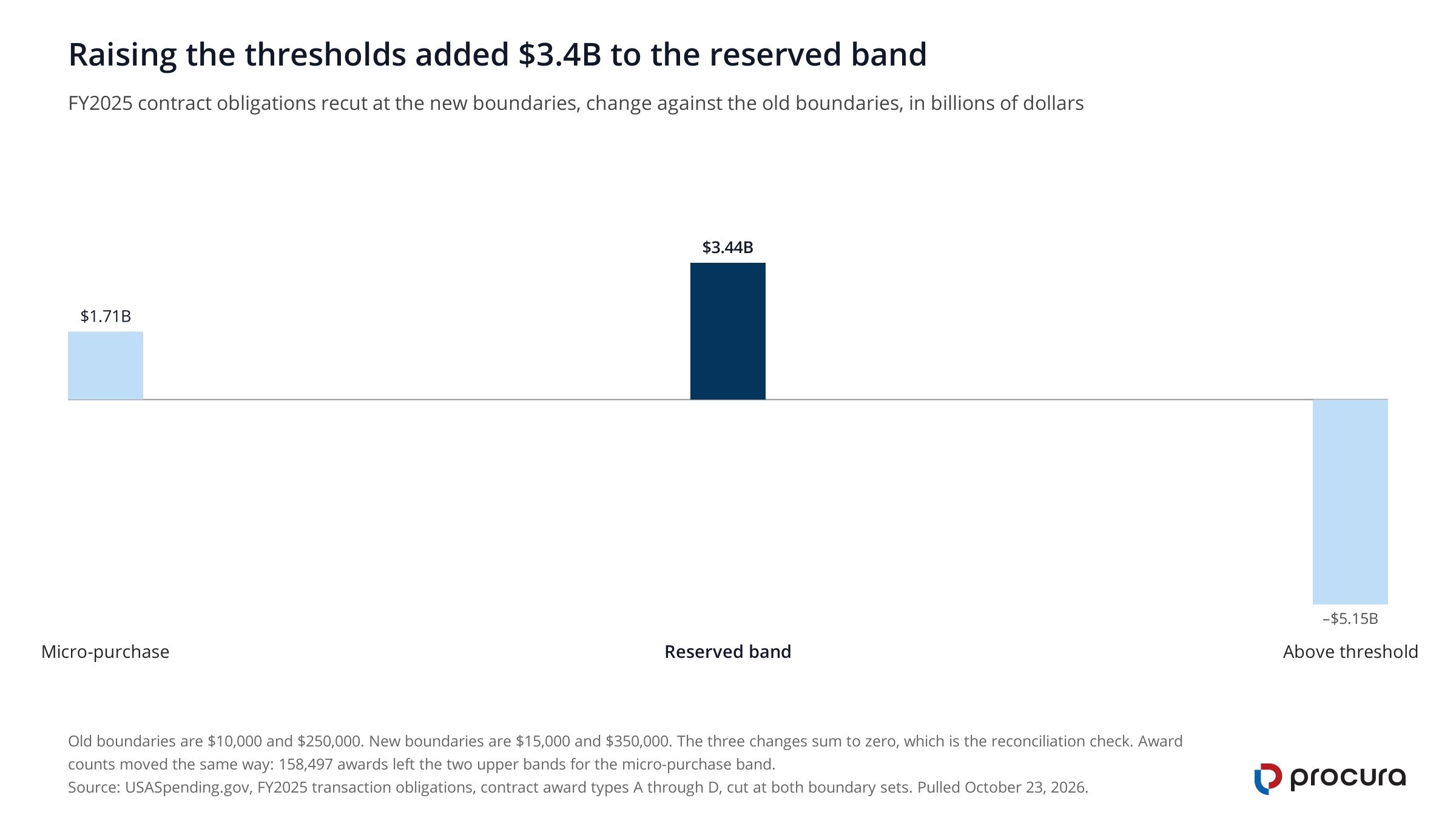
The $5.15 billion that moved down out of the above-threshold band is the other half of the trade. For example, work priced between $250,000 and $350,000 used to need a full competition. It now qualifies for simplified procedures, and it sits inside the small-business reservation.
The band table above tells you where the volume sits. It does not tell you which of those buys you can win. Browse the award records free, filter them to your codes, then export the result with a free account.
Do small businesses win below the simplified acquisition threshold?
Yes, and the gap against the rest of the market is wide. In FY2025, firms carrying the small-business category took $18.2 billion of the reserved band, which is 53.4 percent of the dollars in it. By contrast, above the band they took $155.4 billion of $739.7 billion, which is 21.0 percent. In other words, the reserved band pays small firms at 2.5 times the rate of the market above it.
Meanwhile, below the micro-purchase threshold the small-business share is 49.7 percent. That is lower than the reserved band, and the reason is the reservation itself. FAR 19.502-2(a) applies only above the micro-purchase threshold, so the card market gets no automatic set-aside.
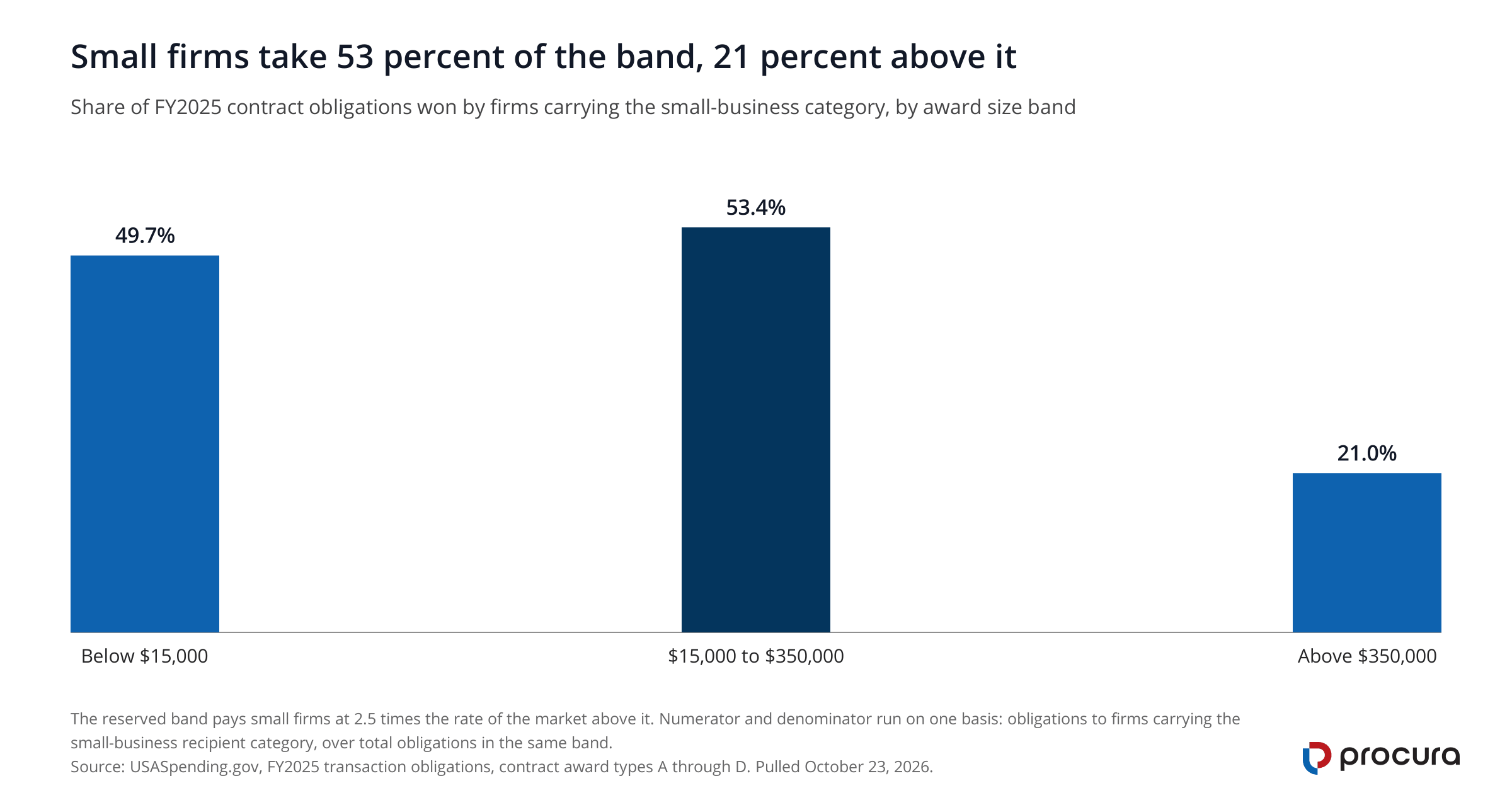
The numbers behind this chart
| Band | Won by small business | Band total | Share |
|---|---|---|---|
| Below $15,000 | $2,543,710,495 | $5,117,204,199 | 49.7% |
| $15,000 to $350,000 | $18,151,109,808 | $34,008,895,111 | 53.4% |
| Above $350,000 | $155,420,354,204 | $739,737,852,413 | 21.0% |
Who buys below the simplified acquisition threshold, and what do they buy?
The Department of Defense obligated $22.1 billion of the band in FY2025, which is 64.9 percent of it. In fact, one agency inside Defense accounts for most of that. The Defense Logistics Agency alone obligated $14.3 billion, or 42.0 percent of the whole band. Therefore, if you sell a product, DLA is the first buyer to study.
| Awarding agency | FY2025 obligations, $15,000 to $350,000 | Share of band |
|---|---|---|
| Department of Defense | $22,087,782,898 | 64.9% |
| General Services Administration | $2,573,730,455 | 7.6% |
| Department of Veterans Affairs | $2,335,738,873 | 6.9% |
| Department of Agriculture | $1,468,693,358 | 4.3% |
| Department of Justice | $1,104,137,346 | 3.2% |
| Department of the Interior | $781,821,238 | 2.3% |
| Department of Homeland Security | $744,657,518 | 2.2% |
| Health and Human Services | $689,164,471 | 2.0% |
Look at the product mix and you can see who the real competition is. For example, drugs and biologicals is the largest product category in the band at $3.9 billion. Passenger motor vehicles follow at $1.8 billion, then meat and poultry and fish at $970 million. The top recipient in the band is AmerisourceBergen Drug Corporation at $3.5 billion, which is 10.3 percent of the band on its own.
In other words, that is a drug distributor filling thousands of small orders, not a small business winning competitions. Of its $3.5 billion in the band, 99.98 percent arrived as delivery orders against contracts already in place. Still, it is a useful corrective. The band is friendly to small firms by rule, and its biggest dollars still move through agreements signed years ago.
Why do only 15 percent of these dollars carry a set-aside code?
This is the question that exposes the gap between the rule and the market, and I have not seen another article ask it. On paper, the FAR says the band is reserved. Of the band’s dollars, only $5.0 billion carries a small-business set-aside code at all, or 14.7 percent. However, contracting officers are not breaking the rule. Instead, they are buying in ways the rule does not reach.
Sort the band by how the award was made and the pattern appears at once.
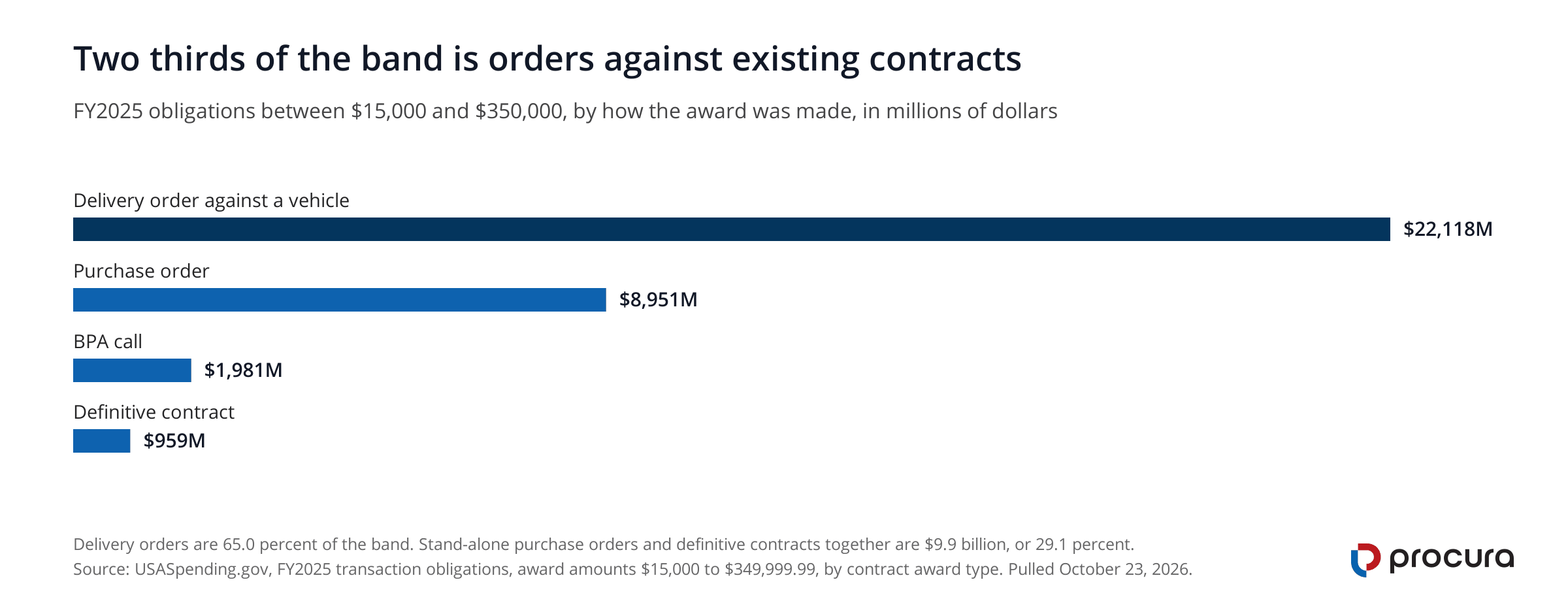
| How the award was made | FY2025 obligations in band | Share of band | Set-aside coded |
|---|---|---|---|
| Delivery order against an existing vehicle | $22,117,764,412 | 65.0% | 4.1% |
| Purchase order | $8,951,078,737 | 26.3% | 35.3% |
| BPA call | $1,980,955,827 | 5.8% | 14.6% |
| Definitive contract | $959,096,135 | 2.8% | 66.2% |
| Whole band | $34,008,895,111 | 100% | 14.7% |
Why do orders rarely carry a set-aside?
A definitive contract in this band carries a set-aside 66.2 percent of the time. By contrast, a delivery order carries one 4.1 percent of the time. That is a factor of sixteen, and three FAR sections explain it.
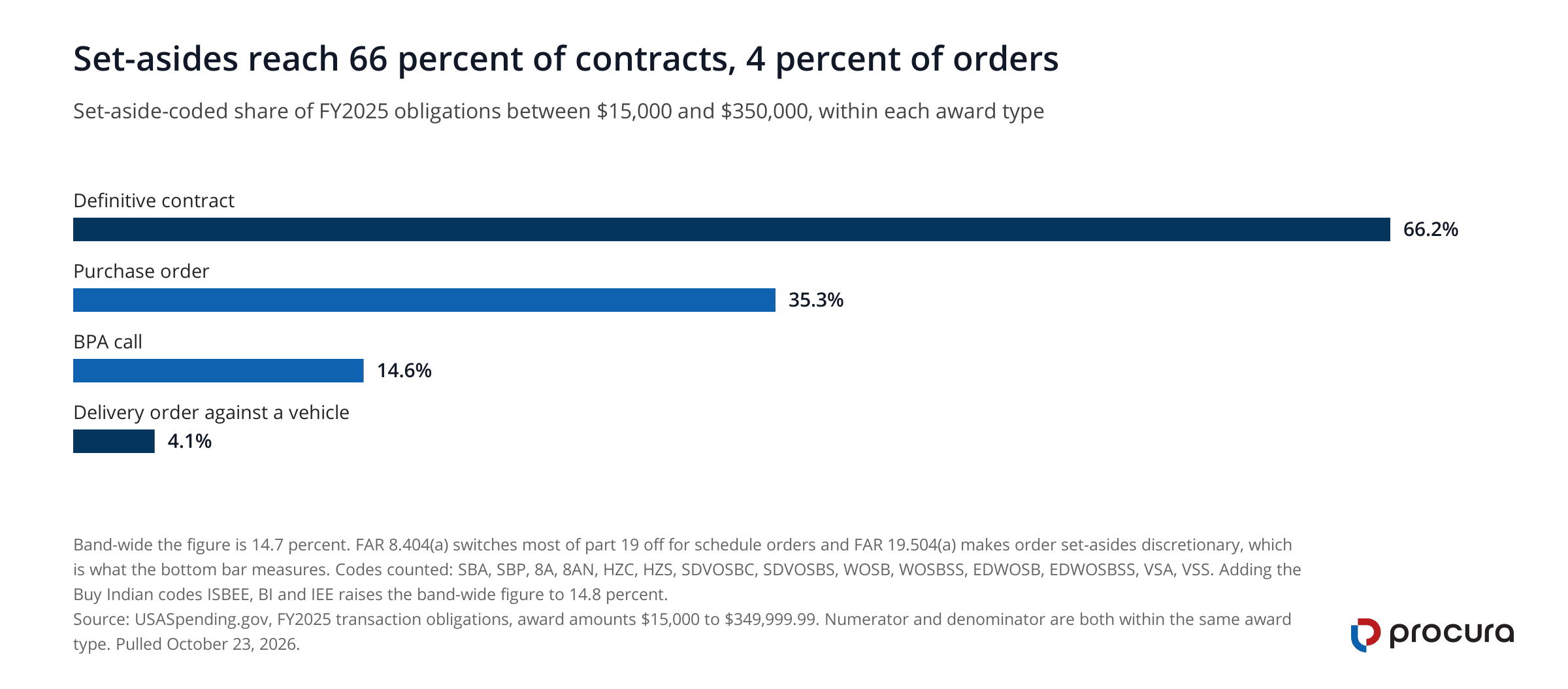
| Section | What it does to the reservation |
|---|---|
| FAR 13.003(a) | Simplified acquisition policy does not apply where the agency can meet the need from a required source under part 8, an existing indefinite-delivery contract, or other established contracts. |
| FAR 8.404(a) | “Parts 13 (except 13.303-2(c)(3)), 14, 15, and 19 (except for the requirements at 19.102(b)(3) and 19.202-1(e)(1)(iii)) do not apply to BPAs or orders placed against Federal Supply Schedules contracts.” |
| FAR 8.405-5(a) | “Although the preference programs of part 19 are not mandatory in this subpart… ordering activity contracting officers may, at their discretion… set aside orders.” |
| FAR 19.504(a) | Order set-asides under multiple-award contracts are discretionary, unless the base contract itself states that they are mandatory when the 19.502-2 conditions are met. |
| FAR 16.505(b)(1)(ii) | “If the order does not exceed the simplified acquisition threshold, the contracting officer need not contact each of the multiple awardees under the contract before selecting an order awardee if the contracting officer has information available to ensure that each awardee is provided a fair opportunity to be considered for each order.” |
What does that mean for a small firm?
Here is the practical translation. Two thirds of the band is orders placed against contracts that were already awarded. In other words, competition for that work happened years ago, at the base-contract level. The stand-alone reservation at FAR 19.502-2(a) does not reach it, and an order set-aside is discretionary unless the base contract made it mandatory. Meanwhile, stand-alone purchase orders and definitive contracts make up the remaining third, worth $9.9 billion. Of those dollars, 38.3 percent carry a small-business set-aside code. The other 61.7 percent is the obvious question, and I can only offer candidates. FAR 13.003(a) lifts the policy where a part 8 source or an existing contract meets the need. In addition, some buys carry a negative determination under FAR 19.502-2(a). Some sit under 8(a) authorities coded elsewhere. Finally, FPDS coding practice is uneven on small actions.
So the band has two doors. First, one door is the $9.9 billion of new stand-alone buys, where the reservation works and where a firm with no contract vehicle can win today. Second, the other door is the $24.1 billion of order work, counting delivery orders and BPA calls together. You get to that door by a place on the vehicle. Two things carry you from the first door to the second. They are a GSA Schedule contract and a seat on a multiple-award IDIQ, GWAC or BPA vehicle.
Does the FAR require three quotes?
No. In fact, the three-quote rule that half the GovCon internet repeats is not a rule. FAR 13.104(b) says to “consider solicitation of at least three sources,” and every word of that sentence is weaker than the advice built on it.
Three things are wrong with the common version:
- The verb is “consider,” not “obtain.” It is a planning prompt, not a quota.
- The sentence lives inside paragraph (b), which applies when the contracting officer does not post the notice to SAM.gov. A buy posted on SAM.gov is on a different path.
- The sentence itself carries an exception for any action that needs a synopsis under FAR 5.101 where no FAR 5.202 exception applies.
What is the real price rule?
Instead, FAR 13.106-3(a) carries the real price rule. The contracting officer must find the price fair and reasonable before award, and competitive quotations are the preferred basis. For example, with one response, the file gets a written price-reasonableness statement. It can rest on market research, prior prices, catalogs, an independent government estimate, or the officer’s own knowledge.
Moreover, one source is enough when the circumstances justify it. FAR 13.106-1(b)(1)(i) lets a contracting officer solicit from one source below the threshold where only one source is reasonably available. Urgency, exclusive licensing, brand-name need and industrial mobilization are the listed examples.
Will the FAR overhaul change the three-quote rule?
Two footnotes are worth knowing, and they point in opposite directions. The FAR overhaul model text for Part 13 deletes the three-source sentence completely, and the standard becomes competition to the maximum extent practicable. But the proposed rule at 91 FR 59406 puts a number back, in a stronger verb. Proposed FAR 13.201(c)(3)(ii) tells a contracting officer to “solicit quotations from at least three sources.” However, that duty applies only where the officer solicits suppliers directly. Direct solicitation is the alternative to a combined synopsis and solicitation. In short, it is a proposal, not a rule.
Can you take a government purchase-card order without a SAM.gov registration?
Yes, under one narrow condition, and the condition is where most readers get it wrong. FAR 4.1102(a)(1) excuses registration for purchases under the micro-purchase threshold. Specifically, the card must serve as both the purchasing and the payment mechanism. The FAR adds the limit in the same breath, as opposed to the card for payment only.
Read the qualifier twice. For example, if the agency issues a purchase order and then pays with the card, the exception does not apply and you must be registered. In other words, that exception covers the true card buy, where the card is the whole transaction.
My advice is to register in SAM.gov anyway, on the first day you decide to sell to the government. After all, the exception is a relief valve for a $900 card order, not a strategy. Moreover, everything above the micro-purchase threshold needs the registration, and that is where the money is.
Why is the card buy so light?
Three further rules make the card buy the lightest transaction in the FAR. First, under FAR 13.201(b), the card is the preferred method for micro-purchases. Second, FAR 13.203(a)(2) lets a card buy proceed without competitive quotations where the price looks reasonable. Third, under FAR 13.201(d), micro-purchases need no provisions or clauses, with two narrow exceptions. That paragraph takes precedence over other FAR requirements to the contrary, and it does not prohibit the use of any clause.
How much card spending never reaches the public record?
A large amount, and this is the honest caveat on every micro-purchase number in this article. FAR 4.606(a)(1) requires agencies to report contract actions over the micro-purchase threshold, which leaves the ones below it outside the individual record. Similarly, imprest fund transactions below the threshold, including card ones, are named at FAR 4.606(c)(1) as actions not to be reported. FAR 4.606(b)(1) says an agency needs written approval from the FPDS Program Office even to submit them voluntarily. However, one feed runs the other way. Under FAR 4.606(a)(2), GSA supplies purchase card data at least once a year, and GSA puts it into FPDS for reports.
How big is government card spending?
GSA reports $39.4 billion of total SmartPay program spend in FY2025 at an average of $480 per transaction. However, GSA says that it has not verified those figures for accuracy. In addition, they cover purchase, travel and fleet cards together, so the total is not a micro-purchase figure. It does show the scale of the buying that the reporting exemption keeps out of the individual record.
So treat the 4,840,200 figure above as prime award records reported to FPDS. In other words, it is not a census of what the government bought below the micro-purchase threshold. The real count of below-threshold buys is far larger, and no public source gives it by transaction size.
Can an agency split a requirement to stay under the simplified acquisition threshold?
No, and the prohibition is broader than most vendors know. FAR 13.003(c)(2) bars a contracting officer from breaking a requirement into several purchases below the applicable threshold merely for two purposes. The first purpose is to permit use of simplified acquisition procedures. The second purpose is to avoid any requirement that applies to purchases above the micro-purchase threshold. That word merely is doing real work, and it separates an illegal split from a legitimate one.
That second prong is the one that matters. In other words, it bans splitting to dodge any rule that attaches above the micro-purchase threshold, and not only splitting to reach Part 13. The bar applies at three levels: the simplified acquisition threshold, the subpart 13.5 ceiling and the micro-purchase threshold.
Watch for a $300,000 need that arrives as four $75,000 orders. In that case, if the four share one statement of work and one period, ask the contracting officer about it. Ask politely and in writing.
What happens above the simplified acquisition threshold, up to $9 million?
FAR subpart 13.5 extends simplified procedures above the threshold for commercial products and commercial services. Specifically, that ceiling is $9 million, and $15 million for the emergency and disaster cases at FAR 13.500(c). The October 2025 rule raised the first figure from $7.5 million and left the second alone.
In fact, this band is large. In FY2025, agencies obligated $125.6 billion on contract actions between $350,000 and $9 million, across 202,732 awards, per USASpending.gov. However, small firms do not get an automatic reservation up there, and the socioeconomic programs get first consideration instead under FAR 19.203(c).
Note what subpart 13.5 is not. The current FAR gives it no expiry date and does not call it a test program, and the word “test” appears nowhere in the subpart. Nevertheless, older guides still describe it as a temporary test authority.
Where do these contracts get advertised?
Three rules decide whether you ever see the buy, and only one of them puts it in SAM.gov.
| Value of the proposed action | What the contracting officer must do | Citation |
|---|---|---|
| Over $25,000 | Synopsize in SAM.gov, the Governmentwide point of entry | FAR 5.101(a)(1) |
| Over $20,000 and not over $25,000 | Display the notice in a public place or by appropriate electronic means, for at least 10 days | FAR 5.101(a)(2) |
| $20,000 or less | No public notice requirement | FAR 5.101 |
| Not over the threshold | No separate synopsis needed where the notice is accessible through SAM.gov and the public can respond electronically | FAR 5.202(a)(13) |
| Over $25,000, synopsis required | Publish the notice at least 15 days before the solicitation. For commercial products and services the contracting officer can shorten it or combine the synopsis and the solicitation | FAR 5.203(a) |
| Over $25,000 and not over the threshold | Set a reasonable response time. No fixed minimum response period applies in this band | FAR 5.203(b) |
Two consequences follow for a vendor. First, a real share of this market never gets a public notice. It sits at $20,000 or less, or it runs as an order against a vehicle. As a result, agency buyers fill that work from suppliers they already know. Second, a commercial buy that does post can carry a response time of a few days. FAR 5.203(a) lets the contracting officer shorten the 15-day wait or combine the synopsis and the solicitation for commercial products and services.
That second point is the reason small simplified buys are harder to catch than big solicitations. For example, a $200,000 commercial purchase order can post on a Tuesday and close on a Friday. Meanwhile, nobody sends you a reminder.
What is changing for the simplified acquisition threshold under the FAR overhaul?
The automatic reservation below the threshold is the thing at risk. Yet I have not seen it covered anywhere. The FAR overhaul model text for Part 19 renumbers the reservation from FAR 19.502-2 to FAR 19.104-1. In addition, it rewrites the test. Under the model text, the set-aside becomes mandatory where the contracting officer expects two or more competitive small-business offers.
That is the positive test, and today it governs only above the threshold. As a result, moving it down flips the default in the band this article is about. Under the codified FAR, a contracting officer who cannot decide must reserve the work. By contrast, under the model text, a contracting officer who cannot decide keeps the choice. Model 19.104-1(b)(1) does add a duty to document the reason when a contract is not set aside.
| Item | Status on October 23, 2026 |
|---|---|
| FAR Part 13 model deviation text | Issued September 18, 2025. Retitles the part “Simplified Procedures for Noncommercial Acquisitions” and deletes subpart 13.5 |
| FAR Part 13 proposed rule | Published as 91 FR 59406 on September 18, 2026, FAR Case 2026-003. Comments closed October 19, 2026. No final rule |
| Commercial $9 million and $15 million ceilings | Survive the overhaul unchanged and move into FAR Part 12 |
| FAR Part 19 model deviation text | Issued September 26, 2025, updated February 20, 2026. Deletes subpart 19.14, moves the SDVOSB rules to 19.106, and renumbers the reservation to 19.104-1 |
| FAR Part 19 proposed rule | None published. Model text and agency class deviations are the only instruments |
| Agency class deviations adopting Part 13 | 32 agencies, including Defense, listed on acquisition.gov |
| Defense class deviation 2026-O0029 | Signed December 18, 2025. Effective February 1, 2026, Defense contracting officers use the overhaul Part 13 in place of the codified text |
Which FAR text should you cite?
That table carries two practical warnings. A Defense contracting officer has worked under a different Part 13 since February 1, 2026, while eCFR still shows the old one. Similarly, FAR 19.203 means two different things, depending on which text you read. In the codified FAR it is the no-order-of-precedence rule. In the model text it is “Equal low bids.”
Therefore, cite the codified FAR and name the edition. That is what I did in every table above, and it is the only way to stay correct for both readers.
Frequently asked questions
What is the simplified acquisition threshold for 2026?
$350,000 for a normal purchase, under FAR 2.101 as codified at FAC 2026-01. It rose from $250,000 on October 1, 2025. The next scheduled inflation adjustment is October 1, 2030, because 41 U.S.C. 1908 runs the review every five years.
Is the micro-purchase threshold $10,000 or $15,000?
$15,000. However, the $10,000 figure was correct until September 30, 2025. Army Federal Acquisition Regulation Supplement table 1-2 still published $10,000 on October 23, 2026. A live government page is not proof of a live rule.
Does a small business get an automatic set-aside below the simplified acquisition threshold?
For a stand-alone acquisition, yes, under FAR 19.502-2(a). By contrast, for an order against a Federal Supply Schedule contract or a multiple-award IDIQ, no. FAR 8.404(a) switches most of Part 19 off for schedule orders, and FAR 19.504(a) makes order set-asides discretionary.
Do I need a certification to win work in this band?
No. The reservation at FAR 19.502-2(a) runs to small business as a class, with no socioeconomic certificate needed. However, a certificate adds a second lane. Below the threshold, FAR 19.203(b) says that the reservation does not stop an award under the 8(a) program, HUBZone, SDVOSB or WOSB. FAR 19.203(a) sets no order of precedence among the four.
Are the compliance rules lighter below the simplified acquisition threshold?
Some are, and fewer than the common advice claims. FAR 13.005 lists seven statutes that 41 U.S.C. 1905 makes inapplicable at or below the threshold. However, wage statutes, the Buy American statute and the socioeconomic programs are not on that list. FAR 13.005(b) makes the FAR Council add later statutes to it. FAR 13.005(c)(1) holds laws with criminal or civil penalties out of that automatic addition.
Can a contracting officer buy from me without a competition?
Below the micro-purchase threshold, yes. FAR 13.203(a)(2) permits a micro-purchase without competitive quotations where the price looks reasonable. FAR 13.203(a)(1) asks for equitable distribution of micro-purchases among qualified suppliers. By contrast, above it, and up to $350,000, a single-source buy needs the FAR 13.106-1(b)(1)(i) determination. Above $350,000 under subpart 13.5, it needs the written justification at FAR 13.501(a).
Is this band shrinking?
No. Measured at today’s boundaries, the band held between $32.0 billion and $35.9 billion in every year from FY2021 to FY2025, per USASpending.gov. FY2024 was the peak. Similarly, award counts held between 701,081 and 721,082 across all five years. FY2026 data is incomplete and I have not used it.
What to do with this
The sequence is short, and none of it is expensive.
- Register in SAM.gov and get the NAICS codes right, because FAR 19.102(b)(1) assigns one code and one size standard to every solicitation and order.
- Write a one-page capability statement that a contracting officer can read in 30 seconds.
- Target stand-alone purchase orders and definitive contracts in the band, because that is where the reservation works.
- Learn your buying agency, not the whole government. Defense is 64.9 percent of this band and DLA alone is 42.0 percent.
- Get on a vehicle once you have two or three awards. That is the route to the two thirds of the band that moves as orders.
- Watch response times. A simplified buy over $25,000 has no minimum number of days.
Three guides cover the wider path from first registration to first award. Start with winning government contracts and the easiest federal contracts to win. Then read the mechanics of responding to a government RFP.
The hard part is not the rule. It is finding the buy.
You can read this page and know more about these two thresholds than most firms that sell into it. However, that knowledge does not find you one $80,000 purchase order. In FY2025 the band produced 702,084 awards, which is about 2,800 for every working day. Moreover, they post with short response times. Many hide inside attachments. Most close before a weekly keyword alert gets to you.
How does Procura find these buys?
That is the problem Procura Federal exists to solve. It reads the attachments on a solicitation, not only the posting, so a statement of work buried in a PDF gets searched like text. Then your capability statement gets scored against each opportunity, so you can tell a $200,000 purchase order you can win from one you cannot. Finally, it flags the compliance terms that decide whether a small simplified buy is worth your afternoon. Pricing starts at $399/month, against five-figure annual contracts at the legacy tools. Our breakdown of the tools that make federal contracts easier to find compares them in detail.
Written by Jacob Grass, founder of Procura Federal. Published November 8, 2026. All FAR text cited from the Federal Acquisition Regulation as codified at FAC 2026-01, cross-checked against eCFR title 48, issue date October 19, 2026. All spending figures are FY2025 transaction obligations on contract award types A through D from USASpending.gov, pulled October 23, 2026.