Federal government contracts in Texas came to $86.4 billion in FY2025, which puts Texas second among the states behind Virginia. However, two companies took 61.0 percent of that money. Similarly, two counties took 66.6 percent of it. Meanwhile, small businesses took 10.2 percent of the dollars, against 22.6 percent nationally. In other words, the real Texas market for a small firm is about $9.9 billion. Moreover, it sits almost entirely in awards under $10 million. However, it is not in the two counties with the biggest numbers.
Counted by place of performance, Procura’s explorer shows $84.33B in FY2025 prime obligations for work done in Texas and $345.01B across FY2021–FY2025 (data updated Oct 20, 2026); totals differ slightly from other counts because of basis and reporting lags. Two congressional districts hold most of it: TX-12 around Fort Worth at $105.5B and TX-33 at $91.2B. The Texas contractor directory lists the companies based in the state.
I am a Navy veteran, and my company supports Air Force Research Laboratory programs as a defense contractor. Texas is the state I get asked about most. Usually, somebody read that it ranks near the top for federal spending and decided to move there. That ranking is real, but it is also close to useless for planning. After all, more than a third of it is one aircraft production line in Fort Worth. Therefore, this page separates the part of Texas you can bid on from the part you cannot.
How much are government contracts in Texas worth?
In FY2025, federal agencies obligated $86,369,099,132 on contracts done in Texas, across 256,662 prime awards, per USASpending.gov. That is 11.1 percent of the $778.9 billion the government obligated on contracts nationwide. In fact, only Virginia, at $120.5 billion, ranks higher. Meanwhile, Texas sits ahead of California by $24.3 billion.
Two things about that figure matter before you use it. First, it counts work done in Texas, not money won by Texas firms. In FY2025 the two bases almost match: companies with a Texas address won $86.5 billion, a difference of 0.14 percent. However, in other years they diverge, so always state which one you mean. Second, the basis is transaction obligations, which include modifications to older contracts and de-obligations. As a result, it runs higher than a count of new awards only.
| Rank | State | FY2025 contract obligations | Share of U.S. total |
|---|---|---|---|
| 1 | Virginia | $120,528,149,441 | 15.5% |
| 2 | Texas | $86,369,099,132 | 11.1% |
| 3 | California | $62,041,841,037 | 8.0% |
| 4 | Maryland | $39,690,398,764 | 5.1% |
| 5 | Connecticut | $35,140,349,685 | 4.5% |
| 6 | Florida | $32,450,089,061 | 4.2% |
| 7 | District of Columbia | $31,425,724,412 | 4.0% |
| 8 | Pennsylvania | $26,942,804,406 | 3.5% |
| 9 | Arizona | $23,714,890,485 | 3.0% |
| 10 | Massachusetts | $19,326,916,383 | 2.5% |
Why is one company 47 percent of government contracts in Texas?
Lockheed Martin entities took $40.9 billion of Texas obligations in FY2025, which is 47.4 percent of the state total. In addition, McKesson took another $11.8 billion, which is 13.6 percent. Overall, the two companies are 61.0 percent of federal Texas. Moreover, the concentration is not an artifact of one year. For example, it ran 46.2 percent in FY2021, 52.1 percent in FY2022, 61.8 percent in FY2023 and 45.5 percent in FY2024. Instead, it moves with Lockheed’s award calendar, and it has never been below 45 percent.
Fortunately, both positions have a plain explanation. Specifically, Lockheed Martin builds the F-35 in Fort Worth, and the F-35 Joint Program Office buys it through Naval Air Systems Command. As a result, the Department of the Navy is the largest federal buyer in Texas, in a state with no major Navy fleet presence. In addition, Lockheed builds Patriot PAC-3 interceptors near Dallas under Army contracts, and runs the THAAD program from Grand Prairie under Missile Defense Agency contracts. However, THAAD interceptors are assembled in Alabama. Meanwhile, McKesson is a pharmaceutical prime vendor, and $11.45 billion of its Texas total came from the Department of Veterans Affairs.
What does Texas look like without the two primes?
Now strip those two companies out and the picture changes completely. Specifically, the rest of federal Texas was $29.7 billion in FY2021 and $33.7 billion in FY2025. In other words, that is a rise of 13.4 percent in four years, and the figure never left that range.
By contrast, the headline did nothing so calm. First, it fell 27.6 percent, from $81.9 billion in FY2023 to $59.3 billion in FY2024, then rose 45.7 percent to $86.4 billion in FY2025. In other words, those swings are mostly one company’s award calendar, not a market in motion. Therefore, plan against the $33.7 billion.
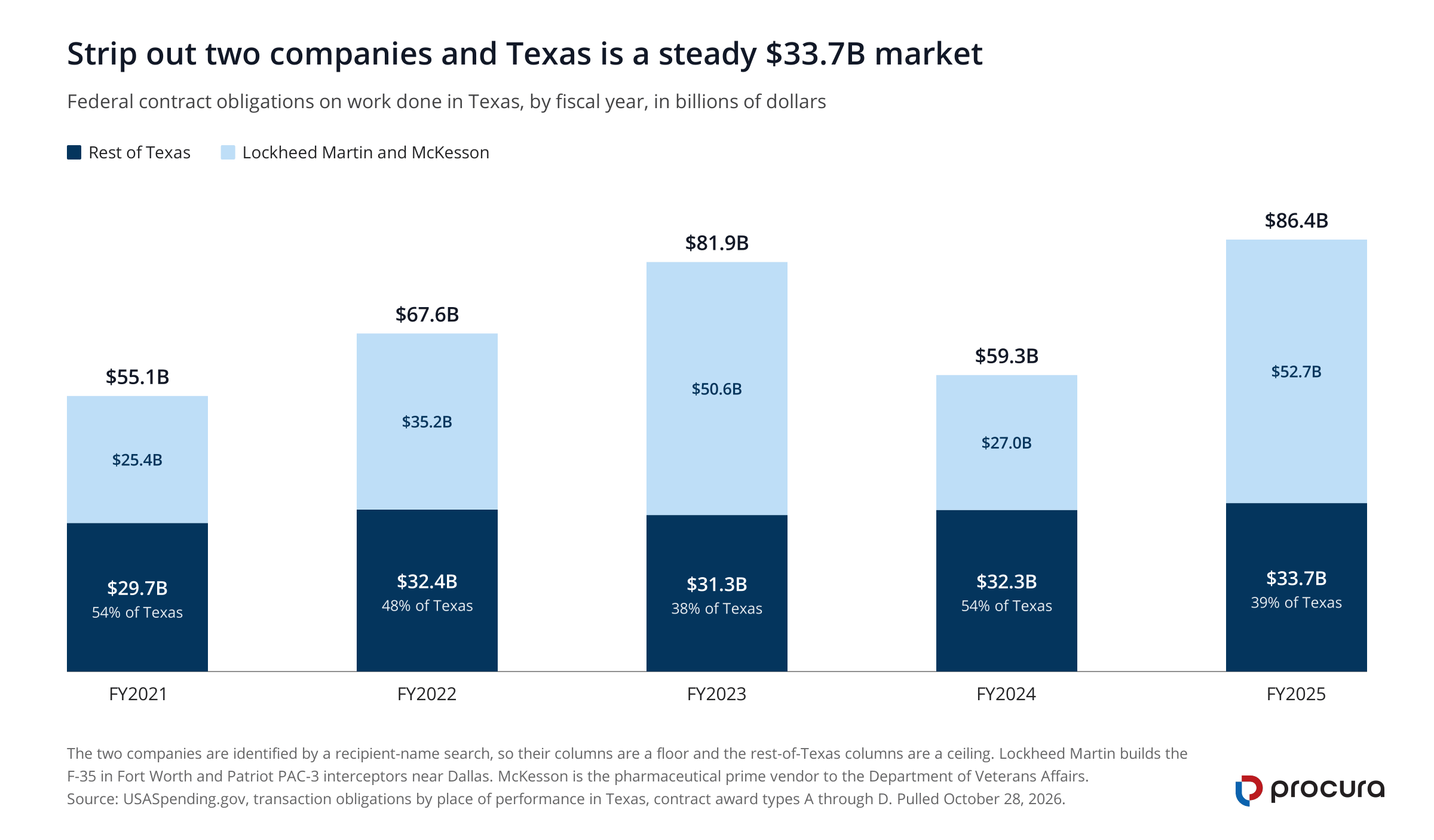
Data table: Texas obligations, two companies against everything else
| Fiscal year | Lockheed Martin | McKesson | Rest of Texas | Texas total | Top two share |
|---|---|---|---|---|---|
| FY2021 | $14,982,730,030 | $10,449,729,648 | $29,665,364,637 | $55,097,824,315 | 46.2% |
| FY2022 | $24,029,370,788 | $11,173,618,857 | $32,377,603,382 | $67,580,593,027 | 52.1% |
| FY2023 | $40,566,093,568 | $10,046,437,323 | $31,267,126,665 | $81,879,657,556 | 61.8% |
| FY2024 | $18,061,144,274 | $8,923,994,276 | $32,279,349,422 | $59,264,487,972 | 45.5% |
| FY2025 | $40,930,806,930 | $11,785,485,676 | $33,652,806,525 | $86,369,099,132 | 61.0% |
Which federal agencies award government contracts in Texas?
Defense agencies obligated $60.9 billion in Texas in FY2025, which is 70.5 percent of the state total. Meanwhile, the Department of Veterans Affairs is second at $15.8 billion, and the two together are 88.8 percent. As a result, if you sell to anyone else, you are competing for the remaining $9.7 billion. Therefore, that is the first number to put in a Texas capture plan. It is also why the rules for selling to DoD matter more here than the national average, where DoD is 63 percent of contract dollars.
| Buying organization | FY2025 obligations in Texas | Share | What it buys here |
|---|---|---|---|
| Department of the Navy | $30,260,705,989 | 35.0% | F-35 production through Naval Air Systems Command |
| Department of Veterans Affairs | $15,797,229,762 | 18.3% | Pharmaceuticals, medical services, facility work |
| Department of the Army | $14,817,339,868 | 17.2% | Missiles, depot work, installation support |
| Department of the Air Force | $8,719,175,532 | 10.1% | Training bases, cyber, aircraft sustainment |
| Defense Logistics Agency | $5,114,950,777 | 5.9% | Fuel, subsistence, spare parts |
| U.S. Customs and Border Protection | $3,508,427,524 | 4.1% | Border infrastructure, technology, services |
| Department of Energy | $1,961,892,157 | 2.3% | Pantex Plant operations near Amarillo |
| NASA | $1,465,813,155 | 1.7% | Johnson Space Center programs in Houston |
| Defense Health Agency | $1,064,442,159 | 1.2% | Military medical services, concentrated in San Antonio |
| U.S. Immigration and Customs Enforcement | $553,160,942 | 0.6% | Detention and transport services |
Why does DLA matter for small Texas firms?
The Defense Logistics Agency row deserves a second look. Admittedly, DLA is only 5.9 percent of Texas dollars. But it is the largest buyer in the part of the market a small firm can win. Specifically, in the under-$10 million band it obligated $3.0 billion. However, DLA buys through its own quoting system rather than through standard solicitation notices. Bidding on DLA DIBBS is a separate skill from bidding on a normal RFP.
Where in Texas do government contracts land?
Tarrant County took $33.5 billion in FY2025 and Dallas County took $24.1 billion. Overall, those two counties are 66.6 percent of the state. However, among the state’s biggest counties they are also the two worst places for a small business to look. Indeed, small firms won 0.97 percent of Tarrant County dollars and 2.68 percent of Dallas County dollars. After all, Fort Worth is an aircraft plant. Similarly, Dallas County is half pharmaceutical distribution and a third missile production. As a result, none of that work is set aside.
Why is San Antonio the best Texas market for small firms?
Bexar County is the opposite case and it is the answer most Texas firms need. Specifically, San Antonio took $5.7 billion, of which small businesses won $2.6 billion, a share of 46.1 percent. In fact, that is the largest pool of small-business federal dollars in the state, ahead of Harris County at $1.9 billion. Specifically, the Air Force is the largest buyer in Bexar County, ahead of the Defense Logistics Agency and the Defense Health Agency. Moreover, the codes they buy are reachable ones: other computer related services, engineering services, custom programming and computer systems design.
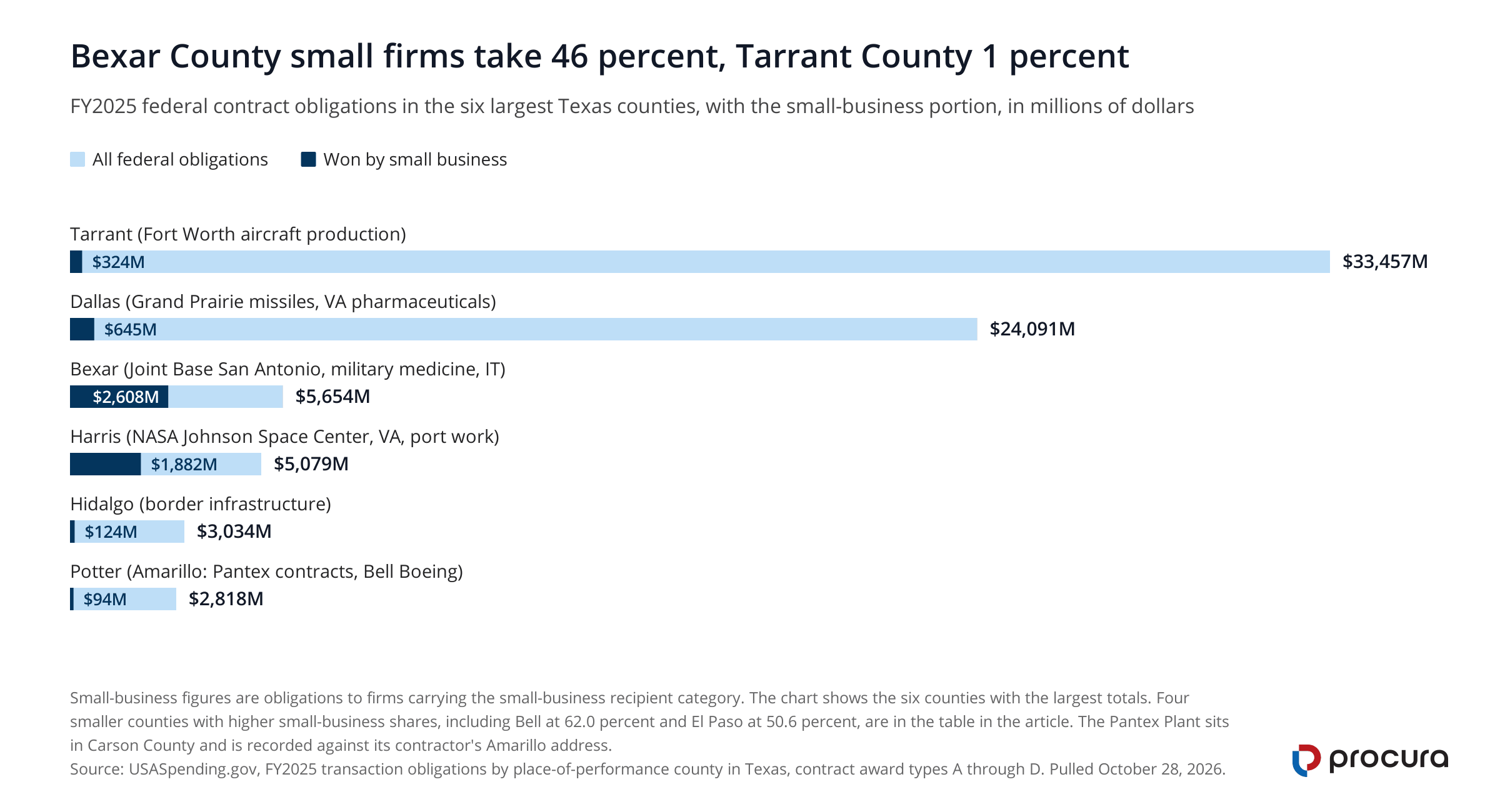
Which Texas counties pay small firms best?
| County | Main federal presence | FY2025 total | Won by small business | Small-business share |
|---|---|---|---|---|
| Tarrant | Fort Worth aircraft production | $33,456,565,341 | $323,564,093 | 0.97% |
| Dallas | Grand Prairie missile production, VA pharmaceutical distribution | $24,090,556,825 | $645,123,487 | 2.68% |
| Bexar | Joint Base San Antonio, military medicine, IT services | $5,653,840,380 | $2,608,526,863 | 46.14% |
| Harris | NASA Johnson Space Center, VA, port work | $5,078,630,569 | $1,882,507,414 | 37.07% |
| Hidalgo | Border infrastructure | $3,033,978,021 | $123,559,556 | 4.07% |
| Potter | Amarillo: Pantex Plant contracts, Bell Boeing rotorcraft | $2,817,610,320 | $94,040,765 | 3.34% |
| Travis | Austin federal offices and IT work | $1,513,790,682 | $422,977,445 | 27.94% |
| El Paso | Fort Bliss | $1,255,200,653 | $634,781,388 | 50.57% |
| Bell | Fort Hood | $552,614,753 | $342,499,956 | 61.98% |
| Wichita | Sheppard Air Force Base | $244,748,359 | $107,696,082 | 44.00% |
One name in that table changed twice in three years, and the old version is still in circulation. For example, Fort Hood in Bell County became Fort Cavazos in 2023. Then, on June 10, 2025, the Army redesignated it Fort Hood, this time for Colonel Robert B. Hood. Therefore, write the current name in a capability statement.
How much of the market for government contracts in Texas is open to a small business?
Awards of $100 million and up carried $65.8 billion in Texas in FY2025, which is 76.2 percent of the dollars across 440 awards. However, small firms took 1.72 percent of that band. By contrast, awards under $10 million carried $9.9 billion, which is 11.4 percent of the dollars across 254,544 awards. There, small firms took 48.4 percent of that band. So 0.17 percent of Texas awards hold three-quarters of the money, and 99.2 percent of Texas awards hold the market you can actually enter.
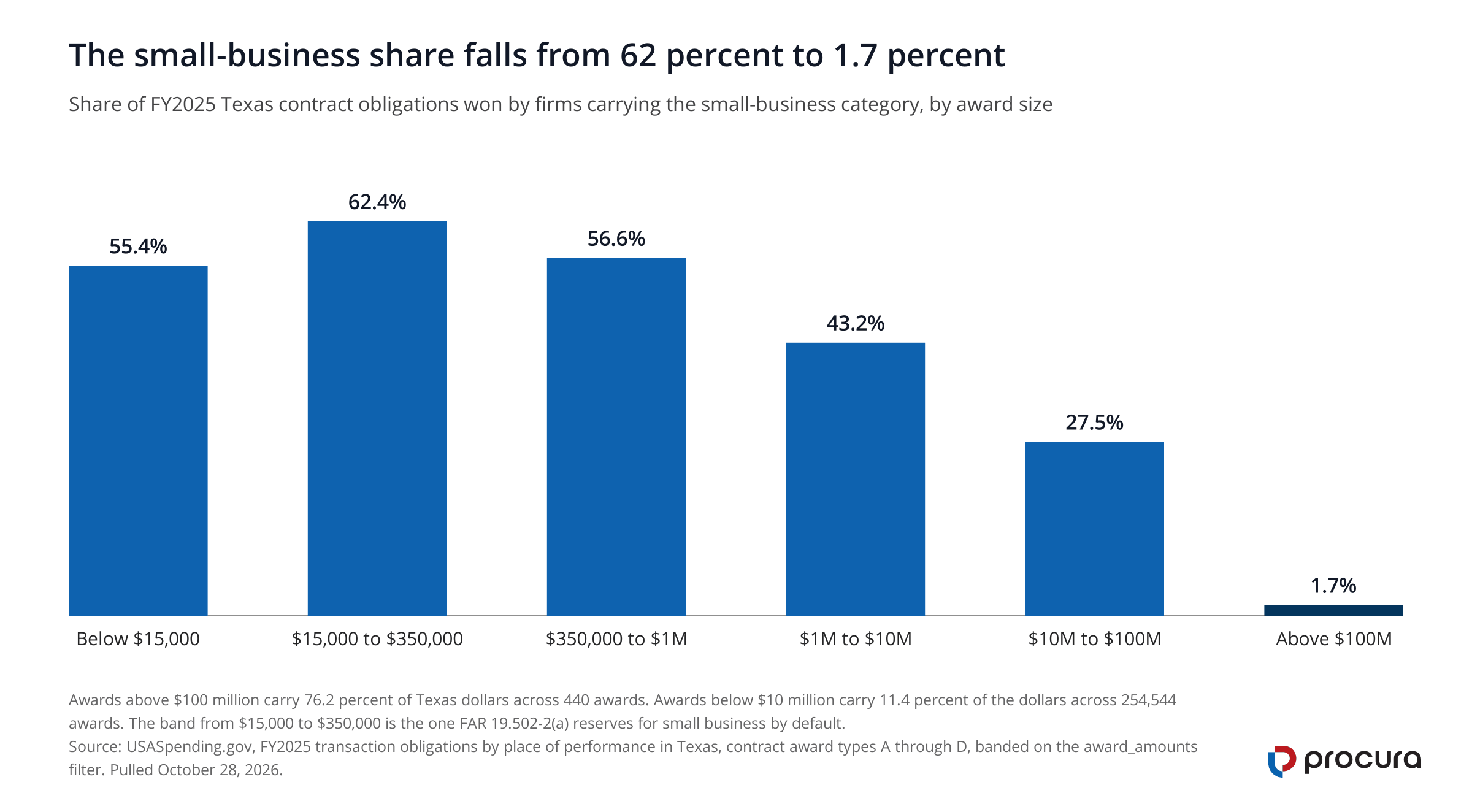
Data table: Texas award size bands, FY2025
| Award size | Obligations | Awards | Average award | Won by small business | Share |
|---|---|---|---|---|---|
| Below $15,000 | $198,923,974 | 212,600 | $936 | $110,164,057 | 55.4% |
| $15,000 to $350,000 | $1,684,195,934 | 31,574 | $53,341 | $1,050,639,441 | 62.4% |
| $350,000 to $1 million | $1,184,643,152 | 4,569 | $259,278 | $670,441,961 | 56.6% |
| $1 million to $10 million | $6,787,872,253 | 5,801 | $1,170,121 | $2,933,957,478 | 43.2% |
| $10 million to $100 million | $10,719,631,586 | 1,677 | $6,392,148 | $2,950,490,128 | 27.5% |
| Above $100 million | $65,801,279,787 | 440 | $149,548,363 | $1,131,373,572 | 1.7% |
Why is the Texas small-business share half the national rate?
Because the mix is wrong, not because Texas firms lose more often. Small businesses took 10.2 percent of Texas dollars in FY2025 against 22.6 percent nationally. Similarly, Texas holds 11.1 percent of all federal contract dollars and only 5.0 percent of federal small-business dollars. But small businesses won 62.0 percent of the state’s awards by count, against 50.7 percent nationally. So small firms in Texas are above average at winning contracts and far below average at winning dollars. The state’s dollars sit in aircraft production, missile production and VA pharmaceutical distribution, and none of that is set aside.
Similarly, the set-aside data says the same thing twice. For example, across all of Texas, only 3.36 percent of obligations carry one of the twelve small-business set-aside codes, against 7.49 percent nationally. By contrast, among the small awards described above, the figure is 16.12 percent, which is 4.8 times the state-wide rate. The reservation in the easiest federal contracts to win operates on small buys, and small buys are a tenth of Texas.
Which rule reserves small Texas buys?
One rule carries most of that, and the table below quotes its operative sentence. Specifically, it reserves every buy above the micro-purchase threshold and at or below the simplified acquisition threshold. However, the main exception is a finding by the contracting officer that two competitive small offers are not a reasonable expectation. In addition, it defers to the order of precedence in FAR 19.203.
In addition, both figures moved on October 1, 2025. As a result, a micro-purchase is now anything at or below $15,000, and the simplified acquisition threshold is $350,000. Specifically, in Texas that band held $1.68 billion across 31,574 awards. Moreover, small firms took 62.4 percent of it.
| Rule | Text |
|---|---|
| FAR 19.502-2(a), second sentence | “Each acquisition of supplies or services that has an anticipated dollar value above the micro-purchase threshold, but not over the simplified acquisition threshold, shall be set aside for small business unless the contracting officer determines there is not a reasonable expectation of obtaining offers from two or more responsible small business concerns that are competitive in terms of fair market prices, quality, and delivery.” |
| FAR 2.101, micro-purchase threshold | $15,000 for most supplies and services, with lower figures for construction ($2,000) and Service Contract Labor Standards work ($2,500), and higher figures for contingency and emergency buys |
| FAR 2.101, simplified acquisition threshold | $350,000, with higher figures for contingency and disaster buys |
What do Texas small businesses actually win?
For example, fuel supply is the single largest line, at $801 million of small-business obligations under petroleum refineries. Next, construction is second at $600 million, which is why federal construction contracting is the most common Texas entry point. After that, the list is services: computer services, research and development, facilities support, engineering and physician services. In fact, none of the top eight lines is a manufactured end item.
| NAICS | Industry | Small-business obligations in Texas, FY2025 |
|---|---|---|
| 324110 | Petroleum refineries | $801,212,526 |
| 236220 | Commercial and institutional building construction | $600,186,551 |
| 541519 | Other computer related services | $578,970,406 |
| 541715 | Research and development in the physical, engineering and life sciences | $429,045,125 |
| 561210 | Facilities support services | $333,291,074 |
| 541330 | Engineering services | $323,643,595 |
| 621111 | Offices of physicians | $300,054,235 |
| 541511 | Custom computer programming services | $297,506,044 |
In addition, two of those eight lines are information technology and software work. Moreover, most of it is bought in Bexar and Travis counties. Therefore, if that is your business, read the pattern in selling software to the government first. In fact, Bexar County takes 71 percent of the state’s small-business dollars in other computer related services and 82 percent in custom programming. Meanwhile, Travis County takes most of the rest.
When do government contracts in Texas get awarded?
In short, September is a third of the year. In FY2025, Texas obligations in September alone were $27.7 billion, which is 32.0 percent of the state total, against a median month of $5.1 billion. Overall, the July through September quarter was 46.4 percent of the year. Then a second, smaller spike came in December at $12.6 billion, which tracks one large aircraft award rather than normal buying. In fact, Lockheed Martin alone was 72 percent of that month.
How should a small firm plan for September?
The practical effect falls on your capacity, not your pipeline. Similarly, small simplified buys tilt the same way, but less sharply. For example, in the $15,000 to $350,000 band September is 14.4 percent of the year, against 32.0 percent for all Texas obligations. Similarly, July through September in that band is 34.5 percent, against 46.4 percent overall. Therefore, to compete for that work, keep proposal capacity free in August and September. By contrast, February was the quietest month of FY2025, at $2.05 billion.
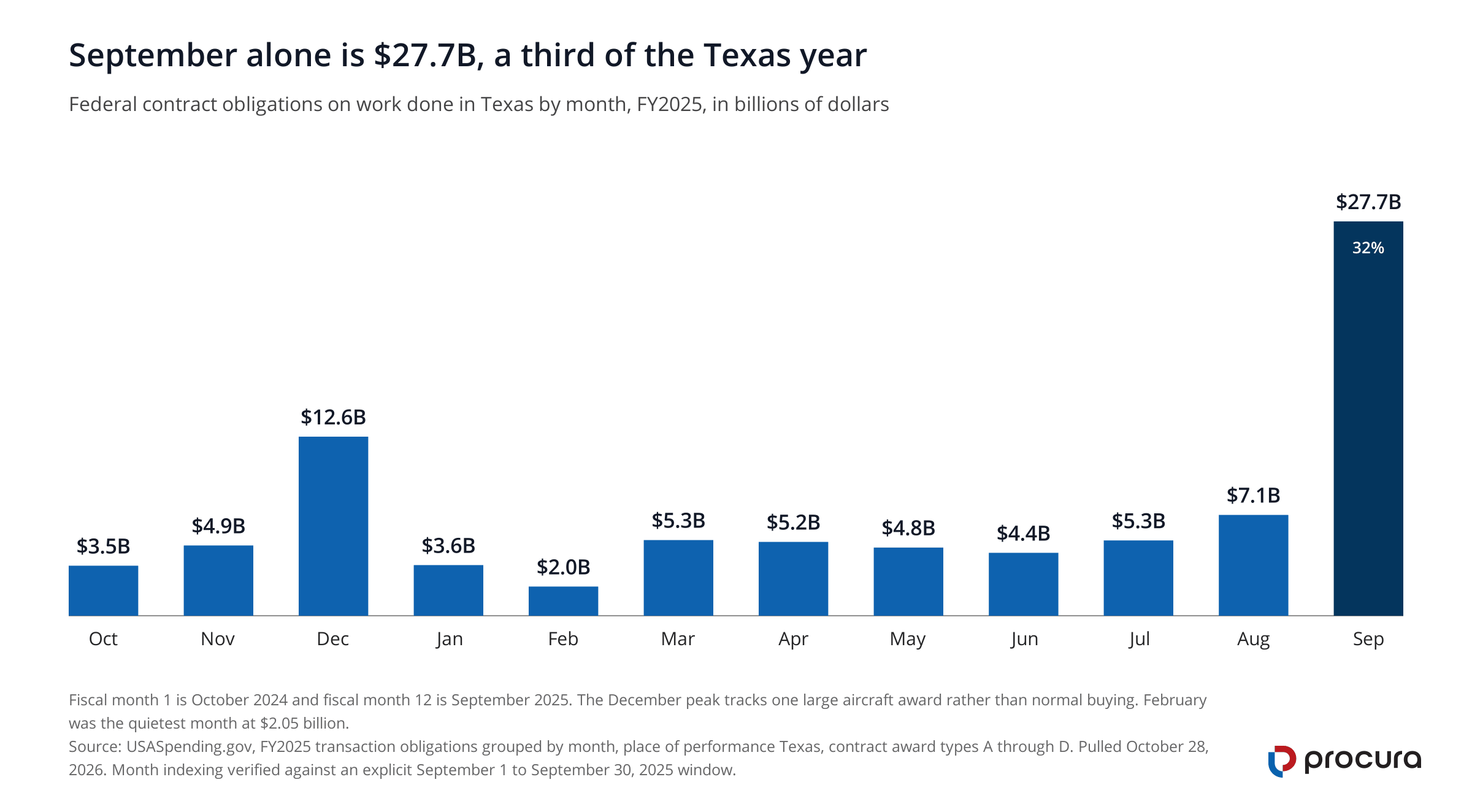
Data table: Texas obligations by month, FY2025
| Month | Obligations | Share of year |
|---|---|---|
| October 2024 | $3,510,402,577 | 4.1% |
| November 2024 | $4,925,310,363 | 5.7% |
| December 2024 | $12,567,610,902 | 14.6% |
| January 2025 | $3,557,443,713 | 4.1% |
| February 2025 | $2,052,830,892 | 2.4% |
| March 2025 | $5,314,760,090 | 6.2% |
| April 2025 | $5,178,569,800 | 6.0% |
| May 2025 | $4,791,428,370 | 5.5% |
| June 2025 | $4,421,362,014 | 5.1% |
| July 2025 | $5,287,515,572 | 6.1% |
| August 2025 | $7,083,826,209 | 8.2% |
| September 2025 | $27,678,038,630 | 32.0% |
Texas award timing moves every year, so a single month column ages fast. The full Texas record set stays free to browse, and you can re-run the month cut whenever new obligations post. A free account lets you export the table and set it beside your own bid calendar.
Do you want federal contracts or State of Texas contracts?
These are two separate markets with separate registrations. Yet readers arrive at this question wanting one and reading about the other. In short, everything above this section is federal: money from a federal agency, posted under federal rules, searchable on SAM.gov. By contrast, the Texas Comptroller of Public Accounts runs State of Texas contracts through its Statewide Procurement Division. As a result, none of the figures on this page describe that market.
- State opportunities above $25,000 post on the Electronic State Business Daily at txsmartbuy.gov/esbd.
- State purchasing runs through Texas SmartBuy at txsmartbuy.gov, and vendors sign up on the Centralized Master Bidders List at comptroller.texas.gov.
- However, a federal registration does not carry over, and a state certification does not qualify you for a federal set-aside.
What do you need before you bid on government contracts in Texas?
No federal entry requirement is Texas-specific. That is the good news, but it is also why a Texas address buys you very little on its own. Instead, you need an active SAM.gov registration, the right NAICS codes, and a capability statement that names your target installations and buying offices. Fortunately, SAM.gov is free, and its own entity checklist tells you to allow at least ten business days after submission. Our SAM.gov registration guide lists the steps that cause the delays.
Which certifications help most in Texas?
Two certifications change the Texas math more than the rest. For example, HUBZone designations exist across Texas, in qualified census tracts and non-metropolitan counties. Find a specific address on the SBA HUBZone map at maps.certify.sba.gov/hubzone/map. However, SBA last updated that map in 2023 and lists more updates for 2026 and 2028, so look again before you sign a lease. Similarly, 8(a) sole-source awards done in Texas took $680.6 million in FY2025 across 775 awards. In other words, that is four times what 8(a) competed awards delivered in the state.
| Set-aside type | FY2025 obligations in Texas | Awards |
|---|---|---|
| Total small business set-aside | $1,420,871,272 | 8,999 |
| 8(a) sole source | $680,563,261 | 775 |
| SDVOSB set-aside | $470,674,027 | 1,422 |
| 8(a) competed | $167,306,450 | 105 |
| WOSB set-aside | $94,566,198 | 137 |
| HUBZone set-aside | $23,273,920 | 75 |
| SDVOSB sole source | $19,362,761 | 63 |
| Partial small business set-aside | $18,070,348 | 53 |
| All twelve codes combined | $2,903,373,126 | 11,663 |
Where can Texas firms get free help?
Two free sources of help exist. First, six SBA district offices serve Texas: Dallas and Fort Worth, El Paso, Houston, the Lower Rio Grande Valley, San Antonio, and West Texas. In addition, APEX Accelerators is the DoD-funded program that used to be the Procurement Technical Assistance Centers. Specifically, it gives counseling at no cost to the business, and SBA links the locator at apexaccelerators.us. For the certification routes, start with HUBZone certification and the 8(a) program. Then put your own numbers beside the national small-business figures.
The hard part is not finding Texas. It is qualifying the buy.
By now you can see the shape of this market better than most firms that sell into it. For example, you know to ignore Fort Worth, to look at San Antonio, El Paso and Killeen, and to stay in the small bands. However, that knowledge does not get you one $80,000 purchase order. After all, Texas produced 41,944 awards between $15,000 and $10 million in FY2025, about 170 for every working day. Moreover, another 212,600 micro-purchases never reach a solicitation notice at all. Meanwhile, the biddable ones post with short response times, and the requirement often sits in an attachment rather than the notice.
How does Procura qualify Texas bids?
That is the problem Procura Federal exists to solve. First, it reads the attachments on a solicitation and not only the posting, so a statement of work buried in a PDF gets searched like text. Then your capability statement gets scored against each opportunity, so you can separate a Fort Bliss support bid you can win from one you cannot. Finally, it flags the compliance terms that decide whether a small Texas buy is worth your week. Pricing starts at $399/month, against five-figure annual contracts at the legacy platforms.
Frequently asked questions about government contracts in Texas
How much do federal government contracts in Texas add up to?
Government contracts in Texas came to $86,369,099,132 in FY2025 across 256,662 prime awards, measured as transaction obligations on work done in Texas. Overall, that ranks second nationally behind Virginia.
Which Texas county gets the most federal contract money?
Tarrant County, at $33.5 billion in FY2025, on F-35 production in Fort Worth. However, for a small business the useful answer is Bexar County, which has the largest pool of small-business federal dollars in the state. See the county table above.
Is Texas a good state for small-business federal contracting?
It is average, not exceptional, and the ranking oversells it. Specifically, the state takes 11.1 percent of federal contract dollars and 5.0 percent of the small-business dollars. Still, small businesses do win a higher share of Texas awards by count than they do nationally.
How do I find government contracts in Texas?
First, search SAM.gov with a Texas place-of-performance filter and your NAICS codes. Then watch the DLA and installation buying offices named above. Our guide to finding federal contracts explains the search mechanics.
Do I have to be located in Texas to win a Texas contract?
No. After all, place of performance and recipient address are separate fields. In FY2025, however, the two produced almost the same Texas total by coincidence, not by rule. However, local presence helps on installation support and construction, where site visits and response times favor a nearby firm.
Are State of Texas contracts the same as federal contracts?
No. The Texas Comptroller runs state work and posts it on the Electronic State Business Daily, under a separate registration. As a result, none of the spending figures on this page include it.
About this analysis
Written by Jacob Grass, founder of Procura Federal. Published November 9, 2026. All spending figures are FY2025 transaction obligations on contract award types A through D from USASpending.gov. The basis is place of performance in Texas unless stated otherwise. Pulled October 28, 2026. FAR text cited from the Federal Acquisition Regulation as codified at FAC 2026-01, cross-checked against eCFR title 48, issue date October 19, 2026.