A UEI number is the 12-character Unique Entity ID that SAM.gov generates for your business. It replaced the DUNS Number as the federal government’s official entity identifier on April 4, 2022. The identifier itself is clerical. However, what it unlocks is not: in fiscal year 2025, federal agencies obligated $813.8 billion on prime contracts, and 100 UEIs took 46.5 percent of it.
I have registered entities in SAM.gov and watched registrations sit in validation for weeks. Yet what stalls a new contractor is never the UEI number itself. Instead, it is the document check behind it, and almost nothing written about the UEI explains that check.
What is a UEI number, and what did it replace?
FAR 52.204-7 defines a unique entity identifier as “a number or other identifier used to identify a specific commercial, nonprofit, or Government entity.” In fact, the wording is deliberately broad. After all, the government changed the identifier once already, and wrote the clause to survive the next change.
The old identifier was the DUNS Number, a proprietary code licensed from a commercial data provider. Then GSA retired it for federal award identification and moved SAM.gov and other GSA systems to the Unique Entity ID on April 4, 2022. GSA’s current guidance page is blunt about the old code. The DUNS Number, it says, “is no longer valid for federal award identification.” As a result, entities that were already registered needed to do nothing, because they already held a UEI.
A UEI number is 12 characters. GSA’s Entity Management API documentation accepts “a single 12-character value” for the ueiSAM parameter. For example, a real one looks like G4KDGE4JFFK7, which is the identifier behind Lockheed Martin’s Fort Worth entity. SAM.gov generates the value, so you do not pick it, and it carries no meaning you can decode. In other words, a UEI is not a code you can derive from a name, a state, or a tax number.
One detail in that same API documentation matters more than it looks. Specifically, the entity record carries two separate expiration dates: a registrationExpirationDate and a ueiExpirationDate. However, GSA defines neither one in the documentation. In practice the registration is what lapses first, which is why a firm can find its own UEI and still be ineligible for award.
Who needs a UEI number, and at what point in a bid?
FAR 4.1102(a) requires offerors and quoters to be registered in SAM.gov at the time an offer or quotation is submitted. FAR 52.204-7(b)(1) tightens it. An offeror must be registered “when submitting an offer or quotation and at time of award.” Both points matter. For example, a registration that was active at bid time, then expired before award, is a real way to lose a contract you won.
However, registration is not universal. FAR 4.1102(a) lists seven carve-outs, and small firms run into the first one constantly:
- Micro-purchases paid with a Governmentwide commercial purchase card used as both the purchasing and payment mechanism
- Classified contracts where SAM.gov registration or SAM.gov data can compromise classified information or national security
- Awards by deployed or overseas contracting officers in military, contingency, humanitarian, peacekeeping, danger-pay or emergency operations
- Contracts with individuals for performance outside the United States and its outlying areas
- Awards made without full and open competition because of unusual and compelling urgency under FAR 6.302-2
- Contract actions at or below $40,000 awarded to foreign vendors for work performed outside the United States, when registration is impractical
- Micro-purchases that do not use electronic funds transfer and are not required to be reported
When does the micro-purchase exception apply?
The micro-purchase exception is narrower than most contractors assume. FAR 2.101 puts the micro-purchase threshold at $15,000, then lists four exceptions. First, two cut it: $2,000 for construction covered by the Wage Rate Requirements statute, and $2,500 for services covered by the Service Contract Labor Standards. Second, two raise it: $25,000 inside the United States and $40,000 outside it for contingency, disaster and emergency buys. A roofer or a janitorial firm thus hits the registration requirement at a far lower dollar value than a parts supplier does.
Similarly, under the urgency exception, registration is only deferred. FAR 4.1103(b) requires the contractor to register within 30 days after award, or at least three days before the first invoice, whichever comes first.
By contrast, subcontractors are a separate case. For example, a sub that will never bid as a prime still needs the identifier, because the prime must report the subaward. Therefore, GSA points those entities to the Unique Entity ID only path instead of a full registration.
How do you get a UEI number from SAM.gov?
There are two paths, and picking the wrong one costs weeks. SAM.gov states that “you can get a Unique Entity ID for your organization without having to complete a registration,” and then states the catch in the next breath: “if you choose to only get a Unique Entity ID, you cannot apply directly for federal awards.”
So the identifier-only path suits a subcontractor that needs to be reportable. A firm that intends to bid needs the full entity registration. FAR 2.101 defines “registered in SAM” as four conditions:
- All mandatory information entered, including the unique entity identifier
- The Core, Assertions, Representations and Certifications, and Points of Contact sections complete
- The Taxpayer Identification Number validated by the IRS
- The record marked Active by the government
However, two of the four depend on the government, not on you. Specifically, they are the last two, so the clock you cannot control runs at the end.
What do you need to start?
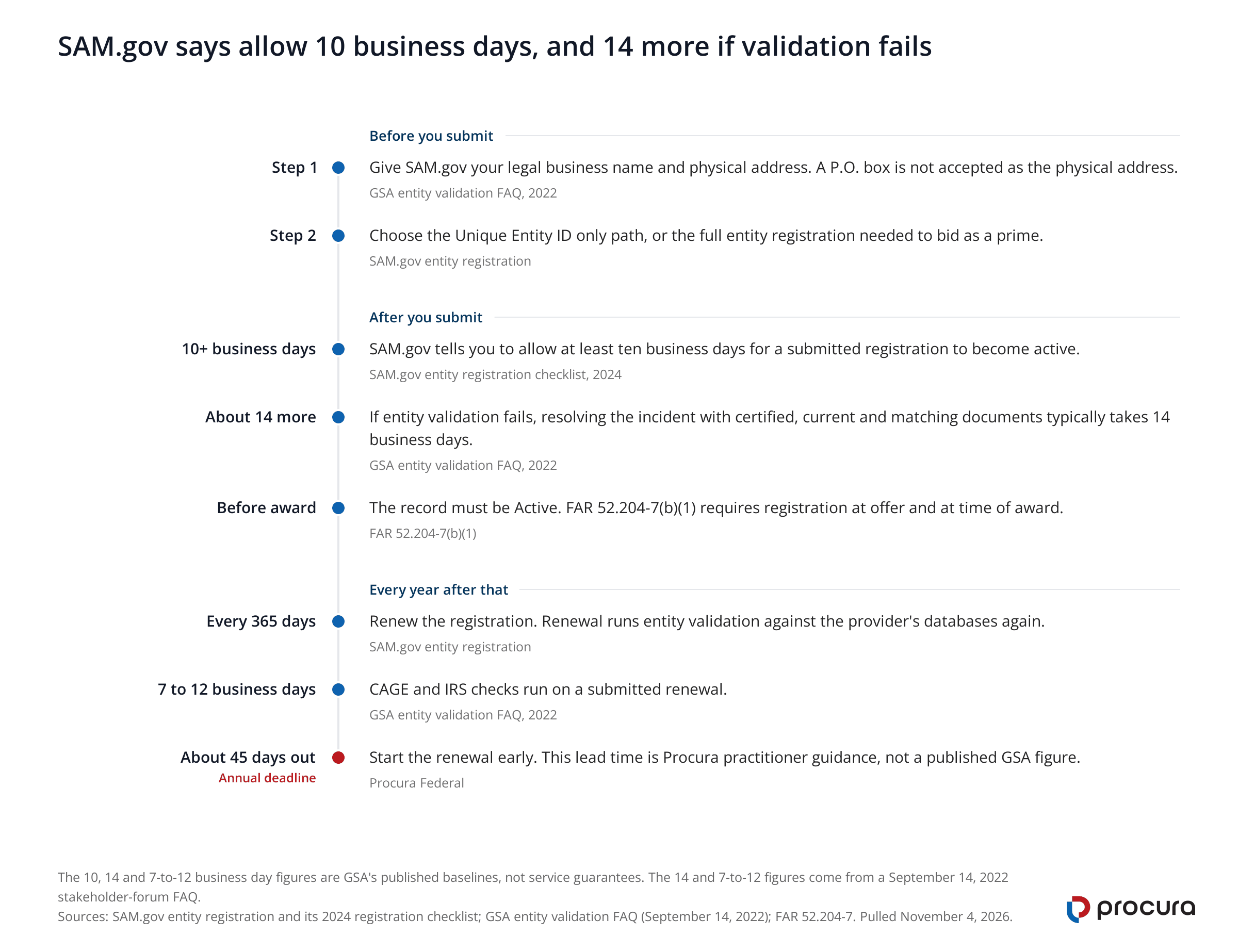
To start either path you give SAM.gov your legal business name and your physical address. In fact, those two fields are the whole game, and the next section explains why. In addition, FAR 52.204-6(c) keeps a direct route open for an offeror with no identifier yet. That clause tells the offeror to contact the entity designated at SAM.gov, and phrases it as advice rather than a command. FAR 52.204-7(d) adds the only scheduling guidance in the regulation, which is to allow for processing time when you register.
Moreover, registration is not permanent. SAM.gov requires you to “renew your registration every 365 days to keep it active,” and the renewal runs the same validation as a new registration.
Why do so many SAM.gov registrations fail entity validation?
Entity validation is the step nobody warns new contractors about, and it is where registrations die. SAM.gov uses an entity validation service to independently verify the existence and uniqueness of an entity against that provider’s databases and data sources. According to GSA, every entity must clear it, even one that already held an active registration. Moreover, the check runs again at four moments:
- A new registration
- The yearly renewal
- Getting a Unique Entity ID
- A change to the entity’s name or address
However, what the service checks is narrow.
What documents pass validation?
At least one of your documents must show your legal business name and your physical address, exactly as you typed them into SAM.gov. GSA’s guidance names the common rejection reasons, and all five are document problems rather than eligibility problems.
| Rejection reason | What GSA says | What to send instead |
|---|---|---|
| Not a certified document | An application or a web form is rejected because it is “not a certified document” | A government-issued or bank-issued document, certified |
| Document too old | A bank statement or utility bill “must be 5 years old or less” | A statement dated inside the last five years |
| Name or address mismatch | The document does not match the name or address in the SAM.gov record | Fix the SAM.gov entry, or send a document that matches it |
| Not in English | A non-English document needs a “certified translation” | The original plus a certified translation |
| P.O. box as the address | “P.O. Boxes are not accepted for an entity’s physical address” | A street address where the business operates |
In addition, a joint venture has one extra requirement. Specifically, GSA asks for a fully executed contract between the two parties, carrying one matching name and address.
How long does validation take?
The timelines are the numbers to plan against, and they come from two GSA documents that say different things. SAM.gov’s own entity registration checklist tells you to “allow at least ten business days” after you submit for the registration to become active. Meanwhile, GSA’s 2022 validation FAQ adds two more figures. A new validation incident with correct documents typically takes 14 business days to resolve, and a renewal goes active after about 10 business days. The same FAQ puts the CAGE and IRS checks on a submitted renewal at 7 to 12 business days. However, it does not say whether that time sits inside the 10 days or on top of them.
Two procedural traps are worth knowing before you are in one. A validation incident in SAM.gov also opens a ticket on FSD.gov. However, that ticket closes if you do not answer the validation service within five business days. Therefore, answer inside the ticket, because GSA explicitly says not to use the chat feature or call the help desk about it. If the ticket closes, you validate again in SAM.gov and open a new ticket quoting the original reference number, which looks like INCGSAFSD1234567.
GSA states the stakes plainly in the same FAQ. In short, no entity can do business with the federal government without validating. As a result, a 45-day lead time before an expiration date is standard practice rather than caution.
How do you find a UEI number, yours or a competitor’s?
Every assigned identifier is public, and three sources expose it. SAM.gov entity search returns the registration record, its status and its expiration date. Meanwhile, USASpending.gov returns the award history attached to it. A free UEI lookup and a CAGE code lookup resolve one without an account.
In practice, looking up a competitor is the underused move here. The record tells you whether a firm is registered, what it is registered to do, and what it has won. As a result, for a teaming decision that is better evidence than a capability statement, and a strong capability statement is still what you send back.
Is a UEI number the same as an EIN, a CAGE code, or a DUNS Number?
No, and one of the four is retired. In fact, four different bodies issue them for four different purposes, and contractors conflate them because all four identify the same company.
| Identifier | Issued by | Format | What it identifies | Renewal | Status in 2026 |
|---|---|---|---|---|---|
| Unique Entity ID (UEI) | SAM.gov | 12 characters | The registered entity for federal awards | Registration renews every 365 days | The official federal entity identifier |
| CAGE code | Defense Logistics Agency | 5 characters | An entity at one physical address | Assigned and verified through SAM.gov registration | Active, and separate from the UEI |
| EIN / TIN | Internal Revenue Service | 9 digits | The taxpayer | None | Active, and validated during SAM.gov registration |
| DUNS Number | A commercial data provider | 9 digits | A business in a commercial database | None | Retired for federal award identification on April 4, 2022 |
However, one registration produces several identifiers at once. FAR 2.101 folds the CAGE code into what it counts as a complete SAM.gov registration. A contractor who finishes registration thus holds a UEI and a CAGE code together, validated against the same name and address.
What does the award data say about firms with a UEI number?
Federal agencies obligated $813.8 billion on prime contracts in fiscal year 2025, per USASpending.gov. The 100 largest entity records took $378.1 billion of that, or 46.5 percent. However, that share had been flat for years at about 42 percent, and then it moved.
FY2025 is the first year in this five-year window where the top 100 cleared 46 percent. In fact, the jump from 41.6 percent in FY2024 is 4.8 points, which is larger than the total movement across the three years before it. FY2026 closed on September 30, 2026 and already reads higher, at 49.1 percent of $800.5 billion. However, late-September actions are still being reported, so FY2025 is the last settled year.
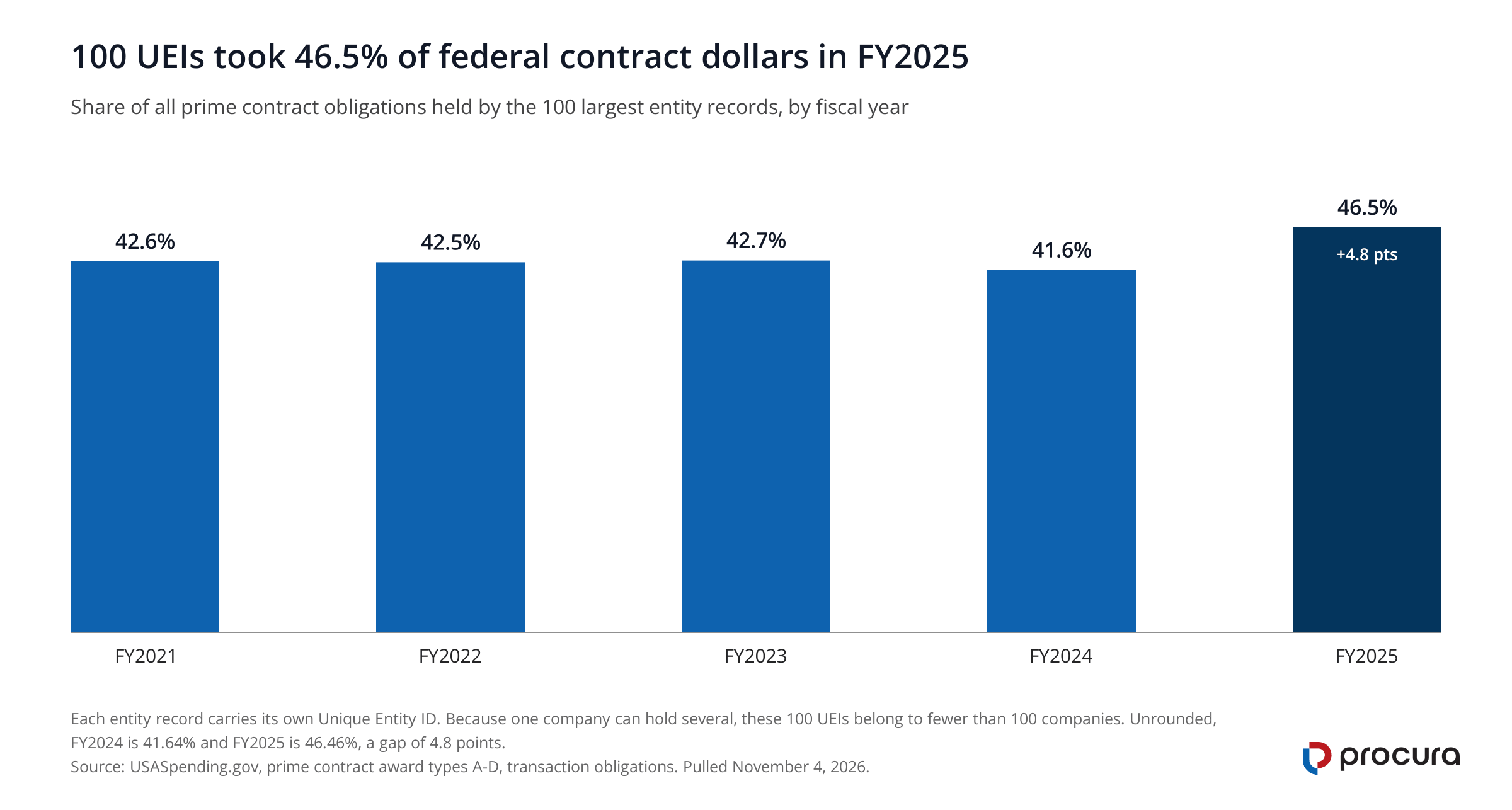
Data table: top-100 entity-record share of prime contract obligations, FY2021-FY2025
| Fiscal year | All prime contract obligations | Top 100 entity records | Top-100 share |
|---|---|---|---|
| FY2021 | $659.0B | $280.6B | 42.59% |
| FY2022 | $702.9B | $298.6B | 42.48% |
| FY2023 | $779.8B | $332.7B | 42.67% |
| FY2024 | $775.9B | $323.1B | 41.64% |
| FY2025 | $813.8B | $378.1B | 46.46% |
| FY2026 (not settled) | $800.5B | $392.8B | 49.07% |
Why are 100 UEIs not 100 companies?
Read the unit carefully, because it is the point of this whole article. Specifically, USASpending groups those obligations by entity record, and each record carries its own UEI. So “the top 100” means the top 100 identifiers, not the top 100 companies. In fact, the FY2025 list proves the difference twice over.
“Lockheed Martin Corporation” occupies two of the top ten slots under two different identifiers. UEI G4KDGE4JFFK7 in Fort Worth, Texas took $34.1 billion and rolls up to a parent identifier. Meanwhile, UEI XFJMYSYFJEK4 in Grand Prairie, Texas took $11.0 billion and is its own parent. Same legal name, two registered entities, two addresses, two identifiers.
Can two names share one parent?
By contrast, the reverse case sits in the same top ten. Raytheon Company in Tucson, Arizona holds UEI VTEWM5QSE598 and took $12.1 billion. Similarly, RTX Corporation in East Hartford, Connecticut holds UEI QN1BCFY7JDJ5 and took $7.3 billion. The two names roll up to one parent identifier, PPLZG8J3N9D4. USASpending does not link the two Lockheed records to a common parent at all, which is the same reporting gap seen from the other side. As a result, if you total them by name, the answer is wrong in either direction.
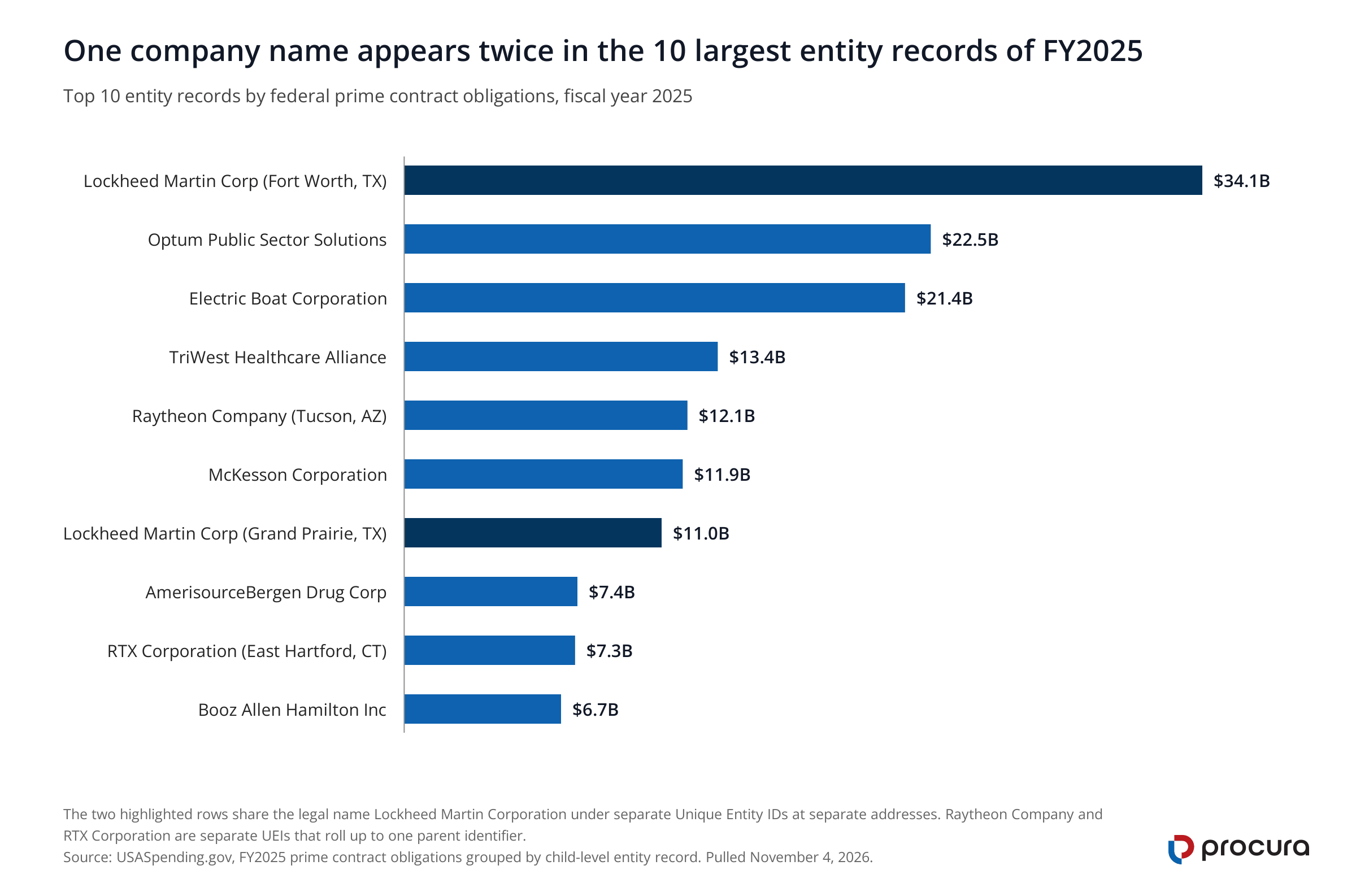
| # | Entity record | UEI | Location | FY2025 obligations |
|---|---|---|---|---|
| 1 | Lockheed Martin Corporation | G4KDGE4JFFK7 | Fort Worth, TX | $34.1B |
| 2 | Optum Public Sector Solutions, Inc. | XMUZGJN98231 | La Crosse, WI | $22.5B |
| 3 | Electric Boat Corporation | E7BEKJ4V9528 | Groton, CT | $21.4B |
| 4 | TriWest Healthcare Alliance Corp | J7M9HPTGJ1S9 | Phoenix, AZ | $13.4B |
| 5 | Raytheon Company | VTEWM5QSE598 | Tucson, AZ | $12.1B |
| 6 | McKesson Corporation | S1RUKWWRYFL6 | Irving, TX | $11.9B |
| 7 | Lockheed Martin Corporation | XFJMYSYFJEK4 | Grand Prairie, TX | $11.0B |
| 8 | AmerisourceBergen Drug Corp | KABZK8W6PQT3 | Conshohocken, PA | $7.4B |
| 9 | RTX Corporation | QN1BCFY7JDJ5 | East Hartford, CT | $7.3B |
| 10 | Booz Allen Hamilton Inc | JCBMLGPE6Z71 | McLean, VA | $6.7B |
What does that mean for a small firm?
Two consequences follow for a small firm. Because one company can hold several identifiers, those 100 UEIs belong to fewer than 100 companies, so true corporate concentration is higher than 46.5 percent. And because obligations attach to the identifier on the award, market research that totals by company name will overstate some competitors and miss others entirely.
However, the small-business side of the same year is not small. Entities coded as small businesses took $169.0 billion of FY2025 obligations, or 20.8 percent of the total. That is the pool a new registrant is actually competing in, and it is worth looking at in detail.
Every table on this page comes from the same public award records the explorer publishes. You can browse that data yourself, free, and cut it to your own codes and dates. A free account adds table export, so you can work the list in a spreadsheet instead of reading it here.
Getting a UEI number is step zero, not an advantage
Here is the uncomfortable arithmetic. GSA’s own fact sheet puts SAM.gov at more than 674,000 registered entities, with more than 56,000 registrations created or renewed every month. However, the sheet carries no date except a June 2023 anchor on its opening figure. Read these as a mid-2023 snapshot, not a current count. By contrast, the top 100 identifiers took almost half of all contract dollars. Registration is a filter that almost everyone passes, which means passing it distinguishes you from nobody.
Firms that sell “UEI registration” sell help with the clerical work and the document chase. That is a real service, and some firms do it well. However, the government charges nothing for the registration itself. In short, a paid filing buys speed and hand-holding, not access to anything closed.
The hard part starts the day the record goes Active. After all, opportunities arrive as a solicitation plus an attachment set. The attachments hold the specifications, the wage determinations and the clauses, and those decide whether the work suits you and whether the price works. However, reading them is slow, and most new registrants never build the habit. That is why a registration can sit unused for a year.
How does Procura help after registration?
That is the gap Procura Federal was built for. First, it opens the attachment set behind each solicitation. Then it scores the requirement list against the work your capability statement claims, and flags the compliance terms that change your price. The price is $399/month. By contrast, published third-party estimates put the incumbent platforms in the five figures a year.
Our comparison of the federal contracting tools states the trade-offs without the sales gloss. The step-by-step guide to winning federal contracts covers what happens after you find a match.
If you are still at the registration stage, start with our SAM.gov registration walkthrough. Then find where the opportunities actually get posted. New contractors tend to do better by aiming at the lower-competition contract types first. Our primer on entering federal contracting puts the whole sequence in order.
Frequently asked questions
Do all businesses have a UEI number?
No. Only an entity that went to SAM.gov and either registered or claimed the identifier holds one. As a result, a business with no federal award history and no subaward reporting duty usually has none.
What does UEI stand for?
Unique Entity Identifier. GSA brands the SAM.gov-issued version as the “Unique Entity ID (SAM),” and the FAR uses the lowercase generic term in its clauses.
How much does a UEI number cost?
Nothing. SAM.gov’s entity registration checklist states that “SAM.gov is FREE to use.” In addition, it states that “there is no charge to get a Unique Entity ID, register your entity, and maintain your entity registration at SAM.gov.” Third-party firms charge for filing help, which is a separate purchase from the identifier.
How long does it take to get one?
Weeks rather than days, and validation sets the clock rather than the identifier. The timelines in the SAM.gov section above give GSA’s published day counts for each stage.
Can one company have two UEI numbers?
Yes. The FY2025 award data shows one legal name holding two identifiers at two addresses, each with its own obligations. In short, separate registered entities get separate identifiers even under a shared corporate name.
What happens if my registration expires?
You become ineligible for award while the identifier stays assigned to you. However, renewal triggers validation again, and the CAGE and IRS checks add 7 to 12 business days. A 45-day lead time before the expiration date is the safe habit.
Book a demo
Bring a solicitation you are unsure about. We will open its attachments on the call, score it against your capability statement, and name the compliance terms that move the price. Fifteen minutes is enough to tell whether the match is real.
By Jacob Grass, founder of Procura Federal. Published November 10, 2026. Last updated November 10, 2026.