
How to get minority government contracts changed on September 10, 2026. On that day a new Small Business Administration rule replaced the 8(a) program’s test for social disadvantage. The rule removed the presumption that members of five designated racial and ethnic groups are socially disadvantaged. Every individually owned firm that applies to 8(a) now meets the same two-part documentary test, whatever group its owner belongs to.
One thing did not change, because it was never true. In fact, the federal government has no certification for a minority-owned business. It certifies four things, and that is not one of them. I run a small veteran-owned engineering firm and I read set-aside solicitations every week. The firms that waste the most money on this question are the ones that pay for a credential the federal buyer cannot use.
Is there a federal minority-owned business certification?
No. Instead, SBA certifies four programs: 8(a) Business Development, HUBZone, the Women-Owned Small Business program, and VetCert for veteran-owned firms. A fifth status, Small Disadvantaged Business, is a representation you make about yourself in SAM.gov. No federal program certifies a business as minority-owned, and no federal contract is set aside on that basis.
So how to get minority government contracts is really two questions, and they have different answers. One is federal. The other is corporate and local.
The credential most people mean by “minority business certification” is MBE certification from the National Minority Supplier Development Council. However, that is a private credential for corporate supplier-diversity programs. NMSDC says so in plain words: MBE certification “does not guarantee contracts, confer procurement preferences, or restrict participation in the marketplace.” It opens doors at corporate buyers. It opens none at a federal contracting officer.
| Credential | Who certifies | Government fee | Processing time | Federal set-aside access |
|---|---|---|---|---|
| 8(a) Business Development | SBA | None | 90 days after a complete application | Yes — competitive set-asides and sole source |
| HUBZone | SBA | None | 60 calendar days | Yes — set-asides, sole source, 10% price preference |
| WOSB / EDWOSB | SBA or four approved third parties | None through SBA | 90 calendar days when practicable | Yes — in designated NAICS codes only |
| SDVOSB (VetCert) | SBA | None | No regulatory deadline | Yes — set-asides and sole source |
| Small Disadvantaged Business | Nobody — you represent it | None | Immediate | No — goal credit and subcontracting only |
| NMSDC MBE | NMSDC and its regional councils | $270–$1,700, by revenue | 45 business days, by NMSDC target | No |
| State or local MBE | State or city agency | Free in Maryland and Massachusetts | 2–3 months in Maryland | No — state and local goals only |
What qualifies as a minority-owned business for federal contracts?
For federal purposes the operative phrase is not “minority-owned.” It is “socially and economically disadvantaged,” and it carries two separate tests in 13 CFR part 124. First, a firm must be at least 51 percent owned and controlled by one or more individuals who pass both. Social disadvantage is the test the September 2026 rule rewrote. Economic disadvantage is unchanged, and it is where most applications actually fail.
| Economic disadvantage test | Threshold | Citation |
|---|---|---|
| Personal net worth | Less than $850,000, excluding your equity in the firm and in your primary residence | 13 CFR 124.104(c)(2) |
| Adjusted gross income, 3-year average | Above $400,000 creates a presumption against you, which you can rebut | 13 CFR 124.104(c)(3) |
| Fair market value of all assets | Above $6.5 million generally disqualifies you, counting the residence and the firm | 13 CFR 124.104(c)(4) |
A married applicant must submit the spouse’s financial information too, unless the two are legally separated. Also, SBA counts the spouse’s position where the spouse works in the firm, holds an office, or guaranteed a loan to it. Community property law does not change the analysis.
What changed in the 8(a) program on September 10, 2026?
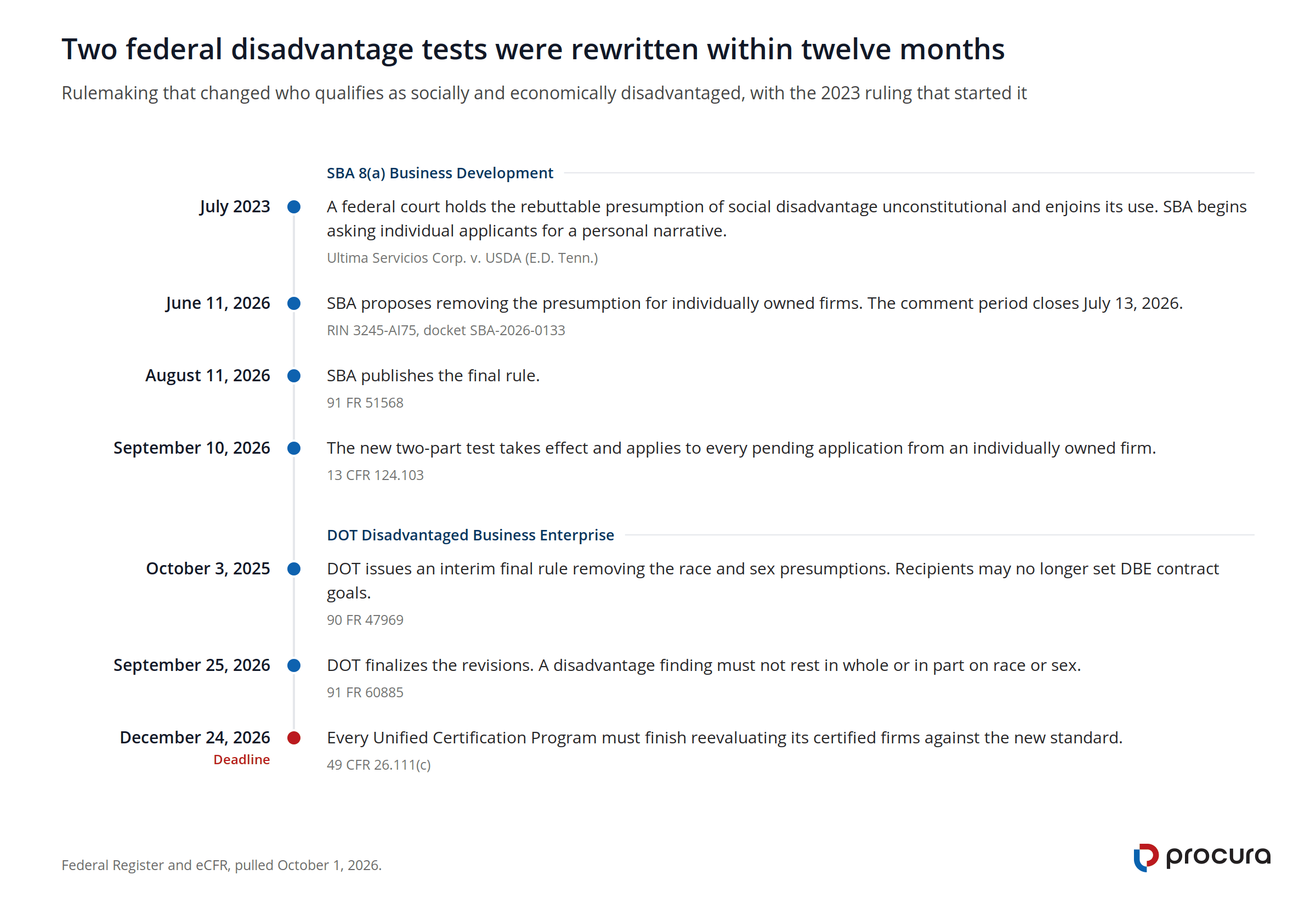
SBA published a final rule on August 11, 2026 at 91 FR 51568, and it took effect on September 10, 2026. In addition, the rule applies to all pending applications from individually owned firms as of that date. Entity-owned firms are not affected. Those are the firms owned by a tribe, a Community Development Corporation, an Alaska Native Corporation, or a Native Hawaiian Organization. Firms already in the program do not requalify.
Before the rule, 13 CFR 124.103(b)(1) presumed five groups to be socially disadvantaged. Those groups were Black Americans, Hispanic Americans, Native Americans, Asian Pacific Americans, and Subcontinent Asian Americans. A federal court in the Eastern District of Tennessee held that presumption unconstitutional in 2023 and enjoined its use. SBA then asked every individual applicant for a personal narrative. The 2026 rule retires the narrative and puts a different test in its place.
The new two-part social disadvantage test
The new 13 CFR 124.103(c) has two parts, and an applicant must satisfy both. Part one is documentary and it is about a group, not about you:
A citizen “must show evidence that a governmental or private entity’s action, policy, rule, regulation or other practice favored other groups, excluding the Citizen’s group, or disadvantaged the Citizen’s group or that the governmental or private entity took adverse actions against or otherwise disfavored the Citizen’s group.”
Part two is a self-certification. You attest that you belonged to the group when the policy was in force. You also attest that the policy caused you material harm. The rule defines that term as “loss of access to or diminished opportunities related to economic advancement.” That is the whole second element.
Part one has a named evidence list. For example, the list includes unlawful diversity, equity and inclusion programs and unlawful affirmative action programs. It also includes race-based quotas, set-asides or hiring targets. Proof can come from government, university and corporate websites, policies, regulations and reports. Statements by officials, court decisions, administrative rulings and specific findings of Congress also count.
One listed example is worth reading twice. The rule says qualifying evidence includes “prior iterations of § 124.103 of this part that excluded the Citizen’s racial or ethnic group as a group entitled to a rebuttable presumption of social disadvantage.” The old presumption itself is now named evidence for the groups it left out.
How to get minority government contracts under the new rule
Two practical consequences follow. The test is open to an applicant of any background, because it turns on a documented policy rather than on membership in a listed group. And the work shifted from writing about your own life to assembling a documentary record. If you drafted a narrative under the old standard, it does not meet the new test. Our guide to 8(a) certification walks the full application.
Nothing in the rule changed the economic tests, the nine-year program term, or the one-per-lifetime limit. SBA also states that social disadvantage stays a one-time determination.
What is a small disadvantaged business, and what does the SDB status get you?
A small disadvantaged business meets the SBA size standard for its NAICS code. It is also owned and controlled by one or more socially and economically disadvantaged individuals, per 13 CFR 124.1001. You claim the status yourself. The representation lives in SAM.gov, in the clause at FAR 52.219-1. Under FAR 19.304 the contracting officer decides whether to accept it.
The SDB standard points back to the same subpart of part 124. So the September 2026 rewrite of 13 CFR 124.103 now governs what you attest to in SAM.gov. Read the new test before you make that representation. A false SDB representation on a prime contract carries the penalties in 15 U.S.C. 645(d), plus other penalties the law allows.
SDB status buys you two things, and neither is a set-aside. First, your award counts toward the government-wide goal of 5 percent of prime and subcontract dollars in 15 U.S.C. 644(g)(1)(A)(iv). Second, it makes you countable under a prime contractor’s subcontracting plan, which must carry a separate SDB percentage under FAR 19.704. There is no SDB set-aside and no SDB price adjustment. FAR part 19 has no subparts 19.9 through 19.12 — the old price evaluation adjustment for SDB concerns is gone.
Goal credit is worth less to you than it sounds, because the goal is a target for agencies and not an entitlement for you. It is still worth claiming. For example, a prime contractor that must fill an SDB line on a subcontracting plan searches on exactly that flag. That makes federal subcontracting the most reliable thing SDB status does for a small firm.
Where does the 8(a) money actually go?
Federal agencies put $24.3 billion through 8(a) awards in FY2025, which was 3.7 percent of all prime contract dollars. That is the headline. The composition underneath it decides whether 8(a) is worth nine years of your time, and almost nobody publishes it.
SBA counted 4,985 active 8(a) firms in FY2025. Of those, 4,190 were individually owned and 795 were entity-owned. The dollars ran the other way.
| FY2025 8(a) program | Individually owned | Entity-owned |
|---|---|---|
| Active firms | 4,190 (84.0%) | 795 (16.0%) |
| 8(a) dollars | $7.99 billion (32.8%) | $16.35 billion (67.2%) |
| Average per firm | $1.9 million | $20.6 million |
| Sole-source dollars | $3.73 billion (25.7%) | $10.80 billion (74.3%) |
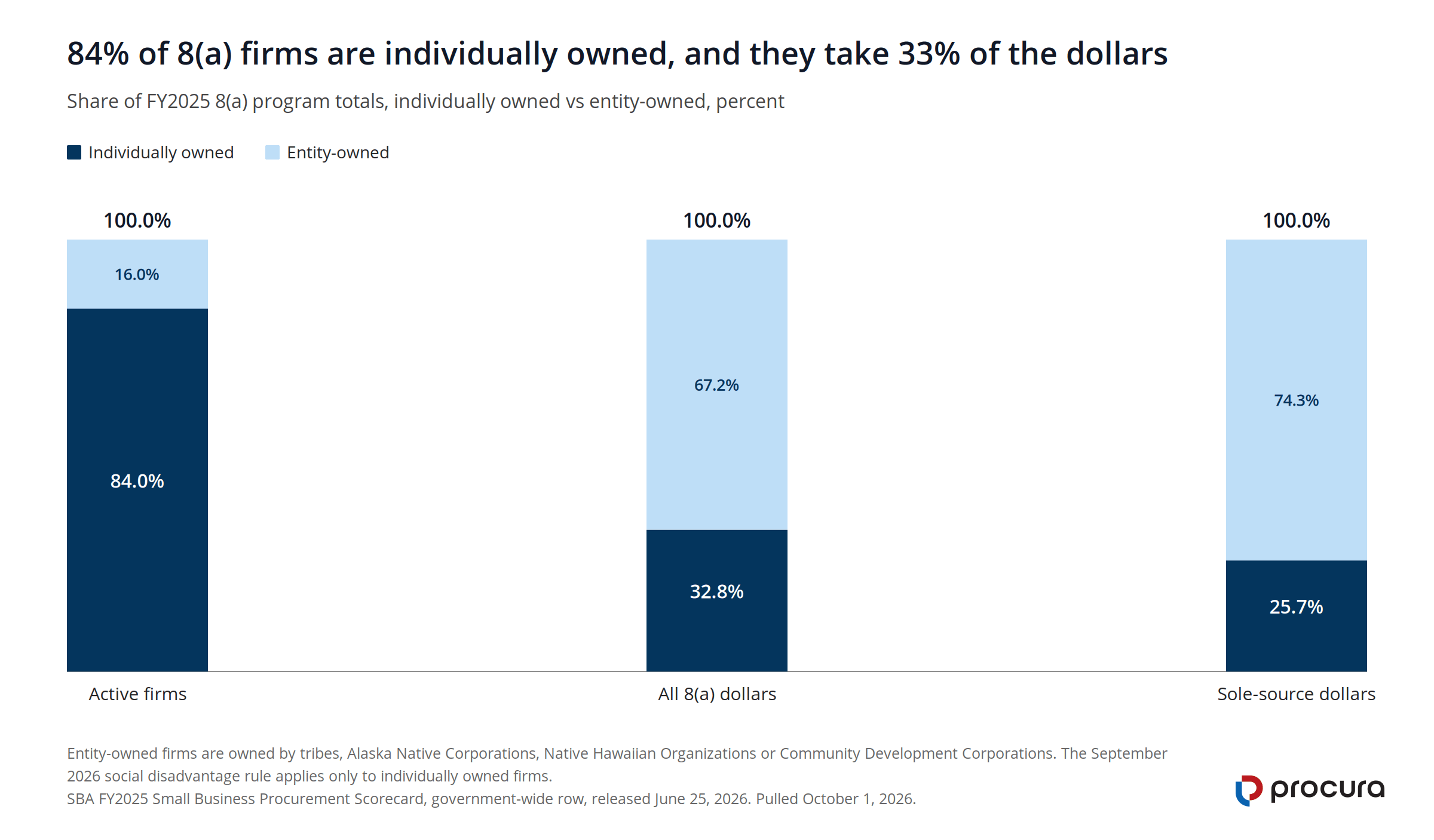
Entity-owned firms take most of the 8(a) dollars
An entity-owned 8(a) firm took about eleven times the federal dollars of an individually owned one last year. Entity-owned firms also took three quarters of the sole-source money, which is the part of the program with no competition in it. The September 2026 rule applies only to individually owned applicants — the 84 percent of firms competing for 32.8 percent of the dollars.
The trend is down. On a set-aside-coded basis, 8(a) obligations rose from $11.3 billion in FY2021 to $15.1 billion in FY2024. They fell to $13.7 billion in FY2025.
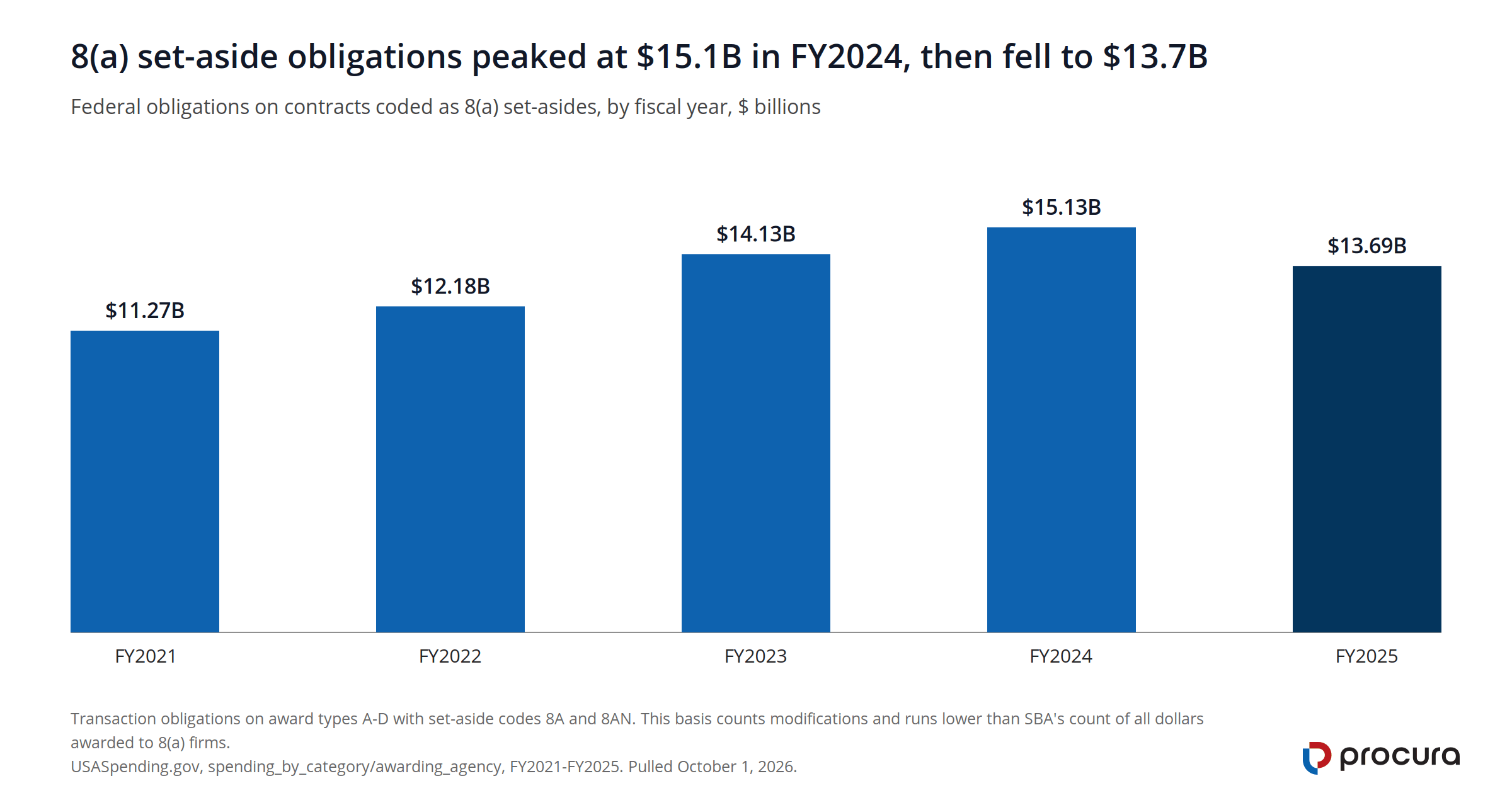
Data table: 8(a) set-aside obligations by fiscal year
| Fiscal year | 8(a) set-aside obligations | Change on the year |
|---|---|---|
| FY2021 | $11.27 billion | — |
| FY2022 | $12.18 billion | +8.1% |
| FY2023 | $14.13 billion | +16.0% |
| FY2024 | $15.13 billion | +7.1% |
| FY2025 | $13.69 billion | −9.5% |
SBA’s own scorecard puts the small disadvantaged business share of prime dollars down from 12.27 percent to 11.60 percent. That is the first decline in that five-year series. Meanwhile, the same scorecard counts 1,143 fewer SDB firms with prime awards. SBA has also moved to remove firms from the 8(a) portfolio and has approved far fewer new entrants than the prior administration did.
Which industries carry 8(a) set-aside dollars
Where the work sits matters more than the total. Overall, construction and professional services dominate.
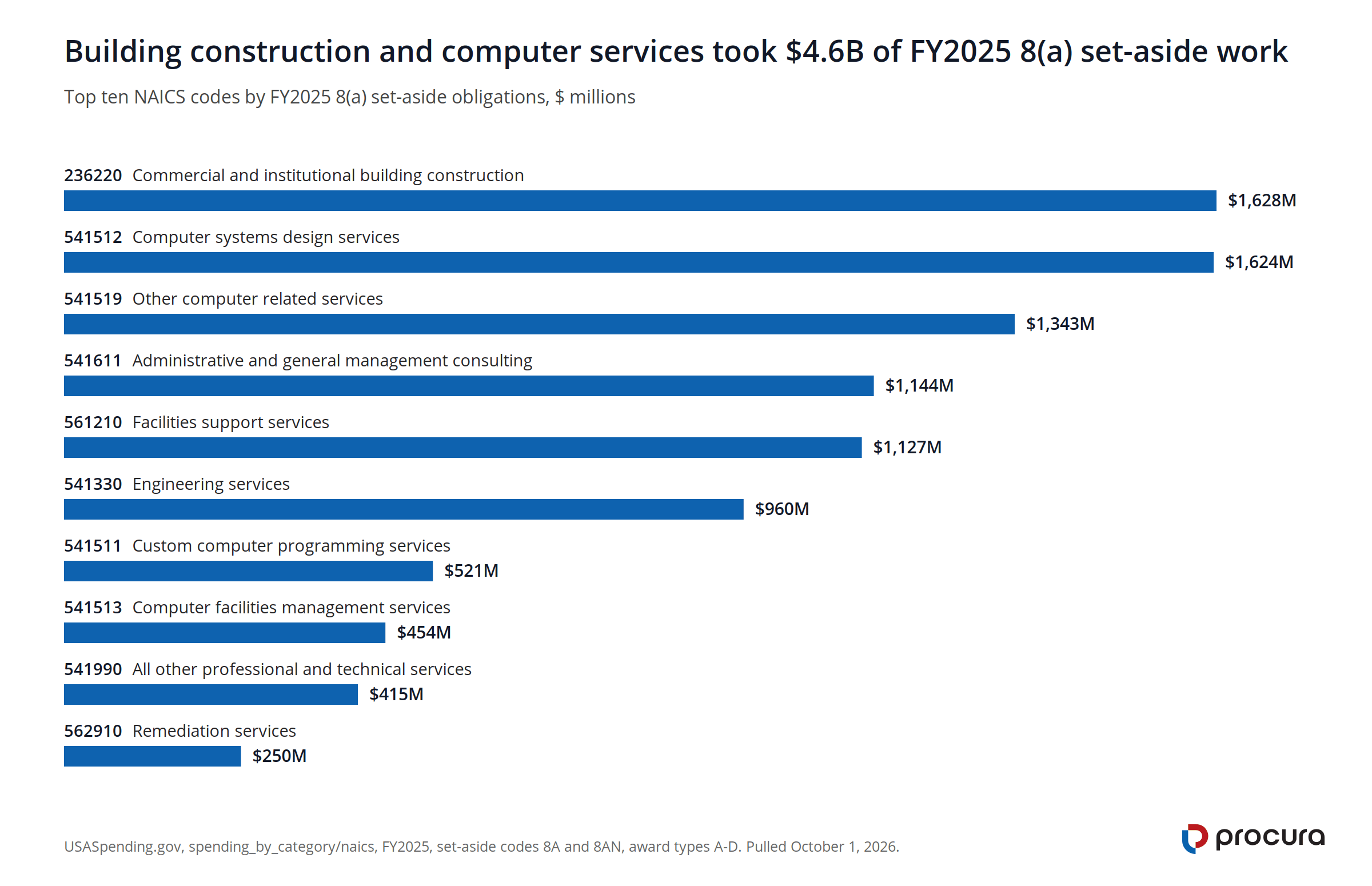
Data table: top ten NAICS codes by FY2025 8(a) set-aside obligations
| NAICS | Industry | FY2025 8(a) set-aside obligations |
|---|---|---|
| 236220 | Commercial and institutional building construction | $1,628 million |
| 541512 | Computer systems design services | $1,624 million |
| 541519 | Other computer related services | $1,343 million |
| 541611 | Administrative and general management consulting | $1,144 million |
| 561210 | Facilities support services | $1,127 million |
| 541330 | Engineering services | $960 million |
| 541511 | Custom computer programming services | $521 million |
| 541513 | Computer facilities management services | $454 million |
| 541990 | All other professional and technical services | $415 million |
| 562910 | Remediation services | $250 million |
The Department of Defense obligated $8.17 billion of the FY2025 8(a) set-aside total. Health and Human Services obligated $920 million and Homeland Security $900 million. If your NAICS code is absent from that list, 8(a) will be slower than the brochures suggest. That goes double when DoD does not buy what you sell. The easiest federal contracts to win are usually the ones with the shortest route from your code to a buyer.

Does MBE certification help with federal contracts?
Not directly. Instead, an MBE certificate from NMSDC gets you into corporate supplier-diversity databases, into member RFPs, and onto lead lists that large companies actually use. For a firm that sells to Fortune 500 procurement teams, it earns its fee. It does not create a federal set-aside, it does not appear in SAM.gov, and a contracting officer has no clause to cite it under.
NMSDC requires at least 51 percent ownership by U.S. citizens who are members of a recognized minority group, with real and continuing control. Regional councils apply a minimum 25 percent ethnic quantum for each qualifying owner. The process runs through an online application, a document review, and a site visit or virtual interview. Certification lasts one year, and renewal is due within 90 days of expiry.
State and local MBE programs work the same way at a smaller scale, and they are tied to that jurisdiction’s own goals. For example, Maryland certifies free, takes two to three months, caps personal net worth at $2,192,035, and runs a 29 percent statewide goal. New York certifies under Article 15-A against a 30 percent goal, with a $15 million net-worth cap. Massachusetts certifies free for three years and tells applicants plainly that certification “does not guarantee a contract award.”
Two cautions on state and DOT minority programs
Two cautions before you spend money here. First, Indiana suspended its state MBE and WBE programs by executive order on July 14, 2026, including pending and active certifications. And the federal Disadvantaged Business Enterprise program for transportation work is in the middle of the same change that reached 8(a) in September.
The Department of Transportation finalized its DBE revisions on September 25, 2026 at 91 FR 60885. The revised 49 CFR 26.5 makes a disadvantage finding case-by-case. It states that the finding “must not be based in whole or in part on race or sex.” Every Unified Certification Program must reevaluate its certified firms by December 24, 2026. Until that reevaluation is complete, recipients cannot set DBE contract goals or count DBE participation. DOT also declined to give 8(a) firms automatic DBE reciprocity. One certification does not carry over to the other.
Which certification should you pursue instead?
How to get minority government contracts comes down to one decision. Work it from the buyer backward, and pick the credential that your buyer can act on:
- You pass the net-worth, income and asset tests and can document a group-level policy: apply to 8(a). A contracting officer can award sole source up to $7 million in manufacturing codes and $4.5 million elsewhere. Above those figures the requirement goes to competition among 8(a) firms.
- Your principal office sits in a designated zone and 35 percent of your staff live in one. HUBZone then adds a 10 percent price preference in open competition, which no other federal program does.
- A woman owns and controls the firm: WOSB or EDWOSB costs nothing through SBA, and EDWOSB uses the same financial tests as 8(a).
- You fail the economic tests: claim SDB in SAM.gov and go at the subcontracting market, where the SDB flag does real work.
- You sell to corporate buyers as well as agencies: pay for NMSDC certification on the corporate merits alone. Do not count it as federal access.
- You want federal revenue this fiscal year: team with a prime. A teaming agreement or joint venture puts you on a bid now rather than after a 90-day review.
Every one of these routes starts in the same place. An active SAM.gov registration with the right NAICS codes is necessary for all of them, and it is free. Our SAM.gov registration guide gives the steps and the real timeline. A one-page capability statement is also necessary, because every program office and every prime asks for one.

The certification is the easy part
Here is the pattern I see in firms that finally win. First, they spend a year chasing a certificate, get it, and discover that the certificate does not tell them which solicitation to bid. SBA admitted 4,985 firms to 8(a) and set aside no contract for a named firm. A person must still read the solicitations.
That reading is where the hours go. Specifically, the requirements that decide a bid sit in the attachments: the statement of work, the wage determination, the past-performance thresholds, the small-business participation plan. A single set-aside RFQ can carry a dozen of them. Qualifying one opportunity properly takes an hour, and a week of federal postings holds hundreds in your codes.
Procura Federal opens the attachments on every set-aside posting and ranks each one against the capability statement you already wrote for SBA. It also surfaces the compliance clauses that decide whether a bid is winnable. It costs $399/month, against five figures a year for the legacy platforms built for large primes. A single capture-manager hire costs more than thirty times that.
Questions about minority-owned federal contracting
How do I register as a minority-owned business with the federal government?
You cannot, because no such federal registration exists. Register the business in SAM.gov first. If you meet 13 CFR 124.1001, claim Small Disadvantaged Business status there. If you meet the eligibility tests, apply to 8(a) through SBA.
Are federal contracts still set aside for minority-owned businesses in 2026?
Not on that basis. The 8(a) set-aside remains in force. It runs on the disadvantage tests in 13 CFR part 124, and those tests no longer presume disadvantage from group membership. The 5 percent SDB figure in 15 U.S.C. 644(g) is an agency goal and not a set-aside.
Is MBE certification the same as 8(a) certification?
No. Instead, NMSDC issues MBE certification for corporate supply chains, and SBA certifies 8(a) for federal contracting. The eligibility tests differ, and neither one recognizes the other.
Do I have to rewrite my 8(a) social disadvantage narrative?
Yes, if SBA had not decided your application by September 10, 2026, because the narrative standard no longer applies. However, firms already admitted to the program keep their determination and do not refile.
What does the Minority Business Development Agency do now?
MBDA is a business-assistance agency and has never certified anyone. However, a 2025 executive order directed its reduction. A federal court vacated those actions and barred them in November 2025, and the appeal was argued on September 16, 2026. Its staffing and business-center funding were cut during 2025. Contact MBDA directly before you count on a center near you.
Which tool finds set-aside opportunities in my codes?
SAM.gov is the authoritative source and it is free, but it lists opportunities without ranking them. Then Procura adds the qualification layer on top of the same data. A firm without a capture team can then work a week of postings in an hour.
Explore the data yourself. Procura’s free contractor explorer filters companies by certification (8(a), HUBZone, WOSB, EDWOSB, SDVOSB and VOSB) alongside industry and location, and each of the agency pages shows that agency’s largest contractors and industries. Browsing is free and needs no login, and a free Procura account lets you save what you find and export the data.
Book a Procura demo
Bring a solicitation you are unsure about. We will run it through the platform on the call and you can judge the scoring against your own read.
Written by Jacob Grass, founder of Procura Federal. Published October 16, 2026. Last updated October 16, 2026.