
How to get military contracts begins with the buyer’s legal name, because that name changed on the building and not in the contract. Meanwhile, the Department of Defense awarded $100.1 billion in prime contracts to small businesses in fiscal 2025. That is 25.71 percent of its prime dollars, against a negotiated goal of 23.17 percent. Executive Order 14347 lets the Department call itself the Department of War. The same order says that every statutory reference to the Department of Defense stays controlling until Congress changes the law.
That split matters on day one. Your registration, your clauses, your reps and certs, and the FAR and DFARS text you must obey all still say Department of Defense. However, the announcement and the sign say Department of War. Also, I run a small veteran-owned engineering firm and I read defense solicitations every week. The most common waste I see is a firm that studies the branding and never reads the set-aside data. Openings live in the data.
Did the Department of Defense become the Department of War?
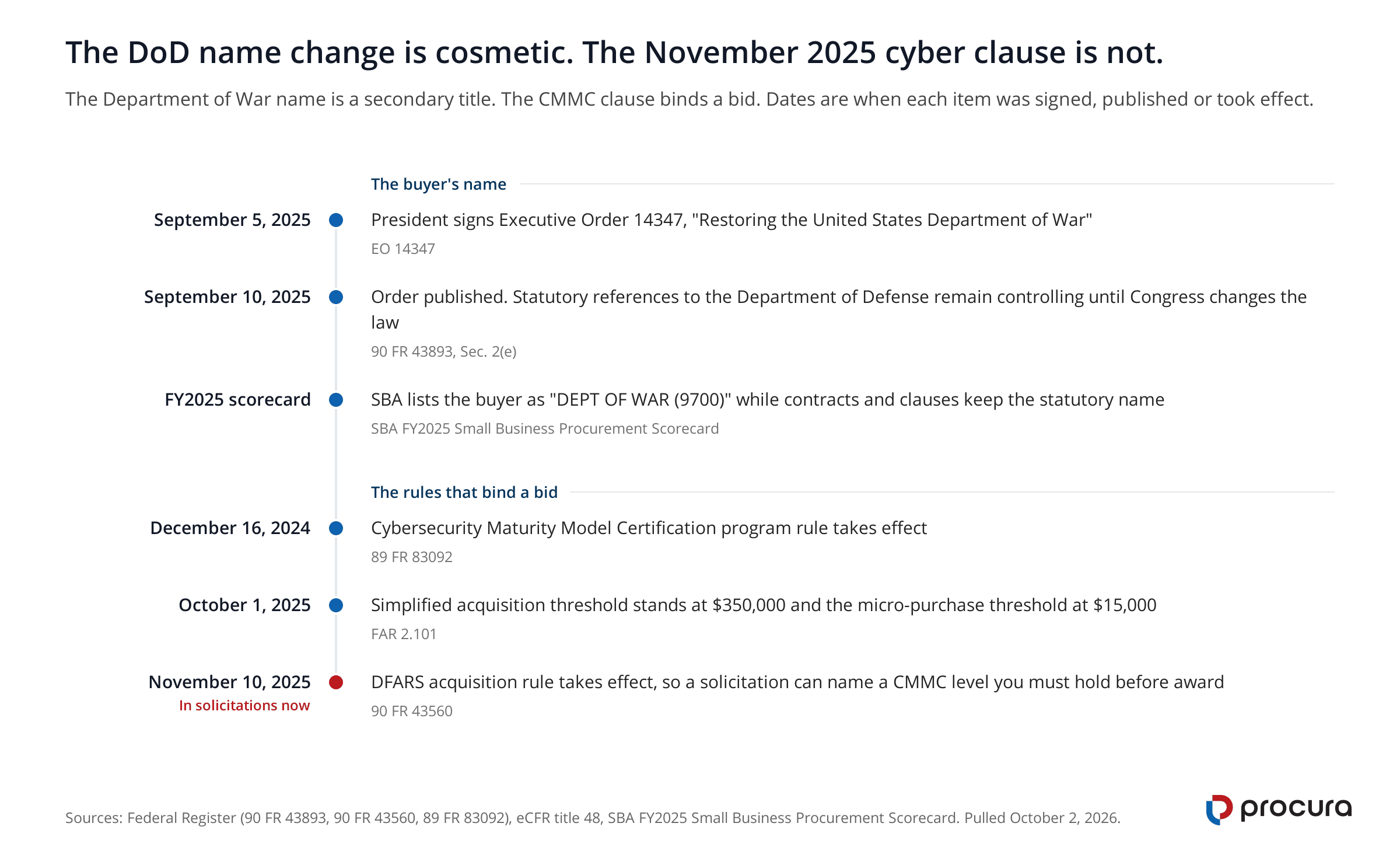
Partly, and only in the places that do not bind you. President Trump signed Executive Order 14347, “Restoring the United States Department of War,” on September 5, 2025, and the Federal Register published it at 90 FR 43893 on September 10, 2025. The order gives the Secretary of Defense a secondary title and lets the Department use the Department of War name in “official correspondence, public communications, ceremonial contexts, and non-statutory documents within the executive branch.”
A contractor needs one sentence out of it. Statutory references to the Department of Defense and its subordinate components “remain controlling until changed subsequently by the law” (Sec. 2(e)). So the buyer publishes its daily award announcements at war.gov, and the award document you sign still names the Department of Defense. The Small Business Administration has already switched its procurement scorecard to “DEPT OF WAR (9700)” while the contract vocabulary stays where it was.
Two practical rules follow. Search solicitations and award history under the statutory names, because that is what the data carries. In practice, write the Department of War name only where you quote the customer back to itself.
How much does the military buy from small businesses?
The number is large and the trend is not simple. In fiscal 2025 the Department awarded $100.1 billion in small-business prime contracts. Its primes placed another $64.3 billion with small businesses as subcontracts, per the Small Business Administration’s FY2025 Small Business Procurement Scorecard. Prime dollars rose by $3.0 billion. The prime share still fell, from 26.32 percent to 25.71 percent, because total Department spending grew faster than the small-business slice.
The vendor count is the number that changes your plan. Meanwhile, SBA counted 29,584 small businesses with a Department prime award in fiscal 2024 and 28,932 in fiscal 2025. In other words, that is 652 fewer firms sharing $3.0 billion more money. Average prime dollars per small-business vendor moved from about $3.28 million to about $3.46 million. More money, across fewer companies, is a market that rewards a firm that bids well and punishes a firm that bids widely.
Set-aside dollars tell the same story from the other side. Similarly, Department obligations under the total small-business set-aside code grew 12.4 percent in fiscal 2022, 10.7 percent in fiscal 2023 and 7.0 percent in fiscal 2024. However, growth fell to 1.8 percent in fiscal 2025, per USASpending.gov. Total Department obligations grew 10.3 percent in that last year. A set-aside is still the cleanest door in, and the door widened very little last year.
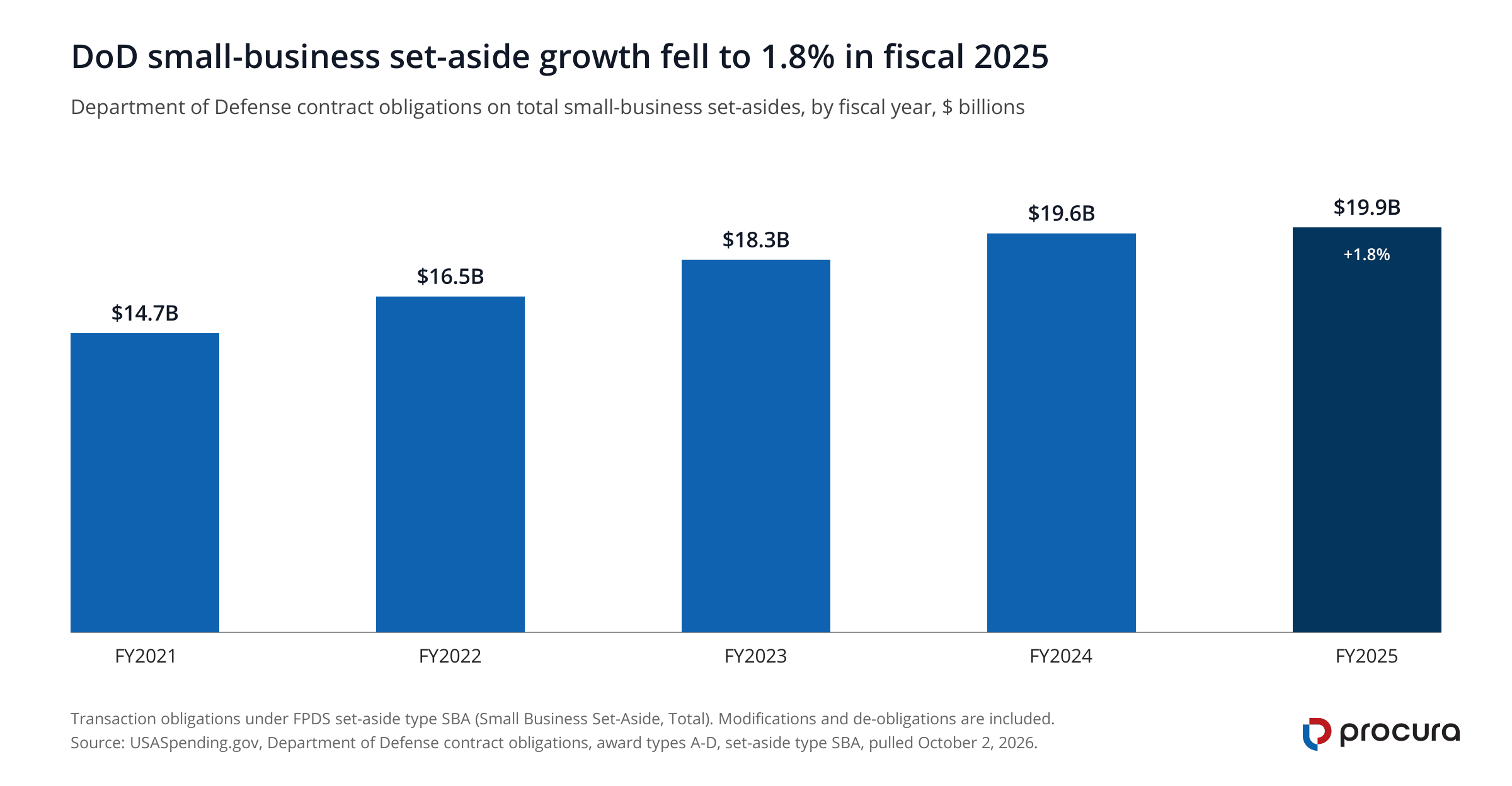
Data table: DoD small-business set-aside obligations by fiscal year, with year-on-year change
| Fiscal year | DoD small-business set-aside obligations | Change on the year |
|---|---|---|
| FY2021 | $14.71B | — |
| FY2022 | $16.54B | +12.4% |
| FY2023 | $18.30B | +10.7% |
| FY2024 | $19.58B | +7.0% |
| FY2025 | $19.94B | +1.8% |
Socioeconomic categories with thin competition
The socioeconomic categories are where the Department misses. Also, it cleared its small-business goal and earned an A on the scorecard. However, it fell short of the government-wide targets on women-owned, service-disabled veteran-owned and HUBZone work. Only 1,621 HUBZone firms won a Department prime award in fiscal 2025.
| Category | FY2025 prime dollars | Share of prime dollars | Goal | Firms with an award |
|---|---|---|---|---|
| All small business | $100.1B | 25.71% | 23.17% | 28,932 |
| Small disadvantaged business | $39.5B | 10.15% | 5.00% (government-wide) | 11,963 |
| Women-owned small business | $14.4B | 3.70% | 5.00% (government-wide) | 5,942 |
| Service-disabled veteran-owned | $12.1B | 3.11% | 5.00% (government-wide) | 3,319 |
| HUBZone | $9.1B | 2.34% | 3.00% | 1,621 |
Read that table as a map of thin competition. For example, a certification the Department underuses is a certification where fewer firms stand between you and the contracting officer. Also, our guides to HUBZone certification and WOSB and EDWOSB certification cover what each one demands.
Which part of the military is easiest to sell to?
Not the biggest one. The Department of the Navy obligated $176.6 billion in fiscal 2025, more than any other component. However, only 2.4 percent of that went to total small-business set-asides. For example, the Army obligated $107.4 billion and set aside 5.7 percent. A small firm that targets the Navy for its size has picked the narrowest small-business door among the three services.
Shipbuilding explains most of the gap. Specifically, Navy money concentrates in long, sole-source platform work with a handful of primes, and that money never reaches a set-aside. Overall, that pattern repeats across the Department. Agencies that buy research, software and professional services set aside the largest share of their budgets. DARPA sent 13.8 percent of its $1.8 billion to set-asides, and the Defense Information Systems Agency sent 9.1 percent of $7.2 billion.
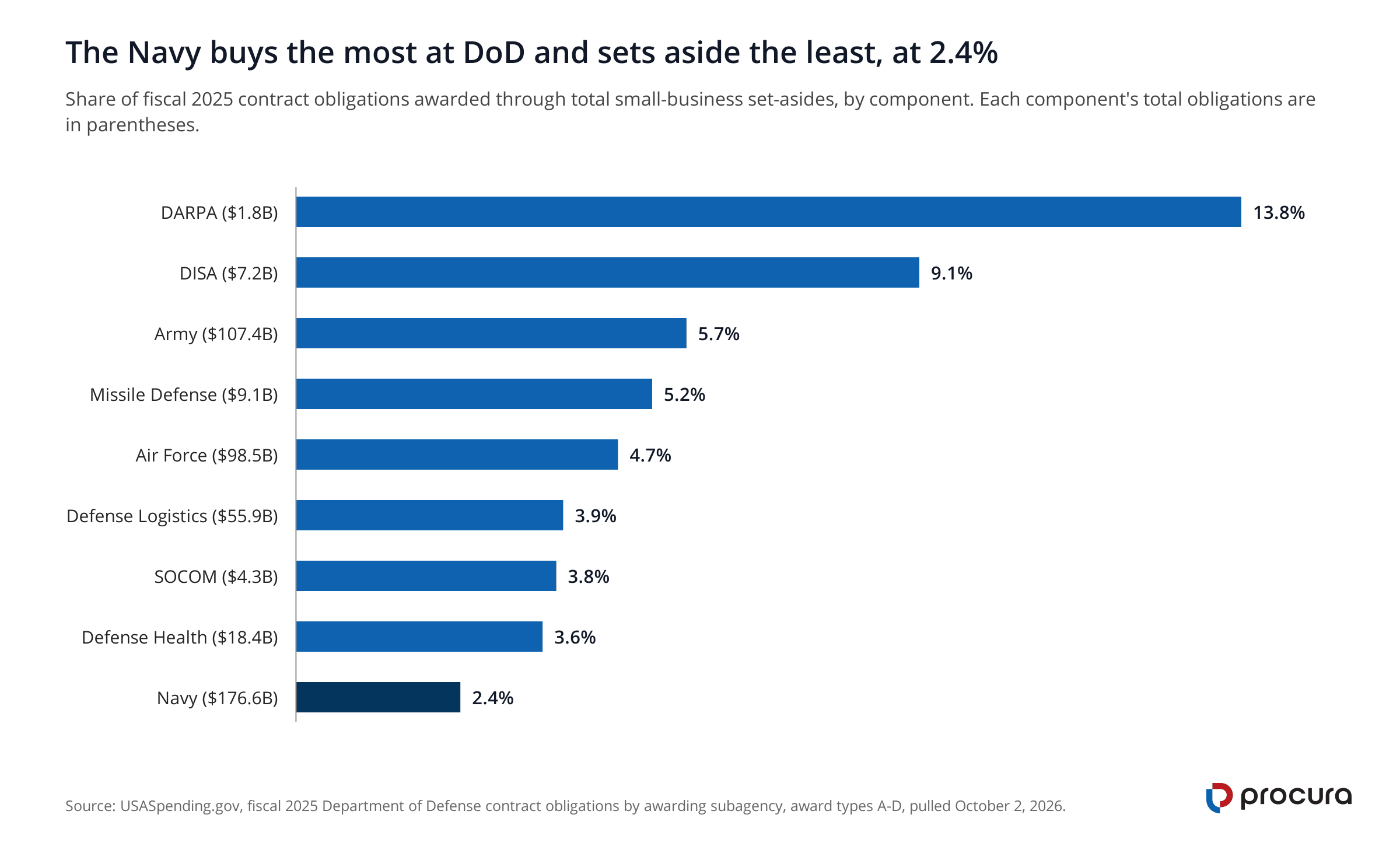
Data table: DoD component obligations, small-business set-aside obligations and set-aside rate, fiscal 2025
| Component | FY2025 obligations | Small-business set-aside obligations | Set-aside rate |
|---|---|---|---|
| Defense Advanced Research Projects Agency | $1.82B | $0.25B | 13.8% |
| Defense Information Systems Agency | $7.16B | $0.65B | 9.1% |
| Department of the Army | $107.45B | $6.14B | 5.7% |
| Missile Defense Agency | $9.12B | $0.48B | 5.2% |
| Department of the Air Force | $98.46B | $4.63B | 4.7% |
| Defense Logistics Agency | $55.94B | $2.17B | 3.9% |
| U.S. Special Operations Command | $4.30B | $0.16B | 3.8% |
| Defense Health Agency | $18.44B | $0.66B | 3.6% |
| Department of the Navy | $176.57B | $4.26B | 2.4% |
Where to start with military contracts
How to get military contracts starts with the right target, so rank by set-aside rate first and by budget second. Still, a 5.7 percent rate on the Army’s $107.4 billion is $6.1 billion of set-aside work. Navy and Air Force set-asides were each smaller than that.
What does the military actually buy from small businesses?
Services and research, far more than hardware. In fact, the largest Department small-business set-aside code in fiscal 2025 was NAICS 541715, research and development in the physical, engineering and life sciences, at $3.6 billion. That is more than double the second code. Computer services, engineering services and building construction follow. Ship building and repairing is the only manufacturing code in the top five. Aircraft-parts and electronic-computer codes below it are smaller than facilities support services.
What product service codes show
Product service codes say it again in the buyer’s own vocabulary. Three of the four largest codes were R425 professional engineering and technical support, then AC12 and AC32 applied research for national defense. DA01 business application development labor came fourth. A firm that sells labor, knowledge and software has more Department set-aside money in front of it than a firm that sells parts.
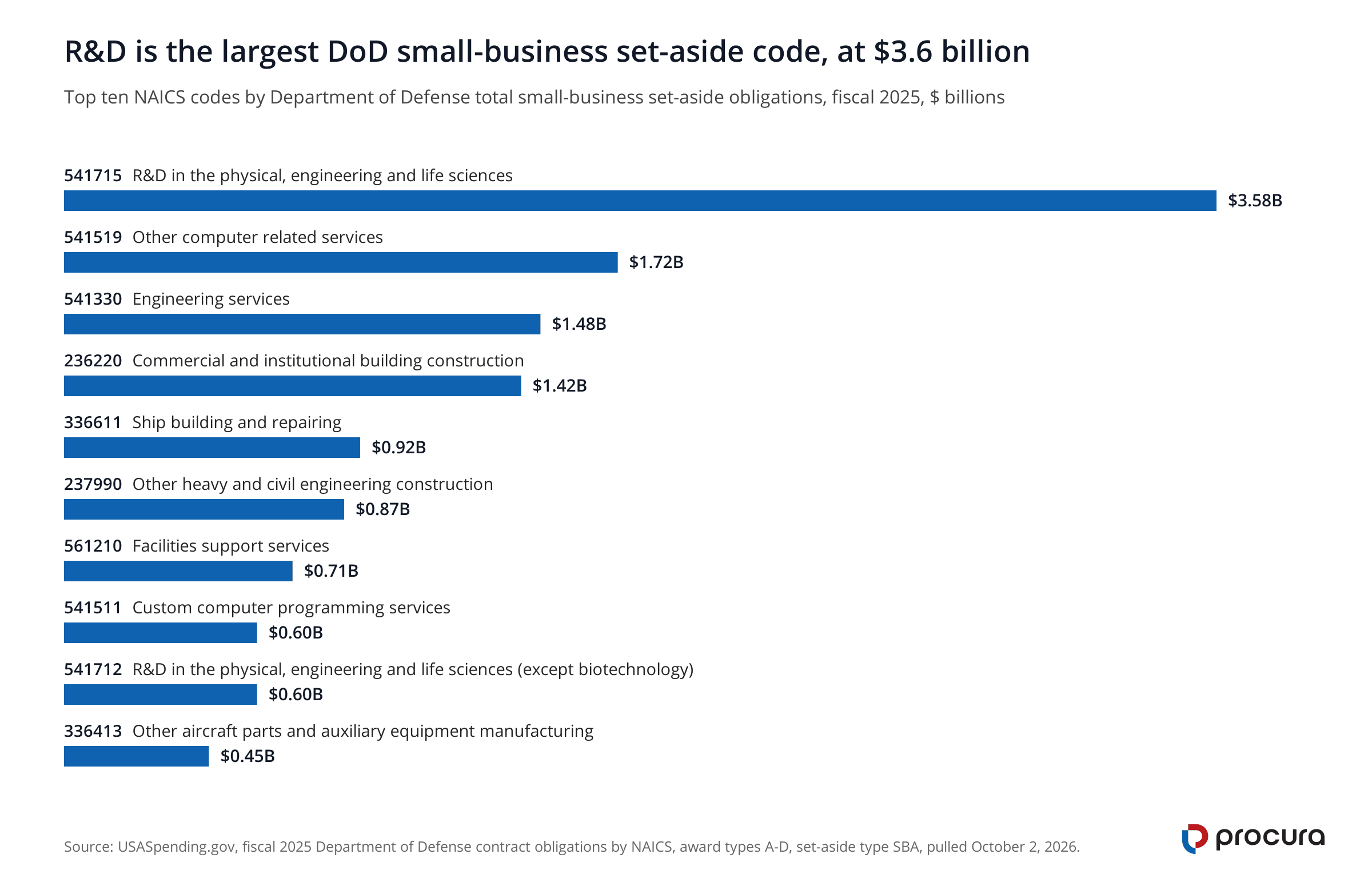
Data table: top ten NAICS codes by DoD small-business set-aside obligations, fiscal 2025
| NAICS | Description | FY2025 DoD small-business set-aside obligations |
|---|---|---|
| 541715 | Research and development in the physical, engineering and life sciences (except nanotechnology and biotechnology) | $3.58B |
| 541519 | Other computer related services | $1.72B |
| 541330 | Engineering services | $1.48B |
| 236220 | Commercial and institutional building construction | $1.42B |
| 336611 | Ship building and repairing | $0.92B |
| 237990 | Other heavy and civil engineering construction | $0.87B |
| 561210 | Facilities support services | $0.71B |
| 541511 | Custom computer programming services | $0.60B |
| 541712 | Research and development in the physical, engineering and life sciences (except biotechnology) | $0.60B |
| 336413 | Other aircraft parts and auxiliary equipment manufacturing | $0.45B |
Pick two or three NAICS codes from that list that you can defend with past work, and ignore the rest. In short, a code you cannot staff is a code that wastes bids. Our guide to the easiest government contracts to win works through the same choice across the whole federal market.

How do you register to bid on military contracts?
Through one system, and the Department adds nothing to it. First, register the entity in SAM.gov, which issues the Unique Entity ID, and complete the representations and certifications that every Department solicitation reads. Then the Defense Logistics Agency assigns the Commercial and Government Entity code through the same registration. A DLA solicitation will not process an offer without that code. Our SAM.gov registration guide sets out the timeline and the mismatches that stall it.
Two cautions about the Department’s own instructions. Also, the Department publishes a “Guide to working with DoD” at business.defense.gov, and parts of it are out of date. It tells readers that “Procurements worth $250,000 or less are typically set aside for small businesses under simplified-acquisition procedures,” and the threshold has been higher since October 1, 2025. The same page tells readers to “search for ‘simplified acquisition’ on www.fbo.gov,” a site the General Services Administration retired in 2019 and replaced with SAM.gov. The guide’s newest spending figure is from fiscal 2021.
Current thresholds for military contracts
These are the current numbers, from FAR 2.101 and FAR 19.502-2. Keep them where you can see them, because they decide which of your bids faces large-company competition.
| Threshold or rule | Current value | What it does for a small business | Citation |
|---|---|---|---|
| Micro-purchase threshold | $15,000 | Below it, a card buy needs no competition. Get on the buyer’s list. | FAR 2.101 |
| Simplified acquisition threshold | $350,000 | Between the micro-purchase threshold and this figure, the buy must be set aside for small business unless the contracting officer finds no reasonable expectation of two competitive small-business offers. | FAR 19.502-2(a) |
| Above the simplified acquisition threshold | No ceiling | The contracting officer must set the buy aside when two responsible small businesses are expected to offer at fair market prices. This is the rule of two. | FAR 19.502-2(b) |
| Micro-purchase threshold for covered construction | $2,000 | For construction subject to the Wage Rate Requirements statute, the micro-purchase threshold drops to this figure. | FAR 2.101 |
How to bid on military contracts: the four doors in
How to get military contracts comes down to four doors, and most firms only ever try one. In practice, each door asks for something different, and the fourth one rewards exactly the thing a newcomer has.
Door one: a small-business set-aside
The total small-business set-aside code carried $19.9 billion of Department obligations in fiscal 2025. With the socioeconomic set-aside and sole-source codes included, the figure reaches $30.5 billion. 8(a) sole source alone accounts for $6.1 billion. Your competition is other small firms in your NAICS code. The work is posted on SAM.gov, the evaluation follows the solicitation, and the rule of two is what creates the opportunity. Read the full solicitation package before you price anything, because the attachments carry the requirements that decide the margin.
Door two: a subcontract under a prime
The Department pushed $64.3 billion to small businesses through its primes in fiscal 2025, which is 32.78 percent of its subcontracted dollars. However, that money sits behind a large-business subcontracting plan, and the plan has goals the prime must report against. For example, a prime that is short on its HUBZone or veteran-owned numbers has a reason to take your call. Our guides to winning government subcontracts and teaming agreements and joint ventures set out the paperwork and the Department’s Mentor-Protégé Program.
Door three: standing supply demand at DLA
The Defense Logistics Agency obligated $55.9 billion in fiscal 2025 and put $2.2 billion of it through small-business set-asides. DLA buys repeatedly, in small quantities, against technical data packages, and it posts that demand in its own system rather than only on SAM.gov. A machine shop or a distributor that learns one DLA system can quote every week instead of waiting for a solicitation. Our guide to bidding on DLA DIBBS explains the attachment reading that decides those quotes.
Door four: an Other Transaction for a prototype project
This is the door that most guides leave out, and the statute writes newcomers into it. Under 10 U.S.C. 4022, Department organizations can run prototype projects outside normal contract rules. Subsection (d)(1) permits such a transaction only when one of four conditions holds. Two conditions are about who is in the room. One asks that a nontraditional defense contractor or a nonprofit research institution participate “to a significant extent” in the project. A second is met when every significant non-federal participant is a small business or a nontraditional defense contractor.
Now read the definition. 10 U.S.C. 3014 defines a nontraditional defense contractor by what the firm lacks. The test covers at least one year before the solicitation. In that year the firm holds no Department contract or subcontract with full cost accounting standards coverage.
A company with no recent Department work is that firm by statute. On this one path, the absence of defense past performance is a qualifying attribute rather than a weakness.
The four doors compared
| Door | FY2025 money behind it | Who it suits | What it demands |
|---|---|---|---|
| Small-business set-aside | $30.5B in Department set-aside and sole-source obligations | A firm with a defensible NAICS code and past work | A compliant proposal and a priced reading of every attachment |
| Subcontract under a prime | $64.3B to small businesses | A firm with a capability a prime is short of | Relationships, and a socioeconomic status the prime needs |
| DLA supply and repair demand | $2.2B of DLA set-asides | Manufacturers, machine shops and distributors | Technical data package literacy and fast, repeated quoting |
| Other Transaction prototype project | Authority, not a budget line | A newcomer with real technology | A technology the Department wants, and nontraditional status |

What compliance does a military contract put on you?
More than a civilian agency contract, and the cybersecurity piece is now live. For example, the Department’s acquisition rule for the Cybersecurity Maturity Model Certification took effect on November 10, 2025, at 90 FR 43560. Specifically, the program rule behind it, at 89 FR 83092, took effect on December 16, 2024. A Department solicitation can now name a certification level that you must hold before award. Our guide to CMMC Level 1 requirements explains the self-assessment and the real costs.
Three more obligations arrive with the work rather than the award. Also, cost-reimbursement and larger Department contracts bring accounting system expectations, which our guide to DCAA compliance explains. Then your performance gets rated and that rating follows you into the next evaluation, which is the subject of our guide to CPARS. Service work on a military installation carries wage determinations under the Service Contract Act. Construction work on base carries its own wage rules, which our guide to government construction contracts explains.
Price the compliance before you bid, not after you win. In practice, a wage determination or a certification level found late is a margin that was never there.
Who helps a new defense contractor for free?
The Department pays for the help itself. APEX Accelerators, formerly the Procurement Technical Assistance Centers, sit under the Department of Defense Office of Small Business Programs. The program describes “90+ Accelerators” in “300 offices” nationwide. Counselors there give registration assistance, suitability assessment, market research and proposal support “at no cost to you,” in the program’s words. Each military service and most defense agencies also run a small-business office whose job is to answer a vendor’s question before a solicitation closes.
Use these two before you spend money on a consultant. Also, a counselor who knows your local installation will tell you in one meeting whether your capability has a buyer nearby.
Registered, certified, counseled: the hard part is still ahead
Everything above is setup work with a clear end. However, the part with no end is the daily question of which Department solicitation deserves a bid. A Department set-aside posting can carry a statement of work, a wage determination, a technical data package, a cybersecurity level and a dozen attached clauses. The requirement that disqualifies you usually sits in an attachment rather than in the description. With 28,932 small firms sharing that money, the winners find their few winnable postings early and decline the rest fast.
That is the work Procura does. Specifically, it opens every attachment on a Department posting, scores the opportunity against the capability statement you wrote, and flags the clauses that change your price. It costs $399/month. A legacy market-intelligence seat for the same job runs into five figures a year. Our guide to the tools that find federal contracts prices them vendor by vendor.
Explore the data yourself. Procura’s free Department of Defense page breaks DoD prime obligations down by sub-agency, industry, contractor and state, and lists its small business specialists. The Army, Navy and Air Force pages go one level deeper. It’s all free to browse; create a free account to save your research and export the tables.
Frequently asked questions
Is a military contract the same as a military enlistment contract?
No, and the search results mix them constantly. An enlistment contract is an agreement between a person and a service about a term of service. A military contract in the procurement sense is an agreement between the government and a company to supply goods or services. This guide is about the second kind.
Do you need a security clearance to sell to the military?
Usually not. In fact, most Department buying is unclassified, and the construction, facilities, logistics and professional-services work in the codes above needs no clearance. A clearance requirement appears in the solicitation when it applies, and a company earns facility clearance through a sponsoring contract rather than in advance.
Can you sell a commercial product to the military without redesigning it?
Often yes. In fact, Federal policy prefers commercial products and commercial services where they meet the requirement. A commercial-item buy also removes many clauses that apply to a developed item. Say plainly in your offer that the item is a commercial product, and name the market it already sells into.
How long does a first military contract take to win?
Plan on a year of bidding, and shorten it by picking small. Also, registration takes weeks. Most of the rest goes to finding a solicitation you fit, pricing it correctly, and losing twice. Firms that start under the simplified acquisition threshold get a past-performance record faster than firms that chase one large award.
Book a demo
Bring a real Department posting to a 20-minute call. We will run it through Procura while you watch. You will see the fit score and the clauses it found in the attachments. Then you can judge whether that reading is worth $399 a month.
By Jacob Grass · Published October 16, 2026 · Last updated October 16, 2026