

Performance bonds for government contracts are not optional on federal construction work. The government wants a performance bond on every federal construction contract over $150,000, at 100 percent of the original contract price (FAR 28.102-1 and FAR 28.102-2). A payment bond of the same size comes with it. Below $150,000, however, the rules change twice, and below $35,000 a construction contract carries no bond rule at all. Federal agencies obligated $51.1 billion on construction contracts in fiscal year 2025, per USASpending.gov. Of the 53,077 awards that year, 42 percent were small enough to escape the full bond rule.
By Jacob Grass, founder of Procura Federal. I read federal construction solicitations every week, and the bond clause is where most first-time bidders stop reading. In fact the rules are short and the numbers are fixed. Yet two of the most-cited figures on the open web are also wrong.
What is a performance bond on a federal contract?
A performance bond is a three-party guarantee that the work gets finished. You are the principal, the government is the obligee, and a surety company stands behind you. If you default, the surety completes the job or pays the government. Still, it is not insurance for you. Afterward, when the surety pays, it comes after you and your personal assets for the money.
A federal construction contract almost never carries a performance bond alone. Instead, three bonds travel together:
- The bid guarantee protects the government if you win and then refuse to sign.
- The performance bond covers completion of the work.
- The payment bond protects the firms below you, because a subcontractor cannot put a lien on federal property.
Indeed, that last point is the reason the statute exists. Congress passed the Miller Act in 1935 to give subcontractors and suppliers on federal jobs a remedy they could not get any other way. The law now sits at 40 U.S.C. chapter 31, subchapter III, and the FAR cites it by that address with the parenthetical “(formerly known as the Miller Act).”
When does the government require a performance bond?
Three bands decide it, and all three sit in FAR part 28. First, a construction contract over $150,000 gets the full treatment. Second, between $35,000 and $150,000 the government takes alternative payment protections instead of bonds. Finally, at $35,000 or less it asks for nothing.
In the middle band the contracting officer picks at least two protections from a fixed list of five. Specifically, FAR 28.102-1(b)(1) tells the officer to give “particular consideration to inclusion of an irrevocable letter of credit as one of the selected alternatives.” The list has five entries:
- A payment bond.
- An irrevocable letter of credit.
- A tripartite escrow agreement.
- Certificates of deposit.
- A deposit of the securities named at FAR 28.204-1 and 28.204-2.
| Contract value | What the government requires | FAR cite |
|---|---|---|
| Construction, $35,000 or less | No bond and no alternative payment protection | 28.102-1(b)(1) |
| Construction, over $35,000 through $150,000 | Two or more alternative payment protections, each at 100% of the original contract price | 28.102-1(b)(1), 28.102-2(c) |
| Construction, over $150,000 | Performance bond at 100% and payment bond at 100% of the original contract price | 28.102-1(a), 28.102-2(b) |
| Any construction contract that carries those bonds | Bid guarantee of at least 20% of the bid price, capped at $3 million | 28.101-1(a), 28.101-2(b) |
| Other than construction | No bonds as a rule. A performance bond is possible above the $350,000 simplified acquisition threshold, in four listed situations | 28.103-1(a), 28.103-2(a) |
When performance bonds for government contracts are due
One more rule catches people at the wrong moment. Under FAR 28.102-1(c) the contractor furnishes the bonds before the notice to proceed, and before any work starts. In short, a bond is not paperwork you clean up in month two. No bond, no notice to proceed.
Why some sources say $100,000 and others say $150,000
Search the phrase and you get both numbers, often on one page of results. Of course, both come from real documents. The statute at 40 U.S.C. 3131(b) opens with “Before any contract of more than $100,000 is awarded for the construction, alteration, or repair of any public building or public work of the Federal Government.” Meanwhile FAR 28.102-1(a) implements that same statute and applies the rule to “any construction contract exceeding $150,000.”
The gap exists because the Miller Act figure is an acquisition-related threshold that gets adjusted for inflation. That adjusted number lands in the FAR rather than in the United States Code, and your contracting officer applies the FAR. Therefore, use $150,000 when you plan a bid. Cite FAR 28.102-1(a) with its FAC date when you put the number in writing. Finally, treat any page that quotes the statutory figure as a page that read the statute and stopped there.
How much federal construction work requires a bond?
Federal construction is a $51.1 billion market, and it has stayed between $39 billion and $55 billion in every year from fiscal 2021. In fiscal 2025 small businesses took $21.6 billion of that total, or 42 percent. Moreover, the Department of Defense alone obligated $31.5 billion, which is 62 percent of all federal construction dollars. The next three buyers are Homeland Security at $6.2 billion, Veterans Affairs at $3.6 billion, and Interior at $2.3 billion.
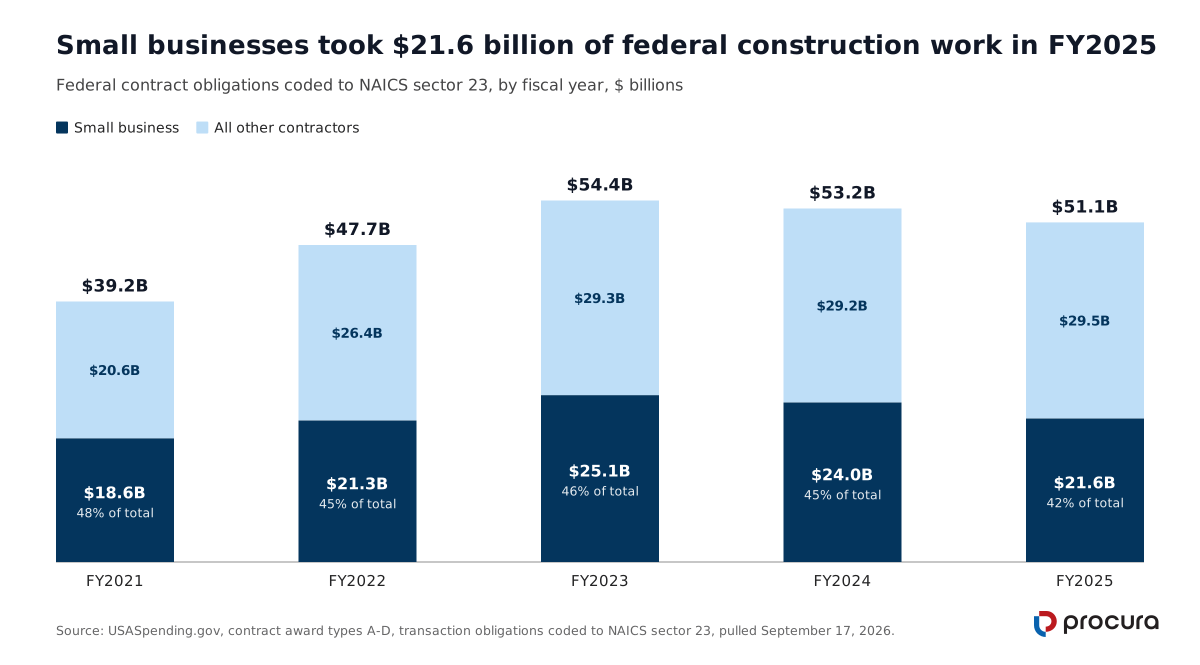
Data table: federal construction obligations and small business share by fiscal year
| Fiscal year | Obligations | To small businesses | Small business share |
|---|---|---|---|
| FY2021 | $39.2B | $18.6B | 48% |
| FY2022 | $47.7B | $21.3B | 45% |
| FY2023 | $54.4B | $25.1B | 46% |
| FY2024 | $53.2B | $24.0B | 45% |
| FY2025 | $51.1B | $21.6B | 42% |
Why award counts matter more than award dollars
Award counts tell a different story than award dollars, and that difference is the point of this article. Of the 53,077 construction awards with fiscal 2025 activity, 22,443 carried a total award value of $150,000 or less. That is 42 percent of the awards. Yet those awards hold $535 million between them, which is 1 percent of the money.
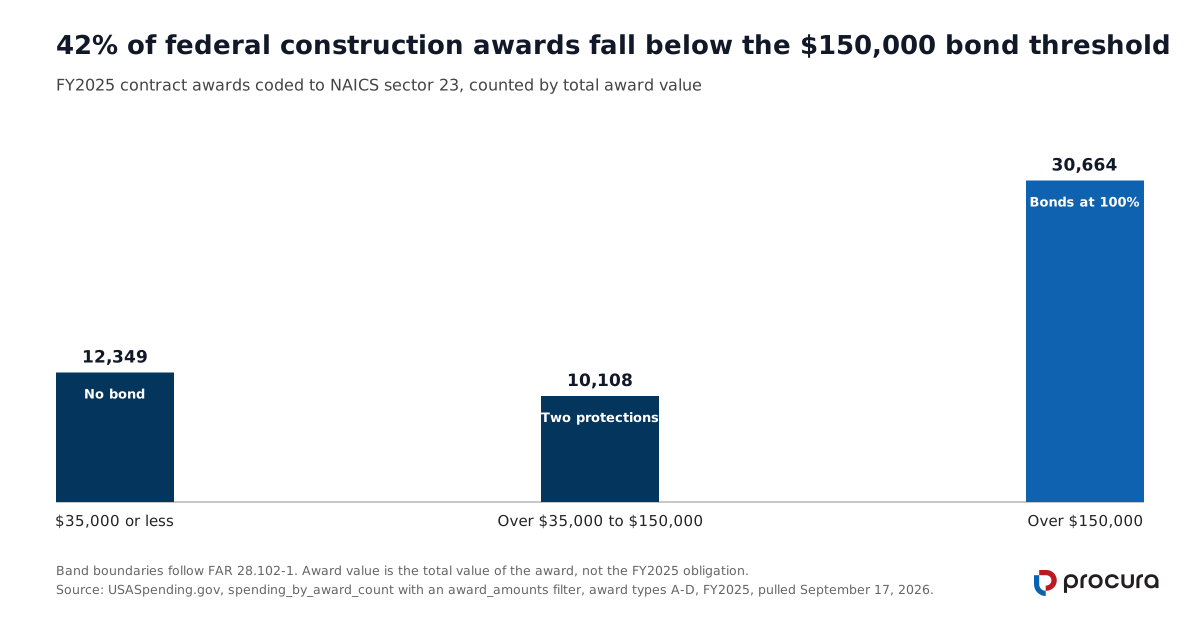
Data table: FY2025 federal construction awards and obligations by bond threshold band
| Total award value | Awards | Share of awards | FY2025 obligations | Bond rule |
|---|---|---|---|---|
| $35,000 or less | 12,349 | 23% | — | None |
| Over $35,000 through $150,000 | 10,108 | 19% | — | Two or more alternative payment protections |
| $150,000 or less (both bands) | 22,443 | 42% | $0.5B | No performance bond |
| Over $150,000 | 30,664 | 58% | $50.6B | Performance and payment bonds at 100% |
| All construction awards | 53,077 | 100% | $51.1B | — |
Read the two facts together and the strategy writes itself. An unbonded firm still has two of every five federal construction awards open to it, but they are the small ones. Therefore, a firm that wants real volume must solve bonding, because 99 percent of the dollars sit above the line.
Which trades have the most work below the bond threshold?
Trade codes split hard on this question. For instance, painting contractors work almost entirely below the line, with 85 percent of awards under the threshold. Plumbing, heating and air-conditioning work sits at 60 percent, and electrical work at 61 percent. In contrast, general building construction sits at 28 percent, and it carries $30.6 billion of the federal construction total.
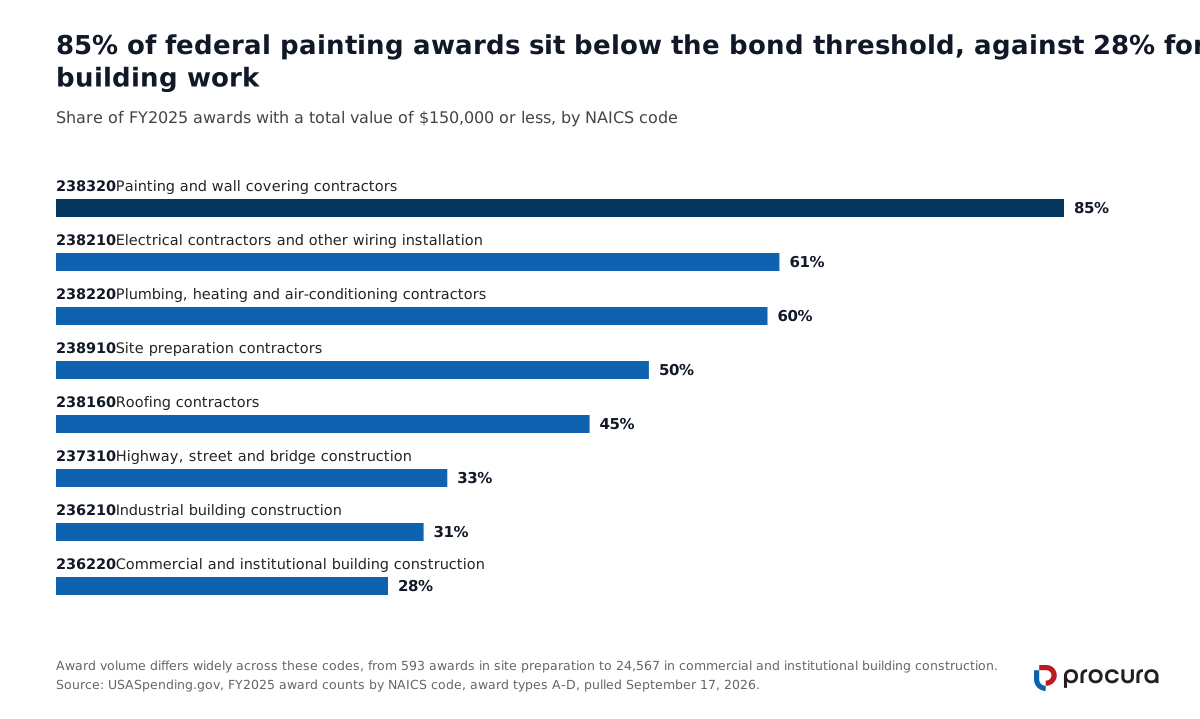
Data table: FY2025 obligations, award counts and threshold share by construction trade
| NAICS | Trade | FY2025 obligations | Awards | Awards at $150,000 or less | Share |
|---|---|---|---|---|---|
| 238320 | Painting and wall covering contractors | $96.9M | 980 | 832 | 85% |
| 238210 | Electrical contractors and other wiring installation | $790.8M | 3,663 | 2,223 | 61% |
| 238220 | Plumbing, heating and air-conditioning contractors | $1,018.2M | 5,350 | 3,199 | 60% |
| 238910 | Site preparation contractors | $148.4M | 593 | 297 | 50% |
| 238160 | Roofing contractors | $450.3M | 1,335 | 595 | 45% |
| 237310 | Highway, street and bridge construction | $1,179.6M | 3,081 | 1,028 | 33% |
| 236210 | Industrial building construction | $1,177.3M | 816 | 250 | 31% |
| 236220 | Commercial and institutional building construction | $30,637.7M | 24,567 | 6,979 | 28% |
A specialty trade is thus a real entry path for an unbonded firm. For example, our guide to the easiest government contracts to win ranks federal categories on the same kind of award data. Similarly, our federal construction guide covers the bid mechanics around these numbers.
How big does the bond have to be?
The performance bond equals 100 percent of the original contract price. If the price goes up, you add an equal amount on the increase. Similarly, the payment bond has a floor, because FAR 28.102-2(b)(2) keeps it no lower than the performance bond. Still, a contracting officer can set a smaller bond when a lesser amount protects the government. In that case cutting the payment bond takes a written determination supported by specific findings.
“Original contract price” has a definition, and it matters on the vehicle types small firms bid most. FAR 28.102-2(a) makes it the award price for a normal contract. On a requirements contract, however, it is the price payable for the estimated total quantity. On an indefinite-quantity contract it is the price payable for the specified minimum quantity. Options stay out unless the government exercises them at award, so a $20 million ceiling does not mean a $20 million bond.
What is a bid guarantee, and how much is it?
A bid guarantee is the promise you make at bid time. In other words, it says that you will sign the contract and produce the real bonds if you win. FAR 28.101-1(a) ties it to the other bonds in both directions. A contracting officer cannot ask for one unless a performance bond also applies, and must ask for one whenever that bond applies. The amount, per FAR 28.101-2(b), is “at least 20 percent of the bid price” and never more than $3 million.
Two details save arguments later. First, on construction, FAR 28.101-1(b) takes only separate bid guarantees, so an annual bond does not cover you. Second, the chief of the contracting office can waive the rule for a specific buy. For instance, the FAR names overseas construction, emergency acquisitions and sole-source contracts.
What does a performance bond cost?
No government source publishes bond premiums, because sureties price them. Instead, third-party estimates put the premium at roughly 1 to 3 percent of the contract amount for a contractor with clean financials. For example, Procore puts the calculation at “about 1%-3% of the total contract amount.” Meanwhile the broker SuretyBonds.com quotes a wider 1 to 5 percent band. That broker says most qualified contractors pay 2.5 to 3 percent, with payment and performance bonds usually issued together for one premium. Still, treat all of that as directional. After all, your credit, your working capital and your completed-job history move the number more than the project does.
| Charge | Amount | Source and basis |
|---|---|---|
| Performance bond premium | About 1% to 3% of the contract amount | Procore, May 21, 2025 — third-party estimate |
| Performance bond premium, wider band | 1% to 5%, and 2.5% to 3% for well-qualified contractors | SuretyBonds.com — third-party estimate from a broker |
| Payment and performance together | Usually one premium of about 3% of project value | SuretyBonds.com — third-party estimate |
| Bid bond | Often no separate charge when the surety expects the final bond | SuretyBonds.com — third-party, one broker’s practice |
| SBA guarantee fee, paid by the small business | 0.6% of the contract price on performance and payment bond guarantees | SBA — refunded if the bond is cancelled or never issued |
| SBA guarantee fee on a bid bond | None | SBA |
Put the bond premium in your bid price
Put the premium in the bid. For example, a 2 percent premium on a $400,000 job is $8,000 of real cost. As a result, a firm that forgets it has given away most of the margin on a job it has not started.
Do service and supply contracts need performance bonds?
As a rule, no. FAR 28.103-1(a) is blunt about it. Agencies generally do not require performance and payment bonds for anything other than construction contracts. Therefore, that one rule saves a lot of worry for firms in janitorial, grounds, pest control, staffing and supply work.
The exception is narrow. Above the $350,000 simplified acquisition threshold, however, FAR 28.103-2(a) lets a contracting officer ask for a performance bond. It names four situations:
- Government property or funds go to the contractor.
- A successor firm takes over after a sale or merger.
- Substantial progress payments come before deliveries start.
- The work is dismantling, demolition or removal of improvements.
Furthermore, a bond cannot be added after award unless the contract called for it.
So a cleaning company or a grounds contractor can bid federal work without ever meeting a surety. For example, the landscaping guide and the snow removal guide both cover service work that sits outside part 28. Demolition, however, is the one service-side trade where the bond question comes back.
How do you get bonded for a government contract?
You do not apply to the government. Instead, you apply to a surety, usually through a bond producer, and the surety underwrites you the way a bank underwrites a loan. Underwriters look at three things and call them the three Cs: capital, capacity and character. In practice the file they open holds five things:
- Reviewed or audited financial statements.
- A work-in-progress schedule.
- Personal credit for every owner.
- A bank line of credit.
- Finished jobs of similar size and type.
Expect a personal indemnity agreement. Almost every small-contractor bond program asks the owners, and often their spouses, to sign personally. Also expect the first approval to be small. Sureties build a single-job limit and an aggregate program limit, and they raise both as you complete work. In short, the path to a $2 million bond runs through a finished $200,000 job.

Which sureties can write a federal bond?
Not all of them. FAR 28.202(a)(1) wants corporate sureties on domestic work to appear on the Treasury list, known as Circular 570. Its formal title names the companies that hold certificates of authority as approved sureties on federal bonds and as approved reinsuring companies. Treasury publishes the list once a year. Most recently, the 2026 revision took effect August 1, 2026, and every certificate expires on July 31 and renews on August 1.
Each company on the list carries an underwriting limitation, and it is per bond. Moreover, the spread is enormous. For example, ACSTAR Insurance Company is listed at $1,974,000 and Colonial Surety Company at $8,830,000, while Auto-Owners Insurance Company is listed at $1,771,490,000. Under FAR 28.202(a)(2) a bond above the surety’s limit works only when the excess is coinsured or reinsured. Therefore, look at the list before you take a quote. A surety that cannot carry your bond size is a dead end two weeks before bid day.
What if no surety will bond you?
The SBA Surety Bond Guarantee program exists for exactly that answer. In short, SBA backs a participating surety against part of its loss, which lets the surety write a bond it would otherwise decline. The program covers bid, performance, payment and ancillary bonds. However, it does not cover commercial or fidelity bonds.
| Question | Answer | Source |
|---|---|---|
| Largest contract SBA will back | $9 million, or $14 million on a federal contract when a federal contracting officer certifies that the guarantee is necessary | 13 CFR 115.10; 115.12(e)(3) |
| SBA share of the surety’s loss | 90% when the contract is $100,000 or less at bond execution, or when the firm is owned and controlled by socially and economically disadvantaged individuals, is a certified HUBZone small business, or is veteran-owned or service-disabled-veteran-owned. Up to 80% otherwise | 13 CFR 115.31 |
| Fee to the small business | 0.6% of the contract price on performance and payment bond guarantees. No fee on bid bond guarantees | sba.gov |
| Two ways it runs | Prior Approval, where SBA approves each bond before issue, and Preferred Surety Bond, where selected sureties issue without further SBA approval | 13 CFR 115.12(a) |
| What you certify | That you are small, that the bond is expressly required by the solicitation or contract, and that a bond is not obtainable on reasonable terms without the guarantee | 13 CFR 115.13(a) |
| Who cannot use it | Firms that are primarily brokers, firms that subcontract the full scope of work, and debarred or suspended firms | 13 CFR 115.13(a) |
Why the 90 percent guarantee tier matters
The 90 percent tier is the part worth planning around. A certified 8(a) firm, a HUBZone firm and a service-disabled-veteran-owned firm all qualify for it. So does any firm on a contract of $100,000 or less. As a result, a surety that says no at 80 percent coverage sometimes says yes at 90 percent. In other words, that turns certification into a bonding tool and not only a set-aside tool.
What the payment bond does for your subcontractors
Work the other side of the bond for a moment, because most small firms start federal work as subcontractors. You cannot lien a federal building. Instead, the payment bond is the substitute, and 40 U.S.C. 3133 gives the rules for a claim.
The three Miller Act deadlines
Three deadlines control it. First, anyone who supplied labor or material can sue on the bond, and that right opens 90 days after the last work, if payment in full has not arrived. Second, a firm working under a subcontractor, with no contract with the prime, must give the prime written notice. That notice is due within 90 days of its last labor or material. It states “with substantial accuracy the amount claimed and the name of the party” it worked for. Finally, every suit must start no later than one year after the last labor or material date.
Two practical notes. First, serve the notice by a method that gives written third-party proof of delivery, which is the standard in the statute. Second, a waiver of the right to sue on the bond is void unless three things are true. It is in writing. It is signed by the party giving up the right. And it was executed after that party furnished the labor or material. Therefore, a waiver buried in a subcontract you signed before work started does not bind you.

Bonding gets you to the bid. Finding the right bid is the other half.
A bonded contractor still has to pick jobs. The bond clause, the wage determination, the liquidated-damages rate and the period of performance all live in attachments. None of them live in the SAM.gov notice text. As a result, a solicitation with twelve attachments takes an afternoon to qualify by hand. Most firms therefore qualify a handful a week and bid the ones they had time to read.
Procura Federal opens the attachments for you. It reads the bond clause, the wage determination and the statement of work in every federal solicitation. Then it scores that solicitation against your capability statement and marks the compliance items that decide a bid. In addition, it costs $399/month, which is less than the premium on one small bonded job. Our comparison of federal contracting tools puts that number against what the incumbents charge.
Frequently asked questions
Is a performance bond the same as insurance?
No. Insurance pays you when something goes wrong. In contrast, a surety pays the government and then collects from you, which is why the indemnity agreement matters more than the premium.
Do you get the money back on a performance bond?
No. The premium buys the guarantee for the life of the job, the way an insurance premium buys a year of coverage. However, the one refund in this area is the SBA guarantee fee, which SBA returns if the bond is cancelled or never issued.
How much does a $500,000 performance bond cost?
On the third-party ranges above, about $5,000 to $15,000, and a well-qualified contractor lands near the bottom of that. In addition, if the bond runs through the SBA program, add the 0.6 percent guarantee fee, or $3,000.
Can a new company get bonded for a government contract?
Yes, at a small size. Sureties that write performance bonds for government contracts start new firms on single jobs in the low hundreds of thousands, then raise the limit as jobs finish. Meanwhile the SBA program and its 90 percent tier exist to open that first door.
What is a little Miller Act?
It is a state-level statute that copies the federal Miller Act for state and local public works. However, the thresholds and deadlines differ by state, so the federal figures in this guide do not carry over to a state job.
Do I need a bond to register in SAM.gov?
No. Registration is free and asks for no bonding information. Instead, bonding becomes a question at bid time on construction work. The step-by-step guide to winning government contracts shows where it falls in the sequence.
Get your next solicitation scored before you buy the bond
Bring a live construction solicitation to a demo. We will open the attachments on the call and find the bond clause, the wage determination and the period of performance. Then we will tell you whether the job matches your capability statement, before you spend a dollar on performance bonds for government contracts.