One buyer takes 98.9 percent of federal non-emergency medical transportation contracts by dollar value: the Department of Veterans Affairs. The VA obligated $218.8 million of the $221.3 million that federal agencies spent in NAICS 485991 in FY2025, per USASpending.gov. By contrast, everything else, across every other department, came to $2.5 million.
Procura’s explorer counts $877M in prime contract obligations under NAICS 485991 in FY2021–FY2025, paid to 157 contractors, and the Department of Veterans Affairs placed 99% of it (data updated Oct 20, 2026). The 485991 contractor directory shows who holds those contracts today.
However, of the two facts, the second matters more. Of the 281 awards in that code in FY2025, the number of medical transportation contracts whose description contains the word “NEMT” is zero. Not one. In other words, the industry name for this work does not appear in the federal record of it. That is why a keyword search finds nothing, and why contractors conclude the market does not exist.
It does exist, it grew 71 percent in four years, and its average award runs to $787,601. However, it is also badly mislabeled.
Who buys non-emergency medical transportation contracts?
The VA is effectively the only buyer, at 98.9 percent, and no other agency buys enough to plan around. In FY2025 the VA obligated $218.8 million across 255 medical transportation contracts in NAICS 485991. By comparison, second place went to the Department of Defense, at $1.8 million. The State Department, Treasury, Health and Human Services and Justice together obligated less than $700,000.
In fact, this concentration is the opposite of what most verticals look like. Federal courier and medical courier work spreads across a dozen departments. By contrast, federal patient transport does not. One agency writes the requirement, one agency sets the terms, and one agency’s regional structure decides where the money lands.
The VA side of it is statutory. Specifically, under 38 U.S.C. 111 the VA pays the travel expenses of eligible beneficiaries to and from its facilities. Paragraph 111(b)(1)(E) applies to the beneficiary who must travel by a special mode and cannot defray the cost. The VA either pays mileage, or it buys the ride. In short, buying the ride is the contract.
Is Medicaid NEMT a federal contract?
No, and this is where most NEMT operators waste their first year. The largest pool of non-emergency medical transportation money in the United States is Medicaid. Instead, states buy Medicaid NEMT, not the federal government. As a result, it never appears on SAM.gov.
Federal law requires it, and leaves the buying to the states. Under 42 CFR 431.53 a state plan must specify that the Medicaid agency will make necessary transportation available to beneficiaries, to and from providers. In addition, that plan must also describe the methods the agency will use. Section 209 of the Consolidated Appropriations Act, 2021 moved that same duty into the statute at 42 U.S.C. 1396a(a)(4)(A). As a result, it is now a condition of the state plan and not a regulation alone.
What the state does next is where your bid goes. For example, many states run the brokerage option at 42 CFR 440.170(a)(4). That option lets a state select a broker through a competitive process under 2 CFR 200.317 through 200.327. Payment then goes to the broker, who manages the network. As a result, in those states the transportation provider does not hold a government contract at all. Instead, the provider holds a subcontract with the broker, and the broker sets the rate.
What federal rule reaches Medicaid NEMT drivers?
One federal compliance rule gets to you through that chain anyway. Section 209 also added 42 U.S.C. 1396a(a)(87). That paragraph makes the state put a mechanism in place, which can be as light as attestation. It must cover four things about every paid NEMT provider and driver, and it excludes public transit authorities:
- No exclusion from a federal health care program, and no listing on the HHS Inspector General exclusion list
- A valid driver license for each individual driver
- A provider process that addresses a violation of a state drug law
- A provider process to disclose each driver driving history to the state Medicaid program, including traffic violations.
That paragraph is why your broker now asks for driving records.
So the honest division is this. Medicaid NEMT is a state and broker business with large volume and thin margins. By contrast, federal NEMT is one agency, 281 awards a year, and award sizes that start where most verticals end. The rest of this guide is about the second one: federal medical transportation contracts.
How big is the market for federal medical transportation contracts, and is it growing?
Obligations on federal medical transportation contracts in NAICS 485991 rose from $129.1 million in FY2021 to $221.3 million in FY2025. In other words, that is growth of 71.4 percent in four years. FY2026 closed on September 30, 2026 with $230.2 million recorded as of this pull, and that figure can still move as modifications post.
However, award counts did not follow. FY2022 was the peak at 325 awards. FY2025 recorded 281 against 279 in FY2021, and FY2026 so far records 265. Average obligation per award rose from $462,699 in FY2021 to $787,601 in FY2025. Dollars per award rose because dollars rose, and not because the award count collapsed. Therefore, for a small operator deciding where to aim, that is the single most useful fact about the market.
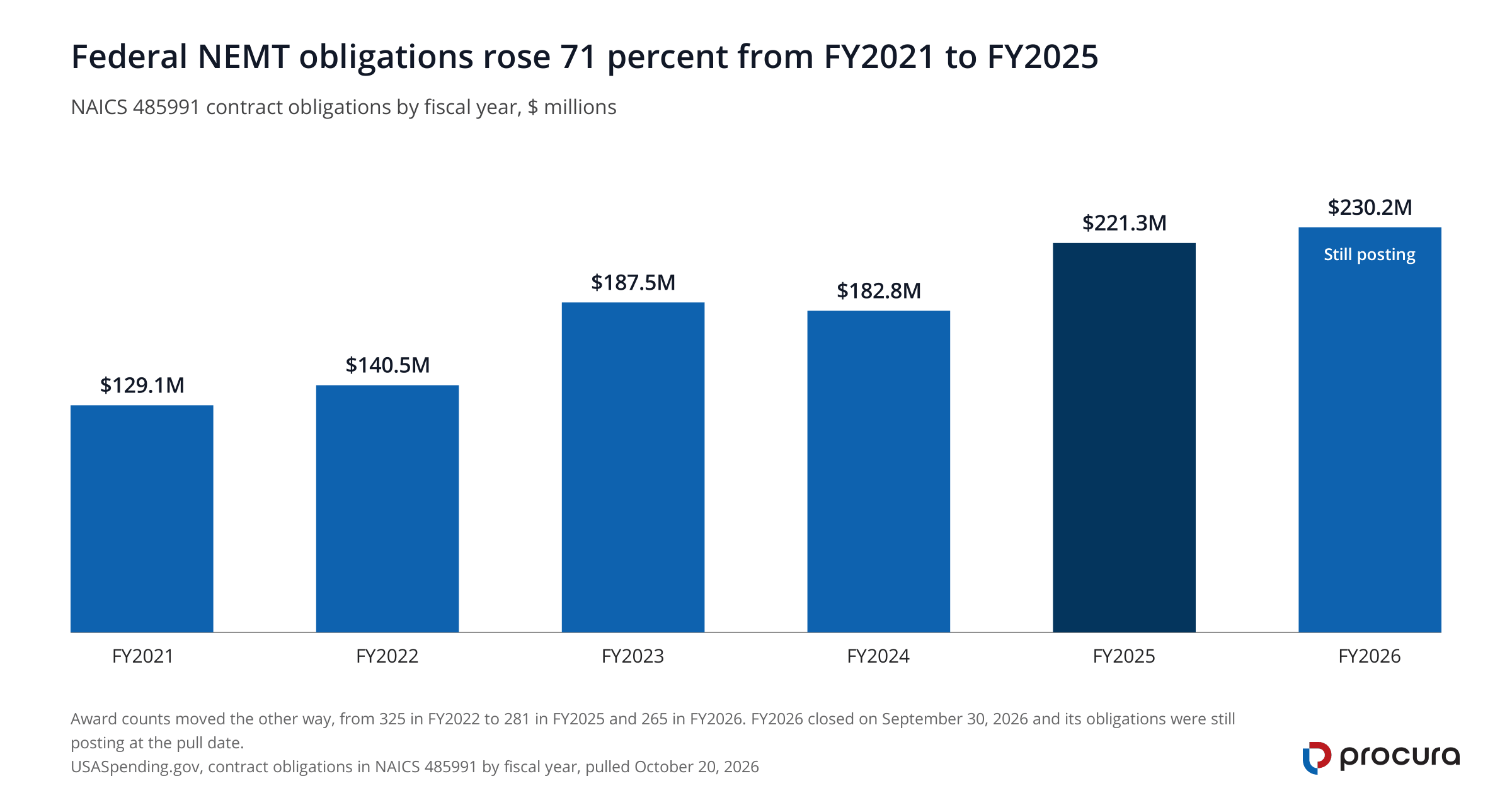
Data table: NAICS 485991 obligations, award counts and average obligation by fiscal year
| Fiscal year | Obligations | Awards | Average per award |
|---|---|---|---|
| FY2021 | $129,092,914 | 279 | $462,699 |
| FY2022 | $140,515,233 | 325 | $432,355 |
| FY2023 | $187,454,609 | 322 | $582,157 |
| FY2024 | $182,774,495 | 296 | $617,481 |
| FY2025 | $221,315,877 | 281 | $787,601 |
| FY2026 (still posting) | $230,206,058 | 265 | $868,702 |
How does NEMT compare with ambulance work?
For scale, the neighboring ambulance code is larger and completely different in character. NAICS 621910, Ambulance Services, carried $423.4 million across 1,740 awards in FY2025. But the VA is only 56.4 percent of it.
Meanwhile, the Federal Emergency Management Agency is 20.6 percent. The Forest Service is 10.3 percent, and three quarters of that total sits under the PSC for forest and range fire suppression. American Medical Response alone took 20.7 percent of that code. In short, ambulance work is a disaster-response and incident-support market with a large incumbent. It is not the same business.
What NAICS and PSC codes do federal medical transportation contracts use?
Use NAICS 485991, Special Needs Transportation. Its small business size standard is $19.0 million in average annual receipts under 13 CFR 121.201, the table effective March 17, 2023. By comparison, Ambulance Services, NAICS 621910, stands at $22.5 million. SBA proposed new size standards for 338 industries on August 20, 2026, and comments close on November 20, 2026. Therefore, confirm the current figure before you certify.
The product service code is where the search breaks. Eighteen different PSC codes appear inside this one NAICS in FY2025, and the code that is literally named AMBULANCE carries 5.9 percent of the money.
| PSC | Official description | FY2025 obligations | Share |
|---|---|---|---|
| V212 | Travel/lodging/recruitment: motor passenger | $97,826,991 | 44.2% |
| V226 | Travel/lodging/recruitment: taxicab | $27,708,125 | 12.5% |
| V999 | Transportation/travel/relocation, other: other | $25,930,542 | 11.7% |
| V222 | Travel/lodging/recruitment: passenger motor charter | $19,304,805 | 8.7% |
| V119 | Transportation: other | $14,883,025 | 6.7% |
| V225 | Travel/lodging/recruitment: ambulance | $12,955,272 | 5.9% |
| V129 | Transportation: other | $11,690,425 | 5.3% |
| Q201 | Medical: managed healthcare | $7,264,077 | 3.3% |
| Other 10 codes | Motor pool operations, motor charter, vehicles, leases and supplies | $3,752,614 | 1.7% |
| NAICS 485991 total | 18 PSC codes | $221,315,877 | 100.0% |
Why does taxi money show up in this code?
Read the second row again. In other words, one dollar in eight in this code sits under the taxicab code. Admittedly, some of that is genuine hired-car work for beneficiaries who can ride in an ordinary vehicle. 38 CFR 70.2 excludes a taxi from its definition of a special mode of transportation. That definition covers “an ambulance, ambulette, air ambulance, wheelchair van, or other mode of transportation specially designed to transport disabled persons”. However, the rest of the taxicab money is wheelchair and ambulette work filed under a travel-administration code. The code does not tell you which is which, and that is why PSC is not a usable filter here.
Why does a SAM.gov search for “NEMT” return nothing?
Because the buyer does not use the word. I pulled the description field of all 281 FY2025 awards in NAICS 485991 and counted the terms a contractor would actually type. Yet the acronym the whole industry uses returns zero matches.
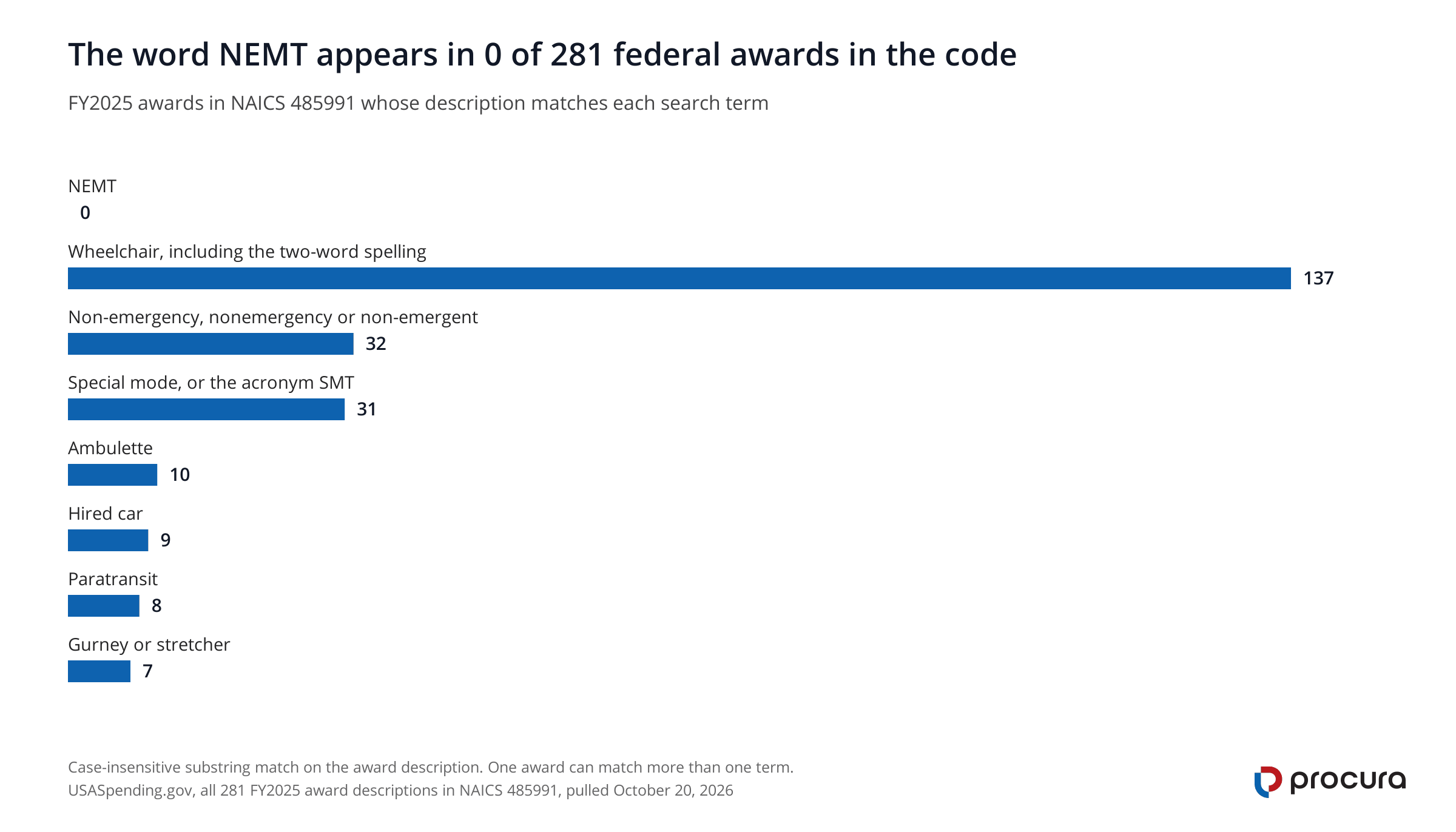
Data table: search terms matched against the 281 FY2025 awards
| What you search | Awards matched | Share of 281 |
|---|---|---|
| NEMT | 0 | 0.0% |
| wheelchair (or “wheel chair”) | 137 | 48.8% |
| non-emergency, non-emergent or non emergent | 32 | 11.4% |
| special mode, or the acronym SMT | 31 | 11.0% |
| ambulette | 10 | 3.6% |
| hired car | 9 | 3.2% |
| paratransit | 8 | 2.8% |
| gurney or stretcher | 7 | 2.5% |
| Any one of the above except NEMT | 212 | 75.4% |
What words does the VA use instead?
Those 281 awards carry 196 distinct description strings. In fact, the VA title for the requirement moves by medical center. All of these appear in the FY2025 data:
- Wheelchair van services
- Special mode transportation (SMT), for the San Francisco Veterans Affairs Health Care Center
- Ambulette transportation services
- Gurney transportation
- Hired car
- Non-emergent patient transportation
- Paratransit/special needs transportation services, at the Indianapolis VA.
Two awards spell it “wheel chair” as two words, which a search for the one-word spelling misses entirely. Similarly, two more spell it “nom-emergent”.
That has a simple and expensive consequence. A saved search on the exact phrase “non-emergency medical transportation” catches 8 of the 281 awards, which is about one in 35. Loosen it to any non-emergency spelling and you still catch one award in nine. Search for “NEMT” and you catch none. Therefore, to see the whole market you must search the buyer words, in all of their regional variants. You must then read the attachment to learn whether the requirement is a wheelchair van run or a gurney transfer.
How are federal medical transportation contracts actually awarded?
Mostly as orders against vehicles that already exist. Delivery orders carried $182.9 million in FY2025, which is 82.7 percent of the dollars and 214 of the 281 awards. Purchase orders carried 10.2 percent, definitive contracts 3.7 percent, and blanket purchase agreement calls 3.4 percent.
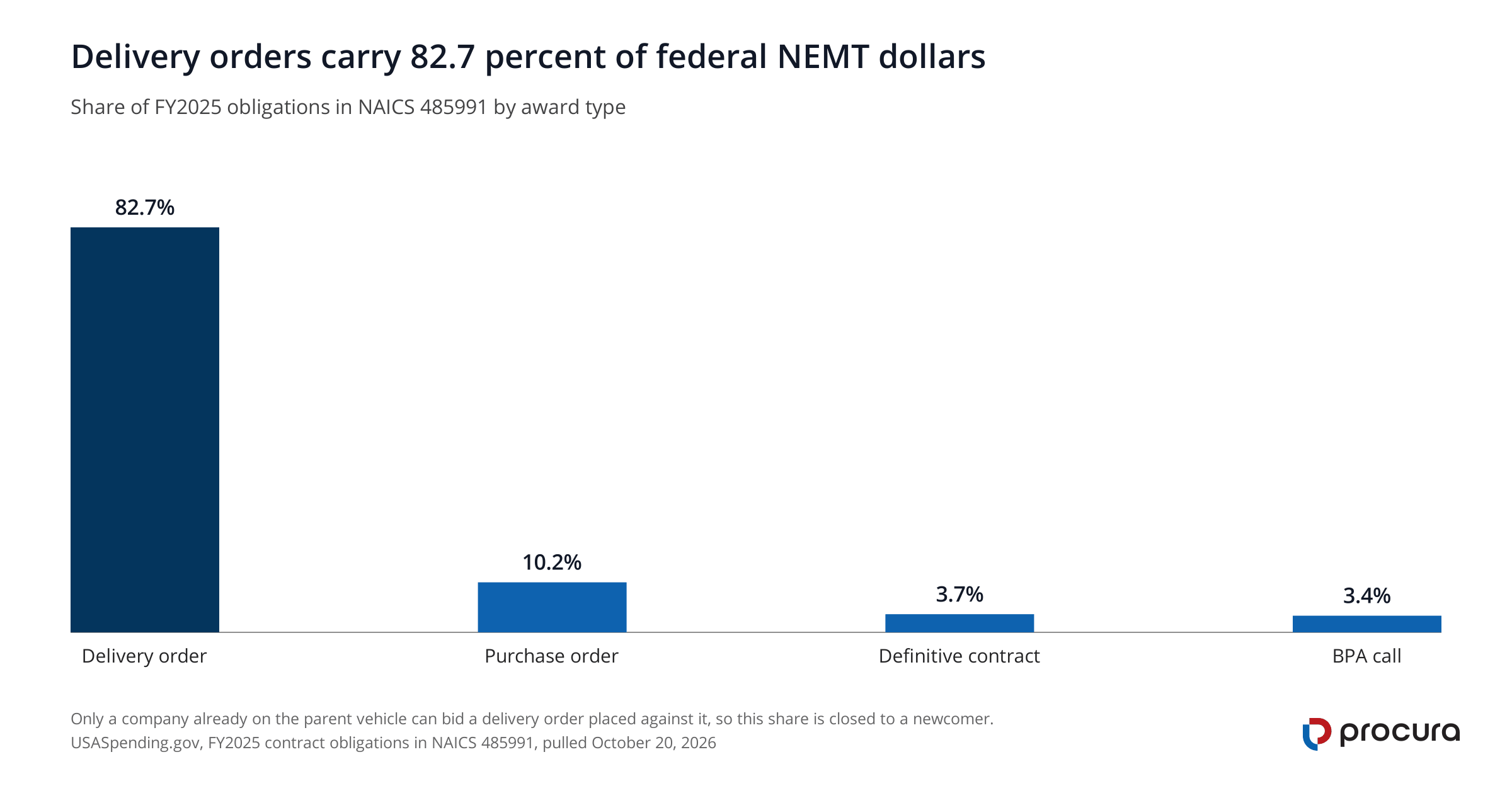
Data table: FY2025 NAICS 485991 obligations and awards by award type
| Award type | Awards | FY2025 obligations | Share of dollars | Can a newcomer bid it? |
|---|---|---|---|---|
| Delivery order (C) | 214 | $182,945,046 | 82.7% | No. Only awardees on the parent vehicle compete |
| Purchase order (B) | 44 | $22,663,006 | 10.2% | Yes. Mostly simplified acquisition buys |
| Definitive contract (D) | 16 | $8,282,730 | 3.7% | Yes. This is the open-market channel |
| BPA call (A) | 7 | $7,425,095 | 3.4% | No. Only BPA holders are solicited |
| All awards | 281 | $221,315,877 | 100.0% | — |
That split tells you where the competition sits. After all, only a company already on the parent contract can bid a delivery order against it. Four dollars in five in this market are thus closed to a newcomer on the day the order posts. By contrast, open-market work, meaning purchase orders and definitive contracts, is 13.9 percent. Add the BPA calls to the delivery orders. Together they are 86.1 percent of the dollars, reachable only by a firm already on a vehicle. In other words, winning a place on the vehicle is the real event, and the orders are what the place is worth. Our guide to IDIQ contract vehicles and task orders covers how that two-stage structure works.
How competitive are these awards?
Competition data points the same way, with one surprise. Competed actions took 76.6 percent of FY2025 dollars and 214 of 281 awards. That count matches the delivery-order count by coincidence, and the two groups are not the same awards. But the largest single category is not full and open competition. It is “competed under simplified acquisition procedures” at $103.2 million, which is 46.6 percent of the dollars and 149 awards. Specifically, FAR 13.500 permits simplified procedures for commercial services up to $9 million. That is far above the $350,000 simplified acquisition threshold in FAR 2.101, and the VA uses the authority heavily here.
For a small firm that is good news twice. Simplified procedures mean a shorter solicitation, a faster award and fewer proposal pages than a Part 15 source selection. They also mean the evaluation is often price against a pass-or-fail technical screen. As a result, a clean quote and a credible vehicle fleet beat a long narrative. If you have never priced a federal bid, start with our walkthrough of how to respond to a government RFP.
How big are typical federal medical transportation contracts?
Federal medical transportation contracts are much bigger than the entry-level verticals. In FY2025, 207 of the 281 awards, or 73.7 percent, were above the simplified acquisition threshold, and those awards carried 96.9 percent of the dollars. In fact, the $1 million to $10 million band alone holds 142 awards and 75.0 percent of the money.
| Award size band | Awards | Share of awards | FY2025 obligations | Share of dollars |
|---|---|---|---|---|
| $10,000 and under | 18 | 6.4% | $1,922,540 | 0.9% |
| Over $10,000 to $35,000 | 13 | 4.6% | $209,259 | 0.1% |
| Over $35,000 to $150,000 | 15 | 5.3% | $4,370 | 0.0% |
| Over $150,000 to $350,000 | 28 | 10.0% | $4,670,236 | 2.1% |
| Over $350,000 to $1 million | 60 | 21.4% | $20,391,820 | 9.2% |
| Over $1 million to $10 million | 142 | 50.5% | $166,049,895 | 75.0% |
| Over $10 million | 5 | 1.8% | $28,067,757 | 12.7% |
| All awards | 281 | 100.0% | $221,315,877 | 100.0% |
The row for awards over $35,000 to $150,000 is worth one sentence of explanation, because it looks broken. Fifteen awards sit in that band and they moved $4,370 in FY2025. The reason is that bands are assigned on total award amount, so an award sized in that band can post almost no obligation inside a single fiscal year.
Is there an entry-level on-ramp?
What this distribution means for a new entrant is blunt. In short, there is no micro-purchase on-ramp here. Moreover, the micro-purchase threshold for services covered by the Service Contract Act is $2,500, not the general $15,000. As a result, only 31 awards in the whole code fell at or below $35,000. Instead, entry means a multi-year wheelchair van requirement at a single VA medical center. It is priced per trip or per loaded mile, with vehicles and drivers on standby. If you want a vertical where the first contract is small, the easiest federal contracts to win are elsewhere.
Look at it from the other side. In fact, small businesses win the large awards here, not the leftovers. Small businesses took 95.4 percent of FY2025 dollars and 88.3 percent of awards. The average small business obligation was $851,380 against $308,291 for other-than-small firms. In other words, in this code the small businesses are the big end of the market. The largest award with FY2025 activity is a $14.1 million VA delivery order to 28 Trans LLC in Florida, for special mode transportation services. That figure is total award value, spread across a performance period that began in FY2024.
The band table above is a market shape, not a target list. Read the underlying awards free, narrow them to the buyers near you, then take the export with a free account.
Which certification matters for VA medical transportation contracts?
One of them, and it is not the one most contractors chase. In FY2025, service-disabled veteran-owned small business set-asides took $14.9 million across 14 awards in NAICS 485991. As a result, SDVOSB is the largest set-aside family in the code. The partial small business set-aside took $4.2 million on a single award. Total small business set-asides took $2.6 million across nine, and the 8(a) codes took $1.6 million across two.
By contrast, WOSB, EDWOSB and HUBZone set-asides took nothing. All six of those codes returned zero awards and zero dollars in this NAICS in FY2025. In the wider passenger ground transportation group, NAICS 4859, WOSB set-asides did appear at $2.0 million across four awards. So that capability is not invisible across the government. However, it is absent from this code.
The reason is written into the VA’s own statute. 38 U.S.C. 8127(h) orders the preference: service-disabled veteran-owned firms first, other veteran-owned firms second, and the other small business programs after that. 38 U.S.C. 8127(d)(1) then requires a VA contracting officer to restrict competition to those firms. Specifically, the restriction applies whenever two or more are expected to bid at a fair and reasonable price. When one agency buys 98.9 percent of a market and that agency runs a veteran-first preference, the veteran certification is the one that pays.
Can you still self-certify as an SDVOSB?
However, self-certification will not do it. Certification moved from the VA Center for Verification and Evaluation to SBA on January 1, 2023. Under 13 CFR 128.200(c)(1) the deadline for a complete application was December 31, 2023. A firm that missed it lost the ability to self-certify for SDVOSB set-aside and sole-source awards on January 1, 2024.
Under the VA veteran preference authorities, 38 U.S.C. 8127(e) allows an award only to a firm listed in the SBA database. Moreover, the grace period in 13 CFR 128.200(c)(1) expressly excluded VA contracts. One more number is worth knowing: 38 U.S.C. 8127(c) lets the VA make a sole-source award up to $5,000,000 to a qualifying firm.
If you hold a different certification, the honest advice is to stop treating it as a transportation wedge and use it where it works. The WOSB and EDWOSB certification and HUBZone certification guides list codes where those set-asides carry real volume. 8(a) certification remains the strongest general-purpose program. In short, for this vertical, veteran status is the lever.
Why do most of these awards show no set-aside at all?
This is the part that makes published set-aside shares in this code misleading, and the explanation is exact rather than approximate. Every coded set-aside in NAICS 485991 in FY2025 totals $23.3 million across 29 awards. Meanwhile, another 38 awards worth $15.0 million carry the explicit code for no set-aside. That leaves 214 awards and $182.9 million with the field simply blank.
Those 214 blank awards are the 214 delivery orders, dollar for dollar. I ran every set-aside code against delivery orders alone in this NAICS, and every one returned zero. That includes the code that means “none”. In other words, the field is simply not populated at the order level in this code, not even with the code that means none. As a result, whatever restriction the parent vehicle carries, you cannot see it from the order.
Two things follow. First, treat the 6.7 percent SDVOSB share as a floor and not an estimate. After all, the restricted parent vehicles behind those delivery orders are invisible in the set-aside field. Second, do not judge a vehicle by the orders you can see.
Instead, find the parent award. Read its set-aside. Then decide whether your certification lets you compete for its orders.
What labor and compliance rules apply to medical transportation contracts?
The Service Contract Act governs the labor cost, and it governs it from a very low threshold. Under 41 U.S.C. 6702 the Act applies to a federal contract over $2,500. Specifically, what matters is whether the principal purpose is to furnish services in the United States through service employees. All real medical transportation contracts clear that line, so a wage determination sets your floor on driver and attendant wages and fringe benefits for the locality.
| Requirement | Authority | What it does to your bid |
|---|---|---|
| Service Contract Act wage determination | 41 U.S.C. 6702 | Applies over $2,500. Sets minimum wages and fringe for drivers and attendants by locality. |
| Occupation codes you will price | SCA Directory of Occupations, 5th ed. | 12010 Ambulance Driver, 12040 Emergency Medical Technician, 31030 Bus Driver, 31290 Shuttle Bus Driver. |
| Prior authorization for the ride | 38 U.S.C. 111(b)(3)(A) | The VA must authorize special mode travel before it happens, except in a medical emergency. |
| Payment ceiling for ambulance transport | 38 U.S.C. 111(b)(3)(C) | For ambulance transport, and absent a contract, the VA can pay the lesser of your charge or the fee schedule at 42 U.S.C. 1395m(l). |
| Definition of special mode | 38 CFR 70.2 | Ambulance, ambulette, air ambulance, wheelchair van or similar. A taxi does not qualify. |
| Driver screening on the Medicaid side | 42 U.S.C. 1396a(a)(87) | Exclusion-list check, valid license, drug-law process, traffic-violation disclosure. |
| Small business size standard | 13 CFR 121.201 | $19.0 million average annual receipts for NAICS 485991. |
Why do wage determinations matter so much here?
The wage determination is not a formality on these contracts, and the record proves it. One award in this code, with a cumulative value of $5,761,551, carries nothing in its description but “incorporate updated wage determinations and update price schedule”. In that case, a revised determination arrived, the price schedule moved with it, and the modification was the mechanism. If you bid a five-year wheelchair van requirement at today driver wages, with no escalation assumption, expect that argument in year two. The Service Contract Act compliance guide explains how a determination is applied, and what a price adjustment under it looks like.
One exemption deserves a flag rather than a conclusion. 41 U.S.C. 6702(b)(3) exempts a contract for the carriage of personnel by bus or truck where published tariff rates are in effect. However, that exemption is narrow, it turns on the tariff, and I have not found a Department of Labor ruling that applies it to patient transport. Therefore, do not assume that it applies to you. Read the clauses in the solicitation, then ask the contracting officer in writing.
Where is the work, and who holds these medical transportation contracts now?
Florida is the largest place of performance at 15.2 percent of FY2025 dollars. Next, California follows at 9.5 percent, Texas at 7.5 percent, Virginia at 7.0 percent and Massachusetts at 5.4 percent. The top five states hold 44.6 percent between them. Place of performance tracks VA medical centers, so this is a map of regional VA workload rather than of state procurement offices.
No single firm dominates, but the field is small. For example, the largest recipient, Navarre Corporation, took 10.3 percent of the code. The top five took 38.5 percent, the top ten 61.1 percent, the top twenty 81.6 percent and the top fifty 99.9 percent. By contrast, compare that with the ambulance code, where one firm holds 20.7 percent on its own. About fifty companies hold the whole code between them, and the work is divided by medical center rather than nationally. In short, that is the opening. A regional operator competes against the holder of one regional requirement, not against a national incumbent.
When do medical transportation contracts get funded?
In October, which inverts the pattern most federal contractors are taught. For example, standard advice says to watch the fourth quarter, because agencies obligate what is left before the year ends. In NAICS 485991 the biggest month of FY2025 was the first one. October carried 24.9 percent of the year obligations by itself, or $55.0 million. Overall, the first quarter carried 38.7 percent and the fourth quarter 30.0 percent.
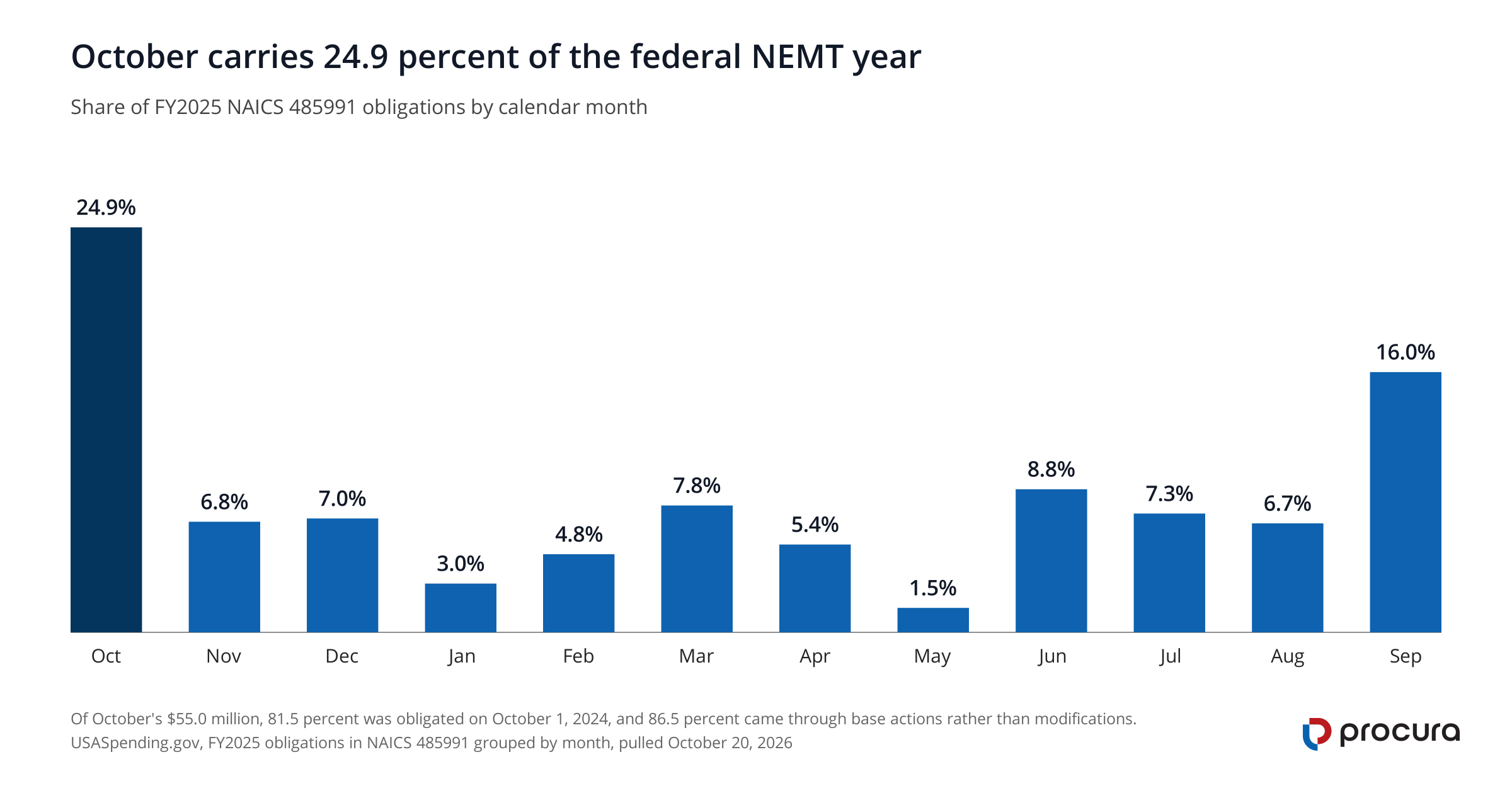
Data table: FY2025 NAICS 485991 obligations by month
| Month | FY2025 obligations | Share of the year |
|---|---|---|
| October | $54,995,821 | 24.85% |
| November | $15,081,966 | 6.81% |
| December | $15,510,852 | 7.01% |
| January | $6,737,318 | 3.04% |
| February | $10,501,603 | 4.75% |
| March | $17,338,416 | 7.83% |
| April | $11,947,794 | 5.40% |
| May | $3,330,464 | 1.50% |
| June | $19,500,171 | 8.81% |
| July | $16,131,995 | 7.29% |
| August | $14,893,369 | 6.73% |
| September | $35,346,109 | 15.97% |
| FY2025 total | $221,315,877 | 100.0% |
Why does October carry so much money?
The cause is a wave of new orders, not a wave of option modifications. Specifically, of that October money, $44.8 million was obligated on a single day, October 1, 2024. Base actions rather than modifications carried 86.5 percent of the month, against 75.3 percent across the year. Those are fresh delivery orders placed against vehicles that already existed, 52 awards across 34 contractors, funding the next ordering year. However, most of it is competed, but competed among the firms that already hold a place.
For bid planning that changes two things. The solicitation you want appears months before the October it funds, because the VA must award a recompete before the incumbent option ends. And the federal fourth-quarter spending spike is the wrong clock for this vertical, even though it is the right clock for most of them.
How to start, if you are not registered yet
This sequence is short, and the order matters. First, register the entity in SAM.gov, because nothing else counts until the registration is active. Our SAM.gov registration guide explains the timeline and the data mismatches that cause most delays.
Then get certified if you are veteran-owned, because in this vertical that is the preference that moves money. Then write the capability statement in the buyer nouns:
- Wheelchair-accessible vehicle count
- Gurney capability
- Attendant staffing
- On-time performance
- Service area by county
- The VA medical centers you can serve.
A capability statement that says “non-emergency medical transportation” and stops there tells a VA contracting officer nothing. For example, it does not say whether you can run a Tuesday morning dialysis route.
If your fleet cannot yet serve a whole medical center requirement, the subcontract route is the normal way in. In fact, prime holders on these regional vehicles routinely add local capacity. Our guide to winning government subcontracts explains how to approach them. Similarly, that same route works in adjacent codes. Operators who run patient transport and freight together often start in government trucking and freight contracts.
The hard part is finding the requirement
Four structural facts in this market work against a keyword search, and they compound. The buyer wrote those 281 awards under 196 different descriptions, and never used the word NEMT. Four dollars in five arrive as orders against parent vehicles, so the thing to find is the vehicle rather than the order. The set-aside field on those orders is blank, so you cannot filter by the restriction that decides whether you can bid. And the NAICS code itself moves. The VA obligated another $26.6 million across 54 FY2025 awards in NAICS 485999, where special mode transportation sits beside employee shuttle service.
Ultimately, what settles it is the attachment. The performance work statement holds the trip volume, the vehicle types, the response windows, the attendant requirement and the applicable wage determination. A notice that says “special mode transportation services” tells you nothing about whether the requirement takes eight vans or eighty.
How does Procura find these requirements?
Closing that gap is what Procura exists to do. Give it your capability statement and it scores each requirement against your fleet, your gurney capability and your service area. Then it names the wage determination, the vehicle specification and the licensing clauses it finds in the attachment. In addition, it searches the buyer vocabulary instead of yours. A wheelchair van requirement at the medical center nearest you then appears under whatever name that center gave it. Procura costs $399/month. By contrast, legacy market-intelligence platforms start in five figures a year, and our comparison of tools for finding federal contracts prices each of them.
Frequently asked questions
How do you get NEMT contracts?
By two separate routes, and they share almost nothing. First, for Medicaid work you contract with the state or with the broker the state selected. Second, for federal work you register in SAM.gov and certify if you are veteran-owned. You then compete for a VA requirement, or for a place on a VA regional vehicle. Sections above on the buyers explain which is which.
How much do federal NEMT contracts pay?
Median award value, meaning the total amount of the award and not one year of obligations, sits well above the $350,000 simplified acquisition threshold. Half of all FY2025 awards in NAICS 485991 fell in the $1 million to $10 million band. Meanwhile, rates themselves are set per trip or per loaded mile in the schedule. The Service Contract Act wage determination sets the labor floor underneath them.
Do you have to be an SDVOSB to win VA medical transportation contracts?
No, but it is the strongest position. However, most FY2025 dollars in the code carried no set-aside code at the order level. The coded 6.7 percent SDVOSB share is a floor and not a measurement. The certification matters where 38 U.S.C. 8127(d)(1) applies, which is whenever the contracting officer expects two or more qualifying veteran-owned firms to bid.
What NAICS code is non-emergency medical transportation?
485991, Special Needs Transportation, for the wheelchair van and ambulette work that forms most of it. When the requirement calls for a licensed ambulance and clinical staff, use 621910, Ambulance Services. Some VA requirements mix the two, and a few are coded to 485999.
Who are the largest federal NEMT providers?
In NAICS 485991 in FY2025 the top four by obligations were Navarre Corporation, 28 Trans LLC, James E Bradsher and GovTranz LLC. They took $22.7 million, $20.1 million, $16.8 million and $12.9 million. Even so, none of them holds more than 10.3 percent of the code. In the ambulance code the concentration is far higher, where American Medical Response alone holds 20.7 percent.
Does the VA still pay mileage instead of hiring a contractor?
Yes, for beneficiaries who can travel by ordinary means, and the contract market exists for the ones who cannot. A buyer section above gives the statutory basis for each case.
Book a demo
Bring one VA transportation solicitation, or the recompete you expect at the medical center nearest you. On the call we will pull the trip volume, the vehicle and attendant requirements and the wage determination out of its attachments. We then score them against your fleet. You can compare that against what you found by hand.