Federal agencies obligated $1.94 billion on government drone contracts in FY2025, and the Department of Defense took 95.6 percent of it. However, that headline number hides the part a small operator needs. Only 134 of the 357 FY2025 awards whose description contains the string “drone” sat in the product service code for unmanned aircraft. By contrast, the other 223 sat in 77 different codes, from radar equipment to diving equipment to expert witness services.
That split is the whole problem with this market. In short, one code holds almost all of the money, and almost none of the dollars a small firm can reach. Meanwhile, the work a small firm can actually take is scattered across dozens of codes that no reasonable person would search. This guide treats both halves. Every figure here is FY2025 obligations from USASpending.gov. In addition, the rules come from the American Security Drone Act and the Blue UAS Cleared List in its new home.
Who buys government drone contracts, and how much do they spend?
Three military departments buy most of it. In FY2025, the Navy obligated $696.3 million under product service code 1550, Unmanned Aircraft. Similarly, the Army obligated $683.4 million and the Air Force obligated $472.2 million. Meanwhile, the Department of State is the largest civilian buyer at $59.5 million, which is more than every other civilian agency put together. Thirteen departments and agencies obligated money in the code at all.
| Agency | FY2025 obligations, PSC 1550 | Share |
|---|---|---|
| Department of Defense | $1,858,129,141 | 95.6% |
| Department of State | $59,455,419 | 3.1% |
| Department of Homeland Security | $11,625,527 | 0.6% |
| NASA | $6,956,454 | 0.4% |
| Department of the Interior | $2,359,788 | 0.1% |
| General Services Administration | $2,012,134 | 0.1% |
| Department of Agriculture | $1,950,882 | 0.1% |
| Department of Justice | $942,259 | <0.1% |
| Department of Energy | $369,498 | <0.1% |
| Department of Transportation | $229,729 | <0.1% |
| Department of Labor | $190,340 | <0.1% |
| Department of Veterans Affairs | $150,348 | <0.1% |
| Department of Commerce | $27,223 | <0.1% |
| Total | $1,944,398,741 | 100% |
Is spending on government drone contracts growing?
The code is growing, but not in a straight line. Obligations went from $1.24 billion in FY2021 to $1.94 billion in FY2025, which is a rise of 56.9 percent. By comparison, measured to FY2026 the rise is 72.7 percent. However, FY2024 remains the peak at $2.21 billion, and FY2025 came in 11.8 percent below it. FY2026 stands at $2.14 billion and is still posting, because Department of Defense data lags 60 to 90 days. By contrast, award counts moved differently. They rose to 570 in FY2022, fell in FY2023 and again in FY2024, then jumped 32 percent to 693 in FY2025.
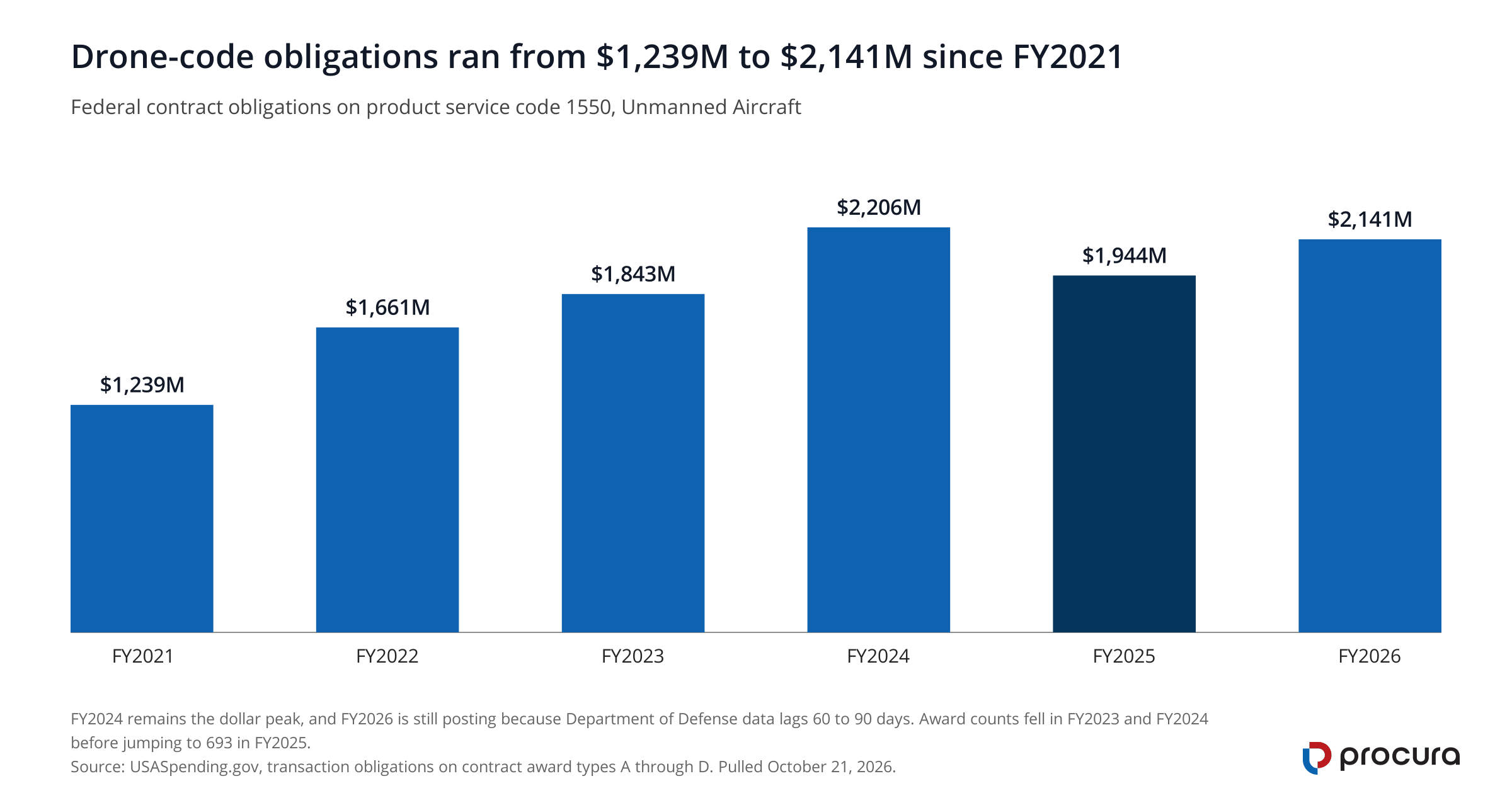
Data table: code 1550 obligations and award counts by fiscal year
| Fiscal year | Obligations, code 1550 | Awards |
|---|---|---|
| FY2021 | $1,239,466,907 | 514 |
| FY2022 | $1,660,978,213 | 570 |
| FY2023 | $1,843,217,838 | 556 |
| FY2024 | $2,205,620,930 | 526 |
| FY2025 | $1,944,398,741 | 693 |
| FY2026 | $2,140,716,015 | 591 |
Why are most government drone contracts closed to a new contractor?
Because it is concentrated, sole-sourced, and large, in that order. For example, General Atomics Aeronautical Systems alone took $745.7 million of the FY2025 total, or 38.4 percent. The top five recipients took 75.7 percent, and the top ten took 90.7 percent. California accounts for 73.7 percent of all obligations in the code. In fact, one San Diego company is 52.0 percent of that California total.
Moreover, competition data makes the point harder. Only 13.5 percent of FY2025 dollars in the code went through a competed action. Specifically, that means full and open competition, full and open after exclusion of sources, or a competed simplified acquisition. The remaining 86.5 percent carried a code for not competed, not available for competition, or not competed under simplified acquisition procedures. For example, a Gray Eagle logistics contract does not go out for bid every year.
Finally, size finishes the argument. Awards worth $1 million or more number 214, and they carry 97.3 percent of the dollars. Just 32 awards at or above $100 million carry 58.8 percent on their own. Admittedly, half of all awards in the code are small, but they are not where the money is.
| Award size band | Awards | FY2025 obligations | Share of dollars |
|---|---|---|---|
| Under $25,000 | 94 | $744,671 | <0.1% |
| $25,000 to $150,000 | 254 | $14,153,216 | 0.7% |
| $150,000 to $250,000 | 58 | $9,704,451 | 0.5% |
| $250,000 to $1 million | 74 | $28,229,857 | 1.5% |
| $1 million to $10 million | 117 | $188,710,512 | 9.7% |
| $10 million to $100 million | 65 | $559,791,424 | 28.8% |
| $100 million and above | 32 | $1,143,064,610 | 58.8% |
How many government drone contracts are set aside?
Small-business set-asides barely exist here. Four set-aside families took any money at all in FY2025:
- Total small business set-asides, $13.6 million across 107 awards
- 8(a) sole source awards, $1.8 million across two awards
- One WOSB set-aside, $169,264
- Two SDVOSB sole source awards, $54,399 between them.
Overall, those four account for 0.8 percent of the dollars in the code. HUBZone, EDWOSB, and competed 8(a) awards returned zero dollars inside code 1550. However, HUBZone does appear outside it, at $57,492 across the wider drone cut.
Where do winnable government drone contracts actually sit?
In short, it sits in the other 77 codes. I pulled every FY2025 contract action whose record matches the word “drone”, which returned 378 records. Of those, 357 carry the string “drone” in the award description, and the other 21 matched on the recipient name alone. Notably, the string rule catches DroneBuster and DroneGun as well as the plain word. Those 357 awards are spread across 78 distinct product service codes, and only 134 are in code 1550.
Moreover, the codes that hold the rest are not near-misses. Counter-drone jammers and DroneBuster handheld units sit in code 4220, Marine Lifesaving and Diving Equipment, which holds 28 of the awards. Similarly, aerial ignition rigs for wildfire burns sit in code 1680, Miscellaneous Aircraft Accessories and Components, with 24 awards. JROTC competition drone kits sit in code 6910, Training Aids. A Treasury buy described as “drone services” and “drone production services” sits in code R424, Support Professional: Expert Witness.
Which codes carry the most drone dollars?
By dollars, however, the ranking changes. Radar equipment, code 5840, carried $37.2 million of obligations on actions matching “drone” in FY2025. That is more than any other code in the table, and none of it is aircraft. Instead, it is detection radar and handheld defeat units.
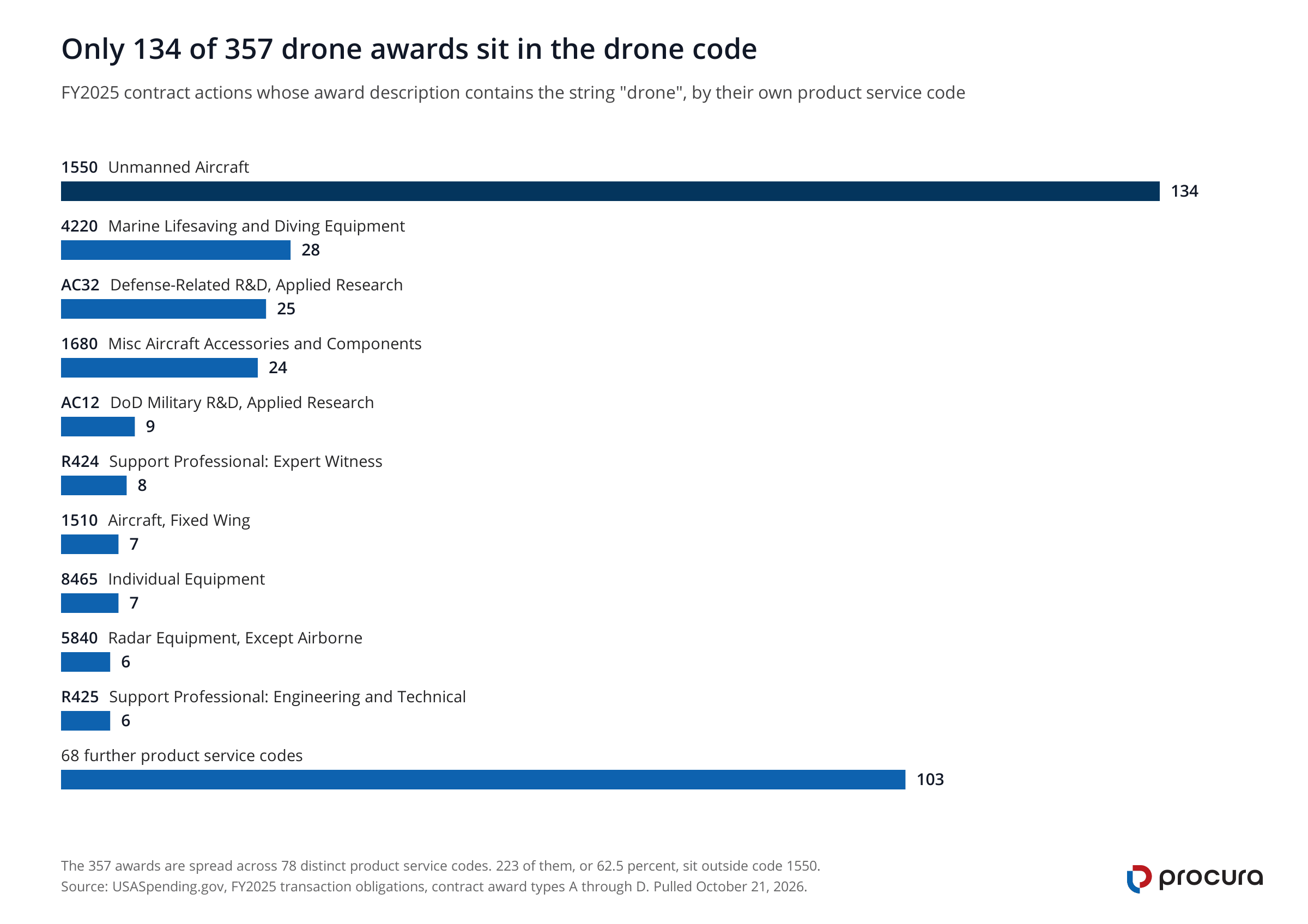
Data table: FY2025 drone-description awards by product service code
| Product service code | Name | Drone-text awards |
|---|---|---|
| 1550 | Unmanned Aircraft | 134 |
| 4220 | Marine Lifesaving and Diving Equipment | 28 |
| AC32 | National Defense R&D, Defense-Related, Applied Research | 25 |
| 1680 | Miscellaneous Aircraft Accessories and Components | 24 |
| AC12 | National Defense R&D, DoD Military, Applied Research | 9 |
| R424 | Support Professional: Expert Witness | 8 |
| 1510 | Aircraft, Fixed Wing | 7 |
| 8465 | Individual Equipment | 7 |
| 5840 | Radar Equipment, Except Airborne | 6 |
| R425 | Support Professional: Engineering and Technical | 6 |
| 68 further codes | Training aids, IT, security detection, charter air, and others | 103 |
| 78 codes | Total | 357 |
Which product codes hold drone-text awards?
| Code | What the government calls it | FY2025 obligations on drone-text awards | What actually gets bought there |
|---|---|---|---|
| 1550 | Unmanned Aircraft | $78,920,157 | Airframes, from Skydio X10D kits to Quantum-Systems Vector buys |
| 5840 | Radar Equipment, Except Airborne | $37,205,944 | Drone detection radar and tracking systems |
| 4220 | Marine Lifesaving and Diving Equipment | $21,786,859 | Counter-drone jammers, DroneBuster and DroneGun units |
| AC32 | National Defense R&D, Defense-Related, Applied Research | $10,931,427 | SBIR and applied research on autonomy and counter-UAS |
| AC12 | National Defense R&D, DoD Military, Applied Research | $9,925,235 | Service-funded applied research |
| R425 | Support Professional: Engineering and Technical | $5,797,498 | Robotics and autonomous systems advisory work |
| 1680 | Miscellaneous Aircraft Accessories and Components | $2,169,354 | Aerial ignition payloads, airframe accessories, BPA calls |
| 1510 | Aircraft, Fixed Wing | $1,528,635 | Fixed-wing kits, including law enforcement buys |
| 8465 | Individual Equipment | $628,975 | Organic drone build kits and FPV airframes |
| R424 | Support Professional: Expert Witness | $2,600 | Drone services and drone production services |
How much of the wider drone market goes to small business?
One number here changes how you prospect. Federal agencies obligated $247.3 million in FY2025 on contract actions matching “drone”, counted at transaction level across every code. Small businesses took $201.1 million of that, or about 81 percent. By contrast, in code 1550 the share runs the other way, because small businesses took only 14.7 percent. The average small-business obligation in code 1550 was $783,465 across 366 awards, against $5,023,426 across 330 awards for firms that are not small.
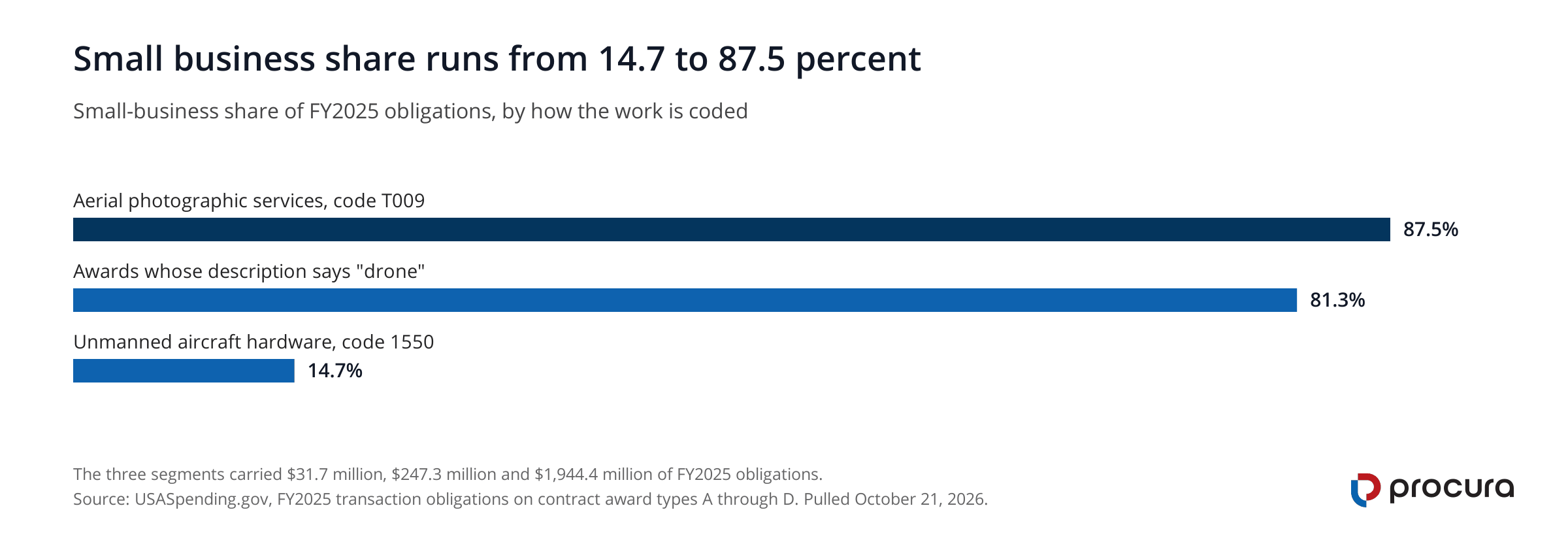
Data table: small-business and other-than-small obligations by segment
| Segment | Small business | Other than small | Small business share |
|---|---|---|---|
| Aerial photographic services, code T009 | $27,744,608 | $3,969,651 | 87.5% |
| Awards whose description says “drone” | $201,246,182 | $46,411,431 | 81.3% |
| Unmanned aircraft hardware, code 1550 | $286,748,037 | $1,657,730,478 | 14.7% |
Similarly, set-aside behavior inverts the same way. Small business set-asides took 13.8 percent of those matching obligations, against 0.7 percent inside code 1550. In other words, the buyer is not hostile to small firms. That buyer is buying two different things, and only one of them lands in the obvious code.
Which civilian agencies award government drone contracts?
Fifteen departments and agencies placed at least one of the 357 drone-text awards. A total of 150 of those awards, or 42.0 percent, came from outside the Department of Defense. For example, Customs and Border Protection made an 8(a) direct award for a “drone as first responder” program. Similarly, the Drug Enforcement Administration bought 16 long-range drone detection systems. The Department of the Interior and the Forest Service bought aerial ignition machines on blanket purchase agreement calls from a Nebraska small business. Those are winnable government drone contracts, and none of them would appear in a saved search built on one code.
In addition, the vocabulary runs the other way too. Only 136 of the 693 FY2025 awards in code 1550 contain the string “drone” at all. A test across six plain-language strings matches 286 awards, and leaves 407 that match none of them. The six are drone, UAS, sUAS, UAV, unmanned aircraft, and unmanned aerial. Instead, those 407 descriptions name the platform instead, most often MQ-9 or Reaper.
If you fly rather than manufacture, add code T009, Photo, Map, Print, Publication: Aerial Photographic. Agencies obligated $31.7 million across 39 awards there in FY2025, and small businesses took 87.5 percent of it. In other words, that is a higher small-business share than code 1550 by a factor of six.
What does the American Security Drone Act require?
In short, it bans federal money from touching a drone built by a covered foreign entity. Moreover, the ban now reaches operations as well as purchases. The American Security Drone Act of 2023 is subtitle B of title XVIII of the FY2024 National Defense Authorization Act. Congress enacted it as Public Law 118-31 on December 22, 2023. Then the FAR Council implemented it in an interim rule at 89 FR 89464, effective November 12, 2024. That rule created FAR subpart 40.2 and clause FAR 52.240-1.
FAR 40.202-3 carries three prohibitions, each of them subject to the exemptions at FAR 40.202-4, the exceptions at 40.202-5, and the waivers at 40.202-6. Agencies cannot procure a FASC-prohibited unmanned aircraft system, and that includes an option exercise or a renewal. Second, on or after December 22, 2025, agencies cannot procure services for the operation of one. Third, on or after the same date, agencies cannot use federal funds for the procurement or operation of one. The authorities in FAR 40.202 expire on December 22, 2028.
What catches contractors out?
Two details catch contractors out. First, FAR 40.202-2 applies the subpart to every acquisition. That includes contracts at or below the micro-purchase threshold, and contracts for commercial products and commercial services. As a result, a $4,000 card buy is in scope.
The second detail is that the clause binds you and not only the agency. FAR 52.240-1 prohibits the contractor from delivering a prohibited system. From December 22, 2025, it also prohibits operating one during contract performance. Therefore, a drone you already fly can disqualify you from work that has nothing to do with aviation. The clause reaches the aircraft you propose to use.
| Requirement | Authority | What it means for your bid |
|---|---|---|
| No procurement of a prohibited UAS | FAR 40.202-3(a), sections 1823 and 1826 of Pub. L. 118-31 | Applies now, and covers option exercises and renewals |
| No procurement of operating services | FAR 40.202-3(b), section 1824 of Pub. L. 118-31 | In force since December 22, 2025 |
| No federal funds for procurement or operation | FAR 40.202-3(c), section 1825 of Pub. L. 118-31 | In force since December 22, 2025, grants included |
| Applies to micro-purchases and commercial items | FAR 40.202-2 | No dollar floor and no commercial-item carve-out |
| Contractor delivery and operation ban | FAR 52.240-1 | Your own fleet is in scope during performance |
| Narrow exceptions only | FAR 40.202-5 | Wildfire, search and rescue, intelligence, Tribal agencies |
| Remote pilot certificate | 14 CFR 107.12 | Required for the person at the controls on civil work |
| Aircraft registration | 14 CFR 107.13 | Registration under 14 CFR 91.203(a)(2) |
| DoD component sourcing | Section 848, FY2020 NDAA, Pub. L. 116-92 | The rule the Blue UAS Cleared List exists to prove |
Where is the covered foreign entity list?
The list itself is harder to find than the rule. FAR 52.240-1(c) tells contractors to search SAM.gov for the list that the Federal Acquisition Security Council maintains. In addition, GSA confirms that it is published there. However, FAR 40.202-7, which governs the contracting officer’s review, does not point anywhere. Executive Order 14307 gave the Council 30 days from June 6, 2025 to publish the Covered Foreign Entity List. Therefore, confirm the current list in SAM.gov before you rely on any secondary summary of who is on it.
What is the Blue UAS Cleared List, and who runs it now?
The Blue UAS Cleared List is the government’s roster of validated unmanned aircraft. Validation tests an airframe against the DoD component-sourcing rule in section 848 of the FY2020 NDAA. If your airframe is on it, a program office can buy it without building the compliance case itself. By contrast, if your airframe is not on it, every buyer has to do that work, and most will not.
The list moved in 2025, and a lot of published advice still sends people to the wrong place. The Defense Innovation Unit now states that the Blue UAS Cleared List is transitioning to the Defense Contract Management Agency. Specifically, its authority is a July 10, 2025 memorandum titled “Unleashing U.S. Military Drone Dominance”, which DIU attributes to the Secretary of War. The new address is bluelist.dcma.mil, and DIU describes the move as in progress rather than finished. As a result, search results that send you to diu.mil for the current roster send you to a redirect.
Executive Order 14307, signed June 6, 2025, pushed hard on the same list. Section 9(a)(ii) ordered the list expanded within 90 days to cover all drones and critical components that meet section 848. In addition, monthly updates came from section 9(a)(iii). Section 9(a)(iv) ordered the Department to prioritize section 848 compliant drones from United States companies. The same subsection limits exemptions and waivers to cases of absolute necessity. Section 7(a) told every agency to prioritize the integration of unmanned aircraft manufactured in the United States.
How are the services using the new authority?
The practical effect inside a service is visible in Marine Corps policy. A November 2025 Marine administrative message implements the July 2025 guidance. Specifically, it lets an O6 commander grant an Authority to Operate for a compliant small unmanned aircraft system. The system does not have to be a program of record.
That authority cannot be delegated further, and the system has to stay on a closed-loop network. Moreover, a Blue UAS purchase carries an Authority to Operate, but it does not include electromagnetic spectrum approval. Group 1 means 20 pounds or less and Group 2 means 21 to 55 pounds.
Read that policy as a demand signal rather than a contracting one. The message delegates an Authority to Operate, not contracting authority, so an O6 commander is not a contracting officer. Instead, what it does remove is the headquarters approval step that used to stall a unit-level requirement before it reached one.
What do you need in place before you bid on government drone contracts?
Four things, and only one of them is aviation-specific. Start with an active registration in the System for Award Management, because no agency can pay you without it. Our walkthrough of SAM.gov registration covers the entity validation step that holds up most first-time registrants.
Second, get the pilot side right. 14 CFR 107.12 requires the remote pilot in command to hold a remote pilot certificate with a small unmanned aircraft system rating. However, an uncertificated person can manipulate the flight controls under the direct supervision of that remote pilot in command. A separate rule, 14 CFR 107.13, requires the small unmanned aircraft itself to be registered. Part 107 was last amended on November 3, 2025. Therefore, read the current regulation text rather than a training provider’s summary of it.
Which codes should a drone firm register under?
Third, pick your codes deliberately. Most drone manufacturers register under NAICS 336411, Aircraft Manufacturing. For example, the SBA size standard there is 1,500 employees. NAICS 336413, Other Aircraft Parts and Auxiliary Equipment Manufacturing, carries 1,250 employees.
Those standards are generous, so a drone firm can stay small by federal definition long after it feels large. Then add the product service codes from the table above to your saved searches. After all, your NAICS code will not find work that a contracting officer coded to diving equipment.
Fourth, build the compliance file before you need it. Write a one-page sheet that names your airframe and its Blue UAS Cleared List status. Add the component sourcing behind that status and your remote pilot certificate numbers. In practice, that sheet answers most of what a contracting officer will ask. Put those facts at the front of your capability statement, because they are what the compliance review asks for first.
How big are the government drone contracts a small firm can win?
Smaller than the headline suggests, and that is good news. Among the 357 drone-text awards, 204 fell under $150,000 and 297 fell under $1 million. In fact, only 12 reached $10 million or more. An airframe purchase is a supply buy, so the general $15,000 micro-purchase threshold in FAR 2.101 applies. However, drone services are a different matter. Work covered by the Service Contract Labor Standards carries a $2,500 threshold, and covered construction carries $2,000.
That $15,000 floor matters more than it sounds. For example, below it a government purchase card can buy a compliant airframe outright, with no solicitation and no competition. Above it, and up to the $350,000 simplified acquisition threshold, a contracting officer can use simplified procedures and award on a quote. Code 1550 carried 94 awards under $25,000 in FY2025, and together they came to $744,671.
Many of those small awards arrive as delivery orders or blanket purchase agreement calls rather than new contracts. In other words, competition already happened upstream. Our guide to IDIQ vehicles, GWACs, and BPAs explains how to reach the vehicle that the order comes from. Readers who are brand new to federal work can start instead with the contract types that are easiest to win.
When during the year do agencies award government drone contracts?
September for the code as a whole, and February for small firms. September 2025 carried 20.2 percent of the fiscal year’s obligations in code 1550, which is $393.6 million in one month. By contrast, July carried 2.0 percent, the slowest month of the year. March at 15.4 percent is the second busiest month, and no other month passes 14 percent.
However, those two peaks belong to the primes. One recipient accounts for 89.2 percent of the March total, and General Atomics accounts for 52.3 percent of the September total. Strip the code down to small-business obligations and the calendar changes completely.
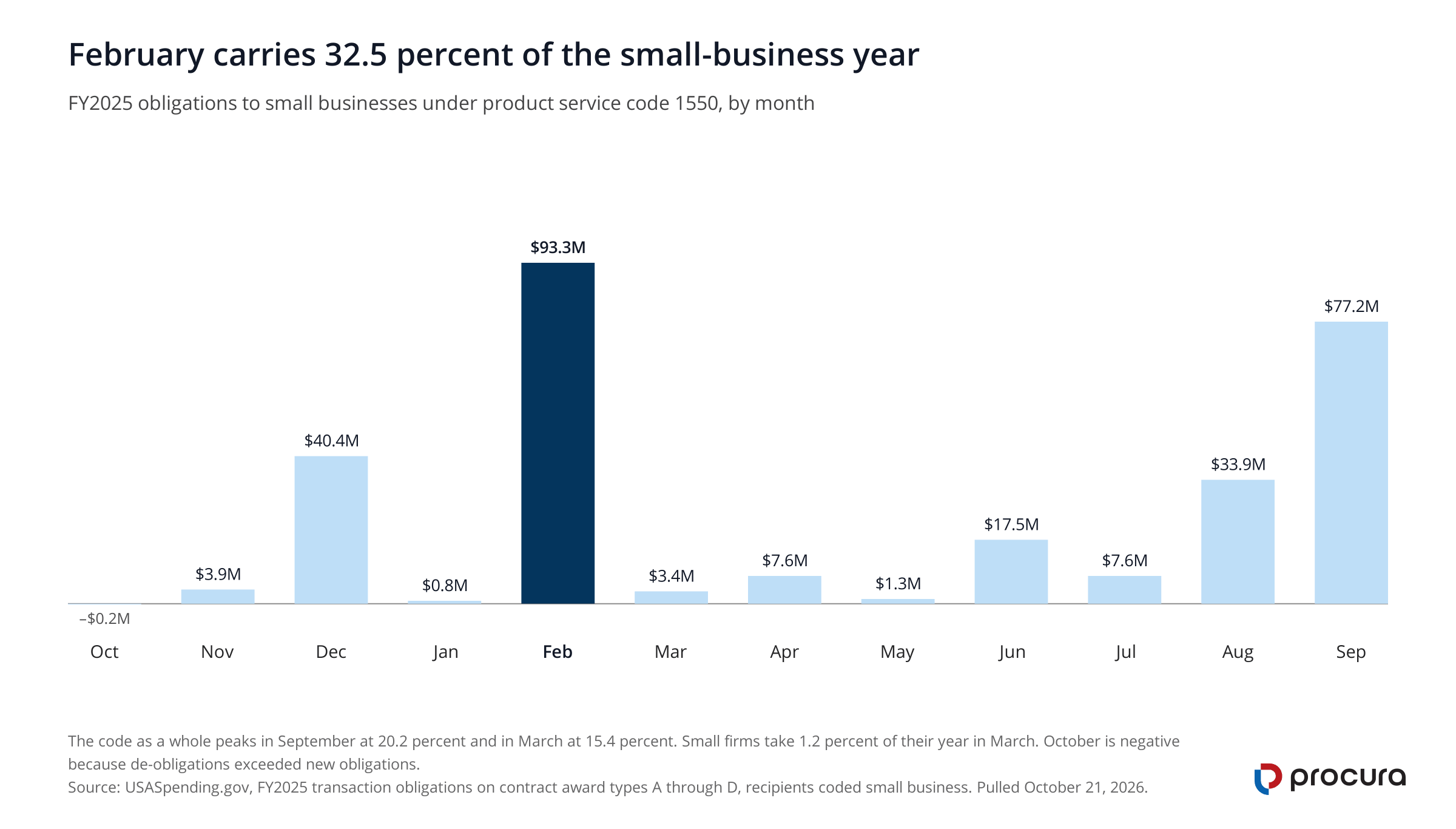
Data table: FY2025 code 1550 obligations by month, all recipients and small business
| Month | All obligations | Share | Small-business obligations | Share |
|---|---|---|---|---|
| October | $167,506,963 | 8.6% | $-206,252 | -0.1% |
| November | $91,468,655 | 4.7% | $3,915,728 | 1.4% |
| December | $52,719,559 | 2.7% | $40,386,283 | 14.1% |
| January | $124,084,418 | 6.4% | $805,529 | 0.3% |
| February | $149,883,516 | 7.7% | $93,274,681 | 32.5% |
| March | $299,500,398 | 15.4% | $3,434,983 | 1.2% |
| April | $126,022,286 | 6.5% | $7,640,481 | 2.7% |
| May | $269,461,983 | 13.9% | $1,263,100 | 0.4% |
| June | $121,822,903 | 6.3% | $17,524,161 | 6.1% |
| July | $39,559,355 | 2.0% | $7,609,474 | 2.7% |
| August | $108,790,235 | 5.6% | $33,893,368 | 11.8% |
| September | $393,578,469 | 20.2% | $77,206,500 | 26.9% |
| Total | $1,944,398,741 | 100% | $286,748,037 | 100% |
When do small firms win government drone contracts?
February carries 32.5 percent of the small-business year inside code 1550, September 26.9 percent, December 14.1 percent, and August 11.8 percent. March, the second busiest month for the code overall, carries 1.2 percent for small firms.
Therefore, plan against the second calendar, not the first. July through September carry 41.4 percent of small-business obligations in the code, against 27.9 percent of the code overall. Admittedly, the fourth-quarter advice does hold for small firms. However, February is the part nobody tells you about. One fiscal year is a thin basis for a seasonal rule, so treat it as a place to look rather than a law.
Drone award timing concentrates in a few months, and the month column above shows which. The award records stay free to read, and you can filter them to your own product codes. Sign up free to pull that filtered list into your own pipeline tracker.
The hard part is not the rules. It is finding the work.
Suppose you have done all of it. You are registered, your pilots are current, and your airframe is on the Cleared List. The data also tells you that 42 percent of the awards that say “drone” come from outside the Department of Defense. Even so, you still have to find the solicitation. Across 78 product service codes, under descriptions that call your product diving equipment or an expert witness service, written by 15 different departments.
Keyword alerts fail at this from both directions. A saved search on the word “drone” misses 80 percent of the awards inside the unmanned aircraft code. Similarly, a search on the code itself misses 62 percent of the awards that do say “drone”. The two obvious searches miss opposite halves of the same market, and neither failure is visible from inside the tool.
Procura Federal was built for that shape of problem. First, it reads every solicitation and every attachment, including the airframe specification and the component sourcing annex. Each solicitation gets scored against your capability statement, and the compliance clauses that disqualify bids get flagged, FAR 52.240-1 among them. Procura Federal costs $399 per month. By contrast, the legacy market intelligence platforms carry deeper historical databases and are built for capture teams rather than for operators.
Frequently asked questions about government drone contracts
Can I bid on federal drone work with a DJI aircraft?
Treat it as disqualifying until you have checked, and check in SAM.gov rather than in a vendor summary. The prohibition at FAR 40.202-3 attaches to aircraft built by entities on the Federal Acquisition Security Council list. FAR 52.240-1 reaches the aircraft you operate during performance. Admittedly, agency exemptions at FAR 40.202-4 and waivers at 40.202-6 exist, but a bidder does not control either one.
How do I get my aircraft onto the Blue UAS Cleared List?
Apply to the program that now holds the list at bluelist.dcma.mil. DIU describes the handover from its own program as in progress rather than finished. Expect a component-level review against section 848 of the FY2020 NDAA rather than a flight test alone.
Do I need a security clearance to sell drones to the government?
No, not for most government drone contracts. A facility clearance matters for classified programs, and classified actions do not appear in USASpending at all. The 204 drone-text awards under $150,000 that do appear are ordinary buys of aircraft, kits, and detection gear.
Is counter-drone work part of the same market?
It overlaps on codes and diverges on buyers. In FY2025, awards matching “counter-UAS” totaled $34.1 million across 17 awards and 14 product service codes. However, only one of those awards sat in code 1550. By obligations the buyers were the Department of Defense at $18.7 million and the Department of State at $15.4 million. The drug enforcement buy named earlier sits in the wider drone cut rather than in this one.
Which single agency should a new drone vendor target first?
The Department of Homeland Security, on the evidence of award counts rather than dollars. It placed 43 of the 357 drone-text awards in FY2025, more than any other civilian department. In addition, its buys skew toward law enforcement kits in the size band a small firm can deliver. The Department of the Interior follows with 28 and the Department of Justice with 15.
Does subcontracting to a prime make sense in this market?
It makes more sense here than in most verticals, because 90.7 percent of the dollars in code 1550 go to ten recipient records. In fact, those ten records are nine companies, because one prime appears twice under separate registrations. Our guide to winning federal subcontracts explains how to approach them. The military contracting guide describes the service-level program offices behind the largest awards.
Next steps
To find government drone contracts, pull the ten codes from the table above into saved searches today. Then set them against Homeland Security, the Interior, and Justice, which place the most civilian awards. Confirm your airframe’s status on the list at its current address. While the FAR citations are in front of you, write the one-page compliance sheet. Then read our walkthrough of federal proposal writing before the first matching solicitation lands in your queue. Keep the comparison of federal contracting tools at hand while you decide how to monitor all 78 codes.
Book a demo
Book a demo and bring a solicitation you are unsure about. We will read it against your capability statement on the call. You will see the compliance flags before you spend a week on the response.