
SBA size standards face a complete rewrite in a proposed rule, and the comment window closes on November 20, 2026. A proposed rule at 91 FR 53741 replaces the current 978 industry size standards with 338. It also removes the maximum on both measures, and moves a net 114,541 firms into small business status. For example, a landscaping contractor’s threshold goes from $9.5 million in receipts to $58 million. By contrast, for a commercial building contractor it stops being a dollar figure at all and becomes a headcount of 600 employees.
What are SBA size standards, and how is mine set today?
A size standard is the line between a small business and everyone else. SBA sets it per industry under 13 CFR 121.201, and the number attaches to a six-digit NAICS code. Each solicitation names one NAICS code, so that code decides which standard applies to that bid. As a result, if you exceed it you lose access to every set-aside, every 8(a) sole-source award, and the small business goals your prime customers must meet.
Generally, two measures cover almost every industry. SBA measures most service and construction industries in average annual receipts across five years. By contrast, it measures most manufacturing industries in average employees across 24 months. The eCFR text current to September 29, 2026 lists 978 six-digit industries. In total, SBA counts 102 distinct standard levels across them, plus 18 subindustry exceptions. The highest revenue-based standard is $47 million and the highest employee-based standard is 1,500 employees.
Those SBA size standards are the baseline the proposal measures itself against, and they are what you are held to until a final rule says otherwise.
What is SBA proposing to change in its size standards in 2026?
The Small Business Jobs Act of 2010 makes SBA review every size standard every five years. SBA published this proposed rule on August 20, 2026 as the third such review. In addition, a companion white paper, the Revised Size Standards Methodology at 91 FR 54096, explains the math. Overall, five changes do most of the work.
- Standards shift to a higher NAICS level, from six-digit codes to four- and five-digit groups. That turns 978 standards into 338, of which 276 sit at the four-digit level and 62 at the five-digit level.
- All 18 subindustry exceptions go away. The carve-outs that gave certain federal contracting niches their own threshold are deleted.
- Employee counts become the default measure. Where SBA has discretion, it proposes headcount instead of receipts, because headcount does not drift with inflation or a single large award.
- The formula changes, and the maximum disappears. SBA drops seven factors for three: national industry size, number of geographic markets, and a net import adjustment. The $47 million and 1,500-employee caps are removed, though a minimum standard stays in place.
- Revenue standards get a productivity adjustment. SBA has adjusted for inflation before, most recently in November 2022, but never for productivity growth. That addition is why the dollar figures jump so far.
What do the new numbers look like side by side?
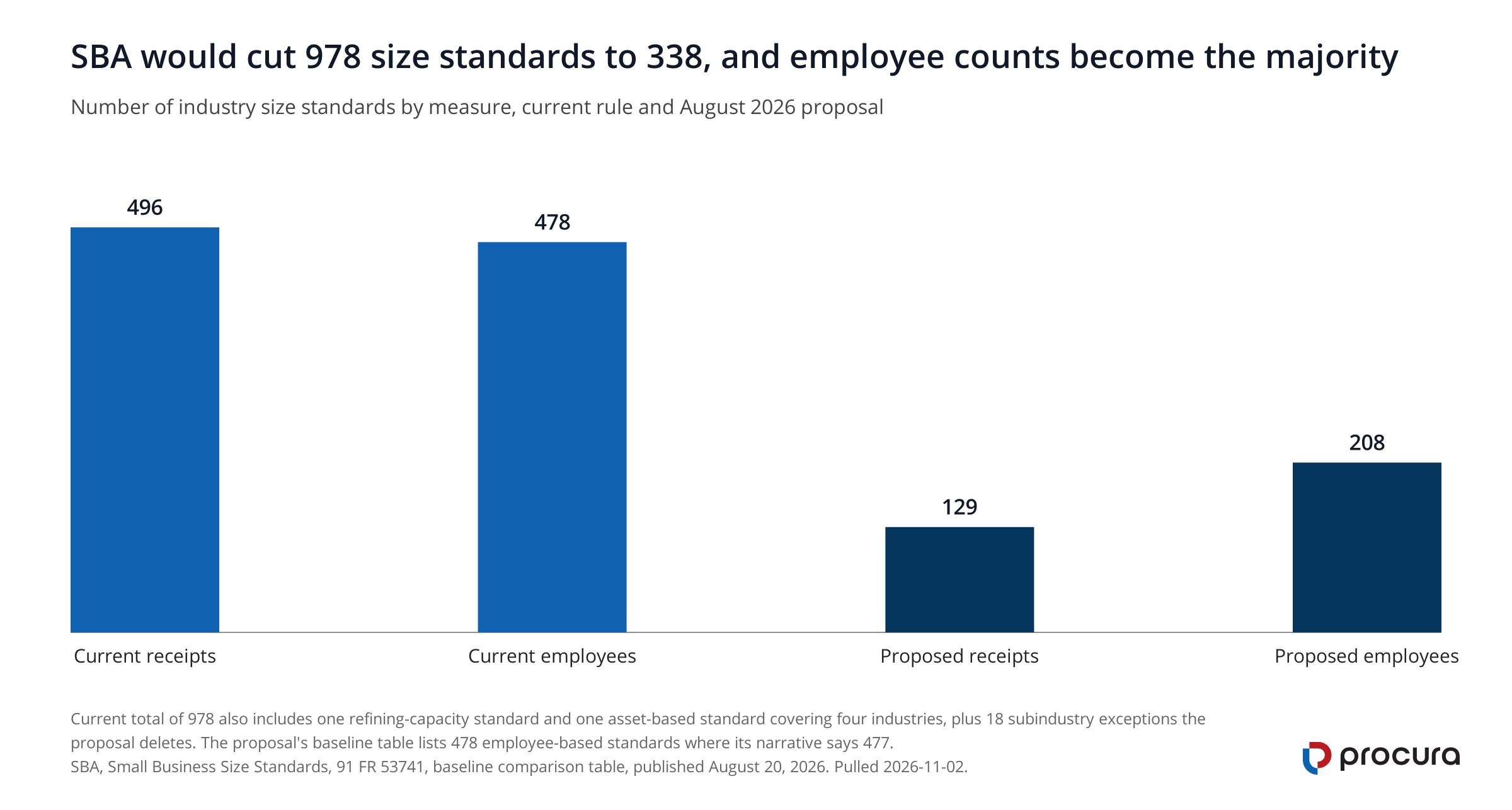
| Baseline (current rule) | Proposed change |
|---|---|
| Separate rules for receipts-based and employee-based standards | One rule establishing all size standards |
| 978 size standards at the six-digit NAICS level | 276 at the four-digit level and 62 at the five-digit level |
| 496 standards based on annual revenue | 129 standards based on annual revenue |
| 478 standards based on employee count | 208 standards based on employee count |
| 18 subindustry exceptions | No exceptions |
| Maximum $47 million in revenue; maximum 1,500 employees | No maximum |
| 6,344,967 firms classified as small | 6,459,508 firms classified as small |
Why is SBA keeping 45 standards where they are?
SBA also decided not to cut anything. In fact, its own analysis supported a lower standard in 45 industries that keep the same measure. Instead, the agency proposes to hold all 45 where they are. Before that decision, 24 of the 338 standards would have cut the count of eligible firms, by fewer than 200 firms in total. After it, a single industry is left with any reduction at all.
How would the proposed SBA size standards change my industry?
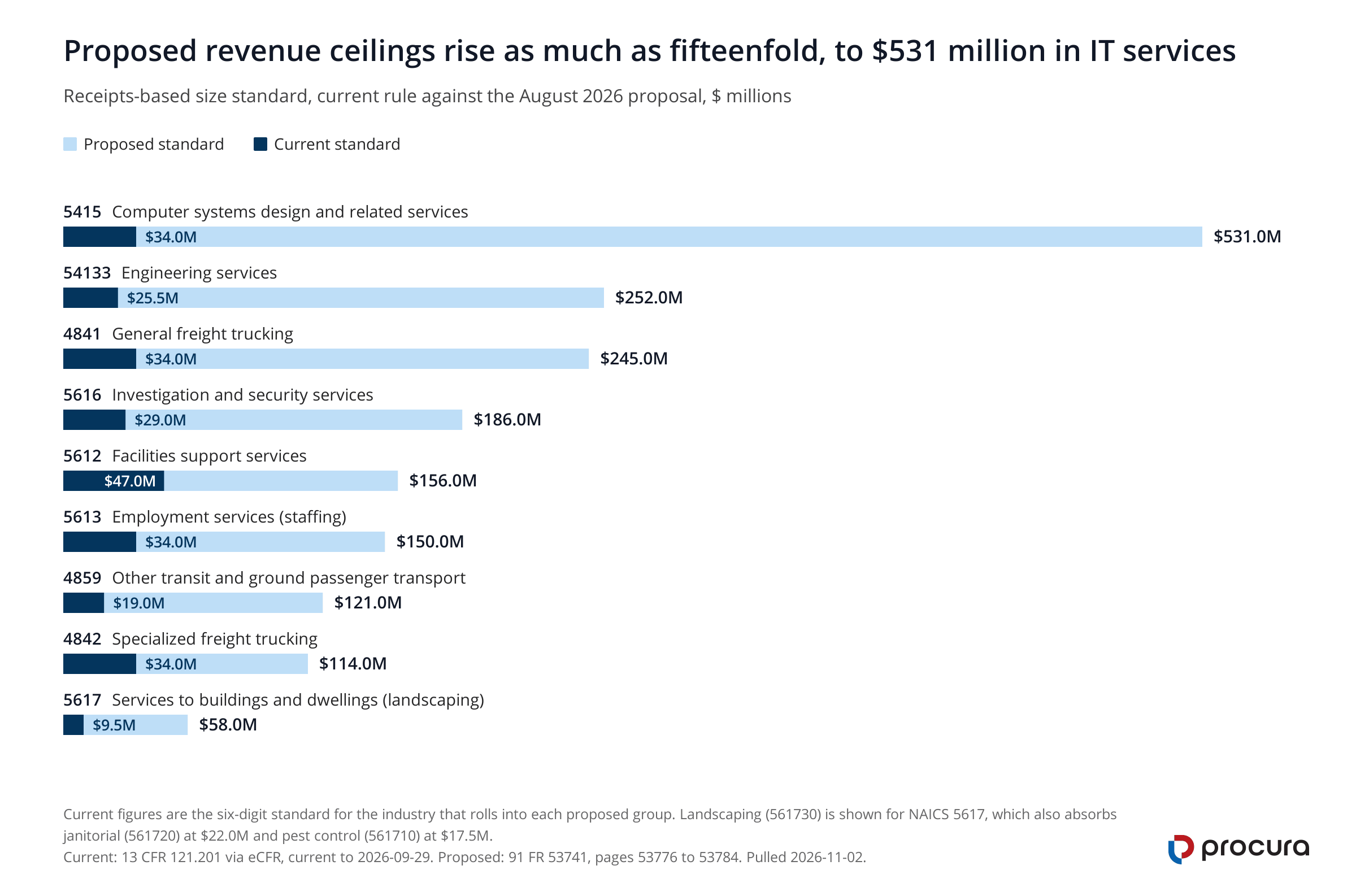
The table below pairs the SBA size standards in force today with the ones SBA proposes, for the industries this site covers most. Specifically, current figures come from 13 CFR 121.201. Proposed figures come from the amendatory table at 91 FR 53776 to 53784. Read the pairs carefully, because the NAICS code itself changes in most rows.
Current and proposed thresholds by industry
| Industry | Current code and standard | Proposed code and standard |
|---|---|---|
| Landscaping | 561730 — $9.5M receipts | 5617 — $58M receipts |
| Janitorial | 561720 — $22M receipts | 5617 — $58M receipts |
| Pest control | 561710 — $17.5M receipts | 5617 — $58M receipts |
| Staffing (temporary help) | 561320 — $34M receipts | 5613 — $150M receipts |
| Facilities support | 561210 — $47M receipts | 5612 — $156M receipts |
| Security guards | 561612 — $29M receipts | 5616 — $186M receipts |
| General freight trucking | 484110 — $34M receipts | 4841 — $245M receipts |
| Specialized freight trucking | 484230 — $34M receipts | 4842 — $114M receipts |
| Non-emergency medical transport | 485991 — $19M receipts | 4859 — $121M receipts |
| IT and computer systems design | 541512 — $34M receipts | 5415 — $531M receipts |
| Engineering | 541330 — $25.5M receipts | 54133 — $252M receipts |
| Research and development | 541715 — 1,000 employees | 54171 — 2,800 employees |
| Waste collection | 562111 — $47M receipts | 5621 — $47M receipts |
| Residential building | 236115 — $45M receipts | 2361 — 550 employees |
| Nonresidential building | 236220 — $45M receipts | 2362 — 600 employees |
| Highway, street and bridge | 237310 — $45M receipts | 2373 — 700 employees |
| Roofing | 238160 — $19M receipts | 2381 — 650 employees |
| Painting | 238320 — $19M receipts | 2383 — 600 employees |
| Plumbing and HVAC | 238220 — $19M receipts | 23822 — 550 employees |
| Courier and express delivery | 492110 — 1,500 employees | 4921 — 1,500 employees |
| Software publishing | 513210 — $47M receipts | 5132 — 3,600 employees |
| Catering and food service | 722310 — $47M receipts | 7223 — 700 employees |
How do the service codes merge under the new size standards?
Three service codes merge into one. Janitorial, landscaping and pest control all become NAICS 5617, Services to Buildings and Dwellings, at a single $58 million threshold. As a result, a landscaping firm measured against $9.5 million now works to a threshold six times higher. It also shares that threshold with the janitorial and pest control companies in the same group. Anyone reading our guides to federal cleaning contracts, grounds maintenance work or pest control contracts is now in one pool rather than three.
The largest jump in percentage terms is computer systems design, from $34 million to $531 million. That is a fifteenfold increase, and it is only possible because SBA removed the cap. However, software publishing is the exception in that sector. It moves to a headcount of 3,600 employees rather than a dollar figure, as our guide to selling software to the government explains.

A size standard only matters next to the awards it gates. Browse federal award records free by industry code, and see what firms your size actually win. With a free account you can export the comparison.
Why does construction stop being measured in dollars?
Construction is the clearest case of the measure flipping. Indeed, every construction code in the table above is a receipts standard today and an employee standard under the proposal. For example, a commercial builder currently has room up to $45 million in average annual receipts. Under the proposal the test becomes 600 employees, and revenue stops mattering.
That swap favors firms that subcontract heavily. For instance, take a general contractor with 40 staff who subcontracts most of the work. That firm can bill far past $45 million and still count as small on a headcount test. Meanwhile, a self-performing contractor with 700 field employees and lower revenue loses status. In other words, two firms with identical revenue can land on opposite sides of the line, and the difference is their labor model.
Specialty trades also get folded upward. Roofing at 238160 disappears into 2381, Foundation, Structure, and Building Exterior Contractors, at 650 employees. Similarly, painting at 238320 joins 2383, Building Finishing Contractors, at 600 employees. Therefore, contractors who work from our federal construction guide must watch the NAICS code on a solicitation. Its shape changes before the dollar threshold does.
Who wins and who loses under the new SBA size standards?
SBA is direct about the trade-off, which is unusual in a proposed rule. Specifically, the rule states that growing firms near the current ceiling face the most new competition. Firms that just became small are the ones closest to them in size. SBA writes that the smallest businesses in an industry are likely not competitive for the same contracts as firms near the standard. Therefore, pressure lands on the mid-sized end of the small business pool.
Consider the size of the pool. Federal set-aside obligations totaled $58.7 billion in FY2025 across all set-aside types. General small business set-asides accounted for $32.8 billion of that, across 167,607 awards. So when 114,541 firms join the eligible pool, more bidders chase the same dollars. SBA accepts this, but argues the number of small businesses winning awards will not fall.
The winners are firms that sat just above the old line. A $40 million landscaping company was large yesterday and is small under the proposal. By contrast, firms at $5 million to $15 million in the same code lose ground. They now bid against companies with four to six times their capacity for the same set-aside. As a result, socioeconomic status becomes more valuable. An 8(a) certification, a HUBZone certification or a WOSB certification narrows the field in a way a plain small business set-aside no longer does.
One industry does lose status outright. Direct Property and Casualty Insurance Carriers, at NAICS 524126, moves from 1,500 employees to $842 million in receipts. However, SBA expects fewer than five firms to drop below that line.
How do I comment before the November 20 deadline?
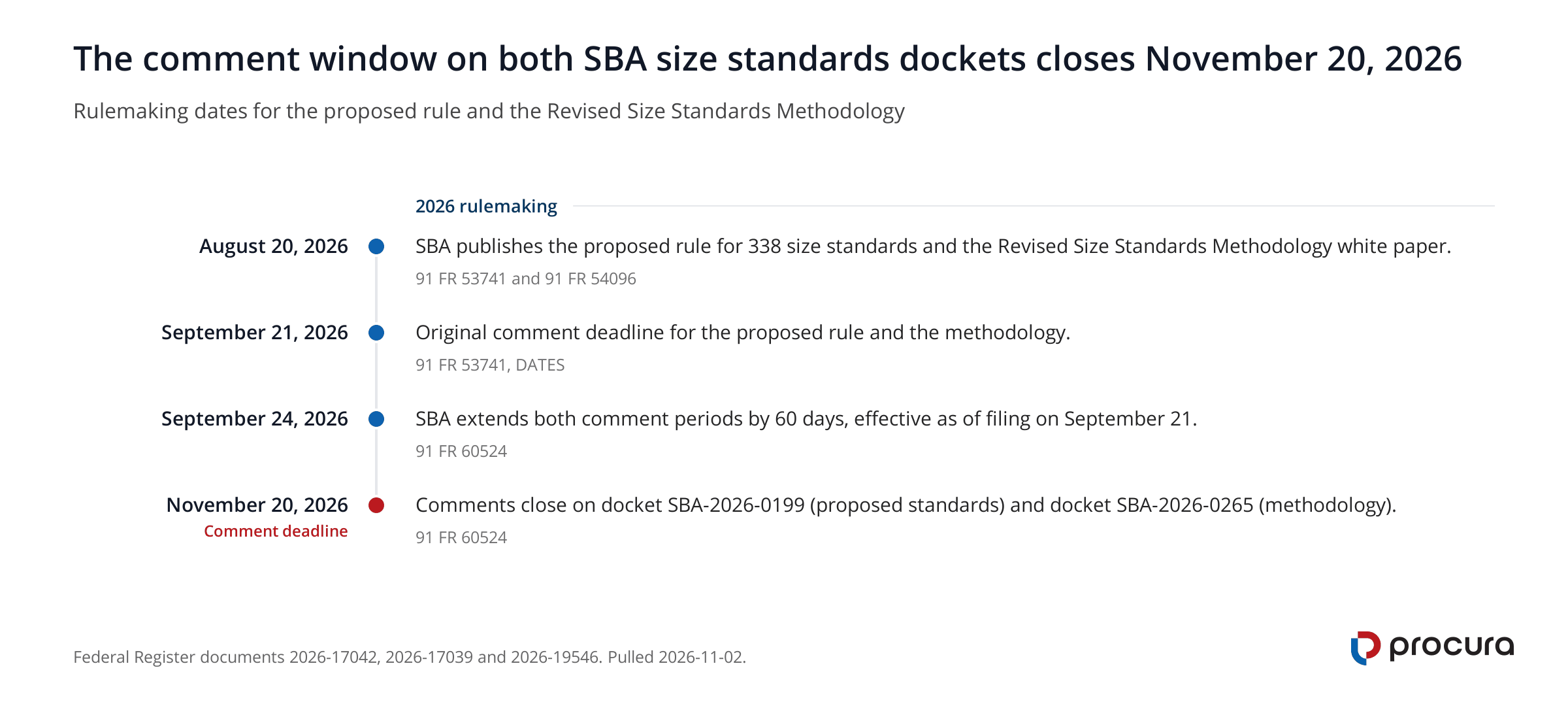
SBA set the original deadline at September 21, 2026, then extended the two comment periods by 60 days on September 24. The new date is November 20, 2026, and it applies to the proposed rule and the methodology white paper alike.
There are two separate dockets, so a comment filed on one is not filed on the other.
- Docket SBA-2026-0199 (RIN 3245-AI67) takes comments on the proposed standards themselves, including the number for your industry.
- Docket SBA-2026-0265 takes comments on the Revised Size Standards Methodology, meaning the formula rather than the result.
File at regulations.gov under the docket number. In addition, the mail address is the Associate Administrator for Government Contracting and Business Development, 409 Third Street SW, Mail Code 6530, Washington, DC 20416. A comment that names your NAICS code, states your revenue or headcount, and explains the practical effect carries more weight than a general objection. SBA commits to give a detailed explanation wherever its proposal departs from the analytical result. For instance, the 45 industries it declined to cut are the largest such departure in this rule.
One practical warning. The amendatory table listing all 338 proposed standards was published as nine page images, not as text. As a result, you cannot search the Federal Register copy for your NAICS code, and you cannot copy a row out of it. Instead, plan to read pages 53776 through 53784 by eye.
What should I do now, whatever SBA decides on size standards?
Nothing changes until a final rule publishes, and SBA gave no date for one. Until then, your current certification in SAM.gov still rests on the SBA size standards in 13 CFR 121.201 as they stand. Four things are worth doing before that changes.
- Find the four- or five-digit group your six-digit code rolls into, and read the proposed number for it. A code you have never bid under can now set your threshold.
- Work out your position under the two measures. If your industry flips to headcount, count your average employees across 24 months. Include part-time staff, as 13 CFR 121.106 requires.
- Include your affiliates in the total. Removing the caps raises the ceiling, but affiliation rules still add a parent or commonly controlled firm to your figures.
- File a comment if the number is wrong for your market. The window is the only point at which the figure is negotiable.
Firms that expect to lose ground can look at structure rather than size. For example, a subcontracting position under a larger prime does not depend on your own size standard. Similarly, a place on an IDIQ vehicle fixes your status at the time of the underlying award in most cases.
The threshold is not the hard part
Whichever number SBA settles on, qualifying was never the bottleneck. In fact, you can be registered, certified and comfortably under the standard and still lose. However, the work of finding the right solicitations and reading them properly does not get easier. For example, a single construction RFQ can carry a dozen attachments. The requirement that disqualifies you usually sits in one of them rather than in the synopsis.
Procura reads each solicitation together with its attachments. Then it scores the fit against your capability statement, and surfaces the eligibility and compliance clauses that sit inside the attachment set. Procura costs $399/month, against five-figure annual contracts at the incumbent platforms. If the proposed standards survive, the pool of bidders in your code grows, and the firms that pick their bids well keep their win rate. Our guides to the easiest contracts to win and winning federal work step by step describe the rest of that process.
Frequently asked questions
Are the new SBA size standards in effect yet?
No. They sit in a proposed rule, and SBA must review comments and publish a final rule before anything binds. Also, the agency has announced no target date for that step.
Does a bigger SBA size standard mean I stay small longer?
Yes, and that is SBA’s stated intent. In particular, a higher ceiling lets a firm take non-set-aside and commercial work without crossing the line. That is the primary benefit the rule claims for growing companies.
Which NAICS code applies if my industry merges into a group?
The contracting officer assigns one code per solicitation, and the standard for that code governs the bid. Under the proposal the assigned code is the four- or five-digit group, so the six-digit distinctions stop mattering for size.
Will set-asides get harder to win?
For firms near the old ceiling, yes, on SBA’s own analysis. Competition rises most where the newly eligible firms overlap in capability, and the agency expects the award count to small businesses to hold steady.
How do I track solicitations in a code that is about to change?
Watch the group instead of the single code. Procura tracks every six-digit code inside a four-digit group at once, so a shift in how SBA aggregates them does not break your pipeline.
Book a demo
Pick a time and we will show you the opportunities in your NAICS group, scored against your capability statement.