
FAR Part 16 sets the government contract types, and the Federal Procurement Data System records them in 16 pricing codes. Firm fixed price took $442.7 billion of the $813.8 billion that agencies obligated on prime contracts in fiscal year 2025. In other words, that is 54.4 percent. However, the question for a small firm is not how many types exist. Instead, it is which one a contracting officer will put in front of you, and award size predicts that better than industry does.
I price federal bids against these arrangements, and the arrangement moves the number more than a single line item does. For example, a fixed-price quote carries every overrun you failed to predict. By contrast, a cost-reimbursement contract carries almost none of that risk, and almost no small firm qualifies to hold one.
What are the four types of government contracts?
The four government contract types that most pages mean are fixed-price, cost-reimbursement, time-and-materials and incentive contracts. That list is a reasonable summary, but it is not what the government counts. For instance, vendor pages variously say four, five, six or seventeen, which is why the answers you find disagree.
FAR Part 16 holds seven subparts, and four of them describe pricing arrangements. In particular, Subpart 16.2 is fixed-price contracts, 16.3 is cost-reimbursement contracts, 16.4 is incentive contracts, and 16.6 is time-and-materials, labor-hour and letter contracts. Meanwhile, Subpart 16.5 governs indefinite-delivery contracts, which are a different thing.
How many contract types does the government count?
The count that the government itself uses is 16. Every federal contract action reports a type-of-contract-pricing code, and the Federal Procurement Data System publishes the full list. However, three of the 16 are structural leftovers. Code 1, order dependent, applies only to indefinite-delivery vehicles. Similarly, codes 2 and 3, combination and other, apply only to awards and are almost never used. Consequently, only 13 codes carried real money on prime contract awards in FY2025.
| Code | Type of contract pricing | Family | FY2025 obligations | Share |
|---|---|---|---|---|
| J | Firm Fixed Price | Fixed price | $442.70B | 54.40% |
| U | Cost Plus Fixed Fee | Cost reimbursement | $120.17B | 14.77% |
| L | Fixed Price Incentive | Fixed price | $77.56B | 9.53% |
| R | Cost Plus Award Fee | Cost reimbursement | $64.48B | 7.92% |
| V | Cost Plus Incentive Fee | Cost reimbursement | $38.33B | 4.71% |
| K | Fixed Price with Economic Price Adjustment | Fixed price | $22.78B | 2.80% |
| Y | Time and Materials | Time and materials | $19.99B | 2.46% |
| S | Cost No Fee | Cost reimbursement | $12.97B | 1.59% |
| Z | Labor Hours | Time and materials | $9.80B | 1.20% |
| M | Fixed Price Award Fee | Fixed price | $2.52B | 0.31% |
| B | Fixed Price Level of Effort | Fixed price | $1.90B | 0.23% |
| A | Fixed Price Redetermination | Fixed price | $0.33B | 0.04% |
| T | Cost Sharing | Cost reimbursement | $0.26B | 0.03% |
| 3 | Other | Awards only | $0.9M | 0.00% |
| 1 | Order Dependent | Vehicles only | $0 | 0.00% |
| 2 | Combination | Awards only | -$1.2M | -0.00% |
How do the dollars split across the three families?
Grouped into three families, the government contract types split FY2025 into $547.8 billion fixed price, $236.2 billion cost reimbursement, and $29.8 billion time and materials plus labor hours. Overall, fixed price is 67.3 percent of the money. By volume, however, the gap is wider still. For instance, agencies recorded 5.79 million prime contract award records in FY2025. Fixed price accounts for 5.70 million of them, against 45,790 cost-reimbursement records and 42,074 time-and-materials records.
When should you use a firm fixed-price contract?
Generally, firm fixed price is the arrangement the regulation reaches for first. FAR 16.202-1 describes it as a price “not subject to any adjustment on the basis of the contractor’s cost experience in performing the contract.”
In fact, the preference itself is stated one subpart earlier. FAR 16.103(b) says that a firm-fixed-price contract “shall be used when the risk involved is minimal or can be predicted with an acceptable degree of certainty.”
You can see every one of these types in real awards. Procura’s federal contract index covers 27,300,018 prime contracts and orders from FY2021–FY2025, and the vehicles directory lists 1,596 multiple-award vehicles with two or more holders (data updated Oct 20, 2026).
Moreover, for commercial products and services the regulation removes the choice. FAR 12.207(a) requires agencies to use firm-fixed-price contracts, or fixed-price contracts with economic price adjustment, for commercial buys. A narrow exception runs the other way for commercial services alone, and FAR 12.207(b) sets its conditions. So a firm selling mowing, janitorial work, office supplies or standard repairs will see firm fixed price on nearly every solicitation it reads.
Alternatively, code K, fixed price with economic price adjustment, is the version that lets a stated price move. Specifically, the adjustment is tied to a published index or an established price rather than to what the work actually cost you. It took $22.8 billion in FY2025, or 2.80 percent of obligations. The share jumped from 1.90 percent in FY2021 to 2.98 percent in FY2022, then held near 2.8 percent. In short, this is a settled practice rather than a trend. Therefore, a supplier exposed to steel, fuel or copper can ask at the pre-bid stage whether the solicitation carries that clause.
What did the 2026 executive order change about government contract types?
Executive Order 14402, “Promoting Efficiency, Accountability, and Performance in Federal Contracting,” was signed on April 30, 2026. Above all, it directs agencies to maximize the use of fixed-price contracts. Meanwhile, the White House fact sheet puts the other side plainly, calling cost-reimbursement contracts “the exception” and requiring “senior-level agency approval” for them.
The FAR Council wrote the order into the model deviation text for Part 16, and agencies adopt that text by class deviation. It states at 16.102(b) that “fixed-price contract types are the default and preferred contract types.” By contrast, the official FAR carries no such sentence. Thus, this is the first time the text states the preference as a default.
Who must approve a contract that is not fixed-price?
A new section 16.104 adds the approval. Specifically, the head of the agency must approve a written justification before the agency uses a contract or order that is not fixed-price. However, that threshold varies by agency.
| Agency | Threshold for the agency-head justification |
|---|---|
| Department of Defense | $100 million |
| NASA | $35 million |
| Department of Homeland Security | $25 million |
| All other federal agencies | $10 million |
Two practical points follow for a small firm. First, the thresholds all sit far above the range where a new contractor bids, so the order changes nothing about the solicitations you see this year. Instead, it lands squarely on the band above $10 million, which is the only band where cost reimbursement holds a real share of the money.
The second point is a citation problem rather than a pricing one. Specifically, agencies operating under the deviation renumber Part 16. For example, the fixed-price preference moves to 16.102 and the firm-fixed-price description to 16.202. The cost-reimbursement limitations collapse into a single 16.301. However, this article cites the official FAR as published in FAC 2026-01, effective March 13, 2026. Therefore, confirm which version your contracting officer uses before you quote a paragraph number back at them.
What are the risks of fixed-price government contract types?
Every cost you underestimated reduces your margin, and the contract returns none of it. In other words, that is the whole design. Three risks do the most damage to small firms.
- Labor rules in the attachments. A wage determination sets the minimum you must pay, and it binds you at the rate in the solicitation rather than the rate you quoted.
- Scope read from the wrong document. The specification sits in an attachment, and a fixed price quoted off the summary page is a price for different work.
- Multi-year option periods. A price good in year one is a price you are still held to in year five, unless the contract carries an adjustment clause.
In fact, two of those three are compliance documents rather than pricing decisions. The Service Contract Act governs wage determinations on service work, and the Davis-Bacon Act governs them on construction. As a result, the attachment set decides each one before you put a number on the bid.

How do cost-reimbursement contracts work, and who can hold one?
A cost-reimbursement contract pays your allowable costs plus a fee in most cases, so the government carries the overrun risk rather than you. Still, that protection is not unlimited. For example, FAR 16.301-1 requires an estimated total cost that the contractor cannot exceed, except at its own risk, without the approval of the contracting officer.
That exposure is still far smaller than a fixed price, which is why the FAR puts four gates in front of this family. FAR 16.301-3(a) permits one only when all four conditions hold:
- The factors in FAR 16.104 are considered
- A written acquisition plan is approved and signed at least one level above the contracting officer
- The contractor’s accounting system “is adequate for determining costs applicable to the contract or order”
- Adequate government resources are available before award, including surveillance during performance
That accounting-system gate is the one that keeps most small firms out. Specifically, an adequate system means job-cost accounting that separates direct from indirect cost and survives an audit. In short, that is a real investment before a single dollar of revenue arrives. Our guide to DCAA compliance for small contractors explains what the audit examines.
Why is cost reimbursement off the table for commercial work?
A second rule closes the door tighter. FAR 16.301-3(b) states that “the use of cost-reimbursement contracts is prohibited for the acquisition of commercial products and commercial services.”
Most work a small firm sells to the government is commercial by definition. Cost reimbursement is thus unavailable to that firm for reasons which have nothing to do with the firm itself.
Similarly, award data matches the rule. Cost reimbursement is 29.0 percent of federal contract dollars and 0.8 percent of award records. It also concentrates in two agencies. For example, the Department of Defense took $155.6 billion of it, and the Department of Energy took $45.5 billion. Together that is 85.1 percent of the family. In particular, Energy runs the national laboratories and the nuclear cleanup sites, and those are management-and-operating contracts that almost no new contractor bids.
What is a time and materials contract?
A time-and-materials contract buys labor at fixed hourly rates and materials at cost, which makes it the arrangement most service firms expect to see. However, FAR 16.601(c) sets a two-part test, and each part must fail before the type is allowed. First, at the time of placing the contract, an accurate estimate of the extent or duration of the work must be impossible. Anticipating costs with reasonable confidence must also be impossible. FAR 16.602 defines a labor-hour contract as the same thing, differing “only in that materials are not supplied by the contractor.”
The FAR is unusually blunt about why it limits this type. A time-and-materials contract, says FAR 16.601(c)(1), “provides no positive profit incentive to the contractor for cost control or labor efficiency.” In addition, the same paragraph makes the government watch the work, through appropriate surveillance of contractor performance.
Two more controls sit in FAR 16.601(d). Under it, the contracting officer must sign a determination and findings that no other contract type is suitable. Furthermore, the head of the contracting activity must approve that finding when the base period plus options runs beyond three years. That contract must also include “a ceiling price that the contractor exceeds at its own risk.”
How much federal money goes to time and materials?
Those controls appear in the data. Time and materials plus labor hours held between 4.4 and 4.8 percent of obligations for four years. It then fell to 3.66 percent in FY2025, the lowest of the five settled years. Overall, the drop from FY2024 is 1.14 points, a relative fall of 24 percent in one year. FY2026 closed on September 30, 2026 and reads 3.93 percent, so the fall did not continue. Because agencies still report late actions, FY2025 is the last settled year.
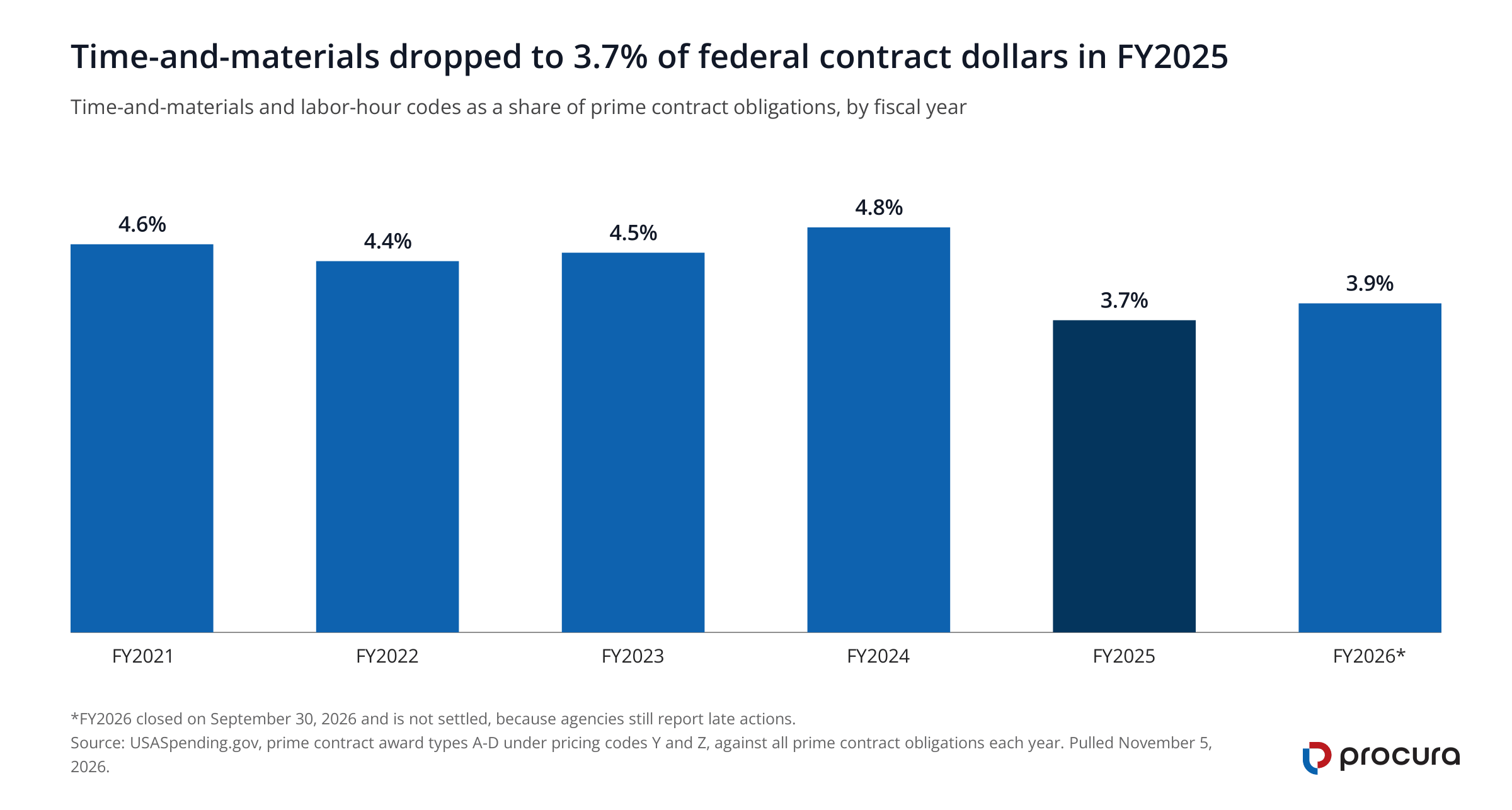
Data table: time-and-materials and labor-hour obligations and share, FY2021-FY2026
| Fiscal year | All prime contract obligations | Time and materials plus labor hours | Share |
|---|---|---|---|
| FY2021 | $659.01B | $30.30B | 4.60% |
| FY2022 | $702.92B | $31.07B | 4.42% |
| FY2023 | $779.83B | $34.80B | 4.46% |
| FY2024 | $775.91B | $37.26B | 4.80% |
| FY2025 | $813.79B | $29.79B | 3.66% |
| FY2026 (not settled) | $800.52B | $31.42B | 3.93% |
Cost plus fixed fee alone, at $120.2 billion, is four times the entire time-and-materials family. That ratio surprises most federal services contractors, because time and materials is the arrangement they see on their own contracts.
Which agencies buy time and materials work?
Similarly, where T&M dollars sit is the other surprise. Defense is 67.0 percent of fixed-price dollars but only 14.7 percent of time-and-materials dollars, and civilian agencies lead the list.
| Awarding agency | FY2025 T&M and labor-hour obligations | Share of the family |
|---|---|---|
| Department of Homeland Security | $4.70B | 15.77% |
| Department of Defense | $4.37B | 14.67% |
| Department of Health and Human Services | $4.33B | 14.54% |
| Department of State | $2.85B | 9.57% |
| Department of Justice | $2.83B | 9.50% |
| General Services Administration | $2.12B | 7.10% |
| Department of Transportation | $2.02B | 6.77% |
| Department of Energy | $1.49B | 5.00% |
Therefore, a services firm that treats federal work as a defense market reads the wrong column. Instead, those civilian agencies buy the hourly work.
| Family | Who absorbs an overrun | FAR subpart | Audited accounting system needed | Allowed for commercial buys |
|---|---|---|---|---|
| Fixed price | The contractor | 16.2 and 16.4 | No | Yes, and required by FAR 12.207(a) |
| Cost reimbursement | The government, up to the estimated cost | 16.3 and 16.4 | Yes, under FAR 16.301-3(a)(3) | No, prohibited by FAR 16.301-3(b) |
| Time and materials | The government below the ceiling, the contractor above it | 16.6 | No, but rates and hours are scrutinized | Commercial services only, under FAR 12.207(b) |
Which of the government contract types will a small business actually be offered?
Ultimately, award size predicts which of the government contract types you get better than anything else in the data. Below the simplified acquisition threshold of $350,000, fixed-price codes took $38.75 billion of $39.06 billion in FY2025 obligations, which is 99.2 percent. The fixed-price share then falls steadily as awards get larger.
First, under $25,000 the pattern is absolute. Fixed-price codes account for $8.14 billion of a $7.97 billion band. Cost-reimbursement and time-and-materials transactions in that band net below zero, because deobligations exceed new obligations. As a result, no other family holds positive net obligations there.
How does the fixed-price share change as awards grow?
From $25,000 to $250,000 fixed price is 98.9 percent of the band. It is 93.5 percent between $250,000 and $1 million, 83.4 percent between $1 million and $10 million, and 61.7 percent above $10 million. By contrast, cost reimbursement climbs to 34.8 percent only in that top band.
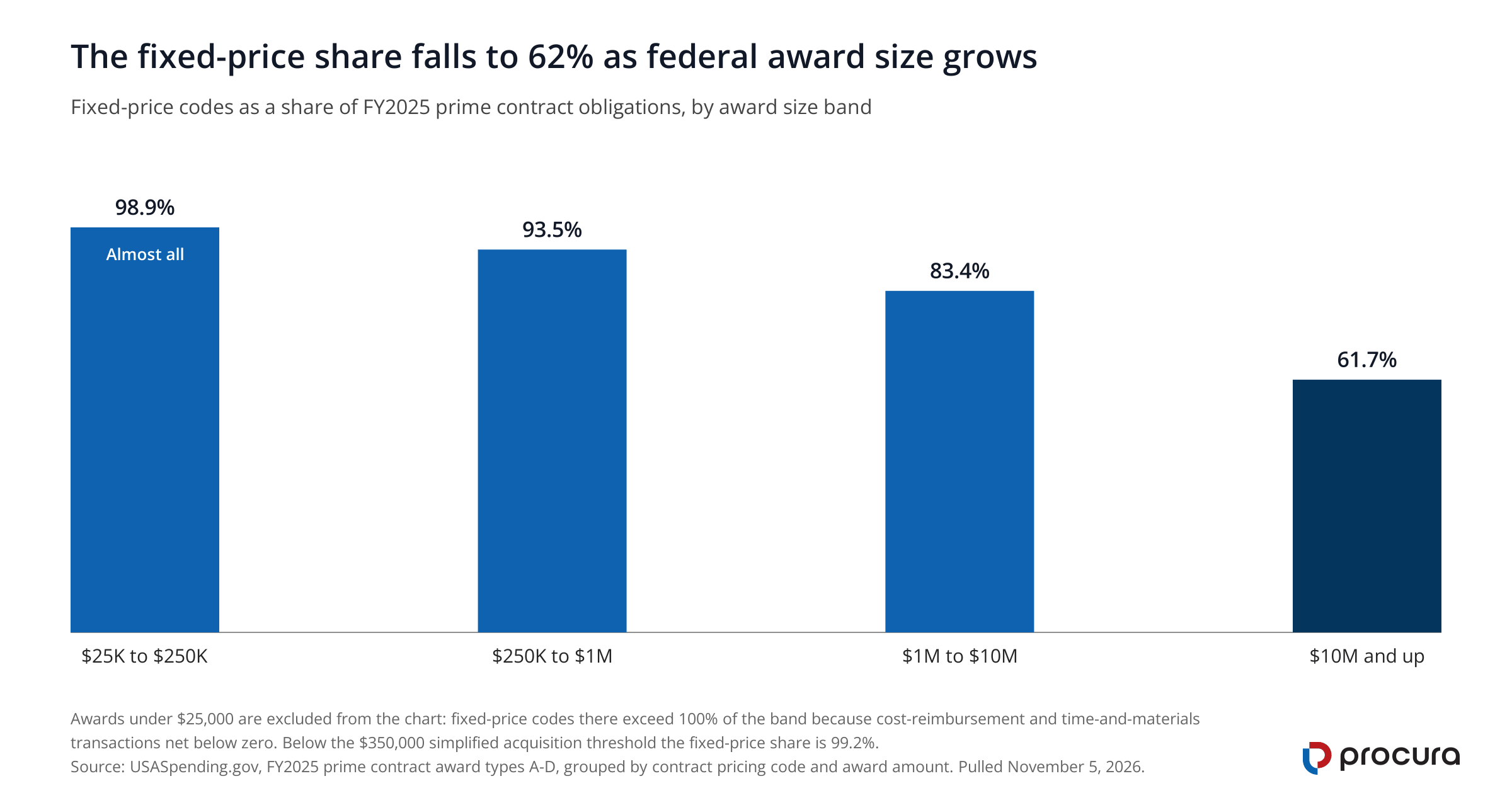
Data table: FY2025 obligations by award size band and pricing family
| Award size band | Band obligations | Fixed price | Cost reimbursement | Time and materials |
|---|---|---|---|---|
| Under $25K | $7.97B | $8.14B (102.1%) | -$0.09B (-1.1%) | -$0.08B (-1.0%) |
| $25K to $250K | $26.00B | $25.71B (98.9%) | $0.12B (0.5%) | $0.17B (0.7%) |
| $250K to $1M | $29.43B | $27.53B (93.5%) | $1.18B (4.0%) | $0.72B (2.5%) |
| $1M to $10M | $109.24B | $91.07B (83.4%) | $11.92B (10.9%) | $6.26B (5.7%) |
| $10M and up | $641.37B | $395.53B (61.7%) | $223.12B (34.8%) | $22.73B (3.5%) |
A practical reading of the government contract types data is short. If you bid in the range a new contractor can win, you bid firm fixed price. In other words, the cost-reimbursement rules are not your problem yet. Pricing discipline and reading the attachments are.
Which government contract types give small businesses the largest share?
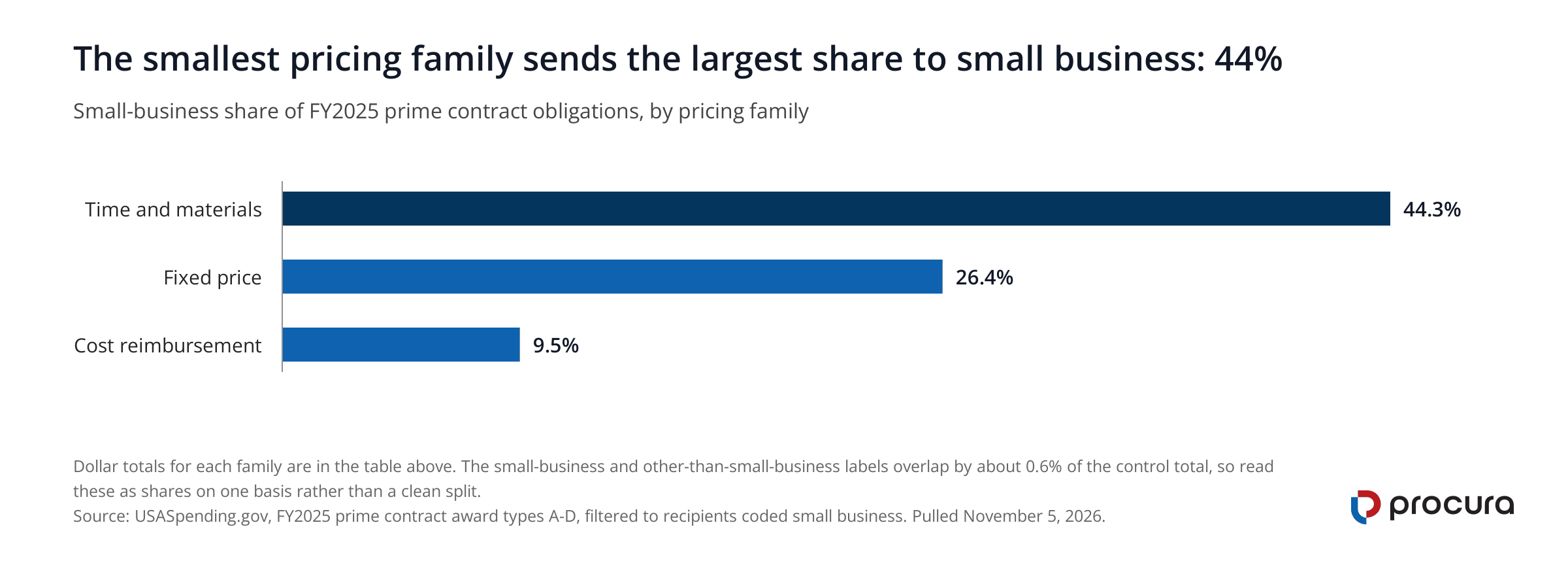
Across government contract types, small business share runs in the opposite direction to the dollars. In fact, the smallest family by obligations carries the largest small-business share, and the largest family by obligations carries the smallest.
| Family | FY2025 obligations | To small business | Small-business share |
|---|---|---|---|
| Time and materials and labor hours | $29.79B | $13.20B | 44.3% |
| Fixed price | $547.79B | $144.67B | 26.4% |
| Cost reimbursement | $236.21B | $22.50B | 9.5% |
| All prime contract obligations | $813.79B | $180.37B | 22.2% |
Still, one code inside the fixed-price family runs the other way hard. Fixed price incentive, code L, added more share than every other code across the five settled years. It rose 2.9 points, to 9.53 percent of obligations in FY2025. However, the series is volatile rather than a trend. It ran 6.59, 7.03, 8.94, 5.39 and 9.53 percent from FY2021 to FY2025, and unsettled FY2026 reads 5.94 percent.
Meanwhile, small business holds almost none of it in a single year of the window. For example, obligations to small business under code L were $239 million in FY2023 and $105 million in FY2024, against family totals above $40 billion. In FY2025 they netted below zero, at negative $230 million, because deobligations on earlier awards exceeded new ones. In short, fixed price incentive runs on large production programs, and that is where it stays.
Pricing type decides your risk before you write a price. The award records behind these pricing codes stay open to browse, filtered by agency. Sign up free and export the pricing cut you care about.
Is an IDIQ one of the government contract types?
No, and the confusion costs real money in bid decisions. Rather, an indefinite-delivery contract is a vehicle under FAR Subpart 16.5, and it governs how orders arrive rather than how they are priced. However, each order under the vehicle still carries a pricing code of its own, from the 15 that apply to awards.
That is why code 1, order dependent, exists at all. Specifically, it marks a vehicle whose pricing arrangement is decided separately for each order. Our guide to IDIQ contract vehicles, GWACs and BPAs explains the vehicle side, and the two decisions are independent. For example, you can hold a fixed-price order and a time-and-materials order under the same vehicle in the same month.
Government contract types are in the solicitation, and so is everything that prices them
The government contract types are a 20-minute education, and the award data says the answer for a small bidder is nearly always the same one. However, the work that decides whether a bid makes money sits one layer down, in the documents attached to the solicitation.
For example, a firm-fixed-price RFQ tells you almost nothing on its own. The attachments carry the specification, the wage determination, the delivery schedule and the clauses, and those decide the number. Similarly, a time-and-materials solicitation adds a ceiling price and a labor-category structure for your staff. Consequently, reading that set properly takes hours per opportunity, which is the practical reason a small firm reviews so few of them.
Procura Federal works on that layer. First, it opens the attachment set behind each solicitation. Then it scores the requirement list against the work your capability statement claims, and flags the compliance terms that change your price. The price is $399/month. In contrast, published third-party estimates put the incumbent platforms in the five figures a year.
Our comparison of federal contracting tools states the trade-offs without the sales gloss. For the bid itself, our guide to responding to a government RFP explains proposal structure. The step-by-step guide to winning federal contracts puts the whole sequence in order.
If you are earlier than that, two routes are worth knowing. New contractors do better at lower-competition contract categories first, and federal subcontracts build past performance without a prime award. After all, a contracting officer checks past performance before awarding anyone a larger contract, and your CPARS rating holds that record.
Frequently asked questions
What is the difference between a fixed-price contract and a firm fixed-price contract?
Fixed price is the family and firm fixed price is one code inside it. The family also holds incentive, award-fee, redetermination, level-of-effort and economic-price-adjustment versions, and those let the final price move on terms set in the contract.
What are the three types of fixed-price contracts?
In fact, FPDS records six fixed-price codes, not three. The three largest by FY2025 obligations are firm fixed price, fixed price incentive, and fixed price with economic price adjustment. Finally, award fee, level of effort and redetermination are the other three.
Which government contract types pay the fastest?
The Prompt Payment Act and the invoicing clauses set payment speed, not the pricing arrangement. A cost-reimbursement contract can be invoiced monthly as costs arise, while a fixed-price contract often ties payment to delivery or to milestones.
Can a contracting officer change the contract type after award?
Not unilaterally. Specifically, a change of pricing arrangement is a bilateral modification, and it requires the same justification the original selection needed. Instead, a follow-on contract is the common place where the type changes. FAR 16.103(c) tells contracting officers not to continue a cost-reimbursement or time-and-materials contract once experience provides a basis for firmer pricing.
Does the contract type decide whether I need a bond?
No. Instead, bonding follows the work and the dollar value, mostly on construction under the Miller Act, and it applies regardless of pricing arrangement. Our guide to bid and performance bonds gives the thresholds.
Which tool shows the contract type before I bid?
The solicitation states which of the government contract types applies, usually on the first form and again in the pricing schedule. In addition, Procura Federal pulls it out with the ceiling price and the labor categories, so the arrangement is visible before you commit time to the bid.
Book a demo
Bring a solicitation you doubt. We will open its attachments on the call and name the pricing arrangement and the ceiling. We will also show what the compliance documents do to your price. In short, fifteen minutes tells you whether the work fits.
By Jacob Grass, founder of Procura Federal. Published November 6, 2026. Last updated November 6, 2026.