Government painting contracts are a $97.0 million a year market, and in FY2025 small businesses took 74.3 percent of the dollars. That is a small market by federal standards. It is also an unusually open one. Agencies made 981 painting awards in FY2025. Of those, 832 came in at or below the $150,000 bonding line. Moreover, within that 832, some 623 came in at or below $35,000. In fact, at that size the contracting officer collects no bond and no payment protection. In short, the barrier in this trade is not capital. Instead, it is paperwork, and it starts at $2,000.
I pull federal spending data every week, and painting is one of the stranger codes to read. First, the money sits with one buyer and the awards are tiny. Second, the compliance load is heavier than the award sizes suggest. Finally, the work is almost impossible to find by the search methods contractors are taught. This guide works through all four. The obligations come from USASpending.gov, and the rules cite the statute or the FAR, not another vendor blog.
How big is the market for government painting contracts?
Federal agencies obligated $97.0 million on government painting contracts coded to NAICS 238320, Painting and Wall Covering Contractors, in FY2025. Specifically, that number is transaction obligations. It counts new awards plus modifications, with de-obligations netted in, on contract award types A to D only. FY2025 is the most recent fiscal year with complete reporting. FY2026 closed on September 30, 2026. But the Department of Defense posts with a 60 to 90 day lag, so the FY2026 figure is still understated.
Procura’s explorer counts $452M in prime contract obligations under 238320 in FY2021–FY2025, paid to 922 contractors; 21 of the 25 largest are DSBS-listed small businesses (data updated Oct 20, 2026). The Air Force placed 28%, and California is the largest place of performance at 19%. September held 33.0% of FY2025 obligations. See who wins in the 238320 contractor directory.
Five years of obligations look like growth that stopped:
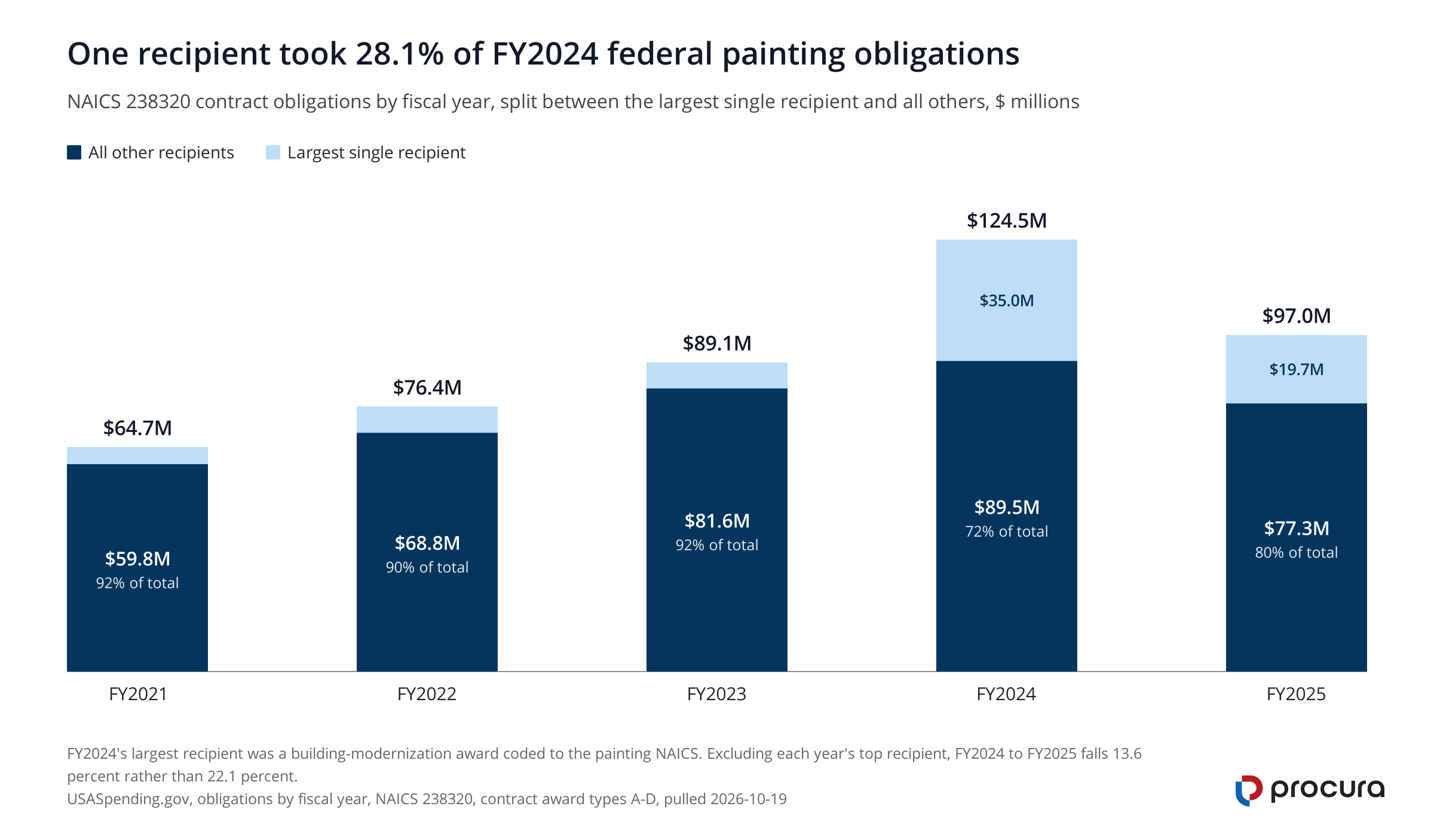
Data table: federal painting obligations and award counts by fiscal year
| Fiscal year | Obligations | Awards |
|---|---|---|
| FY2021 | $64.7M | 1,221 |
| FY2022 | $76.4M | 1,113 |
| FY2023 | $89.1M | 1,137 |
| FY2024 | $124.5M | 1,060 |
| FY2025 | $97.0M | 981 |
Read that FY2024 number with care, because I almost published it wrong. Specifically, one award carried 28.1 percent of FY2024 on its own. Gilbane Building Company took $35.0 million for the Recorder of Deeds modernization project at the District of Columbia Courts. In other words, that is a building modernization job coded to the painting NAICS. Strip out each year’s single largest recipient and the series reads $81.6 million in FY2023, $89.5 million in FY2024, and $77.3 million in FY2025. Still, the decline is real. However, from FY2024 to FY2025 it is a 13.6 percent fall rather than the 22.1 percent the headline suggests.
Award counts tell the plainer story. For instance, the government made 1,221 painting awards in FY2021 and 981 in FY2025, a fall of about a fifth over four years.
Who buys government painting contracts?
One buyer dominates government painting contracts. In fact, the Department of Defense obligated $72.9 million of the FY2025 total, or 75.2 percent. The Department of the Interior adds 11.9 percent and the Department of State adds 7.6 percent. Overall, those three agencies account for 94.7 percent of every federal painting dollar.
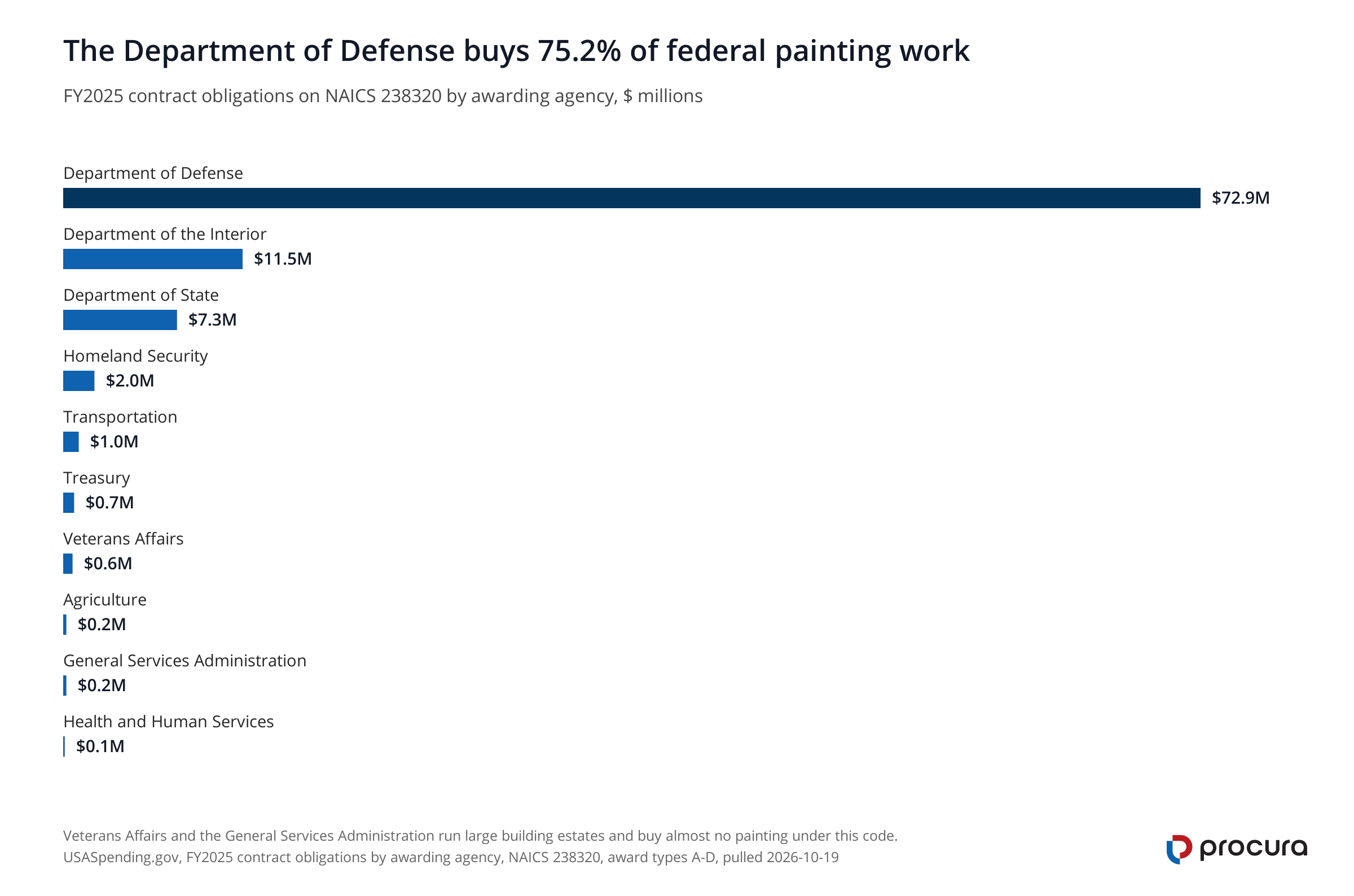
Data table: FY2025 federal painting obligations by awarding agency
| Awarding agency | FY2025 obligations | Share |
|---|---|---|
| Department of Defense | $72,931,001 | 75.2% |
| Department of the Interior | $11,544,317 | 11.9% |
| Department of State | $7,336,670 | 7.6% |
| Homeland Security | $2,008,684 | 2.1% |
| Transportation | $955,213 | 1.0% |
| Treasury | $748,409 | 0.8% |
| Veterans Affairs | $603,917 | 0.6% |
| Agriculture | $182,298 | 0.2% |
| General Services Administration | $170,996 | 0.2% |
| Health and Human Services | $119,772 | 0.1% |
| All other agencies | $355,001 | 0.4% |
Two agencies on that list are worth a second look. Veterans Affairs obligated $603,917, which is six tenths of one percent. However, the VA runs a large hospital estate and buys heavily in most service codes. So a painting contractor who builds a capture plan around the VA aims at the wrong department. The General Services Administration, which owns much of the federal office estate, obligated $170,996. Therefore, a GSA Schedule is not the route into this trade.
In practice, federal painting work means military painting work plus one civilian pocket. Bases, family housing, hangars, bridges and water tanks are Defense. Meanwhile, dams and penstocks are the Bureau of Reclamation, which is most of the Interior share. If you want this market, read our guide on how to win Department of Defense contracts first. After all, three quarters of the money is behind that door.
What NAICS and PSC codes cover government painting contracts?
Painting work sits in NAICS 238320, Painting and Wall Covering Contractors. The SBA size standard for it is $19.0 million in average annual receipts, under 13 CFR 121.201. As a result, almost every painting firm in the country is a small business by that measure.
The Product and Service Code is where this trade breaks the normal advice, and this is the single most useful thing in this guide. In fact, there is no PSC for painting real property. I searched all 2,920 nodes of the USASpending PSC reference list for PAINT, PAINTING, PRESSURE, WASH, CLEAN, SANDBLAST, ABRASIVE and COATING. For example, the paints family covers paint as a product. The 080 service codes cover maintaining paint-handling equipment, and one of them, J080, picked up $2.0 million inside NAICS 238320 in FY2025. However, none of them describes painting a building, and nothing in the list describes pressure or power washing at all.
Z1 codes are maintenance and Z2 codes are repair or alteration. But neither is organized by trade. Both are organized by the facility that was worked on. So painting a hangar is coded as work on a hangar, and painting a dam as work on a dam. As a result, the trade disappears.
Which PSC codes carry the most painting dollars?
In FY2025 the dollars in NAICS 238320 spread across 109 different PSC codes. These seven carried the most:
| PSC | Official description | FY2025 obligations | Share |
|---|---|---|---|
| Y1QA | Construction of restoration of real property (public or private) | $21,461,436 | 22.1% |
| Z2JZ | Repair or alteration of miscellaneous buildings | $9,090,585 | 9.4% |
| Z1FA | Maintenance of family housing facilities | $7,715,602 | 8.0% |
| Z2AA | Repair or alteration of office buildings | $6,033,113 | 6.2% |
| Z2KA | Repair or alteration of dams | $5,990,400 | 6.2% |
| Z1AZ | Maintenance of other administrative facilities and service buildings | $5,414,397 | 5.6% |
| Z1JZ | Maintenance of miscellaneous buildings | $5,096,649 | 5.3% |
Three consequences follow for anybody who searches SAM.gov by hand. First, a PSC-only search finds almost nothing, because no code names the work. Second, a NAICS-only search misses the jobs where a contracting officer coded a repaint to the facility type and never touched 238320. Finally, the top code by dollars, Y1QA, is a construction code. Those solicitations often arrive with construction clauses, drawings and a bid schedule, not a simple quote request.
How big are government painting contracts, and do you need a bond?
Small, and usually not. Government painting contracts cluster far below the thresholds that keep new contractors out of construction work. The bands below are cut to the real decision points rather than to round numbers.
| Award size | What it triggers | Awards | Share of awards | Share of dollars |
|---|---|---|---|---|
| $2,000 or less | No Davis-Bacon | 78 | 8.0% | -0.2% |
| Over $2,000 to $15,000 | Davis-Bacon applies | 366 | 37.3% | 1.8% |
| Over $15,000 to $35,000 | No bond, no payment protection | 179 | 18.2% | 3.9% |
| Over $35,000 to $150,000 | Alternative payment protections | 209 | 21.3% | 12.1% |
| Over $150,000 to $350,000 | Full performance and payment bonds | 61 | 6.2% | 10.3% |
| Over $350,000 to $2M | Bonds, above simplified acquisition | 71 | 7.2% | 33.5% |
| Over $2M | Bonds, full and open procedures | 17 | 1.7% | 38.6% |
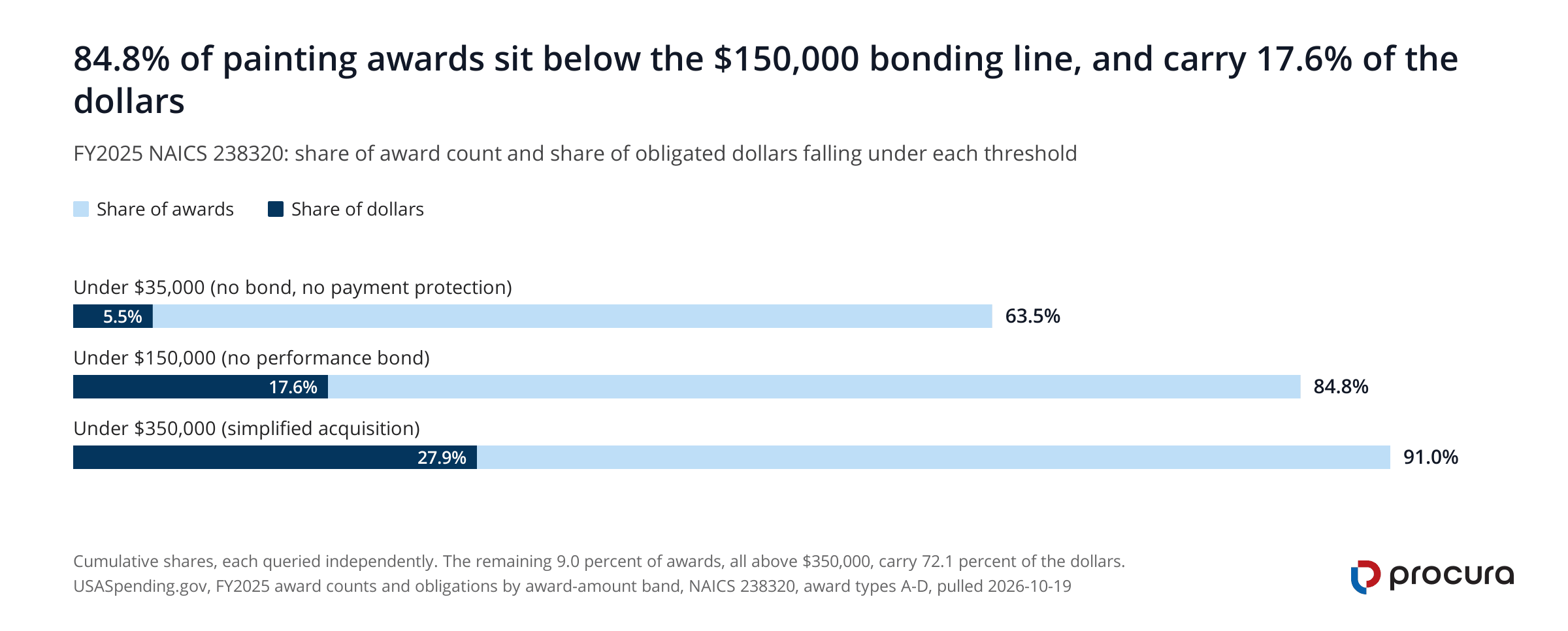
Two cumulative figures matter more than any single row. 84.8 percent of federal painting awards fall below the $150,000 bonding line, and they carry 17.6 percent of the dollars. In addition, 63.5 percent of awards are at or below $35,000. At that size FAR 28.102-1 asks for neither a performance bond nor an alternative payment protection.
Both halves of that sentence are the point. In other words, the door is open, and the room behind it is small. For example, a firm with no bonding capacity and no federal past performance can compete for roughly five awards in six. However, those five awards split about a sixth of the money. Anyone who tells you federal painting is a volume business at the entry level is selling something.
When does a painting contract need a bond?
The bonding rules themselves are worth stating precisely, because the FAR and the statute do not print the same number. FAR 28.102-1 requires performance and payment bonds on construction contracts above $150,000. For contracts over $35,000 but not over $150,000, the rule is different. Instead, the contracting officer picks at least two alternative payment protections from a list of five. Meanwhile, the Miller Act itself, at 40 U.S.C. 3131(b), still prints $100,000, and 40 U.S.C. 3132 still prints a $25,000 to $100,000 range.
That gap is not a drafting error, and it is not a live inflation adjustment either. First, a 2010 FAR inflation rule raised the regulatory figures to $150,000 and $35,000. Congress then closed the door behind it. 41 U.S.C. 1908(b)(2)(D) exempts the Miller Act from future escalation. Instead, it preserves the modification already in effect. The Fiscal Year 2022 National Defense Authorization Act added it. So your solicitation uses the higher figure, and it has not moved since 2010. Our guide to performance and payment bonds on federal work covers what a surety asks for before it issues one.
One more number deserves a flag. In the lowest band the dollar total runs negative, because 31 of those 78 awards are net de-obligations rather than jobs. Still, award counts in that band are sound. The dollar figure is an artifact, so treat the Davis-Bacon finding below as a share of awards and not of money.
Painting award sizes cluster tightly, and the bands above show where. Those award records are free to browse and filter by state. Open a free account to export the band table and compare it against your own bonding limit.
Does Davis-Bacon apply to government painting contracts?
Yes, and at a threshold most contractors guess wrong. The Davis-Bacon Act applies to federal contracts in excess of $2,000 for the construction, alteration, or repair “including painting and decorating” of public buildings or public works. That parenthetical is in the statute at 40 U.S.C. 3142. In other words, painting is not an edge case that got swept into a construction rule. It is named in the law.
FAR 2.101 says the same thing twice over. It defines construction as “construction, alteration, or repair (including dredging, excavating, and painting)” of real property. And it sets the micro-purchase threshold for construction under the Wage Rate Requirements statute at $2,000. By contrast, the $15,000 figure applies to ordinary supplies and services.
How many painting awards cross the $2,000 line?
Put the data against the rule. 903 of the 981 FY2025 painting awards, or 92.0 percent, exceeded $2,000. For work in a State or the District of Columbia, which is the statutory reach, almost every award clears the line. In short, there is effectively no such thing as a simple domestic federal painting job. The statute does not follow the work overseas, and that matters in this code, because foreign awardees took at least 5.8 percent of FY2025 dollars.
A $4,000 repaint of an office suite carries three obligations. It needs a wage determination and the prevailing wage for the painter classification in that county. It also needs weekly certified payroll sent to the contracting agency. And it carries the full labor-standards clause set. That threshold dates from 1935, and it stays there. Indeed, FAR 1.109(c) states that the escalation statute does not permit inflation adjustment of Wage Rate Requirements thresholds.
| Threshold | Amount | Authority | Inflation-adjusted? |
|---|---|---|---|
| Davis-Bacon coverage | Over $2,000 | 40 U.S.C. 3142 | No (FAR 1.109(c)) |
| Micro-purchase, DBA construction | $2,000 | FAR 2.101 | No |
| Micro-purchase, general | $15,000 | FAR 2.101 | Yes |
| Service Contract Act coverage | Over $2,500 | 41 U.S.C. ch. 67 | No (FAR 1.109(c)) |
| Alternative payment protections | $35,000 to $150,000 | FAR 28.102-1 | Frozen at the 2010 adjustment |
| Performance and payment bonds | Over $150,000 | FAR 28.102-1 | Frozen at the 2010 adjustment |
| Simplified acquisition threshold | $350,000 | FAR 2.101 | Yes |
This is where margin goes. For example, a painter who bids a federal job at a commercial rate and then discovers the wage determination has already lost the money. Our Davis-Bacon Act guide for contractors walks through reading a wage determination and filing certified payroll without getting a withholding notice.
Do you need lead-paint certification to bid on government painting contracts?
Sometimes, and the trigger is the building rather than the contract. 40 CFR part 745, subpart E carries the EPA Renovation, Repair and Painting Rule. Specifically, it requires firm certification for paid work that disturbs paint in housing built before 1978. It also reaches child-occupied facilities, which the rule defines by regular visits from children under six, such as day care centers, preschools and kindergarten classrooms. EPA states that firms cannot advertise or do covered work without that certification, and the rule reaches sole proprietors.
Five exemptions matter, and one of them is written for exactly this market. First, housing built in 1978 or later is out. Second, zero-bedroom dwellings are out, which is how barracks and dormitories are classified. Third, housing for the elderly or disabled with no child under six is out. So are components a certified inspector or renovator has declared lead-free. Last, minor repair and maintenance is out at six square feet or less of paint per room inside, and 20 square feet or less outside. Window replacement and demolition of painted surfaces are covered whatever the area.
Match that against the spending. Maintenance of family housing facilities, PSC Z1FA, was 8.0 percent of FY2025 painting obligations, and the Department of Defense runs child development centers on most installations. So the rule bites on a real slice of this market and not on all of it. For example, repainting a 1960s housing unit at an Army garrison is almost certainly covered work. By contrast, repainting a steel bridge is not.
What about government pressure washing contracts?
Government pressure washing contracts exist, but no honest market number exists for them, and I am not going to invent one. There is no PSC for pressure or power washing. The NAICS that carries it, 561790, Other Services to Buildings and Dwellings, obligated $62.8 million in FY2025 at an 83.4 percent small-business share. However, that code is far broader than washing. In fact, its largest single PSC in FY2025 was snow removal and salting at $13.7 million, or 21.9 percent of the code.
So the practical answer is that pressure washing is rarely bought on its own. It arrives as a line item inside a janitorial, grounds maintenance or base operations support contract. That changes which labor law applies. Painting is construction and carries Davis-Bacon. Recurring exterior cleaning inside a services contract normally carries the Service Contract Act instead, which sets a different wage basis and a different clause set.
When does Davis-Bacon reach work inside a services contract?
Department of Labor Fact Sheet 66B gives the test for a contract that mixes the two. Davis-Bacon reaches the construction work inside a services contract only when that work is “substantial” and “physically or functionally segregable”. The fact sheet is explicit that substantiality turns on the “type and quantity of construction work – not merely dollar values or percentages”. Indeed, its own worked example is a base operations contract that requires painting or repainting base housing. Therefore, read the clause list in the solicitation and not the title of the job. Our guides to the Service Contract Act and to federal janitorial and cleaning contracts cover the services side of this work in detail.
Are government painting contracts competed, or already wired?
Competed, mostly. Of the 981 FY2025 painting awards, 815 of them, or 83.1 percent, were competed, and those carried 80.3 percent of the dollars. Measured in dollars, however, the rate barely moves with award size. Below the bonding line 77.4 percent of dollars were competed, and above it 80.9 percent. By contrast, counted by award it does move. Below the bonding line, 85.7 percent of awards were competed. Above it, 68.5 percent. In other words, the big jobs carry most of the competed money, and a larger share of them are sole-sourced.
One caveat keeps that number honest. A quarter of awards, carrying 23.7 percent of dollars, used the code for full and open competition after exclusion of sources. Specifically, that is the code a contracting officer uses when a set-aside or similar restriction narrowed the pool before open bidding started. It is real competition inside a restricted field, so do not read it as a market where anyone could bid.
How much painting work is set aside?
Set-aside data on this code is thin, and the reason is a coding gap rather than a policy. Awards with any small-business set-aside code accounted for $12.4 million, or 12.8 percent of FY2025 obligations. But 671 of the 981 awards, carrying 49.8 percent of the dollars, carry no set-aside code at all in FPDS. Moreover, the gap is worst in the smallest band, where only about one award in seventeen records a code. So 12.8 percent is a floor and not an estimate.
Within the coded awards, the pattern is still informative. For example, the 8(a) program accounted for $5.5 million, and HUBZone for just two awards worth $109,034. By contrast, women-owned small business set-asides accounted for nothing at all. All four WOSB and EDWOSB codes return zero awards in NAICS 238320 for FY2025, while returning 215 awards across the wider construction sector. A WOSB certification or a HUBZone certification is close to worthless as a painting-specific wedge. However, both are worth real money elsewhere in construction. An 8(a) certification is the one that shows up in this code.
Who won the largest painting job of the year?
The largest FY2025 painting award by obligations makes the point better than the percentages do. Atlas Painting and Sheeting took $19,690,000 from the Department of Defense. The job was painting and steel repairs to the railroad bridge at the Cape Cod Canal, Buzzards Bay, Massachusetts. The set-aside field on that award reads NONE. Yet Atlas is a small business. All three awards in this code whose total value tops $10 million were coded with no set-aside. Only Atlas is a small business, and only Atlas carried FY2025 money. A small firm won the largest federal painting job of the year in full and open competition, against seven offers.
That is the inversion worth carrying away. Small businesses took 74.3 percent of the dollars from 53.2 percent of the awards. The average small-business obligation was $137,950. By contrast, the average obligation to a firm that is not small was $54,350. In federal painting, small business is not the small end of the market. Instead, it is the large end.
When are government painting contracts awarded?
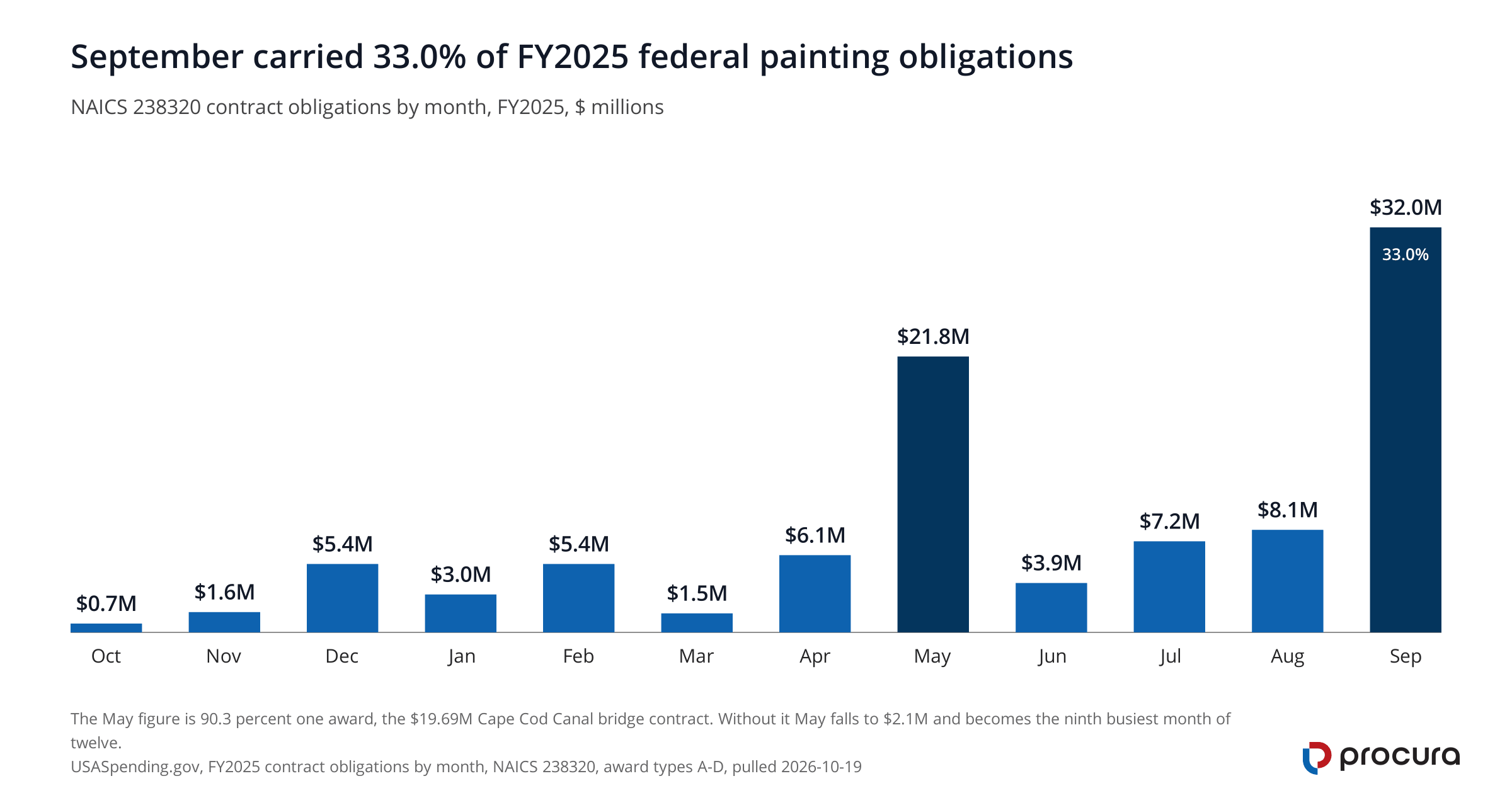
I expected a spring construction season and the data refused to give me one. Government painting contracts follow the ordinary federal year-end spike. Specifically, the fourth quarter, July through September, carried 48.9 percent of FY2025 obligations, and September alone carried 33.0 percent.
Data table: FY2025 federal painting obligations by month
| Month | Obligations | Share of FY2025 |
|---|---|---|
| Oct 2024 | $682,199 | 0.7% |
| Nov 2024 | $1,593,520 | 1.6% |
| Dec 2024 | $5,422,165 | 5.6% |
| Jan 2025 | $3,025,338 | 3.1% |
| Feb 2025 | $5,443,572 | 5.6% |
| Mar 2025 | $1,494,186 | 1.5% |
| Apr 2025 | $6,145,337 | 6.3% |
| May 2025 | $21,803,009 | 22.5% |
| Jun 2025 | $3,938,130 | 4.1% |
| Jul 2025 | $7,229,527 | 7.5% |
| Aug 2025 | $8,147,642 | 8.4% |
| Sep 2025 | $32,031,654 | 33.0% |
May’s 22.5 percent share looks like a second peak. However, it is not one. The Atlas bridge award is 90.3 percent of that month. Strip it out and May’s total falls to $2.1 million. That would make it the ninth busiest month of twelve rather than the second. In short, one award can rewrite a month in a market this size. That is a good reason to be careful with any monthly chart of a $97 million code.
Capacity planning in this trade thus runs against the weather. Agencies obligate the most money in late summer and September, and exterior painting in much of the country wants to be done before then. So watch for the solicitations in spring and early summer, and expect the award to land close to the end of the fiscal year.
How do you get registered and bid on government painting contracts?
Registration works the same way as in any federal trade, and it is not the hard part. Get a Unique Entity ID and an active registration in SAM.gov, which is free. Our SAM.gov registration guide covers the timeline and the mismatch that causes most delays. Then add NAICS 238320 and the facility-type codes you can work on. After that, build a capability statement that names the surfaces and the coatings you have done. For example, a contracting officer who buys a water tank recoat wants tank experience, not square footage.
Then price the job against the wage determination rather than your commercial rate. Then read the whole solicitation package. On a Y1QA construction-coded painting job, that package gets long. Expect drawings, a bid schedule, a site-visit notice, surface-preparation specifications and a containment plan for lead or blast residue.
What FAR change affects painting bids?
One change is in flight that affects exactly this step. FAR Case 2026-010 appeared at 91 FR 59534 on September 18, 2026. Specifically, it proposes a restructure of FAR parts 14, 28, 36 and 52. It also proposes to remove and reserve 52.236-26 through 52.236-28. Those are the Preconstruction Conference clause, the Site Visit provision and the Preparation of Offers provision for construction. The comment period closed on October 19, 2026.
That matters more to a painter than to most trades. After all, on a painting bid, the surface condition drives most of the price. A site visit that is no longer a standard provision is a change worth tracking. However, nothing is final yet, and the codified clauses still govern until a final rule issues.
If subcontracting looks like the faster way in, it often is. Painting is a standard trade on a larger construction prime, and our guide to winning federal subcontracts explains how to get on a prime’s list. Keep your CPARS past-performance ratings clean. On awards this small, the rating is most of what sets you apart next time.
The hard part is not the painting
Everything above adds up to a search problem, not a painting problem. First, the work is scattered across 109 product and service codes with no code of its own. Second, three quarters of it sits inside one department. The compliance load attaches at $2,000, so a wage determination and a certified payroll obligation ride on a job the size of a kitchen repaint. Government painting contracts hide the documents that decide whether a job is worth bidding. Moreover, those documents live in the attachments, not in the notice. They are the surface-preparation specification, the containment requirement and the wage determination.
How does Procura help painting contractors?
That is the gap Procura Federal was built for. First, it opens the whole package, including the attachment that carries the wage determination and the one that carries the surface-preparation specification. Then it rates the job against the surfaces and coatings named in your capability statement. And it marks the labor-standards and lead clauses that decide whether your price survives. For a painting firm, that means two things. You see the wage determination and the lead-containment clause before you spend a day on a bid. And you see the facility-coded jobs that a NAICS search alone never surfaces.
It costs $399/month. In contrast, the older market-intelligence products that hold this data start in five figures a year, which is hard to justify against a code this size. Our comparison of federal contracting tools lists what each one charges.
If painting proves too thin a code to build on, widen it rather than grind at it. Look at the federal contracts that are easiest to win, and at federal construction contracts. The same bonding and wage rules apply there, to a market many times the size.
Frequently asked questions
How much does the federal government spend on painting?
Just under $97 million in FY2025, on government painting contracts coded to NAICS 238320, per USASpending.gov. See the market-size section above for the five-year series and for the single award that distorts FY2024.
Do I need a bond to bid a federal painting job?
Not for most of them. Bonds attach above $150,000, and 84.8 percent of FY2025 painting awards were below that. See the award-size section for the bands and the statutory wrinkle.
What NAICS code is painting?
238320, Painting and Wall Covering Contractors, with a $19.0 million receipts size standard. There is no matching PSC, which is why the codes section recommends searching by facility type as well.
Does Davis-Bacon apply to a small painting contract?
Yes, above $2,000. The statute names painting and decorating directly, and the threshold is exempt from inflation adjustment.
Which agency buys the most painting work?
The Department of Defense, at 75.2 percent of FY2025 obligations. Interior and State take most of the rest.
Is there a federal market for pressure washing alone?
Not as a separate category. No PSC exists for it. Instead, it is normally a line item inside a janitorial or base-operations contract, which makes it Service Contract Act work rather than Davis-Bacon work.
Book a demo
Bring a solicitation you are unsure about. We will read the attachments live and show you the wage determination, the surface specification and the fit score against your capability statement.